
Magic: The Gathering’s voyage through Star Trek appears to be a one-set mission for now. Mark Rosewater, the game’s head designer, has said there are “no current plans for future Star Trek sets,” tamping down speculation that the crossover might soon revisit a narrower corner of the long-running science-fiction franchise.
The wording matters. “No current plans” is not the same as a permanent declaration that Magic will never return to Star Trek. It does, however, mean players and collectors should not treat possible follow-ups—whether based around the Dominion War, the Delta Quadrant, or another era—as products on the visible release path.
A broad Star Trek set, not the first chapter of a series
Magic: The Gathering—Star Trek arrived only a couple of weeks ago as a Universes Beyond release and contains 497 cards drawing from across the franchise’s history. That scale helps explain why fans were already wondering how a future installment could become more focused. A follow-up could theoretically isolate one conflict, crew, region of space, or television era rather than attempting another wide tour of the property.
But those possibilities remain fan ideas, not announced products. The response came after a player proposed a future set built around the Dominion War, a major Deep Space Nine storyline, or a more specific Delta Quadrant theme. Rosewater’s answer made clear that such an expansion is not currently planned.
For anyone mapping a collection, that is a practical distinction. The existing 497-card release stands as the complete known Star Trek Magic offering rather than the confirmed opening entry in an ongoing annual or story-by-story program. That does not settle long-term card desirability, availability, or value, but it does set expectations about near-term franchise expansion.
What Universes Beyond means here
Universes Beyond is Magic’s banner for releases that bring outside entertainment properties into the trading card game. The important point in this case is that a licensed crossover can be designed at very different scopes. A set might cover a large portion of a franchise’s history, center on a particular group of characters, or tell a new story made in collaboration with the license holder.
The 497-card Star Trek release uses the broad-coverage approach. It reaches across the franchise rather than being confined to one named story arc. That does not automatically establish a model for every crossover, as the contrast with Marvel’s plans demonstrates.
Marvel has a different runway
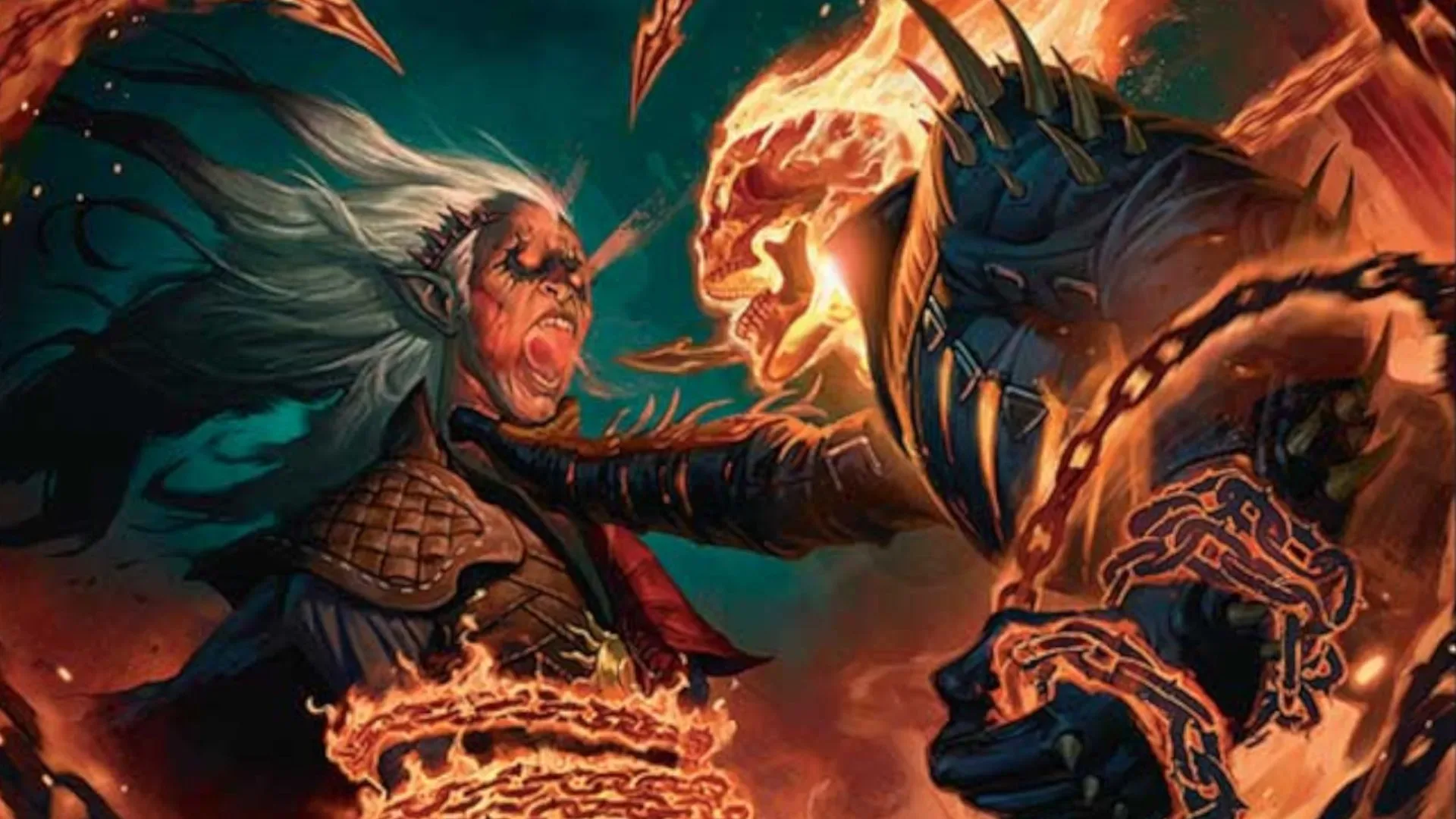
While no additional Star Trek set is currently planned, Magic’s Marvel crossover slate is still moving forward. Darkhold Destiny is scheduled for April 2027 and will be the third Marvel set in Magic.
Related coverage includes Magic: The Gathering Has No Current Plans for More Star Trek Sets.
Rosewater also pushed back on the idea that Marvel Super Heroes was simply a generic, all-purpose Marvel release. He characterized its approach as “Avengers plus”: a specific slice of the wider Marvel property, not an attempt to represent every corner of it equally.
That clarification offers a useful way to read the product naming. A crossover does not need to be titled after a famous comic storyline in order to have a defined creative focus. In the case of Darkhold Destiny, the plan is not to adapt one pre-existing Marvel arc. Instead, Wizards of the Coast and Marvel have created a new story together using Marvel’s characters and setting.
That makes Darkhold Destiny a notably different proposition from a release that primarily pays tribute to a familiar published storyline. An adaptation asks players to recognize how a known event has been translated into cards. An original licensed narrative gives the designers more room to establish an event specifically for Magic’s format, while still working inside the boundaries of the Marvel property.
The Infinity Stone thread is still incomplete
There is also a visible connective idea between the existing Marvel releases. Marvel’s Spider-Man included the Soul Stone, while Marvel Super Heroes included the Mind Stone. Six more Infinity Stones remain after those two appearances.
That does not, by itself, confirm the exact structure or number of future Marvel sets. Still, it gives collectors a reason to watch later releases closely. When a collectible element is spread across products, a single card can function as more than a standalone game piece: it can become part of a longer chase, a themed binder project, or a collection organized around a shared fictional artifact.
For collectors, the sensible approach is to separate what has been stated from what is merely possible. The confirmed facts are that Darkhold Destiny is due in April 2027, it is Marvel’s third Magic set, and two different releases have each included an Infinity Stone. It is reasonable to see the remaining stones as an ongoing point of interest; it is not reasonable to assume their release dates, products, treatments, or rarities before those details are disclosed.
What the Star Trek pause means for players and collectors
The immediate impact is mostly about expectations. Players hoping for mechanics tied specifically to the Dominion War or the Delta Quadrant do not have a forthcoming product to plan around. Collectors who expected a series of era-specific Star Trek expansions likewise should not assume that the first set will soon be supplemented by dedicated releases.
That does not make the current set smaller in creative scope. On the contrary, its 497 cards were built to reach across the franchise’s history. The absence of a sequel plan may encourage fans to view it as a large, self-contained crossover snapshot rather than an installment awaiting an obvious second chapter.
It is also a reminder that licensing strategy is not uniform. Marvel is continuing with at least one announced future Magic release, and its next project has been described as an original story. Star Trek, meanwhile, has no additional set in the current plans despite its expansive debut. Similar-sized entertainment properties can receive very different treatment depending on the collaboration and product roadmap.
Crossovers remain a major point of conversation for both gameplay and collecting communities because they sit at the intersection of a game’s established systems and another franchise’s fan culture. For an up-to-date example of how major fandoms continue to be recognized beyond their original medium, see Apple’s Pokémon 30th-anniversary promotion in Japan.
Keep the distinction between absence and cancellation
The clearest takeaway is deliberately narrow: there are no current plans for more Star Trek Magic sets. That is the only firm signal available on the crossover’s future. It is not a product cancellation announcement, because no specific follow-up set had been announced; nor is it a promise that the door can never reopen.
For now, the franchise’s Magic presence is the existing 497-card Universes Beyond set. Marvel, by contrast, has a confirmed next stop with Darkhold Destiny in April 2027 and an unfinished Infinity Stone thread for fans to track. Those are two very different futures for two of Magic’s biggest licensed universes—and a useful warning against assuming every crossover will follow the same pattern.