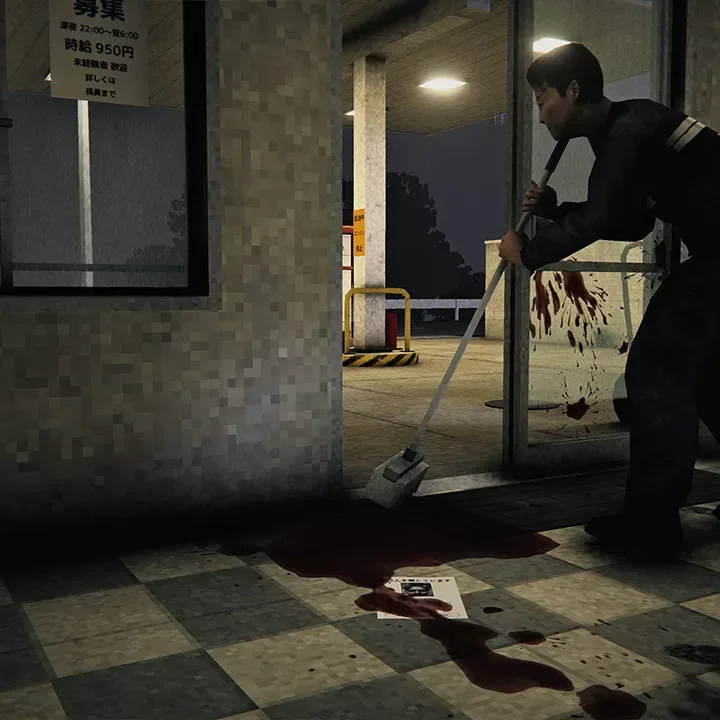
Sankan is aiming to turn an ordinary overnight job into a very bad workplace group project. The newly announced PC horror game places one to three players at a mountain gas station in Japan in 1999, where a voice in the workers’ heads identifies a customer who must be killed. Following that instruction means cleaning the scene and burying the body before morning. Refusing it means the voice begins hunting the group instead.
It is an immediately unpleasant premise in the most promising horror-game sense of the phrase: not merely surviving an external threat, but having to make a choice that is itself the source of danger. Developed by solo creator Dany Rexton under YTKA Games, Sankan is planned for PC in early 2027.
A night shift with no clean answer
The central structure described for Sankan gives players a grim fork in the road. They can comply with the voice’s demand, kill the named customer, then deal with the practical consequences before dawn. Or they can reject the demand and become prey themselves. Neither route sounds like an escape hatch, which is exactly where the tension lives.
The cleanup element matters because it makes the stated choice more than a simple story prompt. Compliance is not presented as an instant resolution. It creates work that has to be completed under a deadline: blood needs to be cleaned and a body buried before daylight arrives. That setup potentially turns time, coordination and concealment into as much of a threat as whatever is speaking inside the characters’ heads.
“Before dawn” is especially useful horror language because it puts a visible end point on the shift. The players have a job, an awful task and a clock. Even without further detail on the game’s systems, that is enough to explain the shape of its pressure: the group will have to decide what it is willing to do, then live long enough to manage the resulting mess.
Co-op makes the moral problem a social one
Sankan supports up to three players in cooperative play. In a co-op game, players work toward a shared goal rather than competing against one another. Here, that apparent simplicity may become awkward very quickly. A decision to obey or defy the voice affects every worker on the shift, so the premise naturally invites discussion, disagreement and frantic attempts to settle on a plan while the night progresses.
That is an analytical read of the announced setup, not a promise of specific voting, role or betrayal mechanics. No such systems have been detailed. Still, the basic scenario has a natural co-op hook: one person’s preference cannot stay private when the group must apparently deal with the same named customer, the same cleanup duties and the same consequences.
For prospective players, the key distinction is that this is not described as a horror experience where friends simply stand together against a monster. The threat is tied to an instruction, and the instruction creates a shared ethical and practical dilemma. A team that wants to refuse has to face the danger that follows. A team that agrees to comply still has evidence and a body to manage. There is no indicated “normal” shift to retreat to.
Related coverage includes Sankan Brings Three-Player Horror to a Japanese Mountain Gas Station in 1999.
Players looking for another PC co-op release can also keep an eye on Clone Drone in the Danger Zone’s anniversary update and co-op additions, though its challenge-driven action is a very different proposition from Sankan’s intimate, late-night horror setup.
Later shifts remember what happened
The most intriguing detail may be the game’s stated persistence. People encountered during one shift can return during later ones, and prior actions also return with them. In game-design terms, this suggests that player choices are not limited to a single isolated encounter. A persistent consequence system is a broad label for design where decisions made earlier remain relevant later, whether through returning characters, altered circumstances or branching outcomes.
Only the announced premise is confirmed here, so it would be premature to assume exactly how deep those consequences go. There is no stated list of variables, no explanation of whether every customer can recur, and no breakdown of how co-op decisions are recorded. What is clear is the intended dramatic effect: an encounter is not necessarily over when the current shift ends.
That creates a useful contrast with horror built around disposable scares. If the people players meet can reappear, each interaction has the potential to gain weight. If past actions return as well, then the game’s question is not only “what will you do tonight?” It is also “what will the next shift remember?” For a setting centered on repetitive work, that is a particularly fitting way to make routine feel threatening.
Rexton has said there will be several endings. Multiple endings generally mean that a game can resolve in more than one way, often based on decisions, routes or conditions reached during play. The announcement does not specify the number of endings or the requirements for each, but the feature aligns naturally with a game built around choices and their lingering effects.
Silent characters, subtitle-only communication
Sankan is also described as having no spoken dialogue: every character communicates through subtitles. This does not mean the game has no writing or communication. Rather, players will read what characters say instead of hearing voiced performances.
That approach can serve the announced setting and visual style in several ways. It keeps the player’s attention on text, ambient unease and the immediate environment rather than on voice acting, while making the silence around the station more conspicuous. More importantly, it leaves room for players to interpret the tone of a line through context. A plain subtitle can become reassuring, evasive or threatening depending on who is saying it, what happened on an earlier shift and whether the voice’s demand is hanging in the air.
There is a practical co-op angle too. Subtitle-based dialogue puts information in a readable form for everyone present, assuming the players are following the same scene. But it also means friends will likely need to talk over what they think a character means, what they remember from a previous encounter and whether the current customer is someone they can trust. The game itself may be silent; the group chat probably will not be.
A deliberately retro-looking nightmare
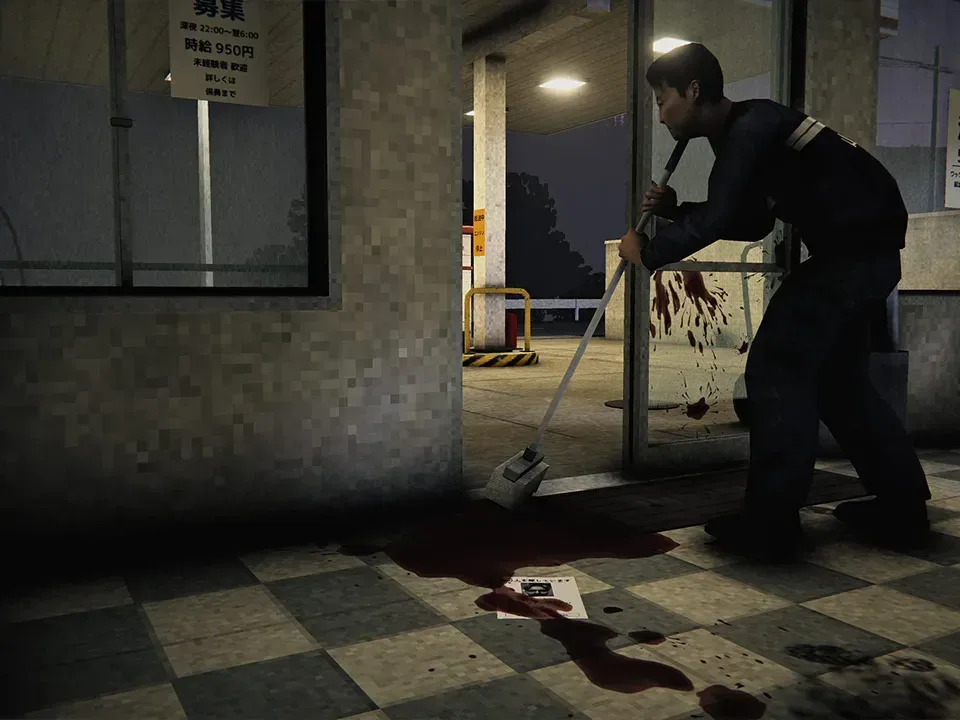
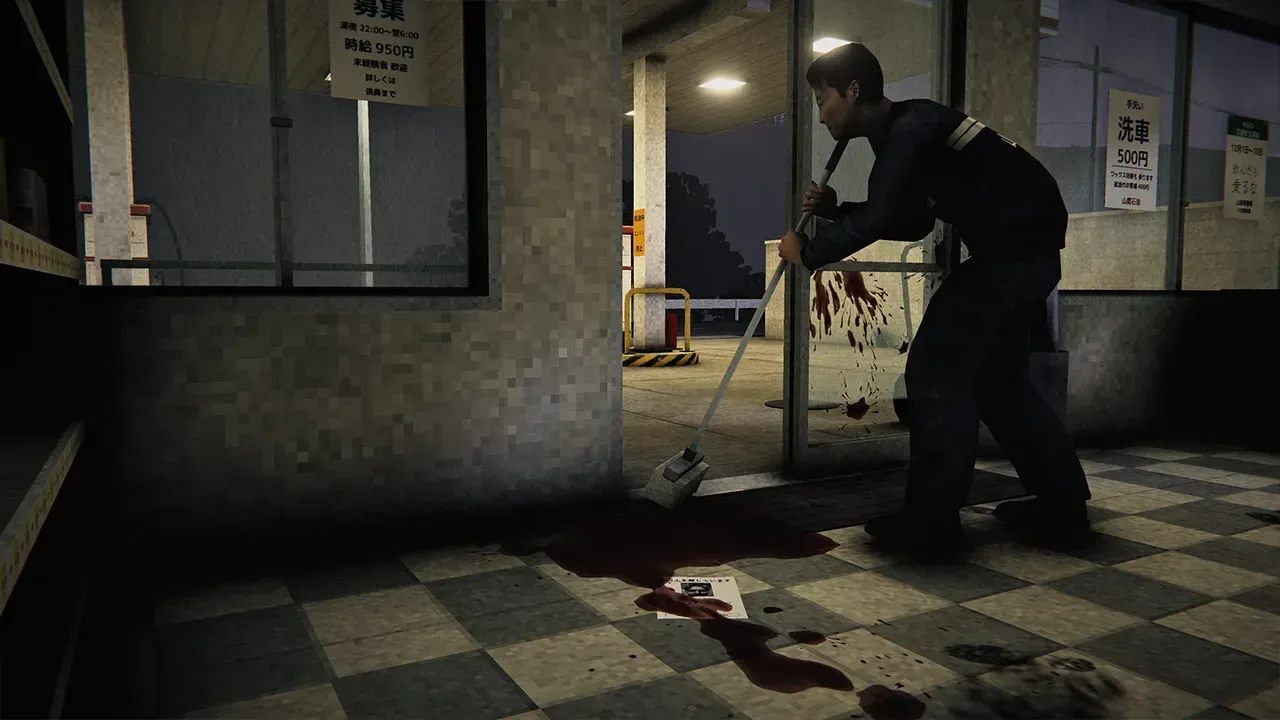
The early footage presents Sankan with graphics reminiscent of the original PlayStation era. “PS1-style” is commonly used to describe modern games that evoke the low-resolution textures, simplified models, sharp visual edges and atmospheric limitations associated with 1990s 3D console games. It refers to an aesthetic influence, not an announcement that the game is coming to original PlayStation hardware.
For Sankan, the retro visual direction fits the 1999 setting without requiring the game to reproduce that period literally. A mountain gas station already offers a small, isolated place where headlights, darkness and the arrival of strangers can do a lot of storytelling work. Filtering that space through an older-looking 3D style may make familiar objects feel less legible and more uncanny: a strength of intentionally rougher visuals is that they can leave detail to the player’s imagination.
The first materials describe the overall presentation as moody and creepy, and that seems consistent with the design ingredients that have been shared: an isolated work site, late shifts, recurring people, unreadable motives and a disembodied force issuing an impossible command. The game does not need a sprawling map in its pitch. Its horror comes from being stuck in one place where every new arrival could matter.
What is confirmed, and what remains unknown
At this stage, Sankan has a sharp concept but a relatively compact set of confirmed details. The confirmed basics are worth separating from reasonable speculation:
- Developer: Dany Rexton of YTKA Games, working as a solo developer.
- Platform: PC.
- Release window: Early 2027 is the current plan.
- Players: Solo play or co-op with up to three people total.
- Setting: A mountain gas station in Japan in 1999, during night shifts.
- Core dilemma: A voice names a customer to kill; compliance requires hiding the evidence before dawn, while refusal causes the voice to hunt the players.
- Story structure: Characters encountered and previous actions can return in later shifts, with several endings planned.
- Presentation: Subtitle-only character dialogue and a PS1-era-inspired visual style.
Details such as the exact release date, the full range of player actions, how the threat behaves, the way endings are determined and whether online co-op has any particular restrictions have not been outlined. That uncertainty is normal for an early announcement, and it is better treated as an open question than filled in with imagined systems.
For now, Sankan stands out because its horror pitch is unusually specific. The setting is not just “somewhere scary,” and the cooperative hook is not just “bring friends.” It asks a small group to work a shift at a remote station, obey or resist a malicious inner voice, and reckon with the fact that customers and choices may not stay in the past. That is a strong foundation for a game where the worst part of the job may be deciding what counts as getting through the night.