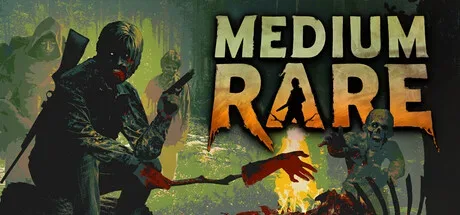
Medium Rare, a turn-based horror dungeon crawler built around dice-based combat and unforgiving inventory decisions, is scheduled to have a public demo available on Steam on October 9 as part of the October Steam Next Fest lineup.
Its premise is not especially interested in easing players into the room. The journey sends players up a mountain in search of their wife, against a backdrop of industrialized cannibalism and the possibility that the rescue may already be catastrophically late. It is a horror hook with an appropriately bleak sense of urgency: dinner plans have gone very, very wrong.
The available details point to a compact game loop rather than an enormous endurance test. A typical completion of the demo is expected to take roughly one hour and 20 minutes. Within that span, players will face a repeated strategic choice after each area: continue farther into danger, or retreat to base and preserve what they have managed to carry home.
A dungeon crawler where every slot has a job
Medium Rare combines several systems that tend to put pressure on every decision. Its dungeon-crawling structure means players advance through hostile spaces in stages. Its turn-based format means combat is resolved in discrete actions rather than through reflexes alone. And its inventory is described as “inventory Tetris,” a shorthand for an item-management system in which objects occupy differently shaped or sized spaces and must be physically arranged within limited capacity.
That last part matters because the game is not merely asking whether an item is useful. It is asking whether that item is useful enough to claim a portion of a bag that cannot hold everything. Ammunition, weapons, recovery supplies, key items and whatever else the mountain offers may compete for the same finite room. A bulky object can be valuable but difficult to justify; several smaller tools can create flexibility but may leave a player short of a decisive option.
In practical terms, inventory Tetris changes looting from a routine reward into a decision with a cost. Picking something up may require reorganizing the pack, abandoning an existing object or accepting less room for future discoveries. The system also fits Medium Rare’s stated push-or-retreat structure: carrying more may help survive the next area, while carrying too much of the wrong thing can make that same next area worse.
What “dice-based gunfights” suggests
The game’s gunfights are described as dice-based. That establishes that chance is part of combat resolution, although the specific dice rules, probabilities, enemy behavior and available player modifiers have not been detailed. It would be premature to assume a particular tabletop-style ruleset from that phrase alone.
What is clear is that the combat concept combines firearms with a randomized element. In a turn-based game, that can make positioning, resource use and risk assessment especially important: players have time to decide, but no guarantee that an intended action will resolve exactly as hoped. A powerful attack might carry uncertainty; a safer option might consume a scarce resource; retreat might be sensible even if it feels narratively painful.
That is where Medium Rare’s systems appear designed to meet. Dice can make an encounter volatile. Limited bag space determines which tools are available when volatility arrives. The choice to press on or return to base determines whether a successful run is extended or protected. The promise is less about flawless optimization than managing a bad situation before it becomes an edible one.
The decision to push deeper is the game’s central tension
Medium Rare frames progression around a choice made area by area: descend—or, in this case, climb—further into the mountain, or fall back to base. The exact benefits of returning and the exact penalties of continuing have not been specified, but the structure alone gives each cleared stretch a second layer of consequence.
In many dungeon crawlers, surviving a fight is the end of the immediate problem. Here, survival appears to open a new question. Is the current loadout sufficient for another area? Are supplies low enough that returning is wiser? Is there a reason to gamble on another discovery before banking the run? Does the goal of finding the protagonist’s wife justify additional risk when the game’s premise makes the stakes gruesomely personal?
This kind of extraction-style decision point can make retreat a valid strategic outcome rather than a simple failure. Returning to base may mean accepting incomplete progress, but it can also mean preserving resources and information. Continuing may produce better rewards or advance the search, but risks turning accumulated gains into a loss. The supplied information does not define Medium Rare’s exact failure rules, so players will need the demo to establish how punishing that equation becomes.
The compact reported run time should make that learning process more approachable. An approximately 80-minute demo can give players enough time to encounter the core loop—combat, loot management and push-versus-retreat decisions—without demanding a full evening. It also makes the demo a relatively clear test of whether the game’s tonal horror and strategic friction complement one another.
Why the horror premise matters to the mechanics
Industrialized cannibalism is not merely a decorative monster-of-the-week concept in the stated setup. It gives the mountain rescue a deliberately grotesque time pressure. The protagonist is searching for his wife in a place where human beings are potentially being processed into food. The uncertainty over whether she is still alive is part of the premise, not a confirmed outcome.
That uncertainty should be kept separate from the mechanical facts. Medium Rare is confirmed here as a turn-based horror dungeon crawler with dice-driven gunfights, constrained item organization and area-by-area decisions on whether to continue or retreat. Details such as the identity of the people running the operation, the ending, the full progression system and the precise effects of base returns have not been provided.
Still, the premise gives practical meaning to the game’s measured pace. Turn-based combat can create pauses for planning, but the narrative does not make those pauses comfortable. Inventory management may be a puzzle, yet it is a puzzle played amid the implication that there is not much margin for a leisurely cleanup operation. Horror often gets its charge from helplessness; Medium Rare’s described systems instead seem positioned to create anxiety through imperfect control.
What to expect from the October 9 demo
The demo is slated to be public on October 9 in the October Steam Next Fest selection. Players looking in should expect a short-form sample centered on the game’s main pillars rather than assume it represents every system planned for the complete game. The supplied details identify an average demo completion time of around one hour and 20 minutes, not a guarantee that every player will take the same route or finish at the same pace.
- Platform: Steam.
- Demo timing: October 9, during the October Steam Next Fest lineup.
- Genre: Turn-based horror dungeon crawler.
- Combat: Dice-based gunfights.
- Resource pressure: Limited, grid-like inventory organization where carried items matter.
- Run structure: Decide area by area whether to advance or retreat to base.
- Expected length: Roughly 1 hour and 20 minutes on average for the demo.
Steam Next Fest is a natural setting for a game that needs players to understand a systems-heavy pitch quickly. Medium Rare has to communicate its combat probabilities, bag-management rules and retreat logic while sustaining a grim horror atmosphere. A brief demo is likely the most useful way to see whether those individual ingredients form a tense tactical whole rather than a pile of unpleasant things in a backpack.
For a wider look at the kinds of PC projects currently using focused playable updates to establish their identity, see BOXROOM’s retail update ahead of version 1.0. Medium Rare is pursuing a very different mood, naturally: one is about building inviting spaces, and the other is about surviving a mountain where hospitality has taken a culinary turn.
Coverage of the Medium Rare demo is not subject to an embargo, meaning discussion and impressions can be shared without a stated waiting period. For now, the strongest reason to keep an eye on it is the collision of its clearly defined elements: a rescue mission with an awful unknown at its center, tactical gunfights shaped by dice, and a bag full of items that may be one square too large to save anyone.