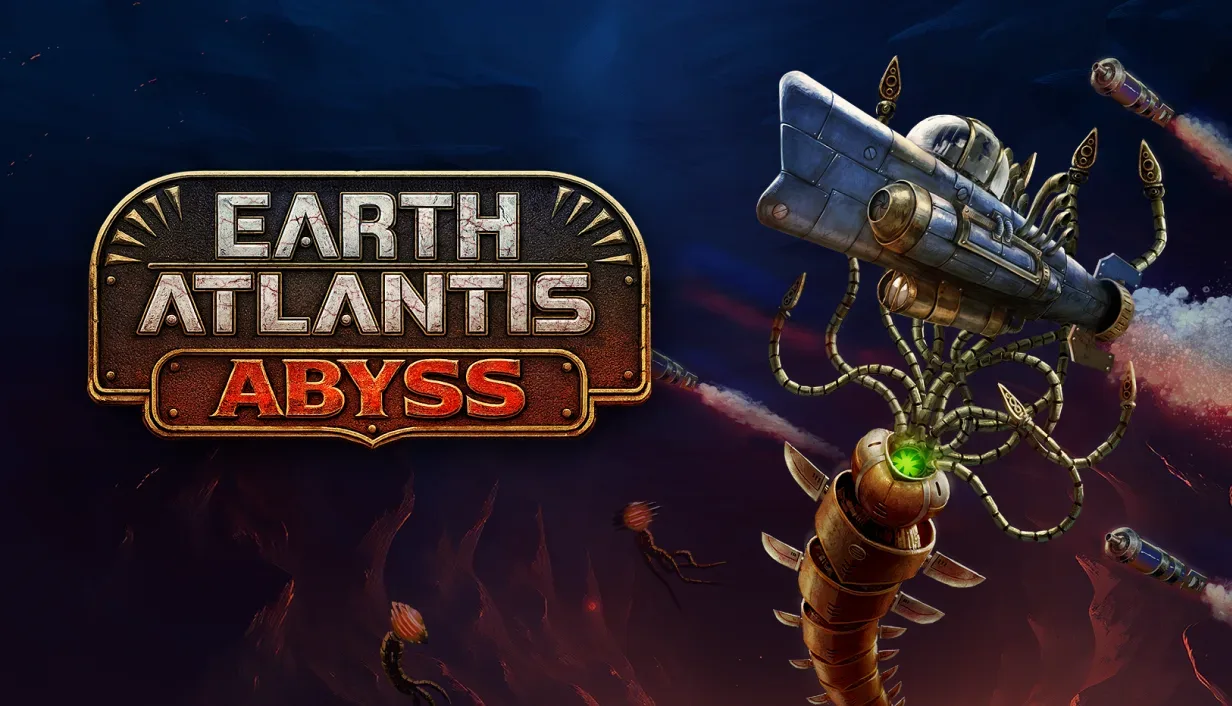
Earth Atlantis Abyss will take the Earth Atlantis series further below the surface in Q1 2027. Pixel Perfex and Eccentrix Studios have announced the PC shoot ’em up roguelike for Steam, with Rising Tide Publishing handling the release. Its premise pairs a deep-sea mystery with a run-based submarine construction system: players descend through seven increasingly dark layers while trying to discover the fate of protagonist Pypher’s missing grandfather.
The important twist is that the submarine is not simply a vehicle carrying the player between fights. It is a buildable, space-constrained machine. Weapons, engines, drones and hull modules occupy a compact internal grid, leaving players to decide not only what equipment to take, but where it fits, what it can combine with and whether the complete setup can stay supplied with power and under its heat limits.
That gives Earth Atlantis Abyss two very different pressures at once. Outside the submarine, the ocean grows darker and hostile enemies culminate in bullet-hell boss encounters. Inside it, every available grid square can become a difficult choice. A powerful item may be less useful if it blocks an engine, prevents a fusion or contributes to a loadout that overheats before it can finish a battle.
A descent shaped by darkness and a family mystery
Players control Pypher, a 17-year-old captain who pilots her grandfather’s old submarine into the abyss. Her goal is to find out what happened to him after he travelled to the same location three years earlier and did not return. The narrative is designed to reveal more as the dive continues through the seven layers.
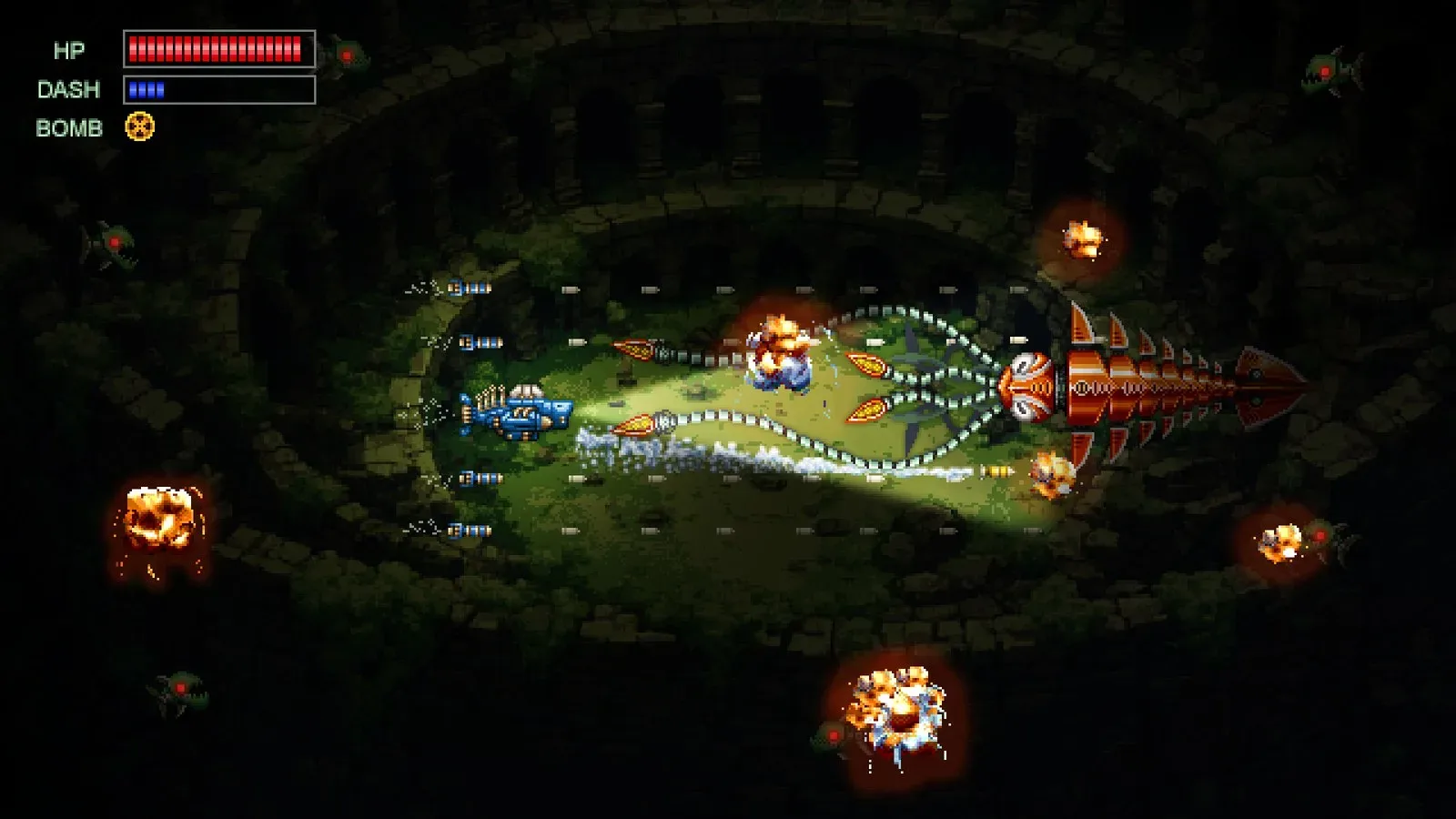
The setting is the flooded world of Earth Atlantis, but Abyss puts a particular emphasis on limited visibility. Light is a managed resource rather than pure atmosphere: the submarine’s spotlight controls how much of the surroundings can be seen, while each successive layer is darker than the last.
That distinction matters because visibility systems can change the nature of a shoot ’em up. In the broadest sense, a shoot ’em up asks players to read enemy positions, incoming fire and safe routes rapidly. A bullet-hell encounter intensifies that formula by filling the arena with dense, patterned projectile spreads that must be navigated precisely. If light governs what is visible, illumination becomes part of moment-to-moment decision-making instead of being merely a visual effect.
Earth Atlantis Abyss has eight bosses across its seven-layer journey, and those fights are built around the bullet-hell approach associated with the series. The announced structure leaves room for both the immediate challenge of surviving the attack patterns and the longer-term question of whether a submarine build has the damage, power and thermal headroom needed to keep fighting effectively.
The submarine is also a packing puzzle
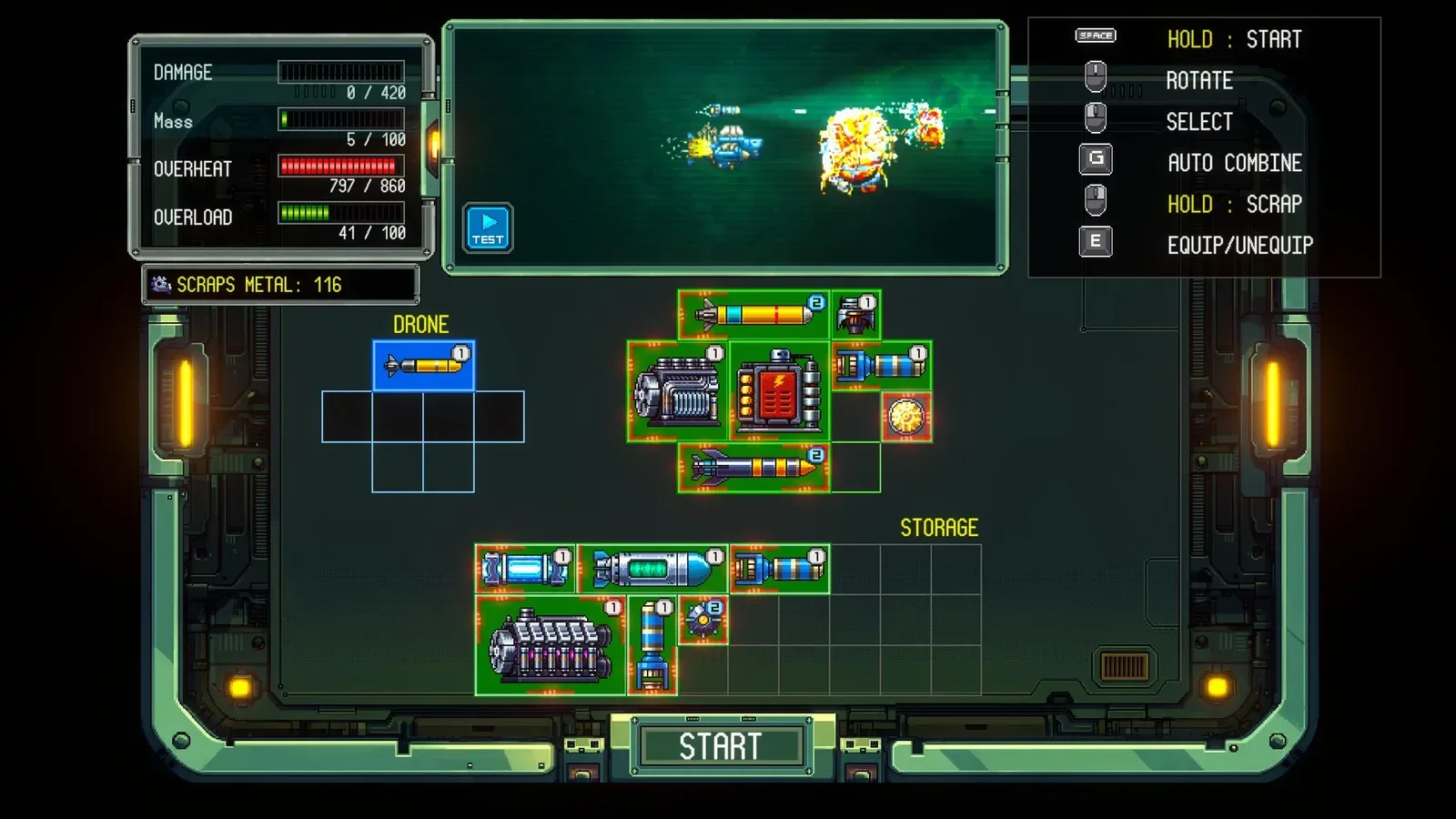
Between combat sequences, Earth Atlantis Abyss shifts into a packing-puzzle format. The modules installed in the submarine each take up space on a small grid. Players place components, then can merge or fuse them to improve their level or produce hybrid equipment.
That makes positioning consequential. A packing puzzle is not just an inventory screen where capacity rises and falls as a single number. The geometry matters: one part can occupy the cells another part needs, and a promising upgrade path can be constrained by the physical layout of the ship. The game’s available categories include weapons for offense, engines, drones and hull modules, suggesting that ship layout will require trade-offs between firepower, movement-related equipment, auxiliary support and durability.
Fusing adds a second layer to the decisions. Rather than treating every part as a final piece of gear, players can use merges and fusions to level equipment or turn parts into hybrids. One named example is the ability to use a Dwarf Star acquired from a boss in a fusion. The announcement does not spell out every possible result or the full rules around those combinations, so the exact range of hybrid builds remains to be seen. What is clear is that boss rewards can feed directly back into the submarine-building loop.
The stated aim is that no two runs construct the same ship. That is a core roguelike idea applied to the loadout rather than a fixed campaign craft. In this context, “roguelike” signals repeatable attempts whose equipment choices can vary from run to run; it does not, on its own, confirm the game’s complete progression rules, failure conditions or permanence systems. Those details have not been outlined yet.
Heat and power are build constraints, not background meters
Every build also has to contend with heat and power management. Players must balance those resources so their weapons do not jam. This gives the item grid practical stakes beyond fitting the highest number of damage-focused components into the vessel.
A heat system typically creates a trade-off between sustained output and the risk of temporary breakdown. Here, the confirmed consequence is weapon jamming. Power is likewise presented as a resource that must be managed alongside heat, meaning a setup has to function as a system rather than a pile of individually strong modules. An aggressive arrangement may therefore demand compromises elsewhere, while a more balanced ship could prioritize reliable operation during long fights.
These mechanics also connect cleanly to the deep-sea concept. Darkness asks the player to ration light; combat asks them to avoid bullet patterns; internal systems ask them to ration what the submarine can safely operate. The game’s announced parts are different systems, but they are pointed at the same tension: every descent becomes an exercise in operating a fragile craft under escalating pressure.
What co-op could change
Earth Atlantis Abyss will support cooperative play in both local shared-screen and online modes. The announcement does not detail player roles, scaling, shared resources or how packing-puzzle decisions are handled in co-op, so those are open questions. Still, the inclusion of both options means players will be able to approach the descent with another person either on the same screen or remotely.
For a game mixing bullet-hell combat with build management, co-op has obvious potential to change priorities. In battle, two players may be able to divide attention between enemies and projectile patterns. Between encounters, they may need to agree on how a limited grid should be used. That is analysis based on the announced systems, not a confirmed description of the co-op rules, but it illustrates why shared-screen and online support are more than a simple checkbox for this format.
The visual direction is also aligned with the premise. Earth Atlantis Abyss is being presented with detailed pixel art and a dark, deep-sea atmosphere. Pixel art refers to visuals deliberately built from individually defined pixels, often using carefully controlled shapes, palettes and animation rather than pursuing photorealism. In a game where a spotlight determines how much can be seen, that style could make contrast and readability especially important—though how the finished game balances atmosphere against combat clarity will need to be judged when more is shown.
What is confirmed—and what is still unknown
The announced feature set establishes a clear foundation: a Steam launch is planned for Q1 2027; Pypher’s voyage will pass through seven abyss layers; the game has eight bosses; submarine parts can be placed, merged and fused in a grid; light, heat and power require management; and local shared-screen plus online co-op are supported.
There are also sensible limits to what can be concluded now. No price, precise release date within Q1 2027, additional platform plan, hardware requirements or exhaustive item list has been provided. Likewise, the announcement identifies major component types and fusion possibilities but does not define every module, hybrid effect or boss reward. Players interested in the game’s progression model should also note that the “no two runs” concept describes varied ship construction, while the full details of how a run begins, ends and develops have not yet been specified.
For now, Earth Atlantis Abyss looks set to distinguish itself through the way its systems reinforce one another. The descent supplies mystery and darkness; the bosses bring the series’ bullet-hell identity; and the submarine’s compact grid turns preparation into a mechanical puzzle rather than a quick equipment menu. Its eventual success will depend on whether those pressures produce satisfying improvisation instead of overload, but the announced design makes the intended balancing act easy to understand: see just enough, build smartly enough and keep the old submarine running long enough to reach the truth below.
PC players tracking forthcoming games can also follow broader Steam-related news in our PC coverage.