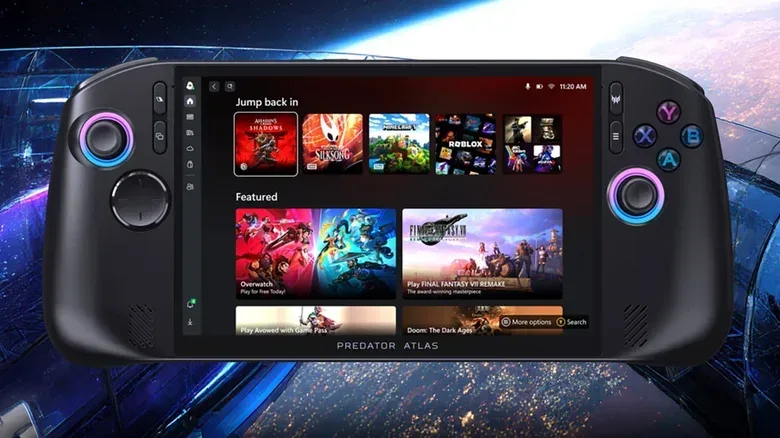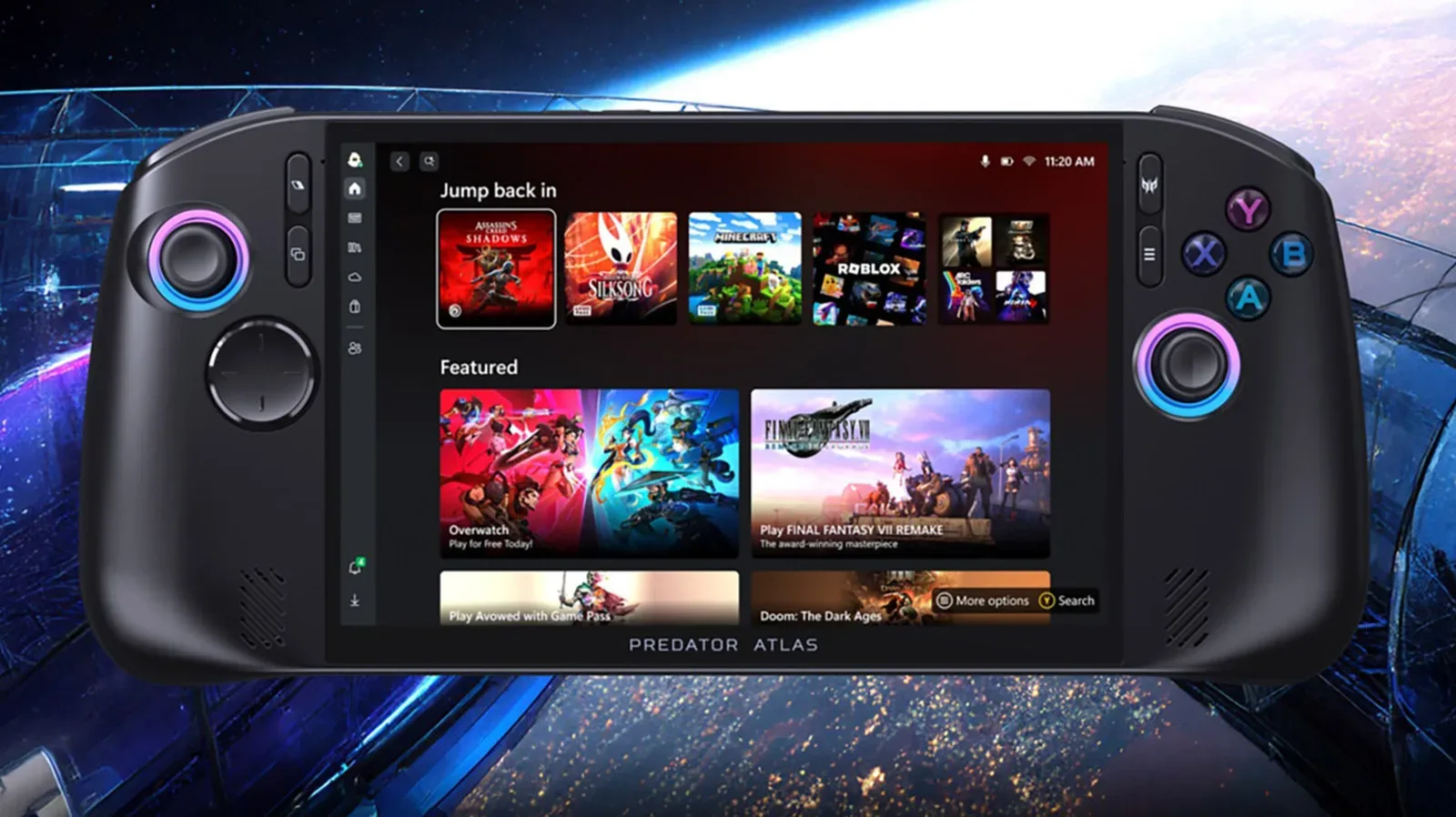
Acer’s Predator Atlas 8 is scheduled to arrive in the US on November 1, priced at $1,300 and sold exclusively through Best Buy. The launch matters for more than the arrival date: it marks Acer’s first gaming handheld officially going on sale in the country, and US buyers will receive the higher-powered Intel Arc G3 Extreme version rather than a lower-tier Intel Arc 3 model.
There will be only one Atlas 8 configuration at launch. That simplifies the purchasing decision, though the price puts the device firmly in premium Windows handheld territory. Best Buy has said initial pre-orders sold out immediately, and a new online ordering round is planned for November 1, the same day the system reaches stores.
What the US Predator Atlas 8 includes
The US model pairs Intel Arc B390 graphics with 12 Xe3 GPU cores and 24GB of LPDDR5x memory. It has an 8-inch IPS screen rated for 500 nits of brightness and a 120Hz refresh rate. Acer’s control hardware includes dual-mode triggers and TMR joysticks, while its connectivity list includes high-bandwidth docking support, a microSD UHS-II card slot, Wi-Fi 7 and Bluetooth 5.4.
- Graphics: Intel Arc B390 with 12 Xe3 GPU cores
- Memory: 24GB LPDDR5x RAM
- Display: 8-inch, 500-nit, 120Hz IPS panel
- Controls: Dual-mode triggers and TMR joysticks
- Expansion and wireless: microSD UHS-II, Wi-Fi 7 and Bluetooth 5.4
- Software: Windows 11, with support for Xbox Game Pass and games included with that subscription
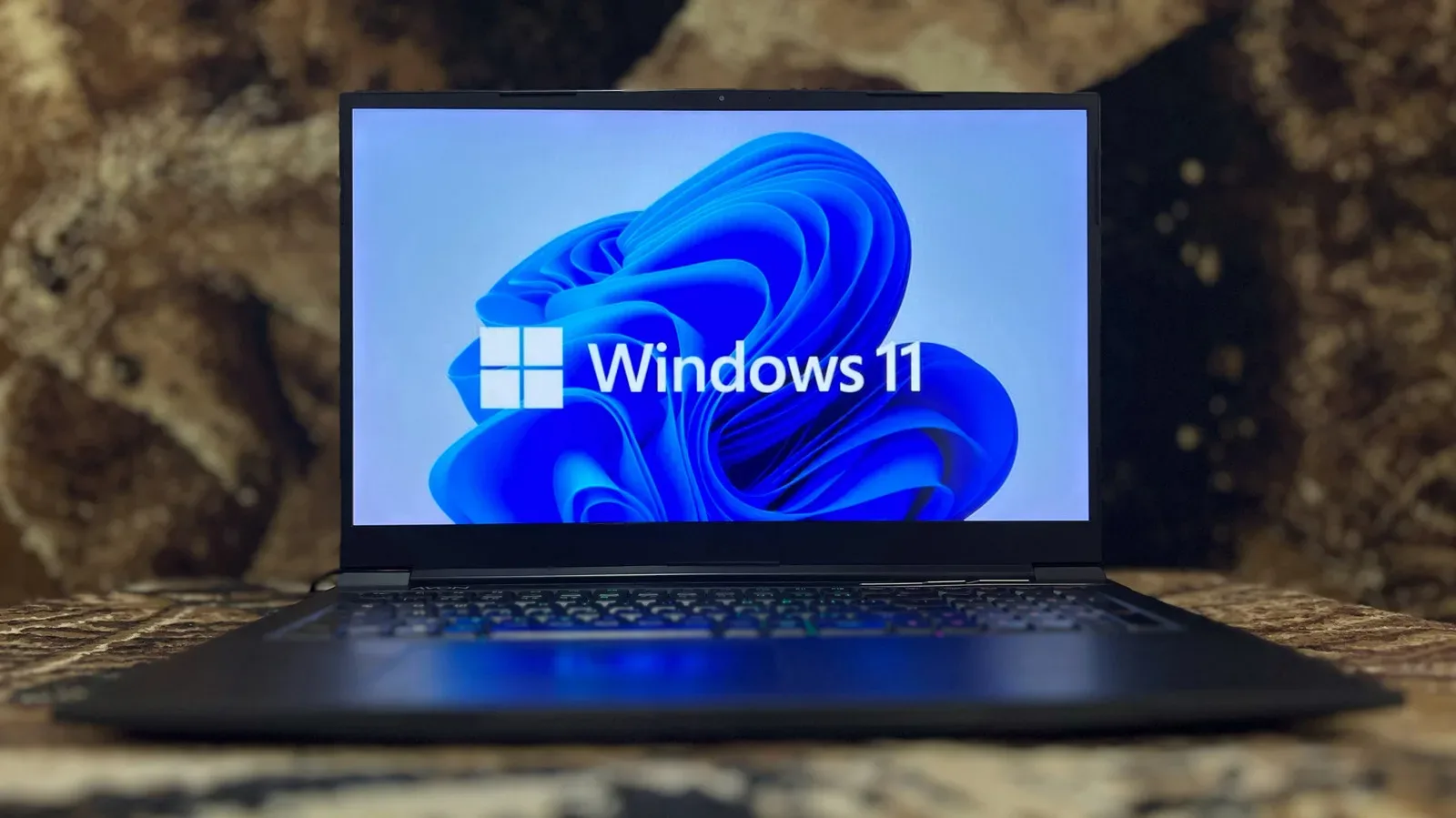
Those details establish the Atlas 8 as a handheld PC rather than a closed-console-style device. Windows 11 is the operating system, so the machine sits in the same broad category as other Windows gaming handhelds. The practical implication is that its game access is tied to the Windows PC ecosystem, including Xbox Game Pass support, rather than a dedicated store and platform designed solely for one portable device.
Why the single-model approach is notable
Handheld PC specifications can quickly become difficult to compare when a product is offered in several chip, memory or storage combinations. Acer’s US plan avoids that particular issue. There is no need to determine whether a cheaper launch option sacrifices graphics performance, memory capacity or another core component, because the announced US offering is specifically the Arc G3 Extreme version.
That does not make $1,300 a casual purchase. It does mean that the listed price is attached to the more capable configuration described for the Atlas 8, not a base version with less powerful Intel Arc graphics. For buyers assessing the system, the central question is consequently less about moving between Atlas 8 trims and more about whether its particular combination of display, controls, memory and PC flexibility fits their gaming habits.
The 24GB LPDDR5x figure is especially relevant in a compact Windows machine. RAM, short for random-access memory, is working memory used by the operating system and active applications. In a handheld that runs Windows 11 as well as games, available memory has to serve the broader PC environment as well as the game being played. Acer’s stated capacity is therefore a meaningful part of the package, even though performance in individual games will depend on their own requirements and settings.
Display and controls: the portable experience
The Atlas 8’s name aligns with its 8-inch display. Its 120Hz specification means the panel is capable of refreshing up to 120 times per second. A higher refresh-rate screen can make motion appear smoother when the system and game can produce frames at a matching pace; it is not, by itself, a promise that every game will run at 120 frames per second.
The IPS designation refers to the screen-panel technology. Acer also rates the display at 500 nits, a brightness measurement. These numbers are useful specifications, but they should be read as descriptions of the panel’s capabilities rather than a substitute for real-world judgments about image quality, battery behavior or game performance—areas not detailed in the launch information.
The controls carry two particularly technical labels. Dual-mode triggers suggest trigger inputs designed to operate in more than one mode, while TMR, or tunnel magnetoresistance, refers to the joystick-sensing technology named in Acer’s specification. What matters to a prospective owner is straightforward: the Atlas 8 is positioning its integrated controls as a major part of the premium hardware proposition, alongside the display and graphics hardware.
For players who value a larger setup at home, Acer also lists high-bandwidth docking. A dock generally provides a way to connect a portable system to external accessories or displays, although the supplied information does not specify a dock bundle, port configuration, supported display modes or other requirements. It is a feature worth distinguishing from an included accessory.
Storage expansion and newer connectivity
Acer’s inclusion of a microSD UHS-II slot provides a stated path for removable storage expansion. UHS-II is a speed-class interface associated with compatible microSD cards. Compatibility matters: a card slot supporting a particular standard does not mean every card performs identically, and no capacity, bundled storage amount or game-installation guidance was provided for the Atlas 8.
Wi-Fi 7 and Bluetooth 5.4 round out the device’s wireless specifications. These standards describe the machine’s connection capabilities; the actual experience also depends on the network, router, peripherals and software in use. The headlines are still useful for anyone considering wireless accessories, downloads, streaming or a docked desk arrangement, but prospective buyers should avoid treating the protocol names as automatic guarantees of a particular result.
Game Pass is part of the Windows proposition
Because it runs Windows 11, the Predator Atlas 8 supports Xbox Game Pass and the games included with that subscription. That gives the handheld a clear connection to Microsoft’s gaming ecosystem without making it an Xbox console. The distinction matters when comparing a Windows handheld against dedicated living-room hardware: the hardware, operating system and use case are different even if Game Pass is part of both conversations.
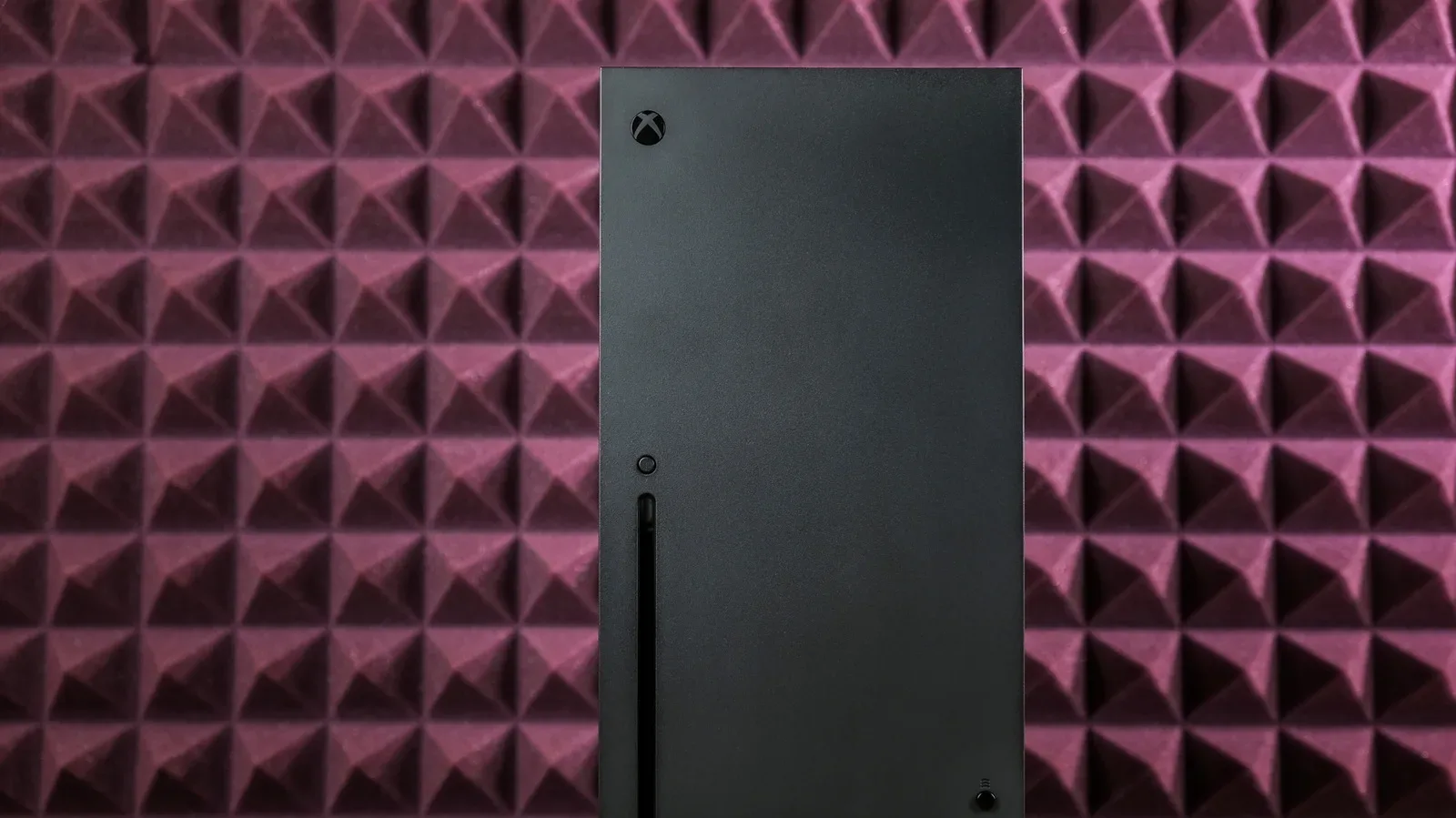
Anyone weighing the broader trade-offs of fixed-console hardware alongside a portable Windows machine may also want to consider four Xbox Series X drawbacks to consider before buying in 2026. The Atlas 8’s appeal is not that it duplicates a traditional console. Its appeal is a compact PC format with built-in controls, an 8-inch display and support for the Windows and Game Pass ecosystems.
What is known about the smaller Atlas 7
Acer also recently showed the Predator Atlas 7, a smaller model with a 7-inch display and the same Intel Arc G3 Extreme chip. However, there is no stated US sales plan for that device. Its existence should not be read as confirmation of a second American launch option, and buyers waiting specifically for the smaller form factor have no availability or pricing information to rely on yet.
For now, the November 1 Atlas 8 release is the concrete US plan. It is an exclusive Best Buy launch, it costs $1,300, and it carries the higher-end Intel Arc G3 Extreme specification. With pre-orders reportedly exhausted once already, interested shoppers should treat the November 1 online order window as the next stated opportunity rather than assuming the first launch inventory will remain widely available.