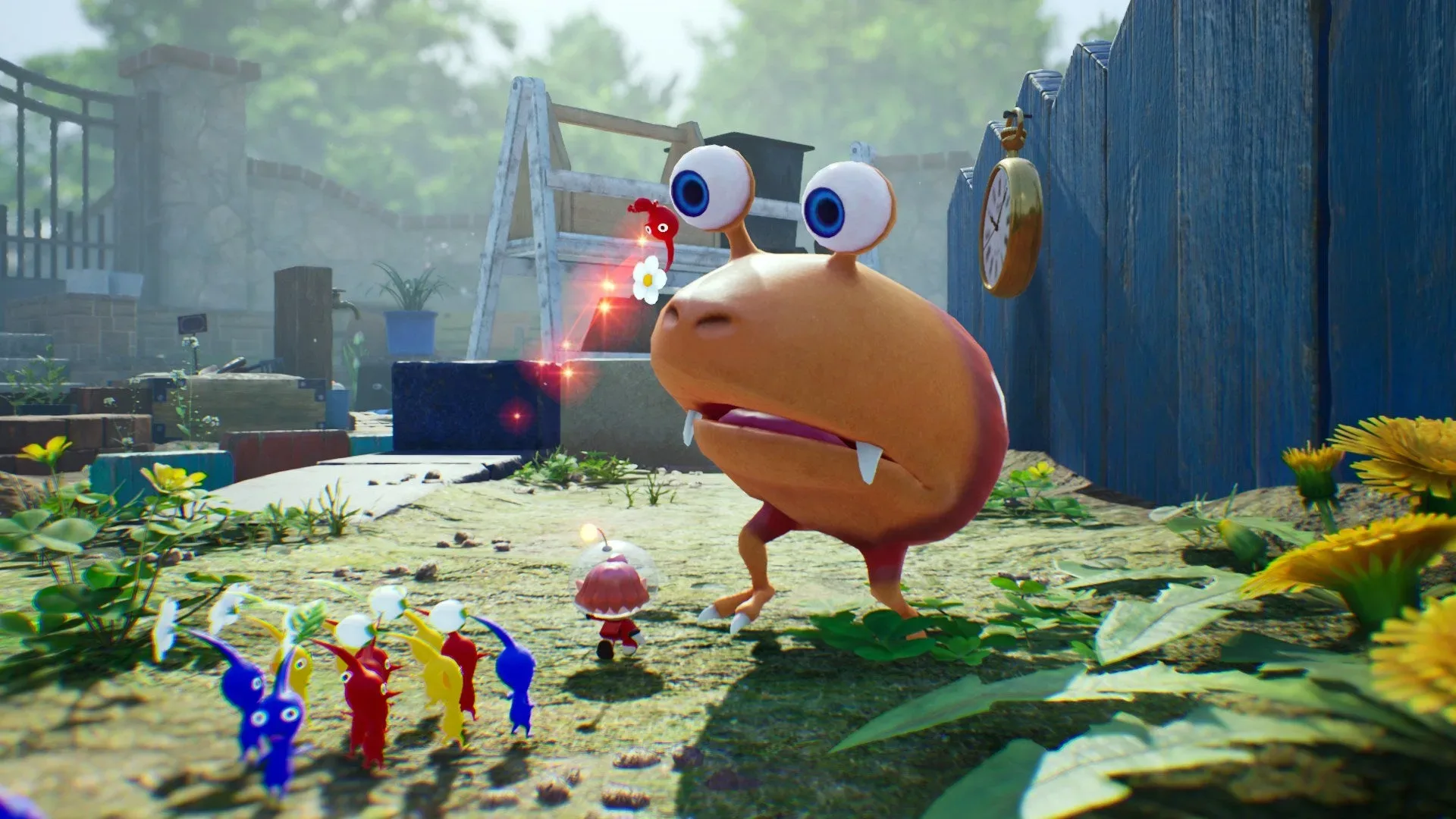
Pikmin 4 Nintendo Switch 2 Edition + Dandori Academy arrived with a straightforward proposition: sharper visuals, voice commands for Oatchi, and an extra Dandori Academy mode. For owners of the original game, however, the $10 upgrade has prompted a notably sour reaction—not merely because some players find the additions modest, but because several reports claim a core part of the experience has regressed.
The most repeated complaint is loading time. Players reviewing the Switch 2 release say transitions that took roughly six seconds in the original can now take more than 30 seconds. That is an especially damaging claim for a paid platform upgrade. Higher resolution, increased draw distance, and other visual improvements are optional luxuries to many returning players; faster, smoother movement through a game is closer to a baseline expectation when newer hardware is involved.
At the time reflected by the available user feedback, the new edition carried a 2.1 user score from 265 ratings on Metacritic. Its base-game counterpart sits at 8.9. A user-score sample of that size is not a definitive technical audit, and angry launches can concentrate the most dissatisfied voices. Still, the consistency of the criticism gives the score context: complaints repeatedly focus on the same technical and value concerns rather than one isolated disappointment.
What the paid edition adds
The advertised package consists of improved visuals, Oatchi voice commands, and Dandori Academy bonus levels. Oatchi is Pikmin 4’s canine companion, while “Dandori” refers to the series’ emphasis on efficient organization: allocating helpers, prioritizing jobs, moving objects, and using limited time well. A Dandori-focused mode should therefore be a natural fit for the game’s existing strengths, particularly for players who enjoy optimizing routes and chasing better results.
But the central dispute is not that Dandori Academy exists. It is whether it offers enough that is genuinely new. Buyers have said much of the mode repurposes maps or Dandori content already present in the base game, with availability limited to particular times. Others characterize the rewards for strong scores as weak. Reusing locations is not automatically a problem—new objectives, layouts, rules, or rankings can make familiar spaces worthwhile—but returning players are clearly judging this package against the expectation created by a separate upgrade fee.
One relatively favorable user review described the new material as meaningful and enjoyable for longtime fans, while still concluding that it does not justify the price for players who have already finished the original. That distinction may be the most useful way to read the backlash. The edition can have welcome features without being a compelling purchase for every existing owner.
The technical complaint is more serious than a missing performance boost
Frame rate has also become part of the debate. Players say the game still targets 30 frames per second, with some arguing that it is now less consistent than the original release. Frame rate is the number of complete images a game displays each second. A 30 FPS target is not inherently bad; a game can feel responsive and stable at that level. The issue is consistency. If performance drops below its target during busy scenes, movement and camera motion can appear uneven.
Likewise, a higher resolution means the game renders more pixels, potentially giving a clearer image. Draw distance is how far into a scene the game can render visible objects or detail. Both upgrades can improve presentation, especially in a game built around surveying environments and directing small units across them. Yet higher resolution and draw distance do not automatically improve every visual asset. One player noted that the clearer presentation can instead call attention to textures that do not appear to have received comparable upgrades.
Related coverage includes Pikmin 4's Switch 2 Upgrade Faces Backlash Over Performance and Value.
That creates a poor trade-off if the reports of much longer loads are accurate. Loading screens occur when the game retrieves and prepares data for the next area or activity. They are not usually the headline selling point of a game, but they shape its rhythm. In a game about planning and repeatedly attempting challenges, delays between those attempts can quickly become more noticeable than a visual upgrade.
For players who believe the original’s loads were faster, the objection is not simply “this did not improve enough.” It is “I paid to make a familiar game less convenient.”
That is why descriptions such as “paid downgrade” have appeared in user feedback. The phrase is obviously rhetorical, and not every player agrees with it. But it captures the specific mismatch between an upgrade label and the experiences being reported. A paid edition does not need to double the frame rate or rebuild every texture to satisfy its audience. It does need to make a convincing case that the overall package has moved forward.
The menu complaint speaks to the value argument
Some fans have also objected to a large Dandori Academy banner occupying space on the edition’s title screen. On its own, this is a minor presentation issue. It becomes more meaningful in the broader conversation because it suggests the added mode is being prominently foregrounded even as players question its depth. A menu banner cannot determine whether a mode is worthwhile, but it can make the mode feel inescapable to someone who sees it as a small add-on rather than a major expansion.
There is a practical difference between a newcomer and a returning owner here. Someone who has never played Pikmin 4 may reasonably value the edition’s visual improvements, draw-distance increase, Oatchi commands, and bonus material as a single package. One user review made precisely that case, calling it the better version for first-time players while advising veterans to wait. Existing owners, by contrast, already own the main adventure and much of the Dandori framework. Their buying decision rests almost entirely on what the upgrade changes—and whether those changes make play better enough to warrant another payment.
Why the review score should be read carefully, not ignored
A 2.1 user score naturally attracts attention, but it is not a substitute for an exhaustive measurement of every copy of the game. User ratings are voluntary and can be shaped by launch-week frustration, value disputes, or a desire to signal displeasure. There are also fans in community discussions who consider the score overdramatic and argue that the release broadly resembles other Switch 2 Edition upgrades.
That pushback matters. It means the available feedback does not establish that every player will find the product unusable or that none of its additions are valuable. In fact, even some more measured reactions acknowledge positives such as the resolution bump, larger visible range, and additional content.
But “not the worst thing ever made” is a remarkably low threshold for a paid upgrade. The lack of a loud, sustained defense of the package is notable in its own way. The more charitable responses largely argue that the criticism has become disproportionate, rather than mounting a detailed case that the $10 addition materially transforms the game for original owners.
The most reasonable interpretation is therefore a conditional one. For a first-time buyer choosing between versions, the Nintendo Switch 2 Edition may still be attractive because it bundles the extras with the game. For an owner of the base Switch release, the current feedback advises caution—particularly for anyone who cares more about quick restarts and smooth performance than a resolution increase or voice controls.
What prospective buyers should weigh
- New to Pikmin 4: Consider which edition includes the features you want, while recognizing that reported performance concerns are part of the picture.
- Already own Pikmin 4: Treat Dandori Academy as the key value question. If revisiting familiar challenge spaces and using Oatchi voice commands do not sound appealing, the case for upgrading is weak on the evidence available.
- Performance-sensitive players: Reports of longer loading and uneven 30 FPS are the most important reason to wait for clearer information or changes.
- Completionists and score chasers: The added Dandori material may still hold interest, but players should temper expectations about how much wholly new content it contains and the strength of its rewards.
The situation is a reminder that “enhanced edition” can mean very different things. Some buyers want a definitive technical revision. Others are content with a modest visual pass and a few bonuses. The reaction to Pikmin 4’s Switch 2 package shows what happens when those expectations collide with reports that a basic convenience—loading into the next activity—has become worse.
For more Nintendo coverage, see our report on player data surrounding Ocarina of Time Remake’s most troublesome enemies.