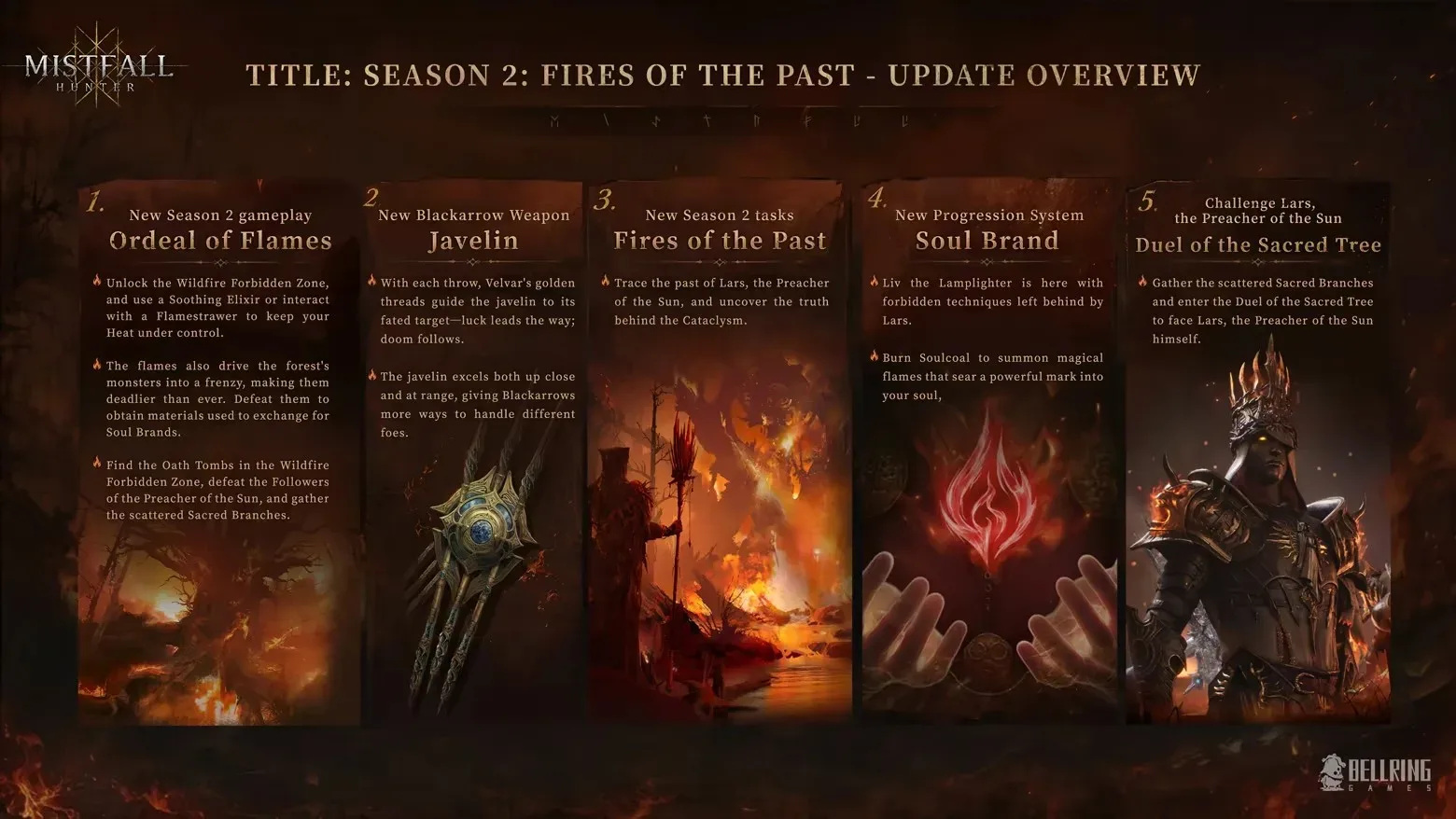
Mistfall Hunter Season 2 launched on November 11, 2026, bringing a substantial set of new systems and revisions to the dark-fantasy PvPvE extraction ARPG. The update is available on PC through Steam and Microsoft Store, PlayStation, and Xbox, with the game also arriving Day One on Xbox Game Pass.
Its central idea is unusually direct: make a section of Hallowgrove actively hostile, then give players a reason to consider stepping into it anyway. The new Ordeal of Flames seasonal mode adds a randomly located Wildfire Forbidden Zone to matches. It is a health-draining hazard, a damage opportunity and the route to a new boss encounter all at once—essentially a big, burning sign that says “valuable things this way,” followed by a much smaller sign that says “probably don’t.”
Alongside the seasonal mode, Season 2 adds Blackarrow’s Javelin weapon school, a Soul Brand progression system, Shrine of Honor appearances, new valuables, quest adjustments, camp-upgrade changes and a broad round of performance, connectivity, balance and quality-of-life work. A 20% discount runs from November 12 through November 19, described as the game’s lowest price to date.
Ordeal of Flames turns a random part of Hallowgrove into a calculated risk
The Ordeal of Flames is the defining gameplay addition. During each match on Hallowgrove, flames engulf a random area that becomes the Wildfire Forbidden Zone. Hunters within this terrain build up Infernal Flame. The immediate downside is steady health loss; the incentive is greater damage output.
That creates a familiar extraction-game choice with a harsher environmental twist. An extraction ARPG combines character combat and loot progression with matches where players collect valuable items and must successfully escape with them. Failing to get out means the run’s rewards are at risk. In this context, the Forbidden Zone is not merely a combat arena: it is a place where players are trading survivability for offensive power while deciding whether the potential haul is worth the danger.
Infernal Flame can also lead to the Burning state. Season 2 includes soothing elixirs intended to manage Burning, so this is not presented as a hazard players simply endure without options. The practical tension lies in when to use a limited response, when to leave the zone, and when a damage boost is valuable enough to justify pressing deeper into an area that is taking health away.
A new fire-aligned monster appears as part of the mode, and Soulcoal is a new crafted item associated with it. The supplied details do not specify the monster’s combat behavior or Soulcoal’s precise recipe and uses, but their addition ties the new seasonal environment to both combat encounters and crafting rather than treating the flames as a purely visual map modifier.
A two-step path to the Preacher of the Sun
The update’s new boss encounter is woven directly into the Wildfire Forbidden Zone. Hunters first need to defeat the Preacher of the Sun Follower in the Oath Tomb, which is located inside the fiery zone. Doing so yields the Sacred Branch. That item is then taken to the Oath Altar, where players can challenge the Preacher of the Sun.
Related coverage includes Mistfall Hunter Season 2 Ignites Hallowgrove With Ordeal of Flames.
The sequence matters because it establishes an encounter chain instead of simply placing a boss at a fixed destination. Players pursuing the Preacher must enter the hazardous territory, clear the Follower, obtain the required item and travel to the altar before the final challenge. It is a more deliberate objective than finding ordinary valuables and extracting, and it should give squads a clear reason to contest the same high-risk section of the map.
Season 2 also adds a main questline centered on the Preacher. Gyldhunters can investigate the character’s past and the truth behind the disaster. While the available information does not outline the story’s answers, it does make clear that the boss is intended as both a gameplay objective and a narrative focus for the season.
Blackarrow receives the Javelin as a second weapon school
Blackarrow gains a second weapon school with the Javelin. The weapon is designed to work at close and long range, giving the class another option beyond its existing approach. Its standout mechanic is Divine Infusion, a mode that imbues the javelin with divine power for a self-aiming throw.
“Self-aiming” is the key part of that description. It suggests Divine Infusion is meant to alter the throwing interaction rather than just increase raw damage, though the update notes do not provide exact targeting rules, limits, cooldowns or damage values. Players should therefore avoid assuming how strongly the feature will track targets until its in-game behavior is clear.
Even with those details unknown, the role is easy to understand: a weapon school that can participate at different distances and includes a guided throwing option potentially expands Blackarrow’s choices around target pressure and positioning. It arrives amid class-wide skill and gameplay adjustments, as well as new tactical items meant to assist less mobile classes.
Season 2 additionally introduces a damage-falloff mechanic. Damage falloff generally means an attack becomes less effective over distance. No specific weapons, abilities or numerical thresholds were listed, so the important confirmed point is its wider balance purpose: range will now be a more explicit factor in damage calculations. That potentially matters greatly in a season that also introduces a flexible ranged-and-melee Javelin school.
Progression and rewards are being made less rigid
Season 2’s new seasonal progression system is called Soul Brand, while the Shrine of Honor introduces an appearance system. New high-value loot and valuables are also being added to the pool players can find, extract and cash in.
The more consequential revisions may be to task completion. The first three chapters of the Main Task no longer have to be completed in a single run or on one life. They also no longer require Chaos or Disaster mode. Those changes reduce the all-or-nothing pressure previously attached to early seasonal objectives and allow steady progress across multiple matches.
Task tracking now distinguishes between solo and three-player modes. Item turn-in quests have been shifted to side quests. Together, these changes separate optional item-delivery work from the principal progression route and acknowledge that solo play and full squads do not necessarily produce comparable outcomes.
The named rewards are as follows:
- Completing Chapter 2 Main Tasks grants the S2 Pip’s Rare Pouch.
- Completing Chapters 3 and 4 Main Tasks grants the season-limited Bell - Path of Thorns appearance and Escape Effects - Path of Thorns.
- Side missions can provide season-limited skins, including the Holy Material Selection Chest and Premium Ship Cosmetic - Dawnchaser.
Season-exclusive gameplay rewards will also have a dedicated exchange store. That is paired with revised camp upgrades: special containers can drop non-tradable fragments for key upgrade materials, and those fragments can be exchanged for complete materials. Overall output for key materials has been increased. The combination is aimed at smoothing a progression path that might otherwise depend too heavily on individual drops.
Loot economy changes affect both discovery and crafting
More containers are being placed on maps, and high-value items have higher drop chances. Combat pack affix combinations have been reworked, forging fees have been removed and expected returns from forging have increased.
An affix is a modifier attached to an item, typically changing its properties. Reworking the possible combinations on combat packs can change what kinds of gear results players see and which pieces feel worth keeping. The supplied notes do not detail particular affixes, but the economic intention is clear: more opportunities to discover valuables, fewer costs attached to forging, and stronger expected crafting results.
These systems matter especially in an extraction game because a valuable find is only the first half of the decision. Players must assess whether they can carry the loot to an exit safely, whether further exploration is justified, and whether hostile players may be converging on the same promising area. Season 2 increases the number of such opportunities while the Ordeal of Flames gives an especially dangerous place to pursue them.
Servers, performance and storage receive attention
Season 2 includes new servers and a global network acceleration system intended to reduce latency and resolve routing issues. Asia servers are moving to Hong Kong, and a new US West server has been added.
Latency is the delay between a player action and the game receiving or returning the resulting information. Routing refers to the network path that data takes between a player and the game service. Both can be especially important in PvPvE encounters, where delayed information can affect positioning, attacks and escapes. The update promises improvements in these areas, though individual results can naturally vary with region and a player’s own connection.
For readers weighing their home setup as part of smoother online play, our look at a dual-band Wi-Fi 7 router with PC gaming in mind provides related context on local-network hardware—distinct from game-server routing, but part of the broader connection picture.
Engine and resource optimizations are also intended to improve performance. The update notes do not attach targets or platform-specific benchmarks to those changes, so they should be understood as stated optimization work rather than a guarantee of a particular frame rate or system requirement.
Several smaller changes address friction outside the fight. Gems now have a dedicated warehouse rather than occupying standard storage. Players can remove all gems in their backpack with one action, destroy starter equipment in one step after assembly, and disable the Triumph Drink animation through a setting. None of these alter a boss battle, but they reduce repeated inventory and interface chores around matches.
What Season 2 is trying to change
The update’s design direction is consistent across its many parts. The Wildfire Forbidden Zone makes the map more volatile, offering power and objectives in exchange for damage and exposure. The Preacher of the Sun route supplies a specific prize worth entering that danger. The Javelin widens Blackarrow’s tactical identity. Meanwhile, less restrictive tasks, more upgrade-material output, higher-value loot chances, fee-free forging and storage improvements aim to make progress feel less punishing between runs.
The developer has said Season 2 was shaped by Season 1 feedback, specifically around smoother progression, fairer rewards and more stable connections. It has also indicated that further special modes, seasonal events, community tournaments and competitions are planned. No timing or details for those future additions were provided.
For now, the most immediate question is whether players will treat Hallowgrove’s burning zone as a shortcut to wealth, a boss route or a place to avoid until somebody else has already made the first very smoky mistake.