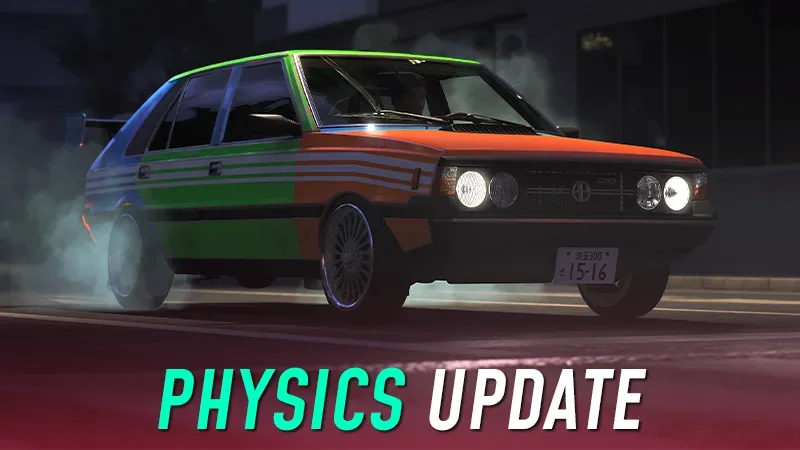
JDM: Japanese Drift Master is receiving an update across all platforms that concentrates on the part of a driving game players feel most immediately: the conversation between steering input, tires, suspension and the road beneath the car. The patch revises suspension response and behavior during skids, returns tire-pressure adjustment to the Car Tuning Workshop, and clears up a spread of multiplayer interface problems and vehicle-specific defects.
It is a notably practical patch rather than a feature dump. The headline additions affect how cars should react over uneven pavement, when the rear begins to move, and how promptly grip returns after a slide. Meanwhile, the restoration of tire-pressure tuning puts one more adjustment back in players’ hands. For a game built around Japanese-car culture and drifting, that combination matters: setup options are only useful if the underlying handling model makes their consequences readable.
Suspension and skid behavior get the main attention
The update enhances suspension response and rebound speed when cars travel over uneven surfaces. In simple terms, rebound is the suspension’s return movement after being compressed. A car running across bumps is not merely moving up and down visually; its wheels need to stay in useful contact with the surface so the vehicle can continue to steer, brake and accelerate predictably.
That does not mean the patch promises a wholly new physics model or one universally ideal setup. It does suggest that rougher road surfaces should produce more considered suspension reactions than before. In a drifting game, that can be especially relevant during transitions, small corrections and moments when a car is already close to the limit of its available grip.
The developers have also improved the translation of forces through the wheels during skids. The stated goals are to correct steering reaction times and grip recovery. Grip recovery describes the point at which a sliding tire regains enough traction to meaningfully settle or redirect the car. If that response is too delayed, too abrupt or unclear, a player may feel that the car is ignoring a correction—or suddenly snapping back once it is too late to manage the result.
There is a further refinement to vehicle behavior during small steering inputs, with particular attention paid to rear-heavy cars. Tiny steering corrections are an important part of holding a drift rather than simply initiating one. The patch notes do not specify individual tuning values, nor do they claim every rear-heavy car will behave identically. But the focus indicates an effort to make those fine corrections more legible and controllable where weight distribution can make the rear end especially influential.
What those terms mean at the wheel
Suspension tuning and tire behavior can sound like workshop jargon, but they map directly to the adjustments a player makes on a controller or wheel. A minor steering correction is the small countersteer or input used to maintain a chosen angle, control the car’s line, or prevent a slide from widening. During a skid, the front wheels must respond convincingly enough that the player can judge whether to add input, unwind the steering, or alter throttle.
The patch’s value will therefore be less about a checklist item and more about consistency. Better response over uneven roads, more accurate wheel-force behavior while sliding, and improved reactions to small inputs all point at the same desired outcome: a driver should have clearer feedback about why a car did what it did. That is analysis rather than a claim of a specific before-and-after performance result; individual impressions will naturally depend on cars, setups, surfaces and player technique.
Related coverage includes JDM Update Refines Drift Physics and Restores Tire Pressure Tuning.
Technical polish of this kind can be just as consequential as a visible new feature. Other game-maintenance updates have similarly focused on failures that interrupt the expected experience, including an emulator update addressing specific crash and freeze issues. In JDM’s case, the emphasis is not only on removing faults, but also on refining the feedback loop at the center of its driving.
Tire-pressure tuning returns to the workshop
The Car Tuning Workshop once again lets players control tire-pressure settings. Tire pressure is one of the more granular variables in a vehicle setup: it concerns how inflated a tire is, and in a simulation or sim-leaning driving context it can be used to influence the way a car responds at the contact patch—the small area where the tire meets the road.
The update does not detail the numerical range of the setting or define its exact effects in JDM, so players should not assume undocumented changes to every aspect of tire simulation. What is confirmed is the return of player control over the setting. Its reintroduction gives tuning-minded drivers an additional tool when tailoring a car for their preferred handling balance.
That matters alongside the physics work because setup choices and vehicle behavior are connected. When a game asks players to develop a drift car, the ability to alter its configuration is most meaningful when the player can identify how that configuration affects turn-in, stability, a slide’s progression and recovery. Tire pressure will not replace driving technique, but it restores a variable for those who want to explore the tuning process rather than stop at broad car-stat changes.
Multiplayer gets fixes for information, flow and controller navigation
The update also tackles several multiplayer issues that could confuse competitors or disrupt the sequence of an event. Track-completion percentages could previously change at random between percentage values and a completed state. That display issue has been corrected. Race progress information is basic, but it is important: it tells participants where they stand and whether the event state matches what is happening on track.
Summary screens have also been fixed for nicknames longer than 10 characters. Longer player names are now handled properly rather than presenting an incorrect display after a race.
Two fixes deal with the timing of prompts and post-race screens. Players attempting to leave an in-progress race will now receive the previously missing pop-up warning. Separately, post-race voting screens should no longer arrive while competitors are still racing. Both corrections address state awareness—the game communicating whether a player is leaving an active event or whether that event has actually finished.
Gamepad navigation has been repaired across event-creation menus as well. This is a small line item with a straightforward practical consequence. A creation menu is only useful when its controls can be navigated reliably from the chosen input device; better controller navigation should remove a barrier from setting up events in multiplayer.
- Track-completion display behavior has been corrected.
- Long nicknames on race-summary screens have been addressed.
- Leaving an active race now triggers a warning pop-up.
- Post-race voting should wait until players are done competing.
- Gamepad navigation across event-creation menus has been fixed.
Specific vehicles and assets receive repairs
Several named vehicles are included in the patch’s asset and behavior work. For the Nissan 180SX Type R, the career screen now updates when car statistics are changed. This is primarily an information fix, but an important one for a game that allows tuning: a player changing stats needs the associated career interface to reflect those changes.
The Nissan Z33’s inverted headlights have been corrected. The Ironvale Hauler F84 receives a front-collision fix intended to stop situations in which the vehicle could clip through objects. The FSO Polonez now has its missing seats restored. Finally, the Akina Phantom and Roebuck Jetstream have fixes for body-kit placement and the right-side mirror.
These entries cover different kinds of quality assurance, from collision behavior to vehicle presentation and interface feedback. They should not be read as sweeping changes to every car in the garage; they are targeted repairs to the named models and assets. Still, the breadth is useful. A driving game’s appeal is not only its lap-to-lap handling but also whether the cars look properly assembled, interact credibly with the environment, and report changes correctly through the surrounding menus.
Liveries are the next major roadmap focus
With multiplayer now released on consoles, the team says it is completing work on the anticipated liveries system. A livery is a vehicle’s visual design or paint-and-decal scheme. The announcement characterizes console multiplayer and liveries as the two largest roadmap features planned for this year.
No release date, design details or list of livery tools have been provided in this update, so expectations should remain limited to the stated plan: the system is being finished. The team also says additional, unannounced content is in development. That points to ongoing support, but it does not establish what that future material will include or when it might arrive.
“JDM has been, is, and will be first and foremost a passion project for us that we want to continue evolving and pushing forward,” the team said, adding that it is working as quickly as possible while acknowledging it cannot match the output level of some AAA games.
That framing is a useful guide to the patch itself. It combines broad, foundational handling work with a set of specific repairs, then points toward a customization feature still in progress. Players can treat the current update as a tuning-and-stability pass available across platforms, while liveries remain the next major confirmed roadmap item rather than a feature to expect immediately.
The game is also discounted for a limited time: 60% off on Steam and 50% off through the PlayStation Store. The update does not provide an end date for either discount, so interested players should check the relevant storefront for current pricing and availability.