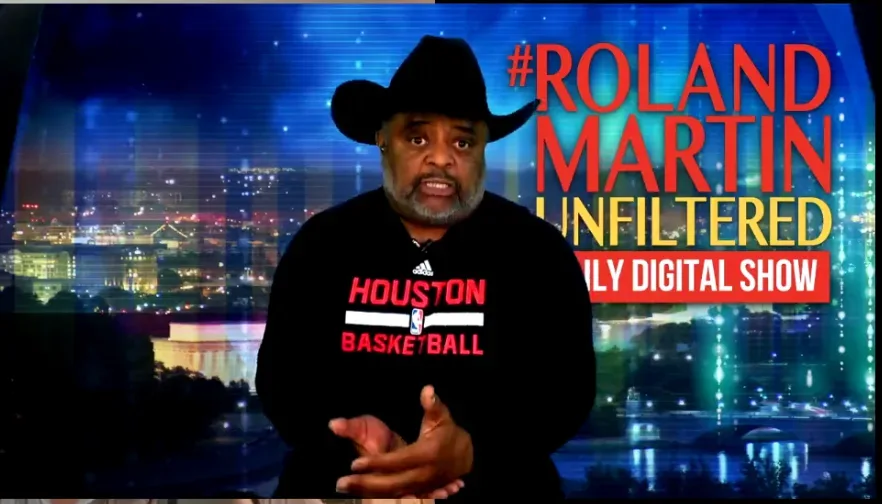
Roland Martin Unfiltered took a deliberately nontraditional route into the final stretch before Election Day: it went on the road. The daily political news and commentary roundtable traveled through 12 cities in 15 days across the three weeks leading to the Nov. 3 midterm election, bringing its production directly into communities where voting access, affordability and attacks on diversity, equity and inclusion were prominent concerns.
The itinerary was extensive. Stops included Little Rock, Arkansas; Fairfax, Virginia; Lansing, Michigan; Indianapolis; Atlanta; Jackson, Mississippi; Baton Rouge, Louisiana; Miami Gardens, West Palm Beach and Tallahassee, Florida; Lithonia, Georgia; Arlington, Dallas and Houston, Texas; and Fort Bend County, Texas. Some places were revisited during the run. The team returned home two days before the election.
That kind of itinerary is significant not simply because it is demanding, but because it reflects an editorial choice. Rather than treating election coverage solely as something assembled from a fixed studio, the program used travel to put its conversations closer to the communities at the center of its subject matter. It is a model made more viable by digital distribution, where a production can be more flexible about location, segment length and visual style than a traditional scheduled television broadcast.
A logistical sprint behind the coverage
Martin described the three-week tour as a fast-moving operation that required him to work well beyond the role of host. During its first week, the team had a 35-foot bus on the road. A Sprinter van was added in the second week. The production schedule often involved flying into a city, staging the show, checking into a hotel and then moving on almost immediately.
The overnight system was designed to keep equipment and luggage advancing even when the on-camera team was airborne. Suitcases were placed in the Sprinter, while the travelers packed only what they needed for the next night. The van would drive to the next location overnight; the team would fly ahead, take a rideshare to the hotel, set up and produce the next show. Martin characterized his work during the trip as a combination of hosting, producing, travel planning and logistics coordination.
It is an unusually hands-on picture of mobile digital production. A road show requires more than booking guests and discussing the news. It also depends on transport timing, hotel coordination, the movement of camera and production equipment, and the ability to rebuild a workable set in each new location. A schedule that is workable on paper can quickly become fragile if a flight, vehicle or setup window changes.
For viewers, the technical arrangements may remain largely invisible. But they help explain why location-based programming can feel different from studio coverage. The practical work of going from city to city is also what allows a program to change the backdrop, draw from local conversations and make its reporting priorities visible in the places it has chosen to visit.
What “digital” changes in a political show
Martin’s central point is not that digital media eliminates production constraints. The tour itself demonstrates the opposite: travel-heavy coverage can be complicated and labor-intensive. The difference is that a digital program can make choices that are difficult to accommodate inside the conventions of linear television.
Linear television generally refers to programming distributed at a prescribed time on a channel or network schedule. A segment must fit its designated block, including transitions, commercial breaks and the programming around it. Digital distribution, in this context, means a show can be produced and presented without being locked to that same kind of channel timetable. It can be built for online audiences and use formats that do not need to conform to a short, uniform segment length.
Martin contrasted his approach with the typical three-to-six-minute news segment. He said the program can instead spend 20 or 30 minutes on a deep dive. A deep dive is sustained treatment of one issue rather than a quick overview: more time for context, competing perspectives within a roundtable and questions that cannot be resolved in a headline-length exchange.
Longer duration alone does not guarantee better reporting or a clearer conversation. It does, however, create room for a different editorial rhythm. Election issues such as voting rights, household costs and DEI policy can be complex, with local effects that resist a rapid summary. A program that chooses a longer format can devote more time to explanation, discussion and audience-facing engagement instead of compressing every subject into a short television package.
The format also permits a looser visual language. Martin said he is not attempting to reproduce the polished presentation of the major broadcast and cable news organizations. He described using a DJI action camera for unconventional footage and framed that lack of strict formality as part of the program’s purpose, not a deviation from it.
Serving a specific audience rather than replicating a network
The road tour was aimed at parts of the South and Southeast where political issues had already energized voters. That regional concentration matters. A national election can be discussed in broad terms, but the stakes are often experienced through particular local institutions, laws, costs and organizing efforts. Taking the show to cities in Arkansas, Mississippi, Louisiana, Florida, Georgia and Texas gave the program a practical way to organize its election coverage around those areas.
Martin has experience in multiple established media environments, including CNN, TV One and Tom Joyner’s radio program. His description of Roland Martin Unfiltered nonetheless emphasizes independence from the structure and aesthetic of conventional national news shows. He said he is not trying to replicate MS NOW, CNN, ABC, NBC, CBS or Fox News.
That distinction is important to understand on its own terms. The stated goal is not merely to put familiar television programming online. It is to use an online format to communicate with an audience differently: longer discussions, direct field production and a willingness to show the mechanics of a less formal operation. In that sense, the camera work and the travel plan are connected. Both reject the assumption that political news must look and move like a fixed-studio newscast.
There is also a community dimension to production that leaves the studio. The choice of venue and city can signal who a program expects to hear from and whose concerns will shape its agenda. That does not erase the need for clear reporting and careful analysis, but it can shift the starting point of a discussion away from national abstraction. Community-centered media events take many forms; entertainment programming has likewise used physical gathering places, including the Vision Theatre’s reopening in Leimert Park, to create a direct connection between programming and place.
The limits and promise of an unconventional format
There is a tradeoff in the approach Martin describes. Operating without the rigid polish of a legacy broadcast can provide flexibility, but it also places a great deal of responsibility on a smaller traveling operation. The host may become the producer, scheduler and problem solver at the same time. A 15-day, 12-city run shows how much work is required to turn flexibility into actual programming.
Still, the effort clarifies why digital political shows can develop an identity apart from traditional television. Their competitive advantage is not necessarily scale or slickness. It can be responsiveness: the capacity to devote time to a topic, to use a small camera when appropriate, to relocate rapidly and to build coverage around a defined audience rather than a generalized national broadcast template.
For Roland Martin Unfiltered, the pre-election trip put that philosophy into operation. The production moved across a wide geographic range, prioritized areas where key voter concerns were already active and used a travel system built around buses, vans, flights and rapid setup. The resulting program was designed to be more than an election-night product. It was an attempt to make the journey to Election Day part of the coverage itself.