Amazon is giving Ring a new robotics label with two mobile security cameras that take very different routes around a property: one flies, the other rolls. The consumer-facing Ring Drone Cam is priced at $249.99 and is scheduled to ship on January 27, 2027. The Ring Rover Cam, priced at $999.99, is aimed at enterprise use cases such as warehouse monitoring and patrols for small and medium businesses.
They are the opening products in Ring Robotics, described as a category for autonomous, mobile security. That distinction matters. These are not fixed cameras with a wider field of view or a motorized pan feature. The intended function is to travel to the area where a sensor detects a possible problem, or to follow a preset patrol path, then provide a view of that location.
The Drone Cam is the more unusual of the pair—and the one with the longer development story. Ring founder Jamie Siminoff said work on a drone concept began in 2016, before Amazon acquired Ring in 2018. A drone was announced in 2021, but the company did not ship the units it had prepared because they were not working well enough. A further setback came in 2025 as the project ran into demands for additional sensors, processing power and battery capacity.
A small indoor quadcopter, with a short flight window
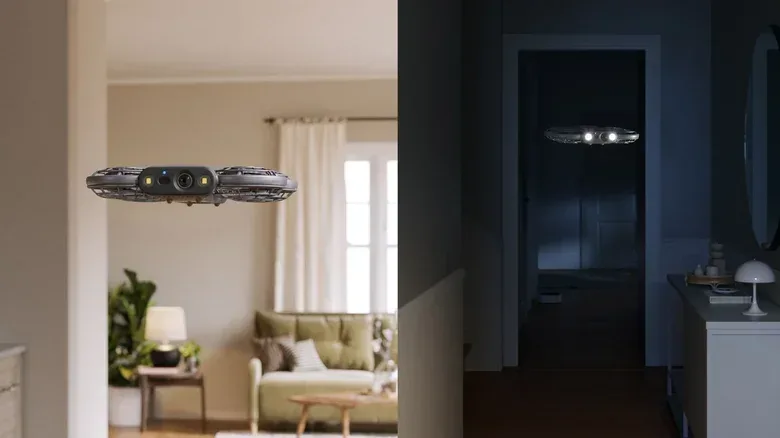
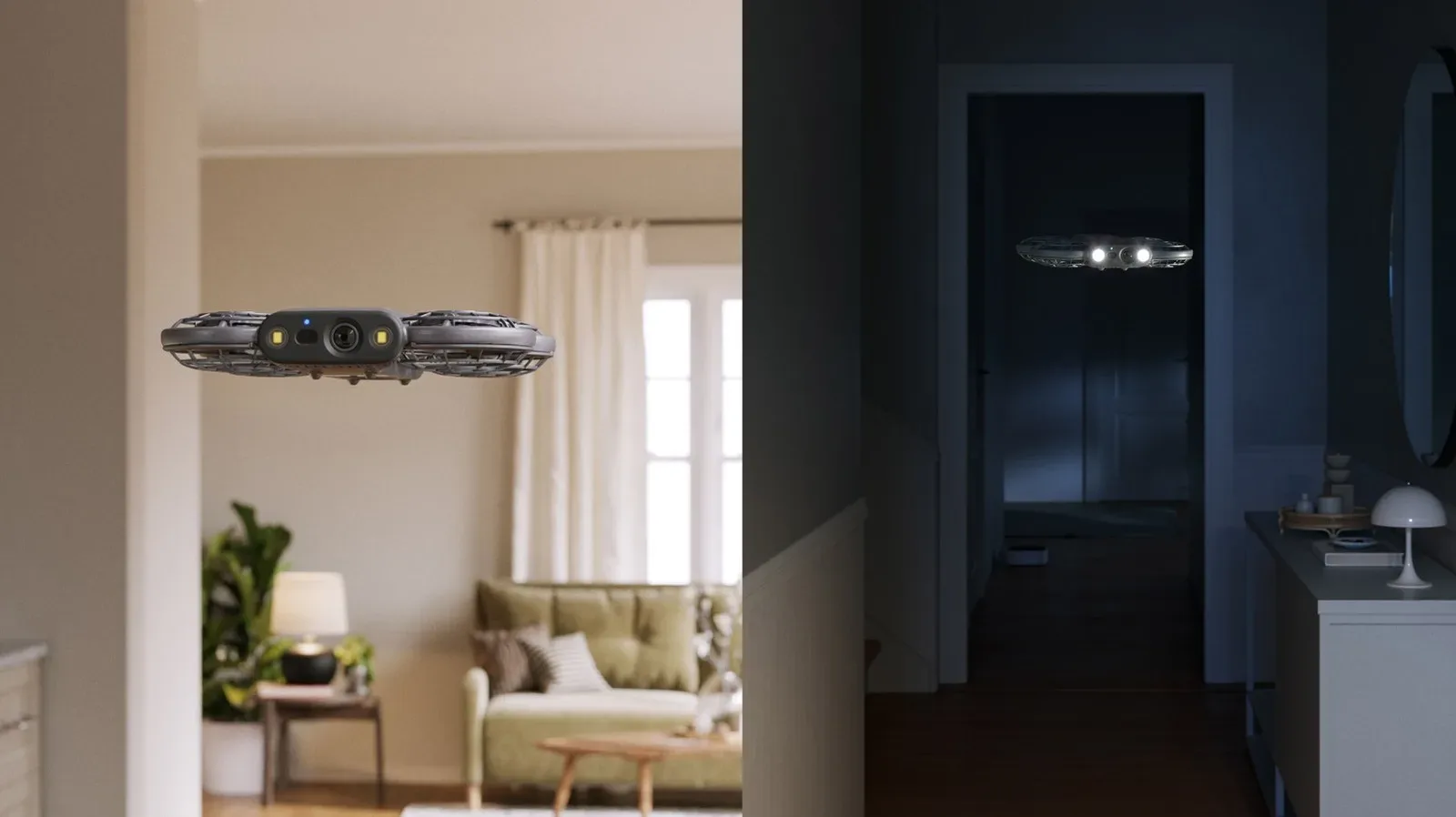
The finished Ring Drone Cam weighs 165 grams, or about 0.36 pounds. It is a compact quadcopter with a 2K front-facing camera accompanied by two LEDs, plus a 1080p camera on its underside and another lower LED for illumination. The split camera arrangement is intended to offer both a forward-looking view during movement and a downward angle beneath the aircraft.
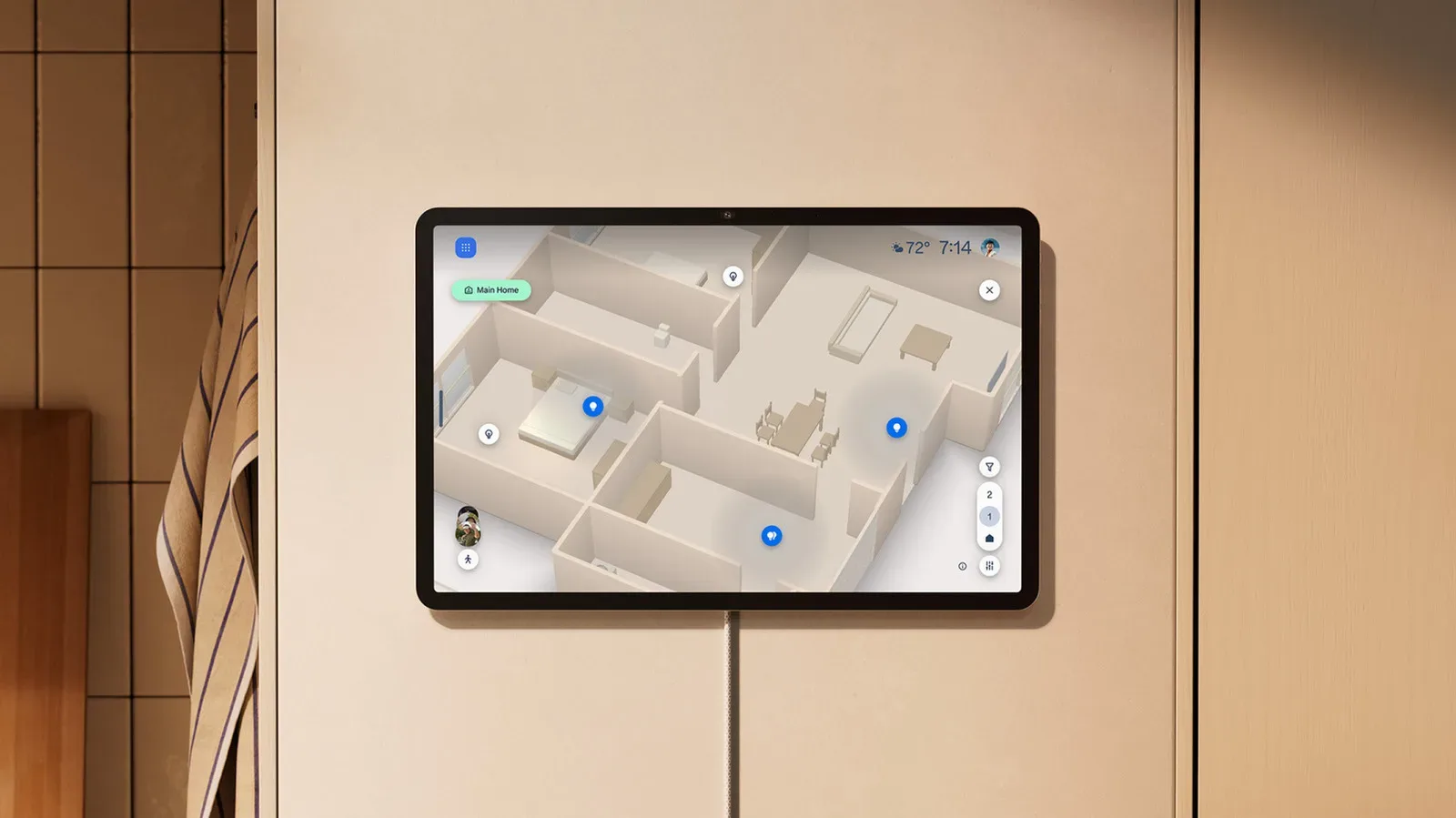
Ring says the Drone Cam can perform scheduled flights, fly to a location after a motion or leak sensor activates, or launch manually. It will work with Alexa Home Map, Amazon’s 3D map view of a home. Rather than piloting the craft through each room, the proposed workflow is to tap a location on that map and allow the Drone Cam to make its own way there.
That is an important practical difference between a remote-controlled camera and an autonomous one. Autonomous navigation, in this context, means the device is designed to choose a route and avoid obstacles without someone continuously steering it. Ring says its AI Pilot system maps a space, proposes patrol points and navigates around obstacles. The company is using that system for both new devices.
The Drone Cam’s mobility also comes with a very firm limitation: battery time. Ring estimates eight to 10 minutes of air time, with the exact result affected by a flight path’s altitude. When the battery is low—or when the unit cannot connect to Wi-Fi—the drone is meant to land or return to its dock. Ring says eight minutes of charging supplies roughly one minute of flight.
Those figures suggest that the product is built for short inspections rather than persistent airborne surveillance. A triggered sensor event, a fast check of a room, or a brief scheduled patrol fits the stated battery model. Long, continuous flights do not. The decision to land when Wi-Fi is unavailable also underlines how central connectivity is to the product’s behavior.
Related coverage includes Ring Drone Cam and Rover Cam Launch as Autonomous Security Devices.
Why cloud processing is central to the design
Ring attributes the Drone Cam’s smaller size and lower price partly to cloud processing and its AI Pilot intelligence. Cloud processing means computational work is handled remotely rather than entirely by chips inside the device. In this case, Ring has described the system as relying largely on Wi-Fi instead of carrying the local AI hardware that would otherwise be needed for its navigation approach.
This approach addresses a difficult design loop that Ring says stalled earlier versions. More sensors and more onboard computing require more power. More power can mean larger batteries; greater weight makes a drone work harder to fly. Safety concerns then call for bigger protective shrouds around moving parts, which can reduce airflow and affect flight performance. Ring said that solving all of those challenges in-device could have pushed the price past $5,000, far outside a typical consumer product’s range.
Moving some of the intelligence away from the aircraft helps explain how Ring reached a $249.99 price and a 165-gram design. But it also means buyers should treat dependable Wi-Fi as a core operating requirement rather than a convenience. This is not a device designed to continue a mission independently when it loses its network link. More broadly, connected products often turn a home network into part of the product itself; that dependency is worth considering alongside other developments in smart-device services, such as Spotify’s expanding AI DJ options.
Ring also says the drone’s lights are meant to do more than make footage usable in dim spaces. The moving illumination may make it apparent that an area is being checked, with the company comparing the effect to a security guard moving a flashlight around a dark building. In other words, the device is being positioned as a deterrent as well as a recording tool.
The Rover Cam revisits the mobile security robot
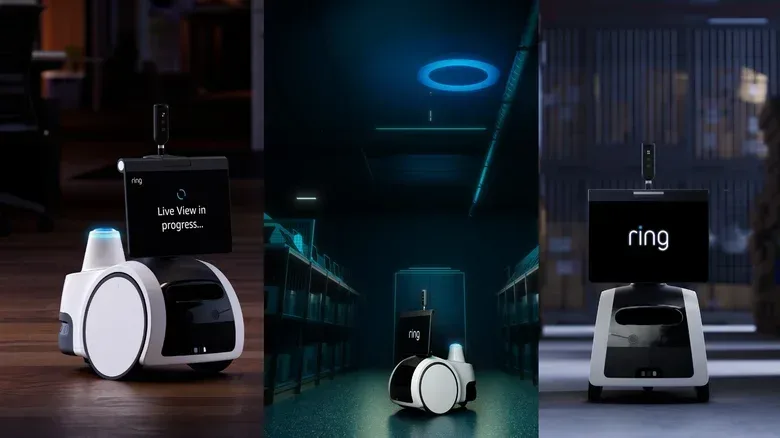
The $999.99 Ring Rover Cam takes a more conventional route—literally. It resembles Amazon Astro, the robot first announced in 2021. Astro’s business-oriented security version, previously priced at $2,350, was discontinued in 2024. Ring says the new Rover Cam was inspired by feedback indicating that roving security was the Astro capability customers valued most.
The Rover Cam has a display-like front, a vertical camera above it, a wheeled body and a light tower on its rear. Its job is to move through commercial environments, including warehouses, responding to a disturbance, following scheduled routes or traveling to a selected point on a map.
For observation, the Rover can rotate 360 degrees and raise its camera on a periscope that extends as high as four feet. Its camera captures 4K video, a higher resolution than the Drone Cam’s stated 2K forward camera and 1080p underside camera. Resolution is not the same thing as security effectiveness, but it refers to the amount of image detail a camera records. A 4K camera can provide a more detailed image than lower-resolution options when other conditions are comparable.
The Rover can stream and record while traveling toward an event rather than waiting until it reaches its destination. That is a meaningful capability for a mobile security device: the route to a location can itself be relevant, especially if movement is occurring in the path ahead. When docked, the Rover is also designed to watch for person motion and begin recording when it detects someone in view.
Other hardware is geared toward interaction and deterrence. The robot includes a speaker and microphone for two-way communication, along with a siren. Its light tower projects a blue ring onto the ceiling to make the machine easier to find and flashes red when the siren sounds. This makes the Rover notably more overt than a passive camera mounted high in a corner.
Alexa Home Map is the shared control layer
Both products tie into Alexa Home Map. The interface is meant to show a 3D representation of a home or workplace and let a user tap a point to dispatch the drone or robot. Amazon says the software will release with the Rover Cam on December 16 and will offer a more photorealistic rendering than the version previously shown.
The map is the visible part of the system, but it is also an essential usability layer. Tapping a destination is much simpler than attempting to drive a drone through an indoor space or steer a wheeled robot along a corridor. Whether that simplicity holds up in a given property will depend on the system’s mapping and obstacle-navigation performance, but the stated purpose is clear: turn a mobile camera from a vehicle someone must actively operate into a sensor-responsive tool that can be sent to a place.
The two products divide their roles cleanly. The Drone Cam is presented as an indoor consumer device that can inspect rooms from the air. The Rover Cam is intended for businesses and moves on the floor, where it can patrol larger operational spaces, extend its camera upward and serve as a conspicuous security presence.
Privacy, visibility and the trade-offs of a moving camera
A camera that can travel through a building creates privacy questions that a fixed doorbell or wall camera does not. Ring’s stated protections include powering the Drone Cam down and switching off its camera while it sits in its base. The company says it records only when a flight is triggered.
Ring also says video from both products is protected with TAKE, short for Throw Away the Key Encryption, which it calls its strongest default encryption. Encryption is a method of converting data into a form intended to be accessible only with the appropriate cryptographic key. The company’s language presents TAKE as a stronger default safeguard for recorded video, though prospective users will still want to understand exactly how the feature applies to their footage and workflow before adopting either device.
Another part of Ring’s privacy and deterrence framing is that the devices are designed to be seen and heard. The Drone Cam’s very presence in the air is difficult to ignore, and its propellers are conspicuous. The Rover’s lights and optional siren are likewise deliberate signals. Ring’s argument is that an intruder who sees a drone overhead or a wheeled robot approaching with an alarm knows they have been detected.
That is a different philosophy from hidden monitoring. Ring is betting that overt, mobile devices can discourage unwanted activity while they document it. For a household, the noise and brief flight duration may limit how often an indoor drone makes sense. For a warehouse or other business site, a visible rover that can respond to a sensor, record while moving and communicate through its speaker may be easier to fit into a security routine.
Ring’s robotics debut therefore is not one product trying to solve every security problem. It is a $249.99 aerial camera with a constrained battery window and Wi-Fi-dependent intelligence, paired with a $999.99 ground robot that repurposes the most security-focused aspect of Astro for business patrols. The real test will be whether autonomous movement, map-based dispatch and overt deterrence offer a useful enough upgrade over fixed cameras to justify adding a flying or rolling machine to the security setup.