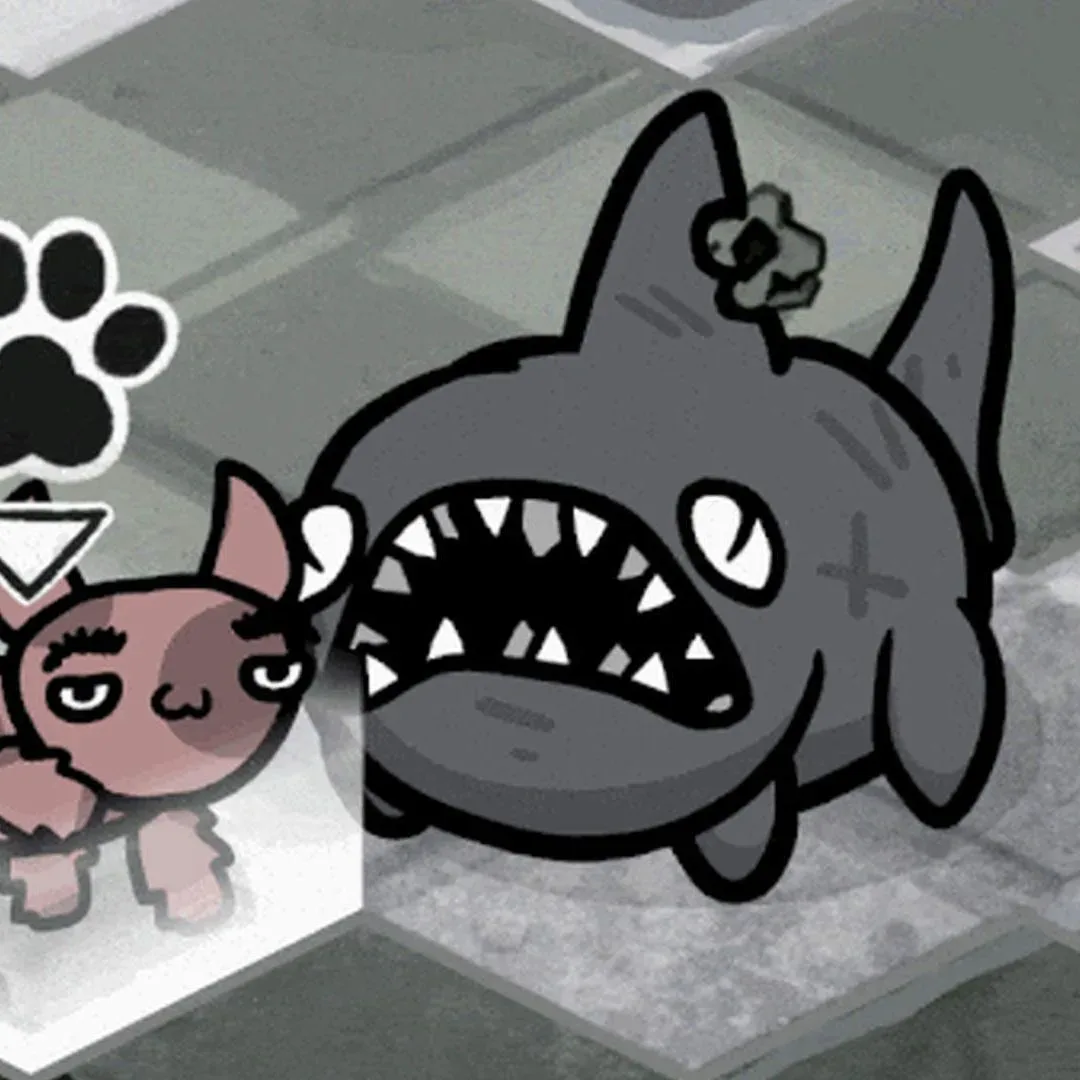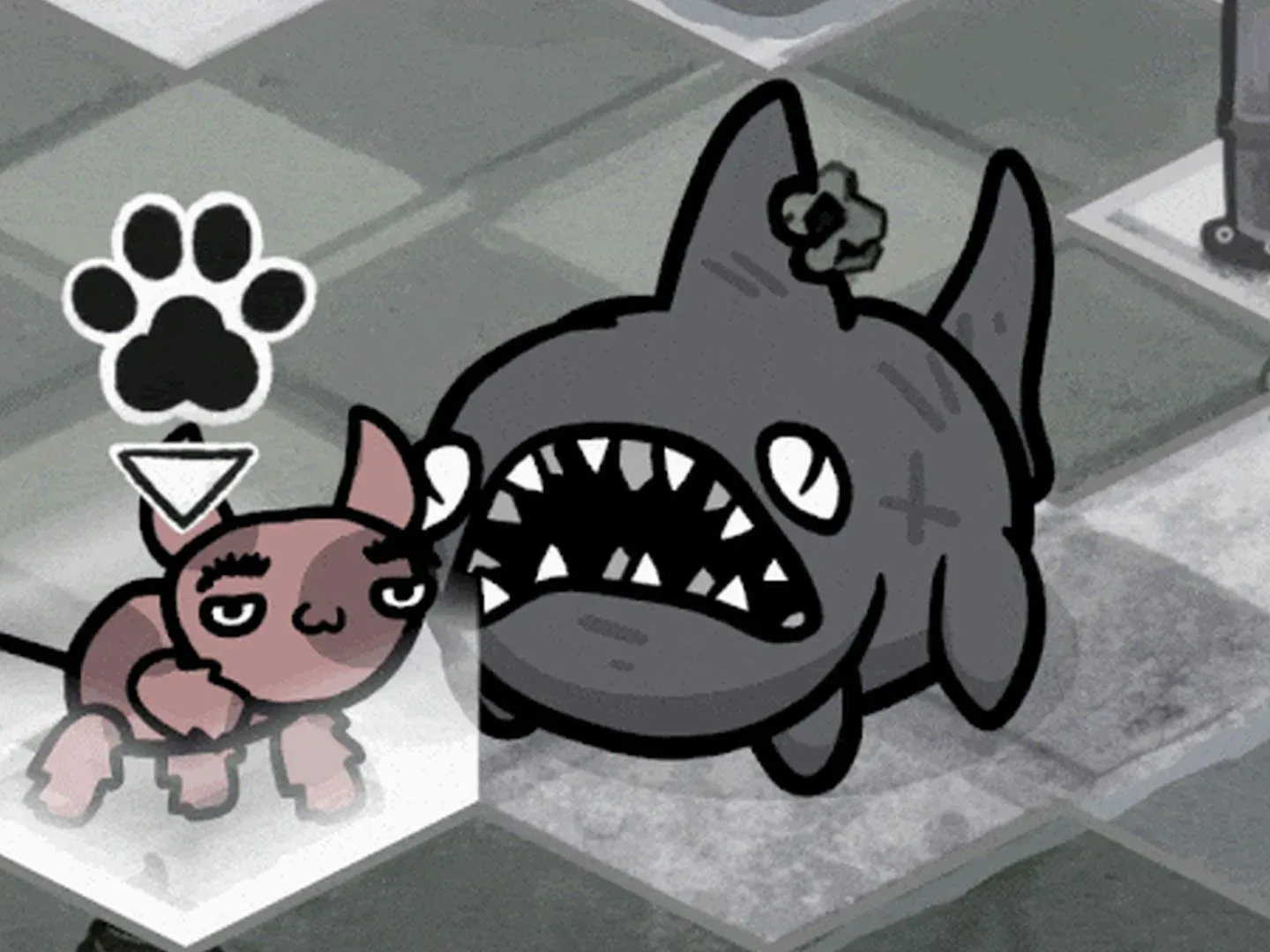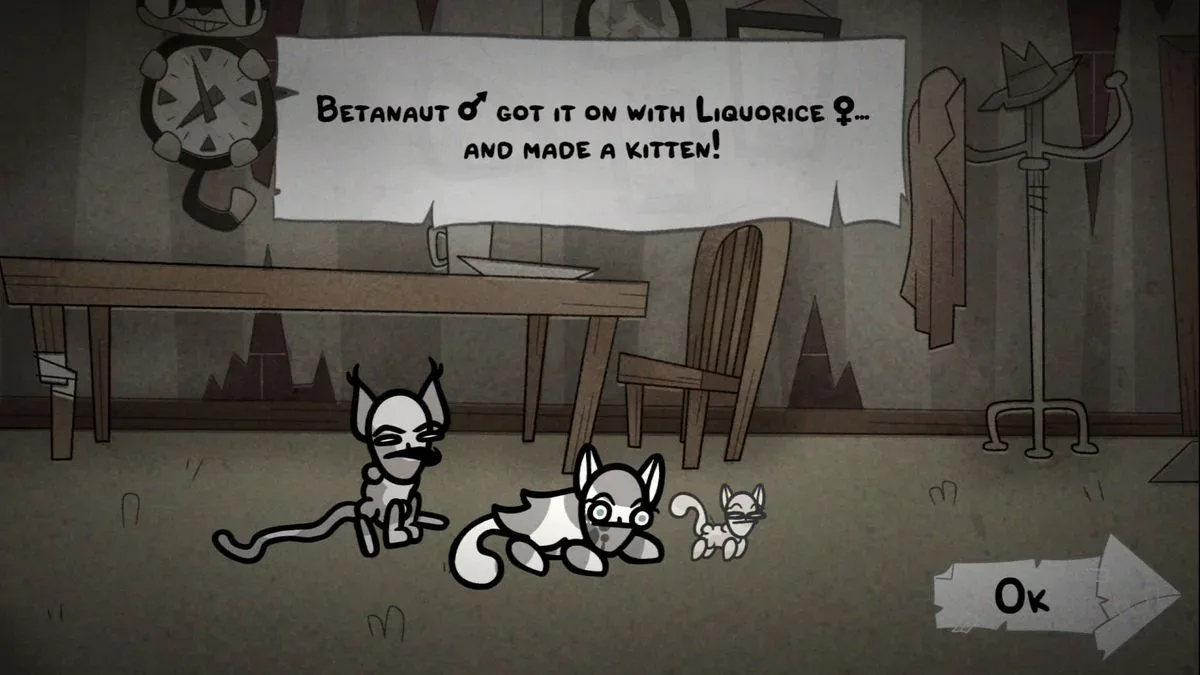
Mewgenics began with a game-jam theme that public voting had effectively discarded. In August 2012, Edmund McMillen chose the joke prompt “1,000 kittens” for Ludum Dare 24, then began exploring an idea that was far more unruly than its name suggested: a game capable of producing an enormous number of distinct cats.
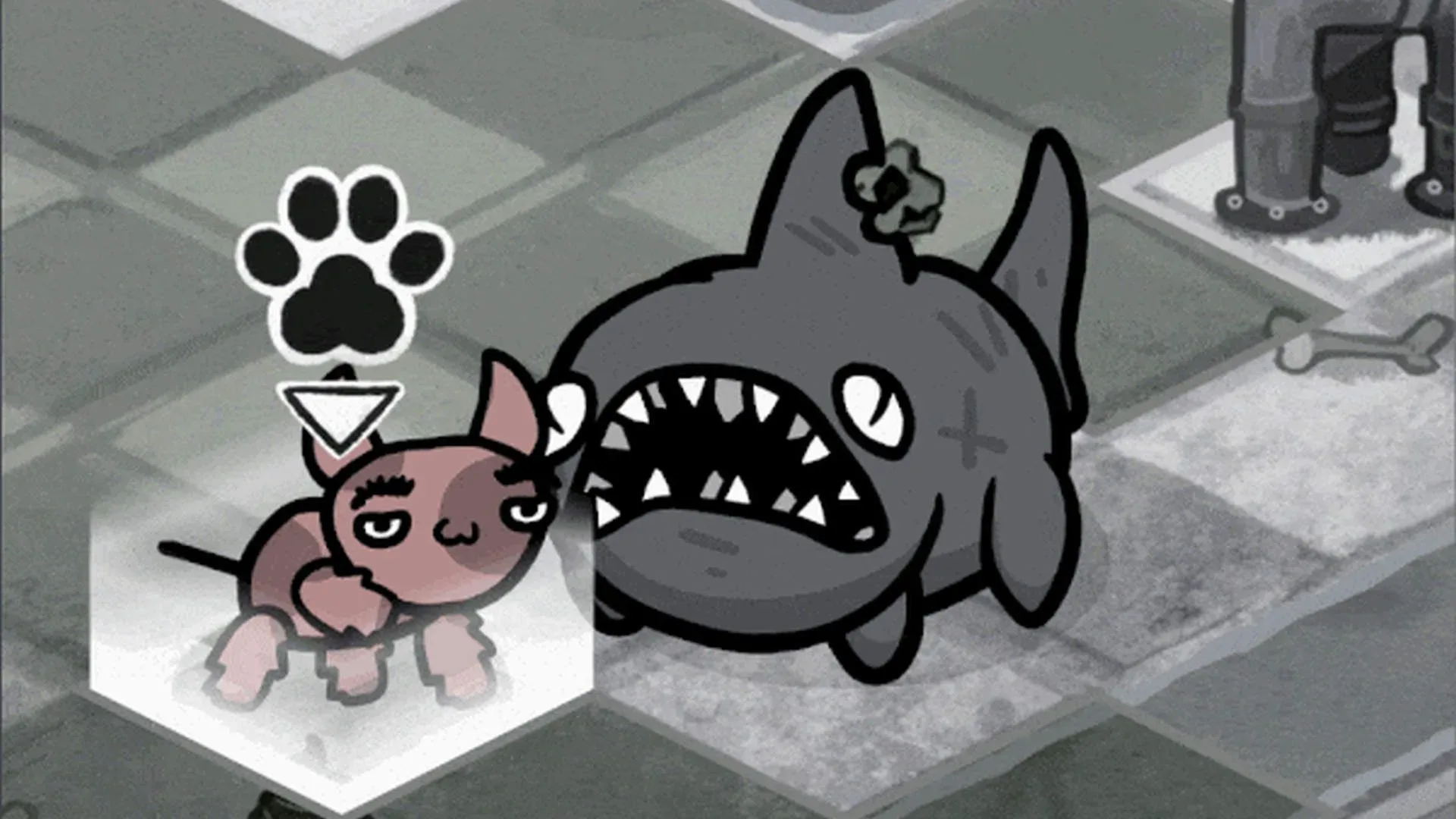
The original ambition was not simply to put a lot of cats on screen. McMillen and Team Meat co-founder Tommy Refenes wanted cats whose visual parts and inherited traits could recombine into new forms. An early pitch claimed there could be 12 sextillion cats. That astronomical figure grew from techniques McMillen had used in Flash: layering character components such as heads, bodies, arms and legs, then randomising the combinations. In Mewgenics, those permutations could be treated as a form of DNA and passed through breeding.
It is a suitably excessive origin for a project that would not settle into its ultimate form for 13 years. Along the way, Mewgenics was announced as Mew-Genics, put on hold, effectively cancelled in its initial form, revisited through several unrelated prototypes and rebuilt around tactical combat. The finished game’s unusual mixture of cat breeding, party-building, environmental effects and darkly comic resource management is not the result of one uninterrupted plan. It is the product of ideas repeatedly tested, rejected, stored away and later repurposed.
From pet house to tactical RPG
The early Mew-Genics prototype was substantially different from the eventual game. Players would improve a house, interact with their cats and bring those cats into minigames. The only functional minigame at the time was a turn-based cat-fighting mode described as Pokémon-like. Team Meat intended to demonstrate that version at PAX Seattle in August 2013, but did not bring the playable build after changing course at the last minute.
That decision led into the project’s first prolonged pause. After the event, Refenes no longer wanted to continue working on Mewgenics, while McMillen remained committed to it. Team Meat shifted attention to what would later become Super Meat Boy Forever, released in 2020. McMillen ultimately left Team Meat in December 2016, having concluded that he and Refenes wanted different things creatively.
Yet the cat project kept resurfacing. McMillen tried reframing it in genres he thought might make it viable: one remembered version took inspiration from Spelunky, while a later prototype involved breeding randomly generated aliens. That alien experiment lasted only around a week. Its body-part animation had a stranger, more physics-driven character, but Tyler Glaiel—McMillen’s longtime collaborator—felt it lacked the personal pull of cats. In blunt development terms, it was Mewgenics with a less compelling skin.
The distinction mattered. The game’s breeder theme was not merely a system in search of a marketable mascot. McMillen’s relationship with cats shaped its underlying satire. His first cat, Guppy, had been an abandoned stray kitten and was later memorialised as a powerful transformation in The Binding of Isaac. His family subsequently owned three hairless cats, including a Russian import named Puggy. McMillen has criticised designer breeding culture for, in his view, favouring traits such as unusual ears or coat patterns over feline health.
That concern gave Mewgenics an uncomfortable thematic edge. Its systems invite players to breed cats for desirable outcomes, then dispose of unwanted kittens or older combatants in exchange for benefits. The game turns the language of rarity, optimisation and “rare drops” back toward the real-world incentives McMillen finds troubling. It is not a gentle pet simulation, even though it grew out of affection for cats.
Related coverage includes Mewgenics Spent 13 Years Becoming Edmund McMillen's Most Ambitious Catastrophe.
Why tactics was the missing structure
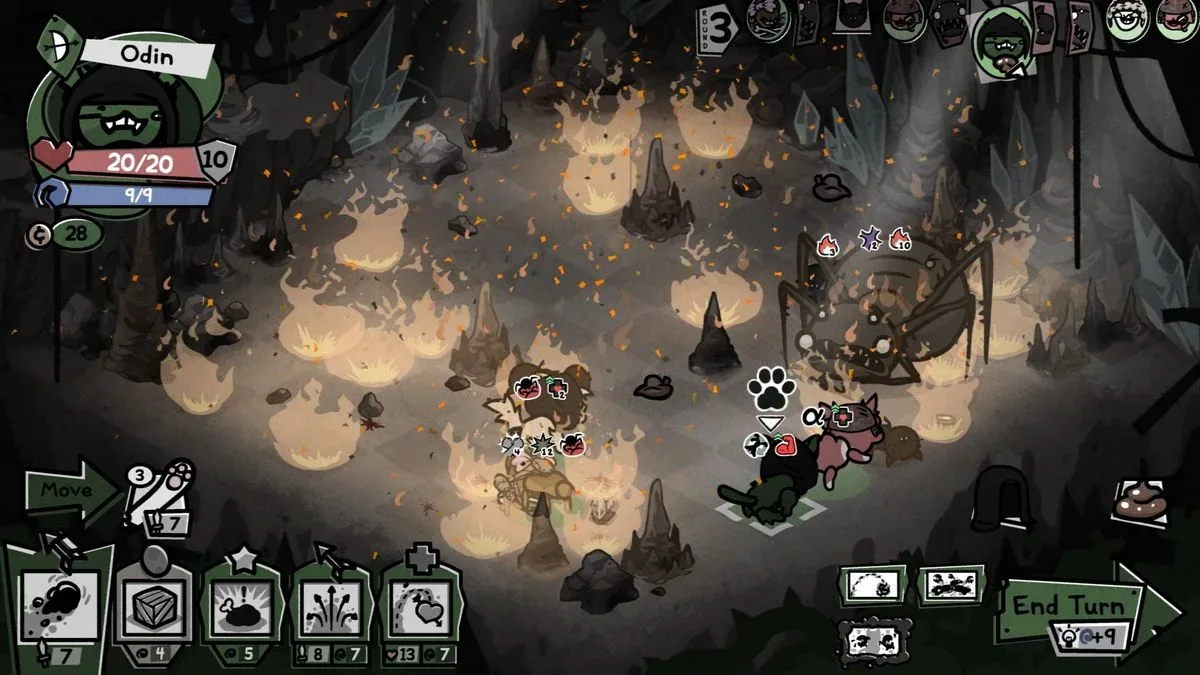
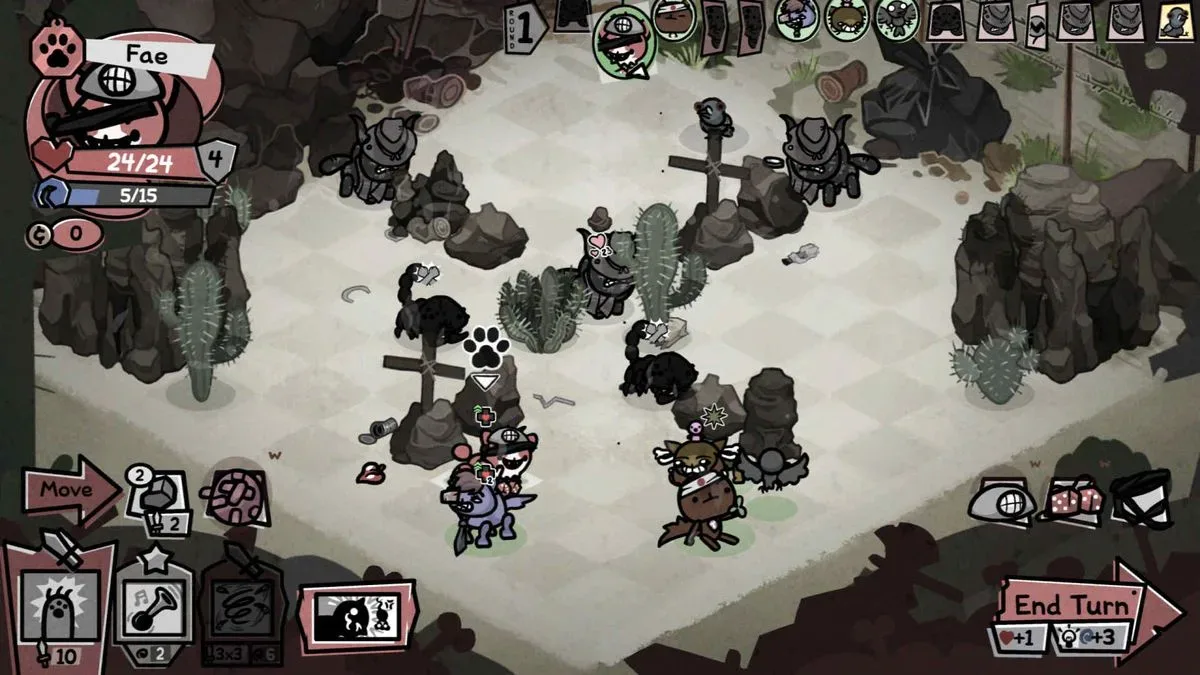
Glaiel had proposed a different combat direction years earlier: tactical battles in the tradition of Final Fantasy Tactics rather than Pokémon-style exchanges. The crucial difference is positioning. In turn-based tactics, the location of a unit and the layout of the arena can be as important as its moves. Distance, terrain, movement routes, area effects and the placement of allies all create decisions before an attack even lands.
That positional layer offered Mewgenics a reason for its cats to be different beyond appearance. A breeding system needs gameplay consequences; otherwise, inherited variations are mostly cosmetic. The pair recognised that combat had to work before they could properly establish the breeding rules, because breeding has limited purpose without challenges that reward a varied, capable roster.
The route to that realisation was not direct. Following the release of The End Is Nigh in 2017, McMillen and Glaiel started prototyping Mewgenics in earnest. One version was a beat-’em-up in the vein of Castle Crashers. It ran into a fundamental problem: the developers wanted a group of cats because a party can create more interesting stories than a lone protagonist, but real-time action makes it difficult to give several units meaningful roles without either multiplayer or cumbersome companion AI.
Another attempt was a real-time strategy game in the style of StarCraft. That was difficult for the opposite reason. RTS games generally give players orders rather than direct control over every movement. To allow players enough time to select cats and move them out of danger, attacks needed lengthy windups. That weakened the moment-to-moment tactical tension the team wanted.
Turn-based tactics solved the control problem without making the cats passive followers. Players could assess the board, move individuals and exploit traits or abilities with a clearer sense of cause and effect. It also created room for environmental interactions. A reported example has a unit standing on dirt use a wind ability and become blinded, an interaction Glaiel himself said he did not remember implementing. Water can make grass grow; gravity can crush grass and immobilise flying units; some elemental tags exist for psychic interactions. Not every possible interaction is confirmed to exist, and the developers were still discussing future possibilities, but the examples show the kind of systemic layering the format supports.
For players, “systemic” means rules can combine in ways that are not limited to a scripted sequence. A dirt tile, a wind power and a status effect can produce a result that feels discovered rather than announced. That is also why players can keep encountering surprises after extensive play: one small rule can become memorable when it overlaps with a particular cat build, enemy, arena tile or ability.
Two games that had to become one
Even after the team landed on turn-based tactics, Mewgenics still had a structural challenge. It had to make a pet-and-breeding simulation and a tactical RPG reinforce each other rather than compete for attention. If the cats were interesting only as collectibles, combat would feel detached. If combat rewards made breeding irrelevant, the project’s defining idea would disappear.
McMillen and Glaiel’s working process was unusually informal. They developed systems that could seem disconnected, then linked them once they were mostly complete. The approach relied on shared instincts but also produced mistakes, because their assumptions did not always align with how features played in practice.
The game’s odd NPCs demonstrate that iteration clearly. Characters including Dr Beanies and Butch had existed visually since 2012, but their practical purpose was undecided until late in development. An early plan let players spend money to upgrade them, but the team disliked the grinding that model encouraged. The eventual answer was already embedded in the game’s economy: cats themselves.
In the final design, players can send kittens with undesirable traits and older fighters to NPCs for rewards. It is a mechanical solution with intentionally grotesque flavour, one that connects the breeding loop to progression rather than treating excess cats as mere clutter. The late addition of side quests for Dr Beanies was part of that same process.
Ability needles took a longer path. At one point, cats sent to Dr Beanies could yield a needle containing a random ability. The result often produced colourless abilities that clogged inventory and made the reward feel disappointing. Rather than erase the system, the developers relocated it: ability needles can be earned by completing an optional hard route in one of the later areas.
That is a revealing design choice. A feature can fail as a routine reward but succeed as a rare, optional discovery for experienced players. In other words, the problem was not necessarily the needle itself; it was the frequency, context and expectation attached to it. For a game with a large catalogue of interacting mechanics, this recycling approach preserves development work while letting the designers place it where it has more impact.
Depth built from old experiments
Mewgenics’ long gestation has clearly shaped its density. McMillen has described players with 300 hours finding things they had not previously seen, while Glaiel noted that the team themselves have forgotten some implemented interactions. That does not mean every hidden interaction is essential to finishing the game. Instead, it points to a design philosophy where rare details help make a ruleset feel alive.
There is a practical lesson in that density for prospective players: the game is likely best approached as a system to investigate, not a checklist to exhaust immediately. A strange outcome may be the result of terrain, an elemental tag, a unit state or a less-obvious ability interaction. Experimentation and observation matter because the same cat can perform differently depending on the battlefield around it.
McMillen’s experience developing years of post-launch content for The Binding of Isaac also raised the standard Mewgenics had to meet. He viewed Isaac’s accumulated decade of additions as a benchmark, not simply an earlier success. That comparison helps explain why Mewgenics contains features tucked into hard routes and uncommon conditions rather than placing every major system on the critical path.
It also gives the project an unusual continuity: the 2012 cast, art direction and even an early Ridiculon theme survived despite radical changes to genre and structure. Mewgenics did not reach its final form by protecting every original idea. It survived because its creators kept the central obsession—the endlessly variable cat—while allowing the surrounding game to change repeatedly.
For more on how long-running game development can reshape a project’s priorities, see this look at changing pressures on specialist game-development work.
Thirteen years after a deliberately silly game-jam prompt, Mewgenics stands as a case for productive stubbornness. The rejected prototypes were not wasted detours so much as a reservoir of systems: some became foundations, some became optional challenges, and some left behind rules whose creators still occasionally rediscover them. For a game built around mutation, inheritance and unexpected combinations, that feels oddly appropriate.