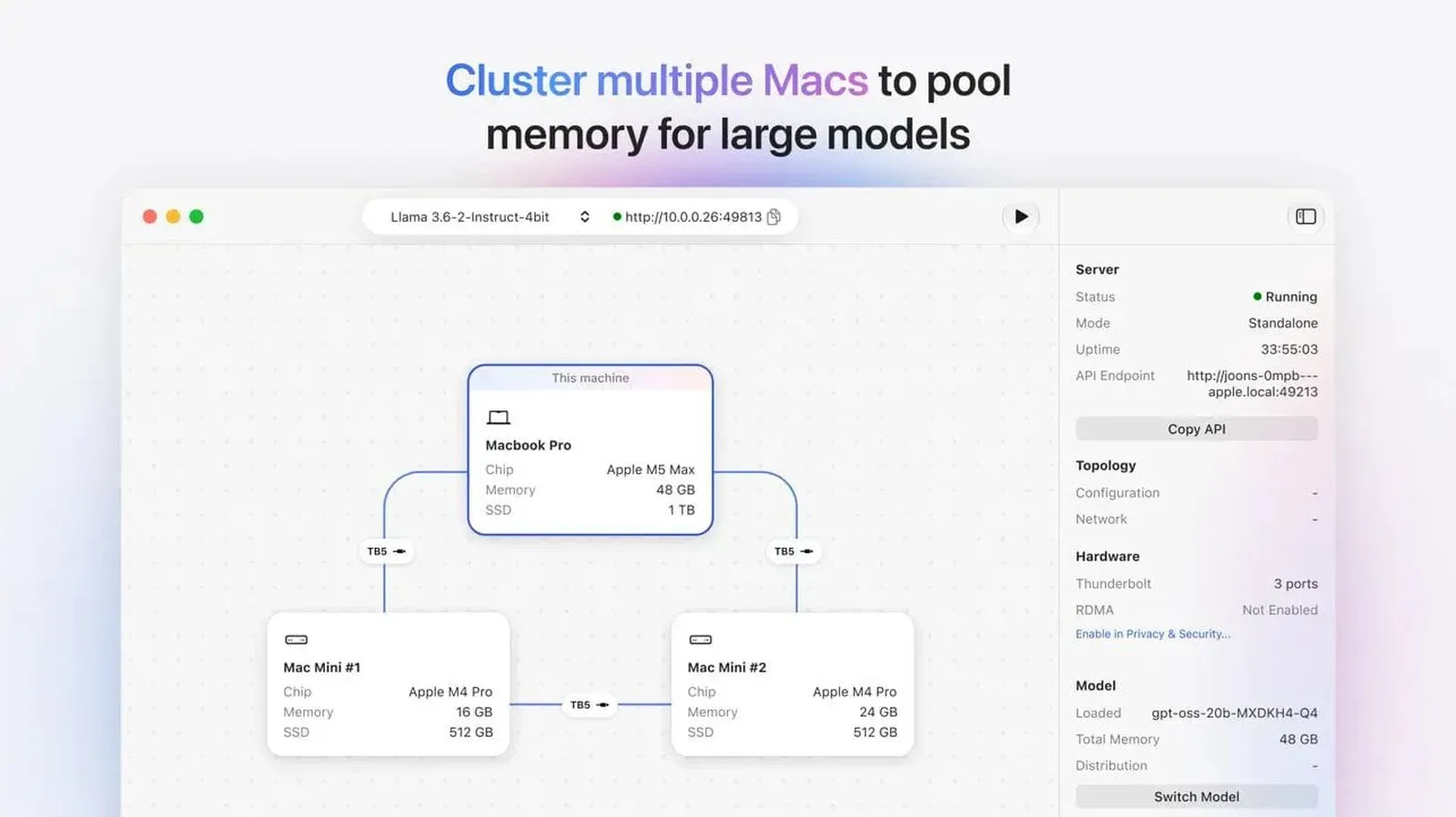
Claris, the Apple subsidiary best known for the FileMaker database platform, is testing a new application called Harbor. Its proposed job is straightforward but potentially significant: turn one Apple silicon Mac—or several linked Macs—into a private server for running AI models locally.
Harbor is in early access and is not publicly available. An App Store listing appeared but has since been removed, so important details remain unsettled, including its eventual release plans, business model and whether it will be free. Still, the outline of the software is clear: it is meant to make local AI inference less intimidating by handling model discovery, downloads, loading and, where supported, Mac clustering without requiring manual configuration or command-line work.
That puts Harbor in a space that matters well beyond AI hobbyists. Local models can appeal to businesses and teams that want their prompts and data to stay on their own hardware rather than travel to a cloud service. The company-name field on Harbor’s sign-up page also points toward a possible business emphasis, which would fit Claris’s existing identity.
What Harbor is designed to do
At its simplest, Harbor can use a single Apple silicon Mac as a local AI inference server. “Inference” means using a trained model to generate an answer, summarize material, classify information or otherwise respond to a request. It is distinct from training a model, the far more resource-intensive process of creating or extensively teaching one.
Harbor is focused on open-weight models. That term generally describes models whose learned parameters, or “weights,” are available for people to download and run. The supplied details do not identify which models Harbor will support, but the application is described as offering an in-app way to browse, download and load compatible open-weight models.
The intended benefit is convenience. Local AI setups can involve choosing a model, acquiring its files, checking whether the machine has enough memory, configuring a server and managing updates or model storage. Harbor’s pitch is to reduce those steps: it handles model management and aims to get users running without command-line knowledge or infrastructure expertise.
Harbor is designed to keep model use on Apple silicon hardware, with data remaining on that hardware instead of being sent to the cloud.
That privacy framing is a core part of the product’s appeal. It does not mean every workflow is automatically risk-free; users and organizations still need to consider which files they provide to a model and how their own network access is configured. But the stated design is fundamentally different from sending prompts to a remote AI service. The computation happens locally on the participating Mac hardware.
The unusual part: combining Macs over Thunderbolt 5
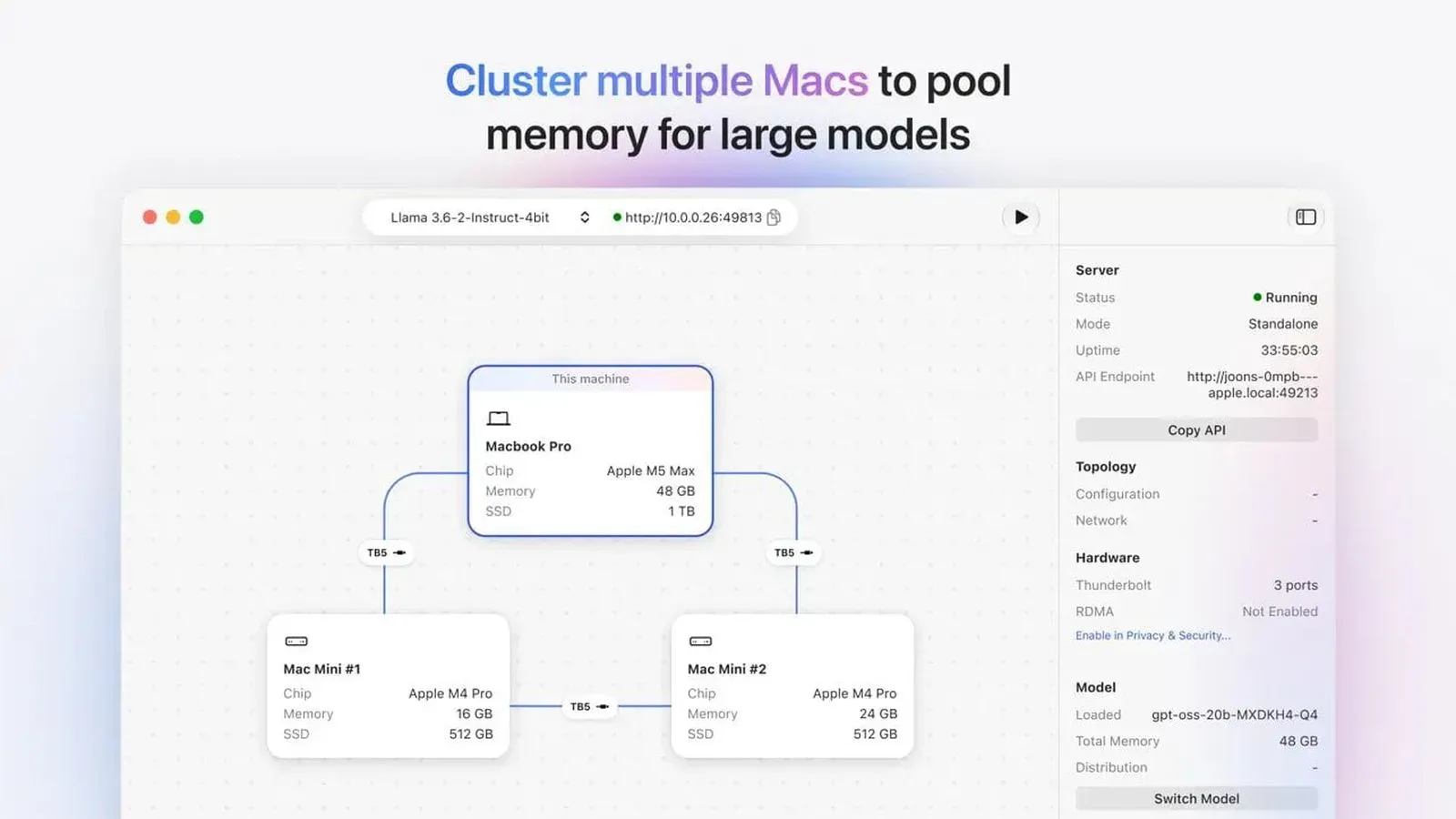
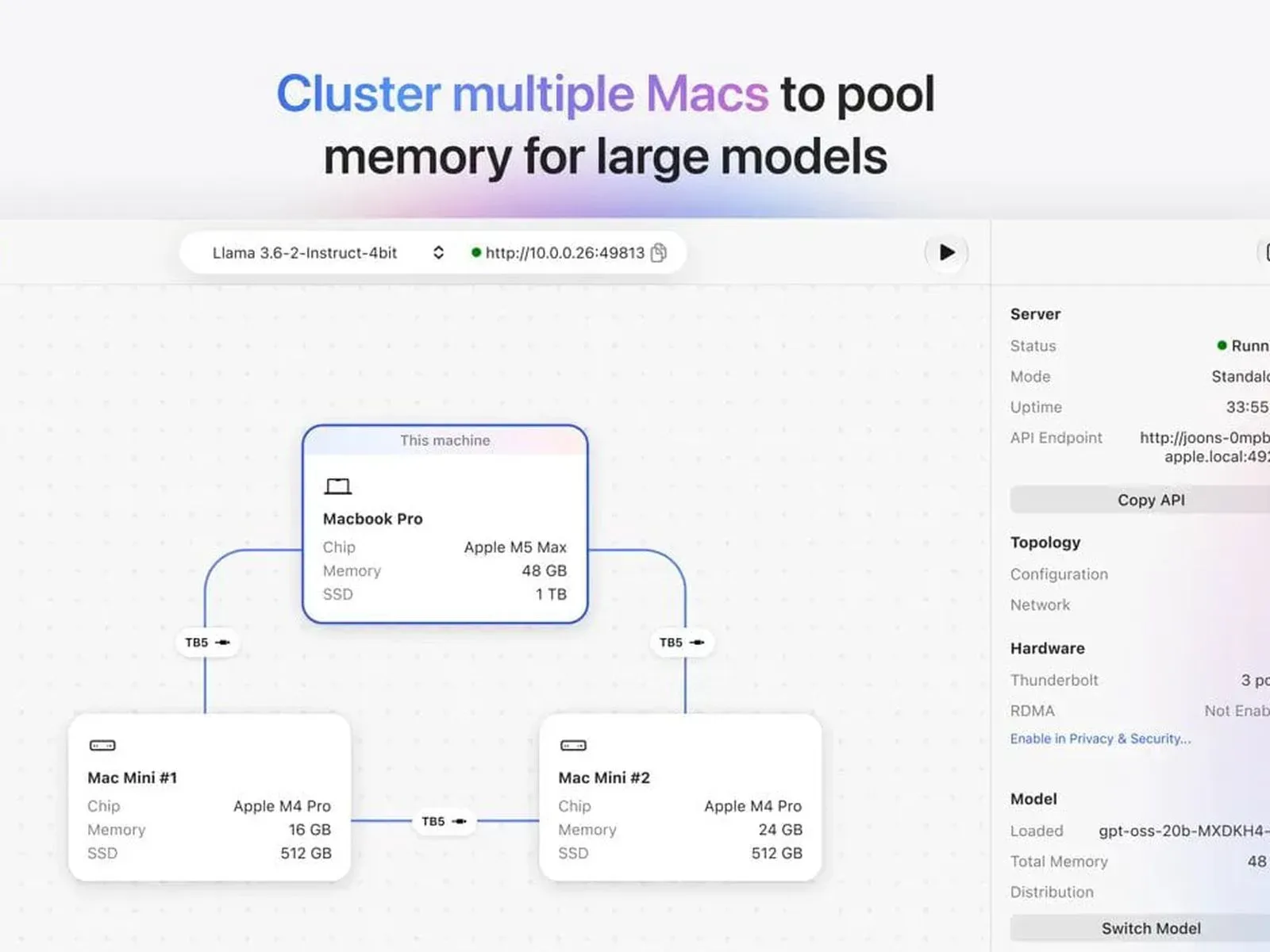
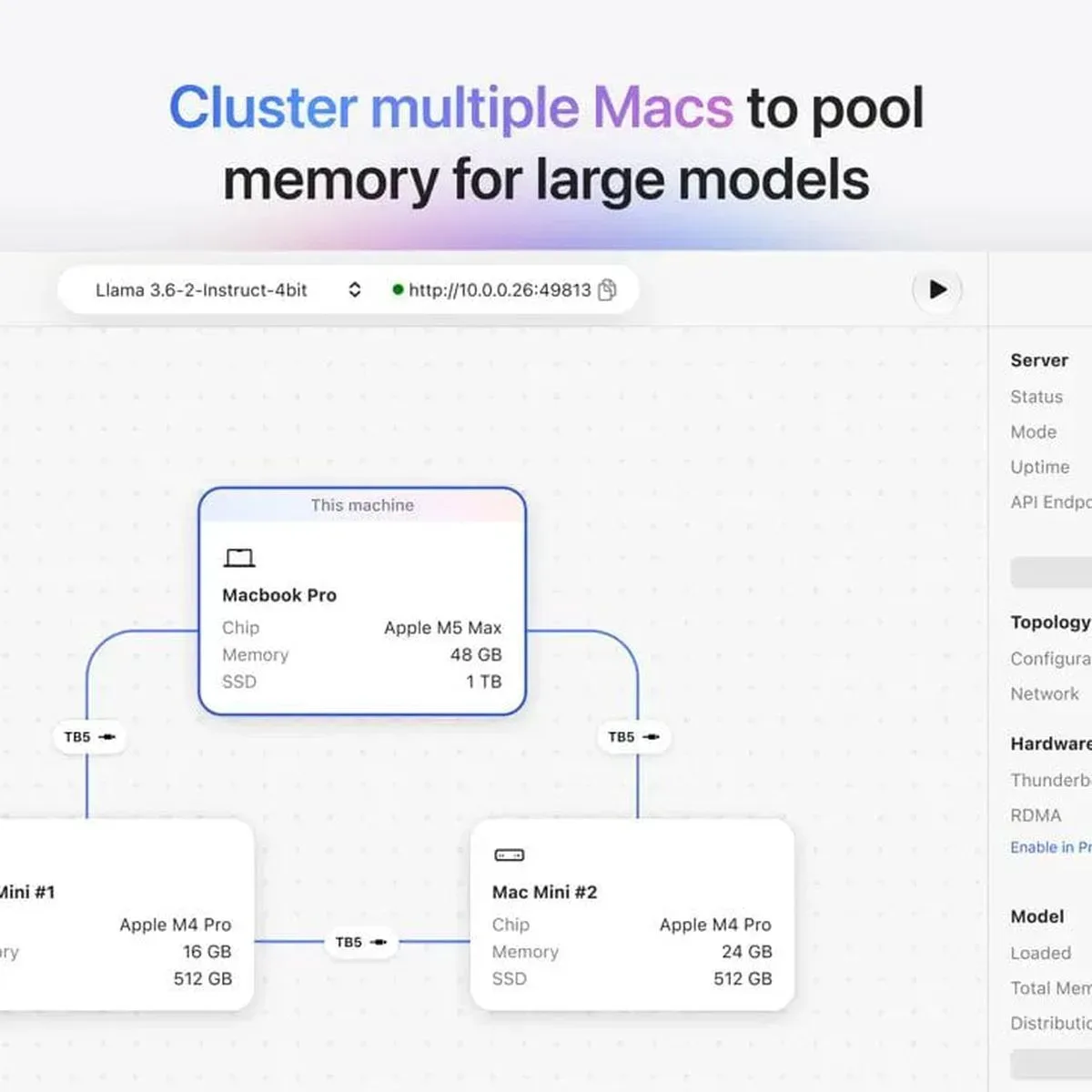
Harbor’s more ambitious capability is clustering. It can connect two or more Thunderbolt 5-capable Macs and pool their unified memory into a single inference resource. In practical terms, that means a collection of compatible Macs could potentially run a model too large for one of those machines to hold alone, or handle more requests at the same time.
Unified memory is central to how Apple silicon systems work. Rather than treating system memory and graphics memory as wholly separate pools, the architecture uses memory shared across the system’s processing components. For AI work, available memory is especially important because a model and the information required to operate it must fit into usable memory. If a model exceeds the capacity available to one machine, that machine cannot simply load it as intended.
Pooling memory is therefore not merely a speed feature. It is a capacity feature. Harbor’s cluster mode is meant to create a larger shared inference resource out of multiple machines, allowing larger models than a single Mac could accommodate. It may also raise concurrency, meaning the number of requests the setup can serve at once. That distinction matters: a team may not need one enormous model, but it may need several people to use an AI tool without each request waiting behind the previous one.
The hardware link is Thunderbolt 5. Harbor automatically detects compatible devices connected over that connection and is intended to form a cluster without users manually assembling the configuration. Plugging together the right Macs is not the same thing as buying instant AI capacity—model size, system capabilities and workload demands still matter—but automatic discovery addresses one of the more awkward parts of multi-machine setups.
Why RDMA is relevant
The clustering plan is also tied to RDMA over Thunderbolt 5, which was added with macOS Tahoe 26.2. RDMA stands for Remote Direct Memory Access. In this context, it refers to a way for connected systems to move or access data with less software overhead than more conventional approaches, making the communication needed for clustering faster.
That technical layer is easy to overlook, but it is important. Splitting AI inference across multiple computers requires those computers to exchange data. If that exchange is slow or cumbersome, linking more machines may create complexity without much useful gain. The addition of RDMA over Thunderbolt 5 supplies the underlying capability Harbor is positioned to use, while the app’s role is to hide the setup work from the user.
In short, the combination is the story: Apple silicon provides the local computing hardware, Thunderbolt 5 supplies the physical high-speed connection, RDMA improves clustered communication, and Harbor is intended to make the entire arrangement approachable.
What this could mean for studios and small teams
Harbor is not presented as game-development software, and there is no indication that it is tailored to games. Yet a simplified local AI server could be relevant to small studios, internal tools teams and other organizations that work with sensitive project material. The attraction would be keeping experimentation on company-owned Macs while using models that can be run locally, rather than necessarily moving prompts or documents through a hosted AI platform.
For game teams, the practical question would be less “can an AI model make a game?” and more “can a local model help with a narrowly defined internal task without adding a large server-management burden?” Harbor’s stated emphasis on setup in minutes, automated device detection and direct model handling is aimed at that operational friction. The supplied information does not establish specific game-development uses, model quality or suitability for production work, so those questions remain open.
Clustering also suggests a different purchasing and deployment conversation. Instead of one machine acting alone, compatible Macs could be combined where a team needs more memory capacity or additional concurrent service. That does not automatically make clustering the right answer for everyone. A single-Mac setup is simpler when it is sufficient, and any multi-Mac arrangement necessarily requires compatible hardware and Thunderbolt 5 connections. Harbor’s value proposition is that the software configuration should no longer be the barrier.
It is also worth separating the promise of local operation from a promise of universal access. Harbor is early-access software, not a public product, and the information available does not define supported Mac configurations, model catalog details, performance expectations, administrative controls or final distribution. Those are consequential details for any organization considering whether a tool belongs in an actual workflow rather than a technical experiment.
Harbor enters a field with existing options
Mac users already have routes to local AI serving. Exo is an open-source tool for clustering Macs, while LM Studio is available for running models on a single Mac. Harbor appears positioned between those ideas: a straightforward interface for working with models paired with an integrated route to clustering multiple Macs.
The distinction is not that local AI or Mac clusters are brand-new concepts. Rather, Harbor’s stated goal is to bundle the steps into a more consumer- and business-friendly experience. If the final product fulfills that goal, the key differentiator could be accessibility: fewer manual choices, less infrastructure knowledge and a more guided path from connected hardware to an active local inference service.
That could be especially meaningful for people who have the hardware but not the appetite to build and maintain a bespoke setup. Conversely, advanced users may continue to prefer tools that expose more configuration or fit their established workflows. The current details do not say how much control Harbor will offer, so it would be premature to treat it as a replacement for every existing local-AI tool.
Early access means the big questions are still unanswered
For now, Harbor should be understood as a test of an idea rather than a shipping platform. Claris is evaluating software that could make a private, Mac-based AI server far easier to deploy, including across a small Thunderbolt 5-connected cluster. The privacy proposition, automatic hardware detection and pooled unified memory are the most concrete elements described so far.
The unresolved parts are equally important. There is no public availability, no stated price, no confirmed long-term marketing plan and no complete public specification of supported models or hardware. Its association with Claris and the company-name request suggest a business-oriented future, but that is an inference, not a confirmed product strategy.
The broader backdrop is that AI tools are increasingly intersecting with creative and technical work, including the concerns around evaluating AI-influenced projects highlighted by the end of an Australian STEM videogame challenge. Harbor addresses a different question: not whether AI should be used, but where it runs and who controls the underlying data and hardware.
If Harbor reaches the public in a form close to its current description, it could give Apple silicon users a notably simpler way to run open-weight models locally—on one Mac when that is enough, or across several when more memory capacity and concurrent requests are required. Until then, it remains an early-access experiment with a compelling technical direction and many practical details still to be filled in.