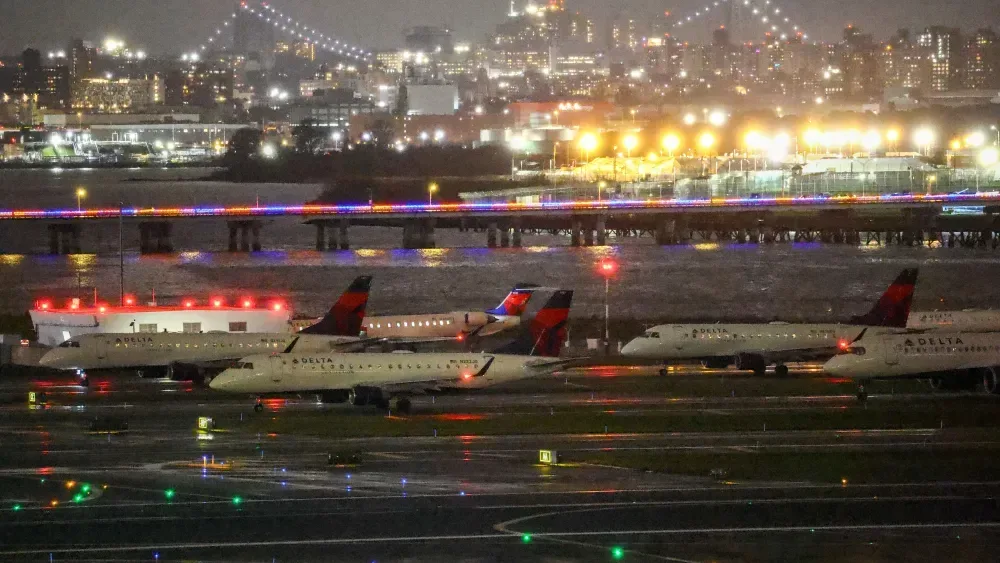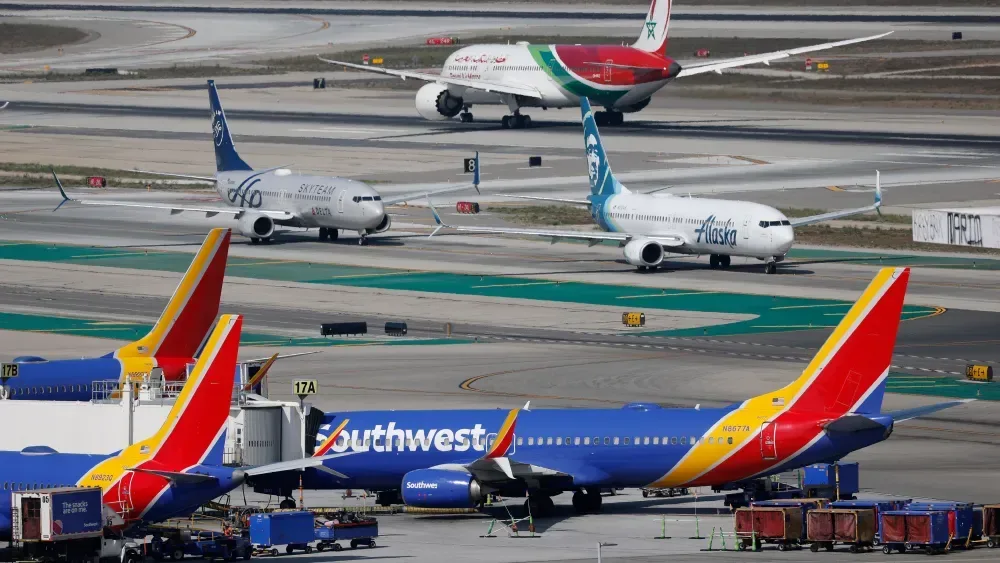
A nationwide halt on U.S. flights turned a crucial Hollywood travel window into a scramble on Friday, disrupting plans around the American Film Market, the Governors Awards and a run of FYC events scheduled for the days ahead. The Federal Aviation Administration paused flights at roughly 1 p.m. PT and canceled the ground stoppage at approximately 6 p.m. PT, creating a four-hour interruption with consequences likely to extend beyond the moment the order was lifted.
For an industry built around meetings that depend on people being in the same room at a precise time, the immediate problem was not simply a delayed arrival. It was uncertainty. Film executives, sales teams, talent representatives, performers and awards-season campaign staff were left trying to work out whether their next flight would move, whether a connection could still be made, and whether an appearance, party or negotiation would have to change shape without them.
A packed industry weekend meets a nationwide pause
The timing placed particular pressure on the American Film Market, commonly shortened to AFM. A film market is a business gathering where companies pursue sales, distribution arrangements and related deals around movies. Those conversations may involve buyers, sellers, financiers, producers and representatives arriving from different cities and countries. That makes air travel less of a convenience than a basic piece of the event’s operating infrastructure.
Several AFM events were canceled during the stoppage as dealmakers approached the final days of the gathering. Ryan Werner, president of global cinema at Neon, indicated that travel complications could prevent him from attending the company’s Saturday party, referring to multiple flights affected by the disruption. The detail underlines the broader issue: even after the FAA ended the order, travelers could still face the knock-on effects of aircraft being in the wrong place, missed connections and itineraries that no longer lined up with scheduled commitments.
The interruption also arrived ahead of the Governors Awards, set for Saturday at the Dolby Ballroom at Ovation Hollywood. An agency department reportedly moved quickly to determine which clients could still reach Los Angeles in time. One particularly complicated case involved a client traveling through Europe who did not know how they would return for upcoming U.S. obligations; the possibility of staying in Canada was raised as a way to remain geographically closer.
That example captures why an aviation disruption can be uniquely awkward during awards-season activity. A guest’s participation may be attached to a set time and place, but the person traveling may be several flights away from that destination. A delay at one point in the route can turn into a broader scheduling problem even when the original pause is relatively short.
What a ground stoppage means in practical terms
A nationwide flight halt, sometimes described as a ground stop, is a safety-driven restriction that prevents departures. Its most visible outcome is straightforward: aircraft do not take off as planned. The operational impact, however, spreads rapidly. Travelers already at airports may be held at gates or left waiting for revised departure information. Travelers who have not yet departed may lose a connection. People crossing borders or moving between international and domestic flights can face even more complicated rerouting decisions.
The FAA initially described the pause as being prompted by extraordinary circumstances and safety concerns. Markwayne Mullin later said the underlying issue was a telecommunications outage and that there was no indication of a nefarious attack against the United States. That distinction matters. A telecommunications outage refers to an interruption involving communications systems; the available information does not establish a security attack as the cause of the flight backlog.
Related coverage includes FAA Flight Halt Disrupts Hollywood’s Film Market and Awards Weekend.
For Hollywood’s immediate purposes, the explanation did not erase the logistical challenge. A market appointment cannot always be rebuilt with a quick change to a calendar invite. Parties, panels and ceremonies also rely on venue staffing, guest lists, press arrangements and tightly managed arrival windows. A person who misses one flight may not only arrive late; they may miss the event altogether, especially if the itinerary included a connection.
Not just executives: public figures were caught in the disruption
The travel impact reached beyond film-industry dealmaking. Brooks Nader’s private jet was reportedly stopped in New York shortly before it was due to depart for Louisiana. Kaitlyn Bristowe was shown stuck at an airport. Flava Flav and Morgan Fairchild also said on social media that their plans had been affected. The Sharpe Family Singers and actor Isaac Robinson Smith were likewise among those left at airports.
Those individual cases are useful reminders that a nationwide restriction does not distinguish between the reason someone is traveling. A private jet awaiting departure, a performer heading to an event, an agency client coming from abroad and a commercial passenger on a conventional route can all be trapped by the same network-wide decision. Different travelers may have different fallback options, but none can simply bypass a departure halt.
There is also a public-facing dimension for entertainers and creators. Airport delays quickly become visible through posts, videos and canceled appearances. For fans, a missed event may look like a no-show. For organizers, it can mean last-minute changes to programming. For representatives, it means communicating a situation that may itself be changing from hour to hour.
The ripple effects after flights resume
The FAA’s cancellation of the stoppage at around 6 p.m. PT was the key operational turning point, but it should not be confused with an instant reset. Ending a flight halt allows the system to begin moving again; it does not guarantee that every passenger resumes the original plan. Aircraft and crews may be displaced, departure slots may need to be reorganized, and travelers who missed an earlier leg still need a way to reach their final destination.
For AFM participants, that could mean replacing in-person meetings with calls, sending another member of a team, or accepting that some events cannot be recovered. The available information confirms canceled events, but it does not establish the eventual outcome for particular negotiations, attendees or parties. It is more accurate to view the episode as a disruption to the conditions under which business is conducted, rather than claim it decided the outcome of any deal.
For the Governors Awards, the core concern was attendance. Agency teams were assessing who could make scheduled appearances in Los Angeles, not declaring that the ceremony itself would be altered. That is an important line: travel uncertainty was real and immediate, while the final effect on the event’s guest list remained unresolved at the time the flight halt was lifted.
FYC, or “For Your Consideration,” is another term central to the weekend’s pressure. FYC activity encompasses the promotional events and outreach used to draw voters’ attention to awards contenders. Panels are particularly vulnerable to travel interruptions because they depend on an expected combination of cast, creators and moderators. If a participant cannot arrive, organizers must decide whether to alter the lineup, adjust the format or cancel.
Why travel resilience matters to entertainment business events
The incident is a sharp illustration of how centralized the entertainment calendar can become. A sales market, awards event and FYC schedule can cluster within a narrow period because that concentration makes it easier to gather decision-makers. The upside is access: a single trip can produce a run of meetings, screenings, panels and receptions. The downside is exposure: a single travel failure can put several obligations at risk simultaneously.
That does not mean every industry event requires a permanent virtual substitute. In-person attendance remains valuable when meetings involve introductions, negotiations and relationship-building. But the travel halt shows why organizers and attendees benefit from having clear contingency plans: contact information that works while people are in transit, flexible remote options where possible, and realistic expectations about what can be preserved when transportation systems are paused for safety.
It also reinforces the difference between a canceled flight and a canceled purpose. A dealmaker who misses a reception may still be able to speak with a counterpart later. A panel may be rescheduled or reconfigured. A guest delayed en route to Los Angeles may reach a subsequent event. Yet the cost of uncertainty is meaningful, particularly on a weekend where a missed hour can mean a missed meeting and a missed meeting can mean a delayed business decision.
For now, the confirmed facts are bounded but significant: the FAA halted U.S. flights for roughly four hours on Friday, said the move was tied to safety amid extraordinary circumstances, later canceled the stoppage, and saw a telecommunications outage identified as the cause of the backup. Hollywood’s tightly scheduled weekend was caught in that pause, with canceled AFM events and travelers racing to determine whether they could still make their next commitments.
That blend of operational disruption and calendar pressure is likely why the stoppage resonated so quickly across entertainment circles. In a business where attendance is often part of the work, getting grounded is not merely an inconvenience. It can be the first domino in a rapidly changing schedule.
For more on the industry’s wider business pressures, see the recent update on the settlement involving Alice Merton and Ye.