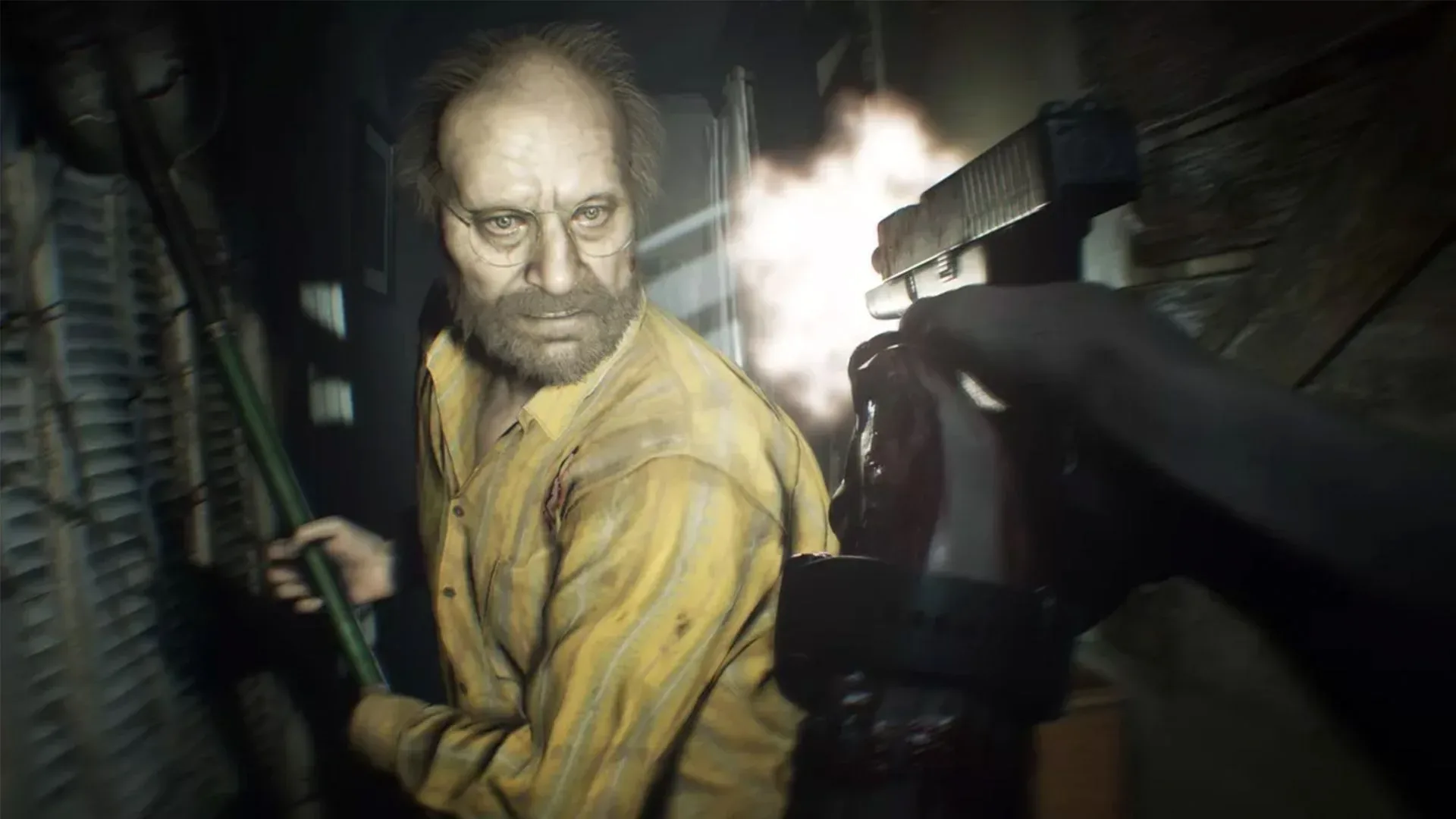
Resident Evil 7’s shift away from the sprawling, high-gloss action of Resident Evil 6 was not simply a matter of changing tone. Miguel Corti, a former senior manager of global production at Capcom, says the project went through several iterations and that the creative reference point eventually moved toward The Last of Us rather than Call of Duty.
The distinction matters because it frames Resident Evil 7’s eventual identity as a response to a larger question facing big single-player games: how could a series with a long history, a complicated mythology, and a recent action-heavy entry pursue both commercial relevance and critical recognition?
In comments shared on BlueSky, Corti said the early plans for Resident Evil 7 changed repeatedly. He described a mandate to emphasize narrative, characterizing that as a perceived justification for making a single-player game at the time. He also said developers wanted the kind of critical acclaim being achieved by other games—especially ones that had, in turn, been visibly influenced by Resident Evil.
“Instead of taking cues from Call of Duty, they were all coming from The Last of Us, with even a mandate to focus on narrative, since that seemed like the only rationale to make a single-player game anymore.”
A course correction in priorities, not a claim of imitation
Corti’s remarks should not be read as a claim that Resident Evil 7 became The Last of Us, or that one game supplied a simple design blueprint for the other. The two are markedly different works. The more useful reading is that The Last of Us represented a persuasive example of a high-profile game winning both substantial commercial attention and critical praise through a narrative-led, single-player structure.
That example appears to have carried weight inside a team considering where Resident Evil should go next. Corti said executives were satisfied with Resident Evil 6’s performance, while developers were seeking the critical response that other games were earning. Those are related goals, but they are not identical. A project can meet business expectations while still leaving creators dissatisfied with how its tone, storytelling, or relationship to a series’ core identity has been received.
“Critical acclaim” in this context is not just a score or an award. It refers to a broader reception: whether reviewers and audiences see a game as coherent, distinctive, emotionally effective, and important within its genre. Corti’s account suggests that this was a meaningful aspiration for the Resident Evil 7 team, even with no indication that the prior game was treated internally as a sales failure.
That tension between commercial performance and creative recalibration is worth keeping in view. Resident Evil 7 did not need to abandon the franchise’s past to justify a new direction. Instead, the stated ambition was for a narrative-driven game with stronger lore connections.
Related coverage includes The Last of Us Helped Push Resident Evil 7 Toward Its Horror-Focused Reinvention.
Why Call of Duty came up at all
Corti contrasted the eventual direction with Call of Duty, a reference that makes sense within the source material’s description of the early 2010s. The franchise’s Zombies mode had built a large and enthusiastic audience, making it an understandable touchstone for teams thinking about what players might expect from undead-themed games.
But a touchstone is not necessarily a destination. Drawing more heavily from a model associated with repeatable, action-forward zombie play could have taken Resident Evil 7 toward a different kind of appeal. The path Corti describes prioritized narrative and lore instead. That does not mean action disappeared from the series’ thinking; it means the reported creative center of gravity changed.
The difference can be expressed in simple terms:
- An action-first reference point tends to put immediate combat intensity, spectacle, and repeatable encounters at the center of discussion.
- A narrative-first reference point puts story framing, character motivation, atmosphere, and the player’s sustained emotional response closer to the center.
Neither approach is automatically better. Their value depends on the game and the goals of the people making it. For Resident Evil 7, Corti’s comments indicate that the team saw the narrative-first path as a way to make the next mainline installment clearer, more meaningful to the series, and more likely to earn the recognition developers wanted.
Resident Evil 6’s scale created a useful contrast
The contrast with Resident Evil 6 is central to why this account has resonated. The earlier game featured multiple characters and a story that could feel difficult to follow, while its broader presentation leaned into large-scale theatrics. Corti’s comments do not reduce the situation to a single criticism, but they reinforce the idea that Resident Evil 7 was designed amid a desire for greater focus.
Focus is a deceptively important production term. It does not merely mean having fewer ideas. It means deciding which ideas lead the experience and which ones serve them. In a long-running series, that can involve difficult choices: which characters carry the emotional weight, how directly the story connects to existing mythology, how much room there is for spectacle, and whether fear or power is intended to be the dominant player sensation.
A horror game needs that clarity particularly badly. Horror depends on control of information, pacing, vulnerability, and anticipation. When players know too much, have too much power, or are constantly pushed into bigger scenes, fear can become harder to sustain. A cleaner narrative structure does not guarantee scares, but it can create a stronger framework for them.
Resident Evil 7’s reputation as a scarier and more tightly dialed-in entry is therefore consistent with the direction Corti describes. That is analysis rather than a claim that a single influence mechanically caused every creative result. Games are made by large teams over long periods, and Corti explicitly noted that the project itself went through multiple iterations. Still, a shift in the team’s priorities can explain why a sequel feels different even when it remains part of the same franchise.
Lore connections were part of the reported plan
Corti also said Resident Evil 7 was intended to have “even more lore connections.” In a legacy series, lore means the accumulated fictional history, recurring ideas, characters, events, and rules that let separate entries feel like parts of one world.
That goal is notable because lore can be used in two very different ways. It can become a barrier, requiring players to keep track of too many previous stories. Or it can act as connective tissue, giving a new narrative added resonance without making it inaccessible. The source material characterizes Resident Evil 6’s additions to the mythology as unclear. A desire for more deliberate connections in Resident Evil 7 can thus be understood as a wish for continuity with purpose, rather than continuity for its own sake.
This is one of the most interesting pieces of Corti’s account. The reported creative response was not simply “make something disconnected and smaller.” It was to make an entry that was more narrative-driven while also better connected to Resident Evil’s larger identity. That is a much more demanding target: accessible enough to provide a distinct experience, but integrated enough to matter to people invested in the series.
What the comments reveal about single-player design pressures
The phrase about narrative being the rationale for a single-player game captures a specific industry anxiety: players and publishers often measure value through different models. Multiplayer and service-oriented games can encourage long-term repeat engagement. A single-player game typically needs to make its case through a more self-contained experience—one with memorable storytelling, atmosphere, mechanics, or some combination of all three.
Corti’s wording presents narrative focus as a response to that pressure, not as a rejection of gameplay. For horror, story and gameplay are frequently interdependent anyway. Narrative context tells players why an encounter feels threatening; limited knowledge creates suspense; the environment and its fiction make danger feel personal rather than abstract.
There is also a useful caution here for readers who treat “narrative-driven” as shorthand for reduced interactivity. It does not have to mean that. The phrase describes an organizing priority: story is intended to guide the experience’s structure and meaning. It does not, by itself, specify camera perspective, combat systems, level design, puzzle density, or how much player agency the game has.
Elsewhere in the industry, debates over creative direction increasingly intersect with questions about who makes games and how ideas are developed, including disputes around AI and authorship, as explored in a recent game-development flashpoint. Corti’s retrospective points to a more enduring reality: even before today’s arguments, teams were already negotiating the relationship between market trends, critical expectations, and a franchise’s creative character.
The practical takeaway for the series
Resident Evil 7 is described as having reinvigorated the community and as leading into Resident Evil 8 and this year’s Resident Evil Requiem. Its sales were lower than those of The Last of Us, but Corti’s account and the surrounding context do not present that comparison as the meaningful measure of success. The point is that Resident Evil 7 helped re-establish a direction for the series after a period in which its previous approach had become divisive.
That makes the story less about one famous game “saving” another and more about creative teams recognizing an opportunity. Developers saw a single-player, story-centered game receive both popular and critical validation. They used that as evidence that Resident Evil could pursue a sharper horror identity, strengthen its narrative connections, and seek a different relationship with its audience.
Corti’s recollection is also a reminder that the version of a game players eventually know is rarely inevitable. Resident Evil 7 went through iterations. At some point, alternatives were considered, priorities were weighed, and a team decided that a more narrative-centered route offered the best way forward. The resulting course correction appears to have been as much about confidence in what Resident Evil should emphasize as it was about reacting to what other successful games had proven possible.