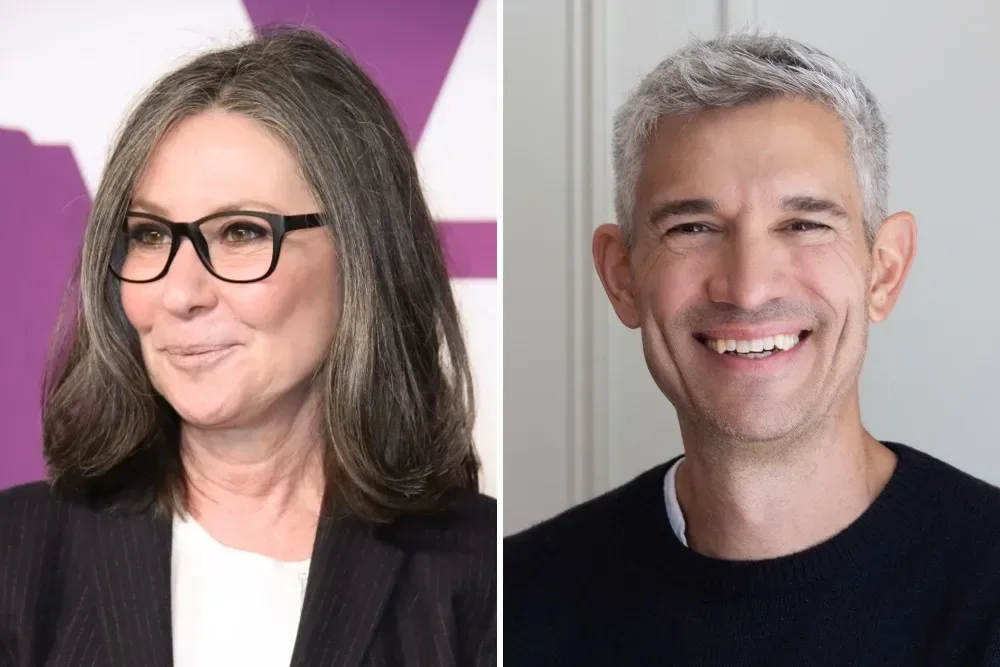
Donna Gigliotti and Mike Farah have been elected the new presidents of the Producers Guild of America, taking over from Donald De Line and Stephanie Allain, who had held the roles since 2022.
The incoming pair arrives with notably different production backgrounds. Gigliotti is associated with major awards-season films including Shakespeare in Love, Hidden Figures, Silver Linings Playbook and The Reader. Farah’s career includes comedy and television work, a long tenure at Funny or Die, and later credits including Weird: The Al Yankovic Story and @fter Midnight. Together, the election puts a veteran of prestige film production and a producer shaped by digital comedy, television and independent work at the head of the organization.
A leadership transition after four years
De Line and Allain became the guild’s presidents in 2022. In statements accompanying the transition, both the outgoing and incoming presidents framed the handover around an industry navigating substantial change, as well as the need to support producers through it.
Gigliotti and Farah emphasized the Guild’s community and its Producers Mark, describing the latter as a validation of a producer’s work at the highest level. They also pointed to a balancing act likely to define their term: producers must be open to new opportunities while retaining the persistence, accountability and broad practical commitment the job demands.
“It is an incredible honor to serve as presidents of the Producers Guild of America at such a pivotal moment for our industry,” Gigliotti and Farah said in a joint statement.
De Line and Allain, meanwhile, said their successors bring distinct viewpoints, deep experience and a shared commitment to producers. The comments do not set out particular initiatives or a policy agenda, but they establish the core theme of the new administration: representing a profession whose work stretches across creative, business and organizational responsibilities.
What the Guild’s focus says about producing
A producer’s credit can mean different things to audiences because the work itself can cover many functions. At its broadest, producing means helping move a project from an idea to a finished work: bringing together creative and practical resources, maintaining momentum, and overseeing the many decisions required along the way. That is why the incoming presidents’ emphasis on tenacity, perseverance and dedication is more than ceremonial language. Those qualities describe the sustained work of carrying a production through its full life cycle.
The Producers Mark is also central to the pair’s statement. In the terms used by Gigliotti and Farah, it is a Guild-backed signifier intended to validate a producer’s work at a high level. Their comments do not detail how it is awarded or what individual projects may qualify. Still, the emphasis makes clear that professional recognition—and being able to distinguish substantive producing work—is important to the Guild’s identity.
Related coverage includes Donna Gigliotti and Mike Farah Elected PGA Presidents.
For people who follow movies, television and related entertainment more closely than the business behind them, this kind of leadership election will not immediately change what appears on screen. Its importance is institutional. The presidents help set the tone for a professional community, particularly when the organization is presenting itself as a place where producers can find support while the wider business evolves.
Donna Gigliotti brings a film awards record and governance experience
Gigliotti produced Shakespeare in Love and was the third woman to win the Academy Award for best picture. She also received best-picture nominations for Hidden Figures, Silver Linings Playbook and The Reader.
Those credits represent films with very different subjects and tones, but they share the visibility associated with top-level awards recognition. That history gives Gigliotti a perspective rooted in feature filmmaking and in projects that have operated within the major awards conversation.
Her résumé also includes six years on the Board of Governors of the Academy Museum of Motion Picture Arts and Sciences. During that term, she served as Governance Chair and Finance Chair. Governance concerns how an institution is directed and held to its rules and responsibilities; finance concerns the oversight of financial matters. Neither role alone tells audiences what a Guild presidency will look like, but both indicate experience with the operational side of a major screen-industry cultural institution.
That combination matters in context. Producing is often discussed through individual films and stars, yet the work also intersects with institutions, standards and the structures that support professional communities. Gigliotti’s background encompasses both the high-profile result of production—Oscar-recognized films—and the less visible governance work behind an organization.
Mike Farah’s route runs through comedy, television and independent producing
Farah has won three Emmy Awards and was Funny or Die’s first producer, beginning there in 2008. He later became an independent producer after spending nearly two decades at the comedy company.
His credits include Weird: The Al Yankovic Story and @fter Midnight, giving him a background that spans feature-length comedy work and television. His professional history also carries a direct connection to outgoing co-president Allain: earlier in his career, he worked as her assistant.
That detail is not a substitute for a platform, but it underlines the continuity within the transition. Farah has moved from an early support role in Allain’s orbit to succeeding her as one of the Guild’s presidents. It is a reminder that entertainment careers are often built over long periods, through evolving responsibilities and professional relationships rather than a single defining credit.
Farah’s time at Funny or Die is especially relevant to the paired leadership structure because it differs from Gigliotti’s awards-focused feature-film path. The source material identifies him as the company’s first producer and notes his nearly two decades there, without reducing his work to one format or title. His later independent status adds another production perspective to the Guild’s leadership at a time when its new presidents are explicitly talking about opportunities and change.
Why a co-presidency fits these two careers
The election does not provide a detailed breakdown of how Gigliotti and Farah will divide responsibilities. What it does offer is a clear picture of complementary experience. Gigliotti’s credits and institutional roles are tied to acclaimed feature films and organizational governance. Farah’s credits and career history connect comedy, television, digital-era entertainment work and independent producing.
Analysis: The practical advantage of that mix is range, not a promise that every segment of the business will receive the same answer. Producers can work in environments with very different creative rhythms and organizational demands. A leadership pair that has encountered distinct sides of the field may be better positioned to recognize those differences. That is an inference from their documented careers, rather than a stated Guild policy.
Their joint statement also avoids presenting innovation and traditional producing values as opposites. Instead, it argues for embracing new opportunities while maintaining a commitment to the fundamentals. For members, that message suggests continuity in professional standards even as the conditions surrounding their work change.
What this means for screen-industry observers
The immediate news is a change in Guild leadership, not the announcement of a new project slate, release plan or production rule. No specific new programs, membership measures or reforms were identified in the election information. Readers should therefore be careful not to read a particular agenda into the transition before the presidents outline one.
There is nevertheless a useful signal in the selection itself. The Guild has chosen two leaders whose combined experience reaches from Oscar-winning film to Emmy-winning comedy and television production, with one coming to the post after a lengthy company tenure and the other bringing governance experience from a major motion-picture institution.
For a wider entertainment audience, producer leadership can seem distant from the finished movie or series. But it is part of the infrastructure that shapes how the people organizing those productions support one another and establish professional recognition. That infrastructure matters across screen entertainment, from conventional feature releases to specialized exhibition formats. For a related look at how presentation technology can change the viewing experience, see our explainer on IMAX Dome and the former OMNIMAX format.
Gigliotti and Farah now inherit a Guild led by De Line and Allain for four years. Their public remarks establish respect for that outgoing leadership while placing the focus on a profession that must keep adapting without losing sight of the demanding, often all-encompassing work represented by the producer credit.