
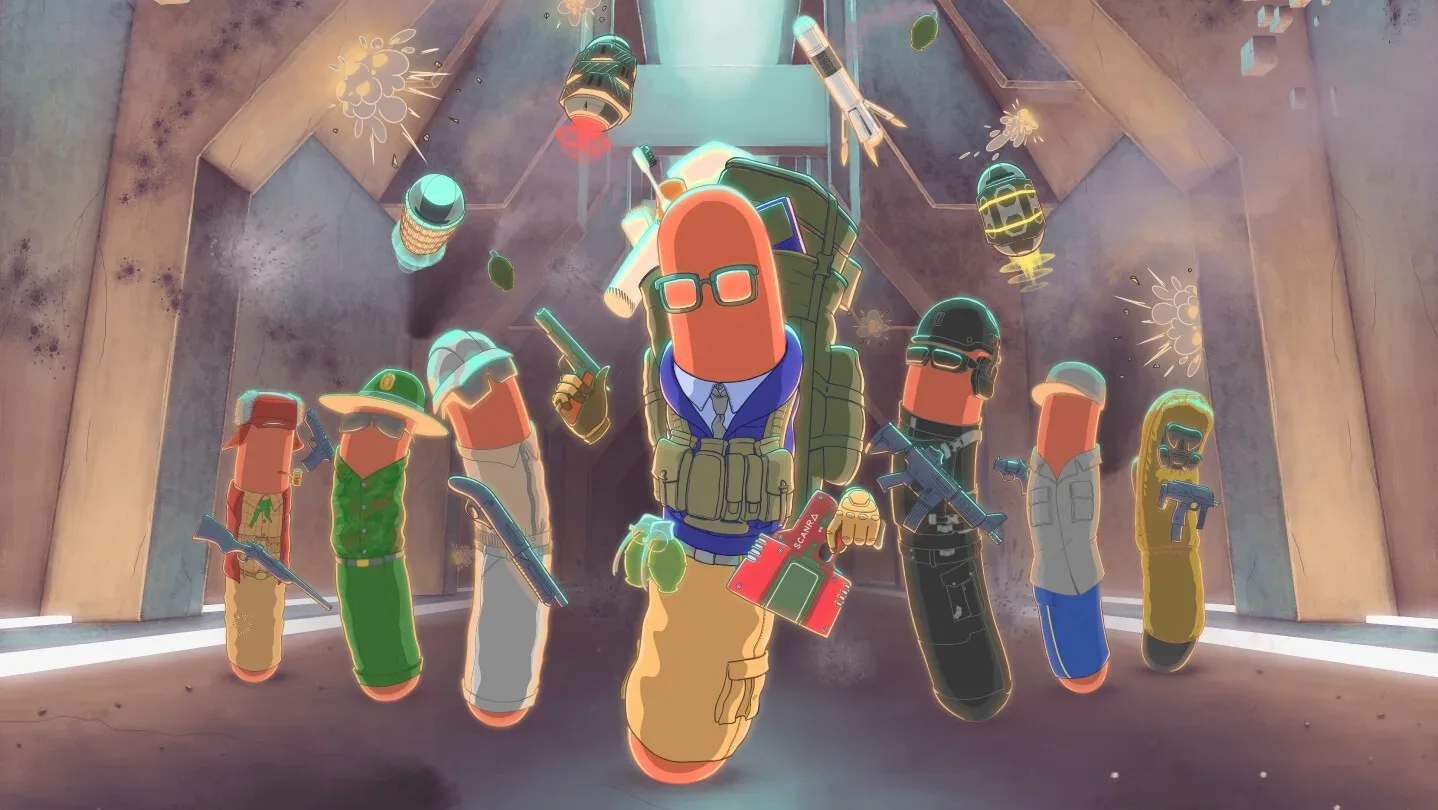
Hot Dogs, Horseshoes & Hand Grenades 2 is now available on Meta Quest 3 and Meta Quest 3S. Developed by RUST LTD, the virtual-reality shooter follows the original Hot Dogs, Horseshoes & Hand Grenades, commonly shortened to H3VR, and puts players in the unusual role of The Handy: a sentient hot dog entering a collapsing megastructure with a formidable assortment of weapons.
The premise is knowingly strange, but the game’s stated focus is precise interaction. H3VR2 is built around physics-based handling and learning to operate its weapon systems, then applying that knowledge in a roguelike campaign structure. Its main environment is an endlessly procedurally generated facility that is gradually falling apart, meaning runs are intended to offer repeatable combat rather than a fixed sequence of levels.
Alongside the campaign-oriented Facility mode, the game includes a range for target shooting, competitive modes with online leaderboards, daily challenges and unlockable equipment, cosmetics and toys. A SteamVR version is planned for the second half of 2027, while a modding framework is intended for a future update.
A VR shooter centered on interaction, not just aiming
The key distinction in H3VR2’s pitch is that weapons are meant to be handled as physical objects in a VR space. “Physics-based interactions” generally refers to a design where players manipulate items through motion controls rather than simply pressing a reload button or selecting a weapon from a menu. In practical terms, that makes competence with the game’s firearm systems part of its wider challenge.
RUST LTD also lists a learning mode for people unfamiliar with firearm operation. That matters because a game focused on weapon mastery can be rewarding for players who want deeper interaction, but it can also appear intimidating to newcomers. A dedicated learning space suggests that the game is designed to teach those systems rather than assume everyone begins with the same knowledge.
The title’s training range serves a related purpose. It provides an activity away from the pressure of a campaign run: players can spend time plinking at targets, becoming familiar with gear and experimenting with the game’s sandbox-style interactions. For a shooter whose central promise is handling an extensive arsenal, a lower-stakes place to practice is more than a side diversion.
The setting and protagonist keep that serious mechanical approach from becoming straight-faced military simulation. Players control The Handy, a sentient hot dog, while moving through a huge structure in the process of tearing itself apart. The result is a setup that combines technical weapon handling with deliberately absurd presentation.
Facility mode is the progression-focused roguelike campaign
Facility mode is the core loop described for H3VR2. Players undertake mission-based runs, battle enemies, extract resources and collect loot that can help on later attempts. It is framed as tactical action roguelike play, a term that usually describes repeatable runs where decisions and performance during one attempt shape what a player can bring into or pursue in another.
Here, the important source-supported details are extraction and persistence. The objective is not merely to survive combat; players are also looking to leave with resources and loot. That creates a useful tension between continuing deeper into danger and preserving what has been earned for subsequent runs. The game supports different approaches, ranging from hardcore extraction-minded play to more arcade-oriented styles, rather than presenting a single prescribed pace.
The facility’s procedural generation is another major element. Procedural generation means game spaces or encounters are assembled using systems and rules instead of being entirely laid out as one unchanging, hand-authored route. H3VR2 describes its megastructure as endless, so the feature is intended to support repeated expeditions and variation from run to run.
That does not automatically mean every run will be completely unrecognizable, nor does it guarantee a particular amount of content. What it does establish is the game’s structure: it is built for replayable deployments into a changing environment, with equipment knowledge and progression carrying particular importance.
Competitive runs put players on the same course
Not every mode is about gathering resources. Combat mode takes a more competitive direction through runs that give each player the same scenario, with online leaderboards tracking results. That shared setup is significant because it makes the comparison less about receiving an easier or harder random run and more about execution within a common challenge.
Daily runs, challenges and a tournament mode extend that framework. Daily content gives players recurring objectives, while leaderboards offer a way to measure performance against others. Tournament mode is also listed among the game’s features, though no further details about its structure have been provided.
This split between Facility and Combat modes gives H3VR2 two clear lanes. Facility mode is positioned around risk, extraction and building up future attempts. Combat mode emphasizes equal-run competition and rankings. Players who enjoy self-directed progression can concentrate on the former, while those seeking repeated score or efficiency challenges have the latter.
Unlocks support both capability and expression
The game includes guns, gear, cosmetics and toys to unlock and collect. Guns and gear are the practical side of that list: in a weapon-focused game, they are likely to matter to how players prepare for runs and experiment with distinct approaches. Cosmetics are the expressive side, allowing personalization without the announcement claiming that they change combat effectiveness. Toys reinforce the game’s playful sandbox streak.
It is useful to separate these unlock categories because “collecting” can mean different things in a roguelike shooter. Some acquired items affect available options during play, while others are there for customization or novelty. H3VR2 is promising both, matching a game that wants to accommodate hardcore extraction decisions and more relaxed range activity.
The breadth of modes also makes its learning system especially relevant. A player can begin by understanding the fundamentals, practice at the range, then move into Facility runs or challenge their results against the leaderboard. That is a coherent path through a game whose appeal rests as much on using its tools well as it does on simply acquiring them.
SteamVR and mod support remain future plans
For now, the stated launch platform is Meta Quest 3 and Meta Quest 3S. RUST LTD plans to bring H3VR2 to SteamVR in the second half of 2027. SteamVR is Valve’s PC virtual-reality platform and software environment, so that planned release represents a separate future destination rather than something included with the Quest launch.
The developer also intends to add a modding framework in later updates. A modding framework is a set of supported tools or systems through which users can create or modify content. The announcement establishes the intent, but it does not provide a date, specify what kinds of mods will be supported or say how the framework will work. Those details remain to be outlined.
PC VR remains an active part of the wider games landscape, as shown by the continued flow of Steam releases such as Rusty Robot Wants to Cry. For H3VR2 specifically, however, Quest 3 and Quest 3S are the platforms available now, with the SteamVR edition explicitly scheduled as a later release.
What Quest players can expect now
H3VR2 arrives with an unusually broad mix of ideas: a sentient-hot-dog lead, detailed physical weapon interaction, an unstable procedural megastructure, extraction-style progression, arcade-capable play styles and standardized competitive runs. Its systems appear designed to give the same core toolbox multiple purposes, whether the player is learning on the range, protecting a valuable haul in Facility mode or chasing a leaderboard position in a daily challenge.
The launch also makes clear what is present versus what is still ahead. Meta Quest 3 and 3S players can access the game now. SteamVR support is planned for the latter half of 2027, and official modding support is intended for an unspecified future update. For VR players on Quest, the immediate proposition is a systems-heavy roguelike shooter where careful operation, repeatable missions and ridiculous sausage-led action are all part of the same package.