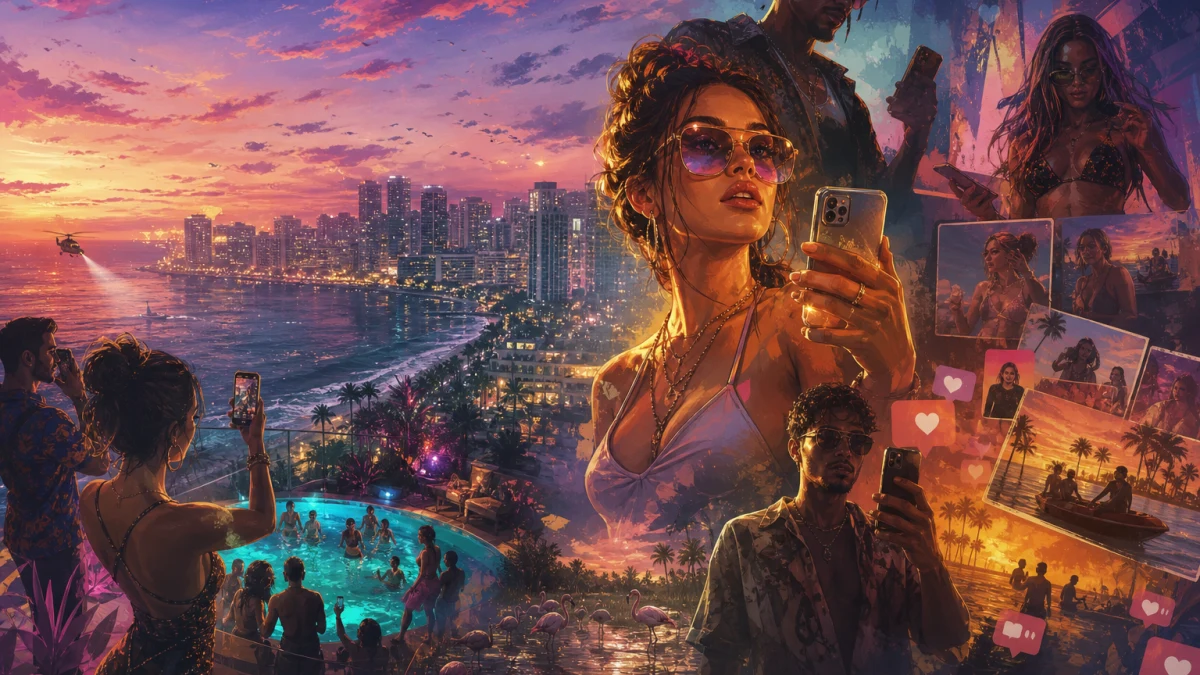
Grand Theft Auto VI does not introduce Leonida solely as a crime story. Its trailers also present the state through vertical videos, livestream-style footage, party clips, public stunts and bizarre incidents that look ready to be watched, shared and discussed.
That presentation makes social media one of the clearest themes in Rockstar’s pre-release material. Leonida appears to be a place where ordinary behavior can become content, public life can become entertainment and attention can have economic value. However, the trailers have not confirmed that players will use a named social-media application, build a following or create their own videos.
That distinction is important. GTA VI is scheduled to launch on November 19, 2026, for PlayStation 5 and Xbox Series X|S, but Rockstar’s available material remains a curated presentation of the world rather than a complete explanation of every system. The trailers show how Leonida looks and feels. They do not automatically confirm that every visual idea can be controlled by the player.
Evidence note: This is a pre-release analysis based on Rockstar’s officially released trailers, character material and media pages. Rockstar has shown social-media-style presentation and described characters whose careers involve viral attention, but it has not confirmed a playable social-media app, creator mode, follower system, video editor, monetization loop or influencer progression. Any discussion of those possible features is speculation, not confirmed GTA VI information.
Trailer 1 turns Leonida into a stream of spectacles
The first GTA VI trailer introduces Vice City and the wider state of Leonida through a visual language strongly associated with modern short-form video. Several moments appear to be framed like phone recordings, livestreams or viral posts rather than conventional film scenes. The trailer moves quickly through parties, performances, fights, stunts and strange public encounters, giving the impression that Leonida is constantly producing material for an unseen audience.
This is an important development in the way Rockstar presents its satire. Earlier Grand Theft Auto games used radio stations, television programs, billboards and advertising to mock the media environment around the player. Trailer 1 adds a networked layer. The public itself appears to be recording, reacting to and distributing the spectacle.
The result is a setting that feels less like a city where absurd events occasionally happen and more like a place where absurdity is continually packaged for attention. A person can participate in an incident while also performing for a camera. A party can be a private gathering, a public show and a piece of potential online content at the same time.
That reading comes from the trailer’s presentation. It is not proof that the final game includes a freely accessible social feed. Rockstar has shown social-media-style imagery as part of Leonida’s atmosphere, but it has not said that players can open a specific app, scroll through posts or reproduce the trailer’s editing language during ordinary play.
- Officially shown: social-media-style framing and viral-video presentation in Trailer 1.
- Not confirmed: a playable feed, named app or player-controlled recording system.
The satire is about attention, not only phones
It would be too narrow to treat the social-media material as a promise of a phone application. The broader target appears to be a culture in which visibility shapes behavior. People do not merely experience events; they stage them, record them and judge them by how much attention they attract.
That is why the trailer’s rapid structure matters. Instead of presenting Leonida through a straightforward chronological introduction, it offers a chain of shareable fragments. Each moment can operate as a joke, a character detail, a location reveal or an observation about contemporary public life. The overall effect resembles the experience of moving through an endless stream of disconnected clips.
Attention becomes a kind of currency in that environment. A person who can create a memorable image may gain status, money or opportunity. Someone who is already famous can turn a public incident into promotion. Even people who are not seeking fame may become part of a spectacle because somebody nearby has a camera.
This is an inference from the promotional material, not an official description of a gameplay system. A trailer can imitate the visual grammar of social media without promising an interactive version of the same structure. Rockstar may be using the format to communicate the culture of Leonida quickly, even if the player never receives a full creator toolkit.
That distinction also helps explain why the trailers can feel contemporary without naming a specific real-world platform. Rockstar does not need to reproduce TikTok, Instagram or another existing service exactly to satirize the habits associated with them. The subject is the behavior: recording, reacting, chasing reach and turning public attention into personal value.
- Inferred: the trailers use social media as a lens for examining public performance and attention economics.
- Not confirmed: that the game contains a complete in-world version of a real social platform.
Real Dimez make visibility part of the story
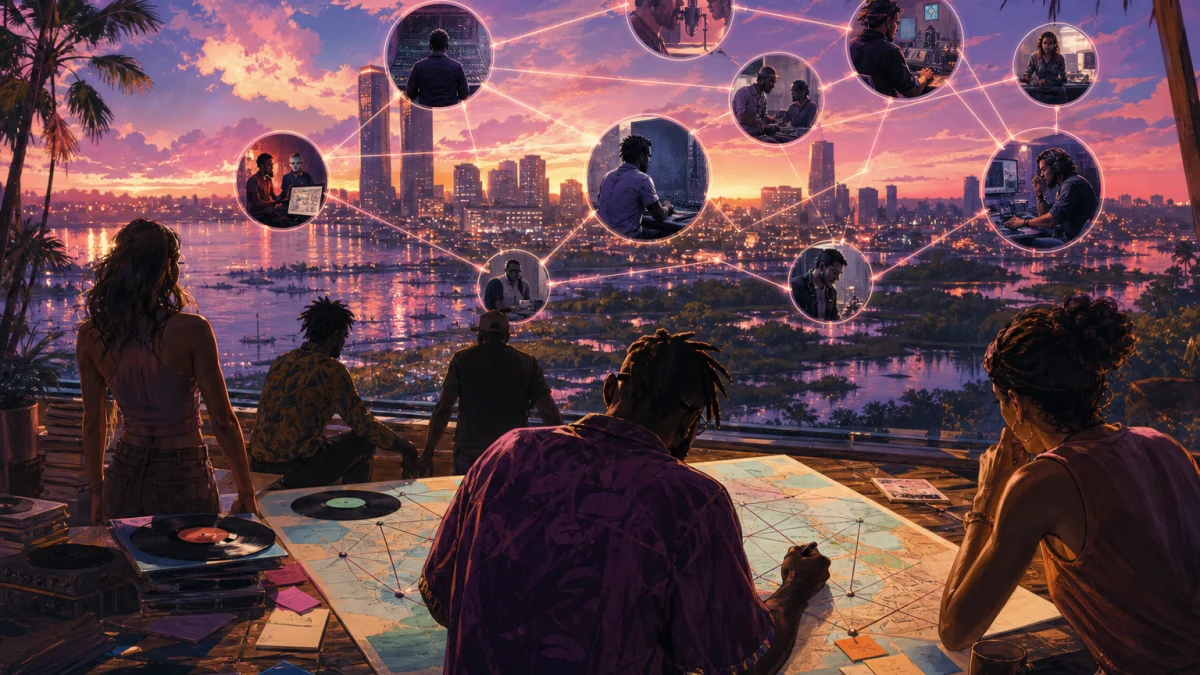
Rockstar’s official Only in Leonida character material makes the theme more concrete through Real Dimez, the rap duo formed by Bae-Luxe and Roxy. The profile describes the pair as using rap tracks and a persistent social-media presence to turn local notoriety into money. It also connects their earlier success to a viral hit and their hopes of achieving fame again.
That gives GTA VI a character-level example of social media functioning as labor. Online attention is not presented merely as decoration around the characters. It is part of how they promote themselves, build a brand and pursue economic opportunity. Their music exists within a system where reach and visibility matter as much as the performance itself.
The idea is significant because it prevents the trailer’s social-media imagery from being reduced to jokes about people holding phones. Real Dimez suggest that online attention can affect careers, ambition and identity. The culture is not simply watching itself; it is trying to benefit from being watched.
Their official profile also fits the wider logic of Leonida. The pair’s public image is connected to music, nightlife, local crime and the struggle for recognition. Those worlds overlap rather than remaining separate. A viral song can be part of a business strategy, a social identity and a route toward legitimacy or money.
However, the profile establishes characterization and worldbuilding, not a player-run music system. Rockstar has not confirmed that Jason or Lucia can manage Real Dimez, promote their music, create campaigns or pursue an influencer-style progression path. Real Dimez show what attention means to these characters; they do not confirm that the player can operate the same machinery.
- Confirmed: Rockstar describes Real Dimez through viral music, online attention and financial ambition.
- Inferred: their story can support a satire of self-branding and attention economics.
- Unconfirmed: a playable influencer, promotion or music-management system.
Dre’Quan extends the attention economy into nightlife
The official profile for Dre’Quan Priest develops the same subject from another angle. Dre’Quan is pursuing a future in music and has signed Real Dimez to Only Raw Records. His description connects the label’s ambitions to performance, clubs, DJs and audience response, including the idea that dancers can function as a form of A&R scouting.
That detail broadens the satire beyond phones and social feeds. The attention economy can shape the physical spaces where people gather. Clubs become testing grounds. Performers are evaluated by crowd reaction. A record’s future depends on whether it connects with an audience and whether that connection can spread beyond the room.
Dre’Quan’s role also helps connect entertainment and business. The official material presents him as a hustler whose ambitions sit close to the criminal and nightlife worlds surrounding him. The pursuit of a hit is not isolated from Leonida’s other economies. Music, clubs, money and crime occupy the same network of relationships.
Together, Real Dimez and Dre’Quan suggest that GTA VI can examine how entertainment industries convert identity and attention into commercial opportunity. A person is not only a musician or performer. They are also a product, a promoter and a public image that must keep generating interest.
Again, this does not confirm a business simulation. The official profiles do not say that players can book performers, monitor engagement numbers, run a record label or manipulate a social-media algorithm. They establish the setting’s concerns without specifying how much control the player receives over them.
- Confirmed: Dre’Quan’s official profile connects Only Raw Records to performers, DJs and audience response.
- Inferred: the music material extends the game’s attention-economy satire beyond social applications.
- Unconfirmed: player-controlled record-label or nightlife-management mechanics.
Trailer 2 shifts from the feed to the partnership
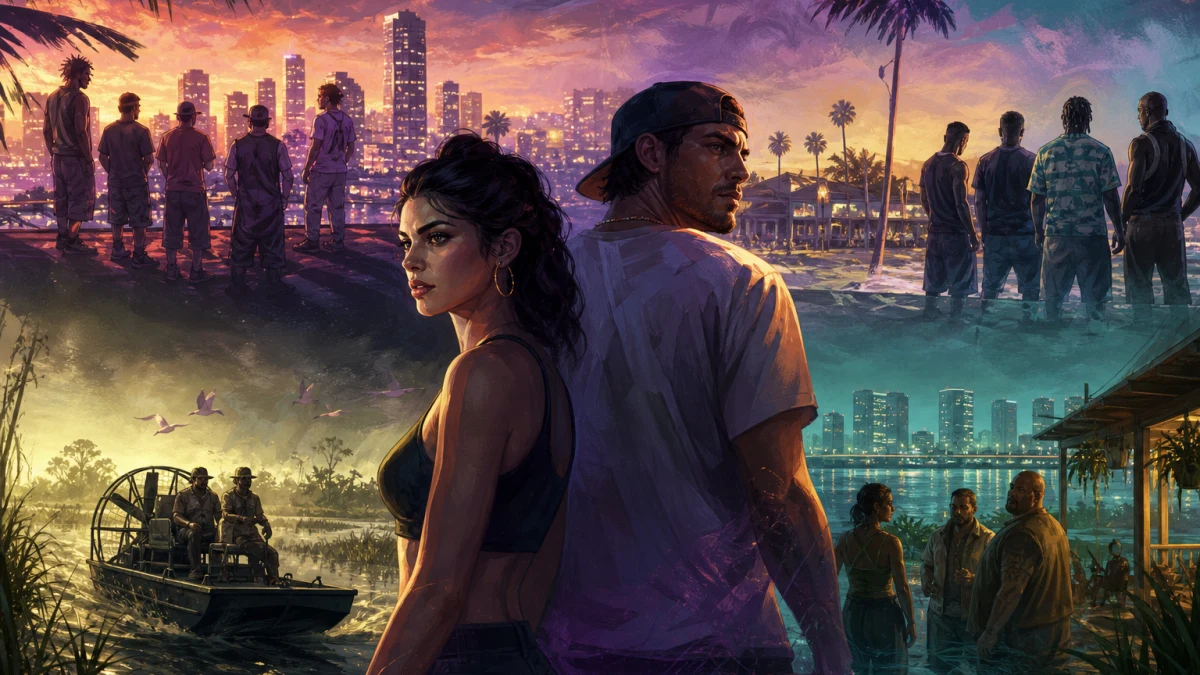
Trailer 2 uses a different emphasis. Rockstar’s official description centers on Jason and Lucia becoming involved in a criminal conspiracy across Leonida. It remains packed with character moments, locations and environmental detail, but its clearest purpose is to develop the protagonists’ relationship and the danger surrounding their criminal lives.
That contrast makes the trailers useful to compare. Trailer 1 often feels like a collage assembled from public clips and moments of viral spectacle. Trailer 2 is more recognizably a narrative introduction. It gives viewers additional context for Jason and Lucia instead of relying primarily on the sensation of scrolling through a series of disconnected events.
The social-media theme does not disappear simply because the presentation changes. A world shaped by recording and online attention can still surround the protagonists. It can influence the people they meet, the businesses they encounter and the way public incidents are interpreted. But Rockstar has not used every trailer to foreground a specific social-media feature.
That matters because marketing can present the same world through multiple lenses. One trailer may emphasize public spectacle, while another focuses on the central crime story. Neither approach proves that the most prominent visual language in the first trailer is a playable system.
Trailer 2 therefore strengthens the evidence boundary rather than weakening it. Rockstar is showing a broad fictional society with different forms of media, entertainment and public behavior. It has not yet explained whether Jason and Lucia can directly participate in all of those activities.
- Confirmed: Rockstar’s official description presents Trailer 2 as a story-focused look at Jason and Lucia’s criminal situation.
- Not confirmed: that Trailer 2’s presentation establishes a playable social-media feature.
The extended look shows in-game footage, not every possible player action
Rockstar’s August 27, 2026 extended look provides another useful comparison. The company describes it as captured entirely from in-game footage on PlayStation 5. The longer presentation offers a more conventional look at characters, environments, vehicles and situations than Trailer 1’s rapid sequence of social-media-style fragments.
That description is valuable, but it does not make the extended look a complete gameplay demonstration. In-game footage can include cutscenes, scripted sequences, transitions and camera work prepared for marketing. Even when a scene comes from the game itself, viewers still need to distinguish between what exists in the fictional world and what the player can freely initiate.
The difference is especially important when discussing social media. A character appearing to record an incident shows that recording behavior exists in Leonida. A shot resembling a phone video shows that Rockstar wants the audience to understand the world through that visual language. Neither fact establishes that the player can select a camera, frame a subject, edit footage, upload a clip, receive reactions or earn money from it.
The official GTA VI media page lists Trailer 1, Trailer 2 and the extended look as separate pieces of promotional material. Comparing those presentations is useful because it reveals how Rockstar changes the audience’s viewpoint from one marketing phase to another. Treating all three as one uninterrupted demonstration of every feature would be less precise.
The extended look may eventually prove to contain more direct evidence about social-media interactions, but the official description alone does not make that case. For now, it confirms the source of the footage, not a complete list of player-accessible systems.
- Confirmed: Rockstar says the extended look was captured entirely from in-game footage on PlayStation 5.
- Not confirmed: unrestricted player access to every camera angle, recording behavior or edited sequence shown.
What Rockstar has not confirmed about the app
No retrieved official Rockstar source identifies a fictional social-media platform in GTA VI by a confirmed name. The trailers do not establish that the game uses TikTok, Instagram, Snapmatic or a direct equivalent. Those names may be useful comparisons for discussing the presentation, but they should not be treated as the identity of an in-game application.
Rockstar also has not confirmed a scrollable feed, recommendation algorithm, follower count, creator mode, video editor or monetization loop. There is no official confirmation that Jason or Lucia can become influencers, build a digital audience or use viral popularity to alter the story.
The same caution applies to mission design. Social-media imagery does not prove that popularity will affect businesses, NPC reactions, criminal opportunities or progression. Those ideas are plausible extensions of the theme, but plausibility is not evidence.
It is possible that GTA VI contains deeper social-media interactions that Rockstar has not shown. It is also possible that the imagery is primarily a storytelling and worldbuilding device. Both possibilities should remain open until Rockstar demonstrates a system directly or explains it through official materials.
The strongest current conclusion is therefore limited but meaningful: social media is clearly part of the world’s presentation and character writing, while the scope of player interaction remains unknown.
- Unconfirmed: the name of any fictional social platform.
- Unconfirmed: player-made uploads, editing tools and monetization.
- Unconfirmed: followers, algorithms and influencer careers.
- Unconfirmed: social-media-driven missions or progression.
- Unconfirmed: a return or evolution of Snapmatic.
Why the distinction matters before launch
GTA VI’s marketing is designed to communicate a large world quickly. A vertical clip can establish a character, a joke, a location and a social observation in only a few seconds. It can make Leonida feel contemporary without requiring Rockstar to explain every fictional institution in detail.
That efficiency creates a temptation to read each visual choice as a hidden feature. If a trailer looks like a social feed, viewers may assume the game includes a social feed. If a character appears to profit from online attention, viewers may assume the player can do the same. Those are understandable interpretations, but they remain interpretations.
Keeping the boundary clear makes the confirmed material more interesting, not less. Rockstar has already shown a world where visibility matters. Trailer 1 turns public behavior into a stream of spectacles. Real Dimez connect viral attention to music, fame and money. Dre’Quan connects performance to audience response and the business of finding a hit. Those ideas stand on their own without an invented app menu or an unannounced progression system.
The distinction also protects the article from confusing presentation with mechanics. Rockstar can use a camera angle to tell the audience how a scene should feel. It can show characters behaving as though they are creating content. That is evidence about the fictional culture, not automatically evidence about the player’s interface.
The safest pre-release conclusion is therefore also the most compelling one: GTA VI appears to treat social media as a lens for understanding Leonida’s entertainment culture, public life and economic ambitions. Whether players can do more than observe that culture will require a clearer official explanation or the finished game.
GTA VI’s trailers make social media impossible to ignore. Vertical framing, viral-video energy and public performances present Leonida as a place where attention is captured, circulated and potentially monetized. The Real Dimez and Dre’Quan Priest profiles reinforce that idea by connecting visibility to music, nightlife and opportunity.
But Rockstar has not confirmed a named social-media app or a complete creator system. There is no official evidence yet for player-made videos, follower counts, influencer careers, algorithmic feeds or social-media-driven missions. Trailer presentation can communicate a theme without promising a feature.
For now, the strongest reading is that GTA VI uses online attention as part of its satire and worldbuilding. The game has shown Leonida performing for an audience. Whether Jason and Lucia can actively manage, create or profit from that performance remains a mystery.
Sources
- Grand Theft Auto VI Trailer 1 — Rockstar Games
- Grand Theft Auto VI — Only in Leonida Character Profiles
- Grand Theft Auto VI — Rockstar Games Media Page
- Grand Theft Auto VI: An Extended Look — Rockstar Games
- Pre-Order Grand Theft Auto VI on June 25 — Rockstar Games
- Grand Theft Auto VI Platforms, Editions, and Versions — Rockstar Games Support