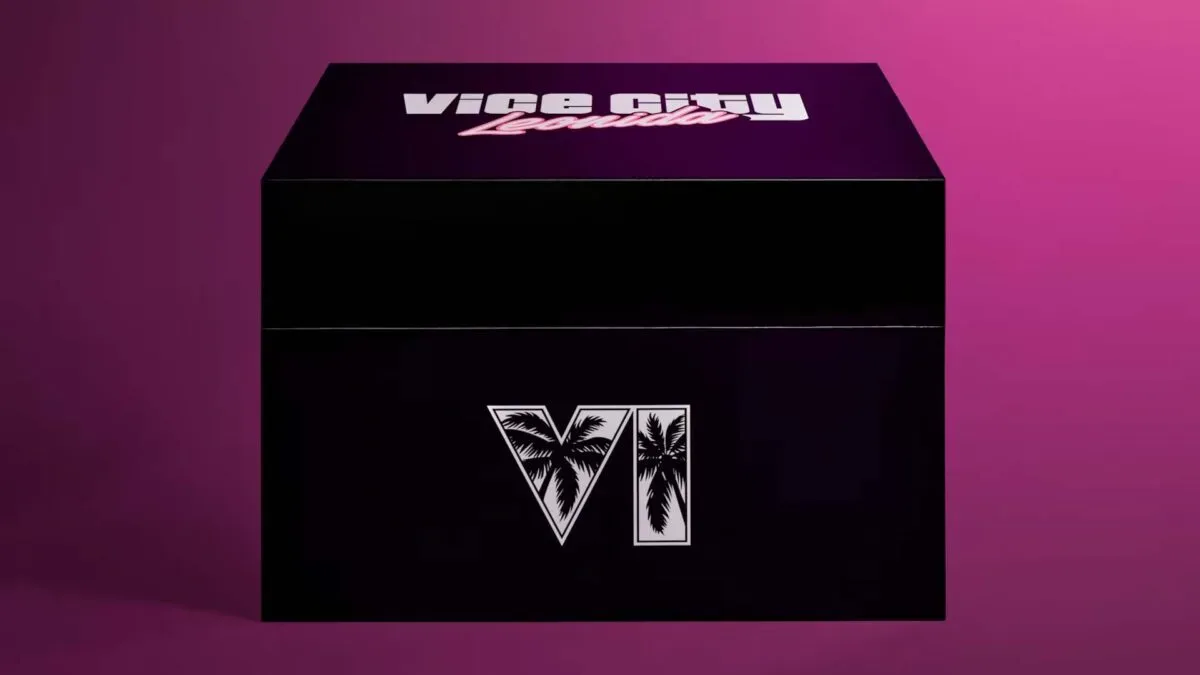
Grand Theft Auto 6’s Collector’s Box is already attracting the kind of secondary-market behavior usually associated with an item that has become impossible to buy at retail. The complication, for would-be flippers, is straightforward: Rockstar’s $400 box remains available to pre-order through the official store.
Listings on eBay have asked between roughly $600 and more than $1,500 for the Collector’s Box. Those figures represent a substantial premium over the listed $400 retail price, but an asking price is not evidence that somebody has paid it. More importantly, the bundle is not described as sold out at its original seller. That makes these listings less a record of established collector value than a gamble that buyers will either miss the official option, prefer not to wait, or expect stock to disappear later.
What the $400 GTA 6 Collector’s Box includes — and does not
The key detail in the debate is that the Collector’s Box does not include a copy of Grand Theft Auto 6. It is a physical memorabilia package rather than a version of the game. Its advertised items include a six-inch alligator figure and a collectible spoon, among other contents.
That distinction matters because “collector’s edition” can mean different things in games. Sometimes it refers to a premium game package with an included disc or download entitlement, plus physical extras. Here, buyers evaluating the $400 price are being asked to value the box and its objects separately from access to the game itself.
There is also a $100 Ultimate Edition of GTA 6 referenced in the current discussion, and unlike the Collector’s Box, that edition includes the game. That does not automatically settle whether the physical box is worthwhile; memorabilia buyers may place real value on display pieces, presentation, or franchise affiliation. But it does make the total outlay especially important for anyone who wants both the game and the physical collection.
Why a listed resale price is not a market price
The word “scalper” is generally used for a reseller trying to exploit limited availability by acquiring products at retail and offering them again at a large markup. It is often used broadly, but the economic question is simpler: can the seller find a buyer at that higher price?
At the moment, the available evidence supports the existence of ambitious listings, not a proven resale market. A $1,500 eBay listing for a $400 item may signal optimism, opportunism, or an attempt to test demand. It does not establish that the box is worth $1,500, that it has sold at that figure, or even that the seller possesses it. Because this is a pre-order item, buyers should pay close attention to what a listing says about delivery timing and order status.
That distinction is valuable beyond this one release. On resale platforms, there are several very different signals that can be conflated:
- Retail price: what the authorized seller currently charges.
- Asking price: what a reseller hopes to receive.
- Completed sale price: what a buyer actually paid, where a completed transaction can be verified.
- Availability: whether a buyer can still order directly without relying on the resale market.
Only the latter two points begin to say much about demand. When retail stock is still available, a reseller needs to offer a concrete advantage to justify a premium. For a standard pre-order, that is difficult to demonstrate.
Fans are questioning the proposition, not just the markup
Online reaction has centered on the base price as much as the attempted resale prices. Some fans have indicated that they would rather buy only the game, while others have criticized the notion of paying hundreds of dollars for a collection that lacks it. That response does not prove the box will fail to sell through. It does show that the $400 package has a narrower audience than a conventional game edition.
For an enthusiast who specifically wants the alligator figure, spoon, and other physical pieces, the box can be assessed as memorabilia: Does the design appeal to them? Do they have room to display or store it? Is the franchise connection worth the cost? Those are personal questions. The item does not need to appeal to every GTA 6 player to appeal to a collector.
For buyers interested chiefly in playing GTA 6, however, the missing game is decisive. They would need to budget separately for the game while also deciding whether the physical items are worth $400. Adding a reseller premium on top of that turns the decision into something far less defensible while the official pre-order remains open.
A practical checklist before anyone pays a markup
The most useful defense against speculative listings is not trying to predict which collectibles will become valuable. It is comparing the exact offer in front of you with the official product listing and deciding whether the premium solves a real problem.
- Check the official store first. If the Collector’s Box can still be pre-ordered at $400, that is the baseline against which every resale listing should be judged.
- Confirm whether the game is included. In this case, it is not included with the physical Collector’s Box. Do not assume a GTA 6-branded package grants access to GTA 6.
- Separate a listing from a sale. A high displayed price can be aspirational. It is not the same as demonstrated demand.
- Read pre-order language carefully. Establish whether the seller is offering an existing order, a promise to buy one later, or an item they expect to receive after release.
- Count the entire cost. Consider the box, the separately purchased game if wanted, shipping, taxes, and any marketplace costs before treating a listing as a bargain or a necessity.
- Buy for enjoyment, not assumed appreciation. A collector’s item may later be scarce, but scarcity has not been established merely because third-party listings appeared early.
What could change the picture
The situation could change if the official pre-order becomes unavailable. A genuine sellout would remove the clearest alternative to resale listings and could make the secondary market more relevant for people who decide later that they want the package. Even then, a sellout would not automatically validate every premium. Supply, the number of buyers seeking the box, the condition of delivered packages, and the specific contents people value would all affect prices.
Conversely, if Rockstar continues taking pre-orders, the rationale for paying $600, $800, or $1,500 to a reseller remains weak. Buyers would be paying more for an item they can still reserve directly, with the same basic waiting period attached to a future release.
The wider commercial attention around GTA 6 has been intense; the game’s pre-order activity has also featured in broader Xbox industry discussion. That attention can encourage sellers to put a premium on anything carrying the GTA 6 name. Yet hype is not the same thing as a completed collectibles market.
For now, the sensible reading is that the resale listings are speculative. The official $400 Collector’s Box is still the relevant price for anyone who wants this game-less physical bundle, while the $600-to-$1,500 figures show what some sellers hope urgency and anticipation might command. Until direct stock changes or verified sales demonstrate otherwise, patience is likely the buyer’s strongest negotiating tool.