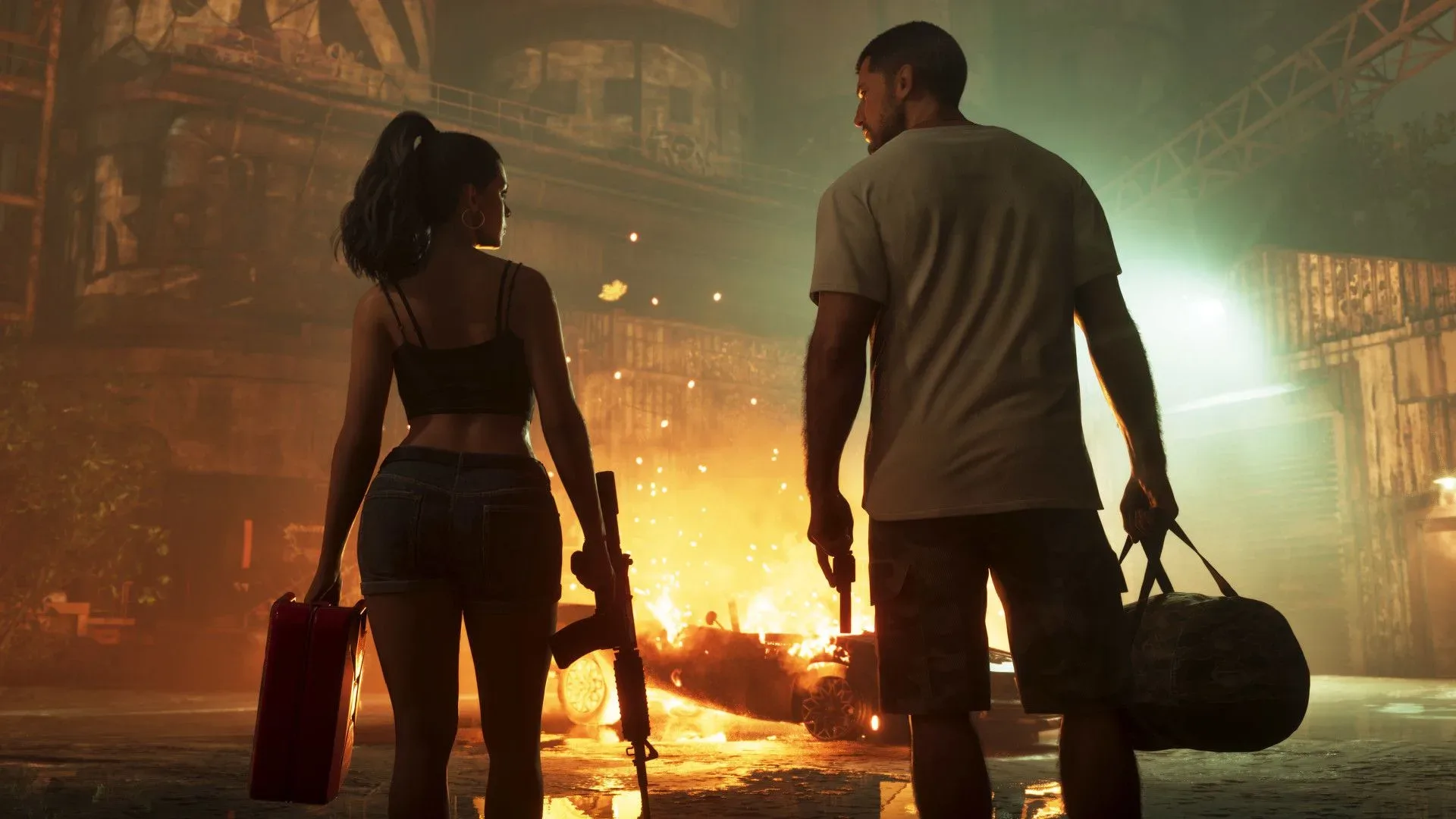

Grand Theft Auto 6 has entered a phase every enormous game release eventually reaches: it is no longer merely a game people are waiting to play, but a cultural object other people are eager to argue about. A recent television discussion managed to demonstrate the risk in that shift with startling efficiency. Basic descriptions of GTA 6’s expected play activities were quickly overtaken by a warning that the game may be bad for culture and society, alongside an unsupported assertion about one of its two playable protagonists.
The conversation reportedly began with familiar open-world possibilities: speaking with non-player characters and petting dogs. Those are modest examples of environmental interaction rather than an explanation of GTA 6’s story, themes, systems, or age suitability. Yet they formed the runway for a much larger objection. Rachel Campos-Duffy said she wanted to “push back,” adding that she did not see the game as good for culture and society, while suggesting viewers wait to judge after release.
That last qualification is sensible in isolation. It is difficult to make a final assessment of a game’s narrative, content, or impact before the public can experience the finished work. The trouble is that the discussion did not stay at that cautious point. When Lucia was mentioned, Campos-Duffy called her a sex worker. Nothing in the supplied reporting establishes that as part of Lucia’s backstory. The available description instead identifies her as Jason’s partner in crime.
The difference between a concern and a claim
There is room for people to dislike Grand Theft Auto, to object to its subject matter, or to be concerned about mature media. Grand Theft Auto has long been associated with crime-focused fiction, provocative satire, and content intended for adults. None of those positions require anyone to invent or assume a biographical detail about a character.
That distinction matters because a claim about Lucia is not simply a statement of personal taste. It is a factual assertion about the game. Once made in a discussion framing GTA 6 as socially damaging, it can shape the audience’s impression of the character and the game before either has been properly established. A concern says, “I may not want this material in my home.” A claim says, “This is what the material contains.” The first is a value judgment; the second needs evidence.
Lucia and Jason are presented in the discussion as the two playable characters. The reporting does not establish further story details, character histories, player choices, or an arc in which Lucia leaves crime behind. Speculation that a player might take her “straight” was framed as a possibility during the segment, not as confirmed game information. Treating speculation as a feature list is exactly how a conversation about entertainment turns unreliable.
What “NPC interaction” actually tells us
An NPC, or non-player character, is any character controlled by the game rather than another human player. Saying that players can talk to NPCs tells audiences only that the game includes a form of interaction common across games of many genres. Likewise, petting an animal is an optional ambient interaction in the way it was described here. Neither detail reveals the game’s rating, the extent of its adult material, its story’s moral framing, or the effects it may have on an audience.
This is a useful example of why a list of isolated mechanics makes thin evidence for a sweeping cultural conclusion. Games are made of systems, stories, player choices, tone, and context. A feature can be technically true and still fail to support the conclusion attached to it. Talking to a virtual stranger or petting a dog is not an argument for or against a game; it is merely a description of something within it.
Related coverage includes GTA 6 Becomes the Latest Target of a Familiar TV Gaming Panic.
Why the framing is bigger than one inaccurate line
The segment’s larger premise is a familiar one: a high-profile game is cast as a looming threat before detailed, public understanding of it is possible. That is often called a moral panic. The term does not mean every concern about media is automatically wrong. It describes a pattern in which an issue is presented as an urgent danger to society, often with simplified examples, a heightened sense of threat, and little proportional attention to evidence or uncertainty.
In this case, the warning arrived alongside information that was either generic, unconfirmed, or incorrectly stated. That combination is particularly unhelpful for parents, players, and anyone simply trying to understand what GTA 6 is. It creates heat without much light: a controversial reputation is substituted for a close reading of the specific work.
There is a practical reason to resist that framing even for people who have no intention of playing GTA 6. Broad arguments about “video games” flatten the medium. They blur the difference between a mature crime game, a family-focused adventure, an online competitive game, and any number of other experiences. They also obscure the tools people can use to make informed decisions: official age information, content descriptors, platform controls, and direct knowledge of the game once it is available.
Most importantly, this approach reduces a character to a label without demonstrated support. Lucia may ultimately prove to be complex, objectionable, sympathetic, ruthless, funny, or something else entirely. The point is not to pre-approve her. It is to leave room for the game to establish who she is rather than asking a television panel to do it through guesswork.
What is known, what is suggested, and what should wait
A cleaner way to discuss GTA 6 is to separate the limited confirmed or reported details from interpretation. The television segment referenced Jason and Lucia as playable characters, described them as criminal partners, and mentioned interactions with NPCs and dogs. It also expressed a negative view of the game’s potential cultural effect.
What does not follow from those points is a supported account of Lucia’s occupation or complete backstory. Nor do they tell us how GTA 6 handles its criminal premise, how much agency players have, whether the game critiques or celebrates its characters, or how individual systems function in practice. The reporting says the game is expected to arrive Thursday, which means many questions should soon be judged against the game itself rather than pre-release assumptions.
- Established in the discussion: Jason and Lucia were identified as playable characters, and Lucia was described as Jason’s partner in crime.
- Claim lacking support in the supplied information: that Lucia is a sex worker.
- Too early to conclude from the information provided: the full nature of the protagonists’ histories, the complete narrative, and any broad claim about the finished game’s cultural impact.
This may sound like a narrow correction, but precision is the foundation of useful criticism. A critic does not have to like a game’s violence, language, sexual content, satire, or portrayal of crime. They should, however, identify those things accurately and distinguish what they have seen from what they infer. The same standard should apply to a blockbuster release as it would to any film, book, or television series.
The practical takeaway for players and families
For players, the immediate lesson is to be cautious about viral snippets that seem to settle a complicated debate in a few seconds. A clip can accurately capture a speaker’s opinion while still offering a poor account of the subject under discussion. If a claim concerns a character, a story beat, or a game feature, it is worth asking whether the information comes from the game or whether it is an assumption attached to a familiar brand.
For parents and guardians, a general warning is less useful than specific information. The relevant questions are concrete: What does the final game contain? What guidance accompanies it? What are the household rules around mature entertainment? Can platform-level controls help apply those rules? Those decisions are better served by clear descriptions than by anxiety about a title’s notoriety.
For the broader conversation around GTA 6, it is worth remembering that anticipation is not evidence. The game’s scale and profile make it an easy target for headline-ready arguments, just as they make it a huge event for players. But attention does not excuse sloppy characterization. Readers looking for more on the game’s wider moment can also see how GTA 6 is already being referenced in gaming’s platform conversation.
The most responsible response to a cultural warning about GTA 6 is neither reflexive defense nor reflexive outrage. It is to ask for accuracy first. With a release said to be close, there will be an opportunity to discuss the game on the basis of what it actually contains. Until then, Lucia is a playable criminal partner in the information available here—not a role assigned to her by an unsupported on-air assumption.