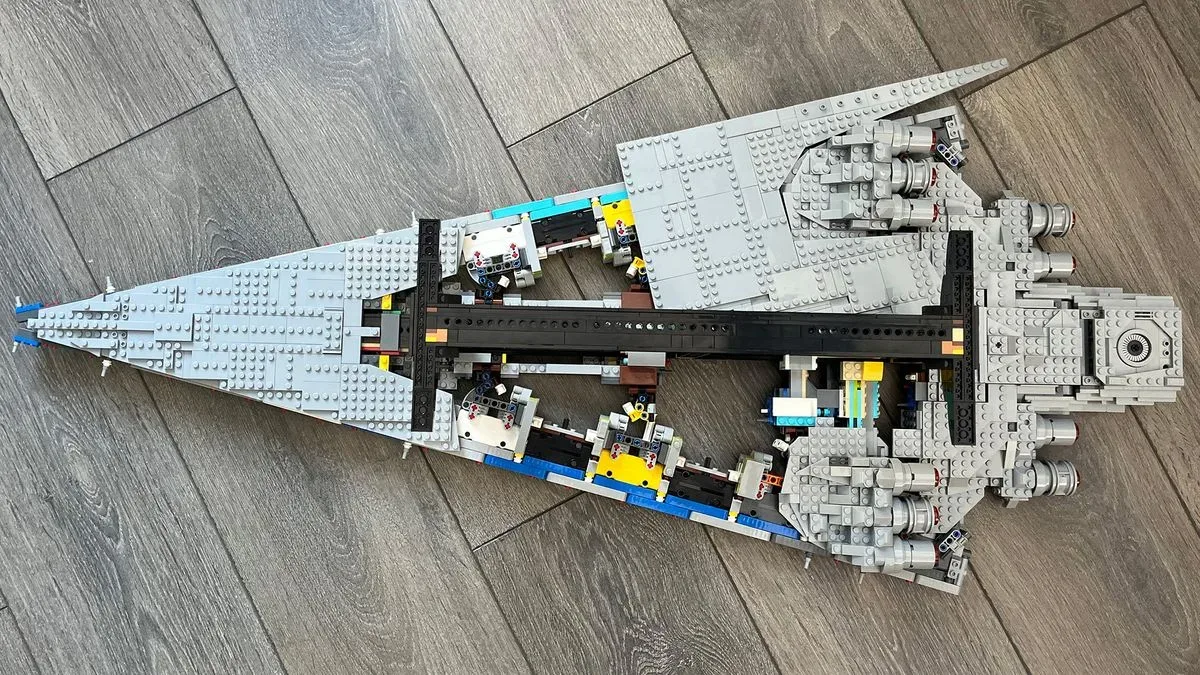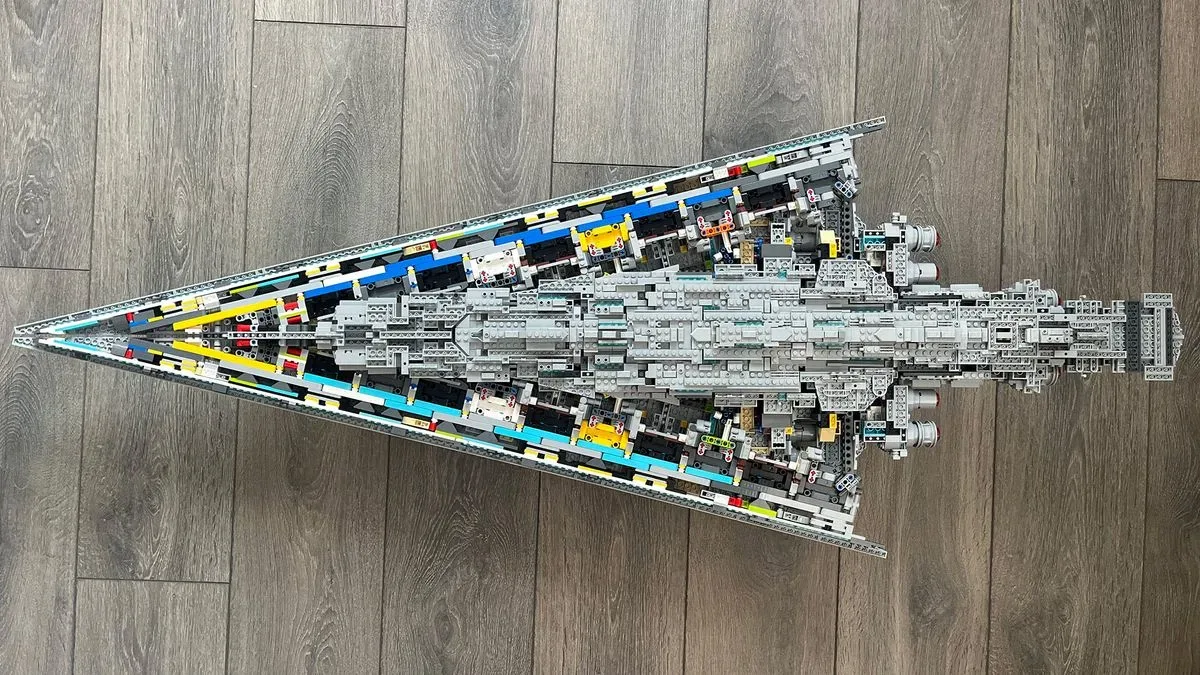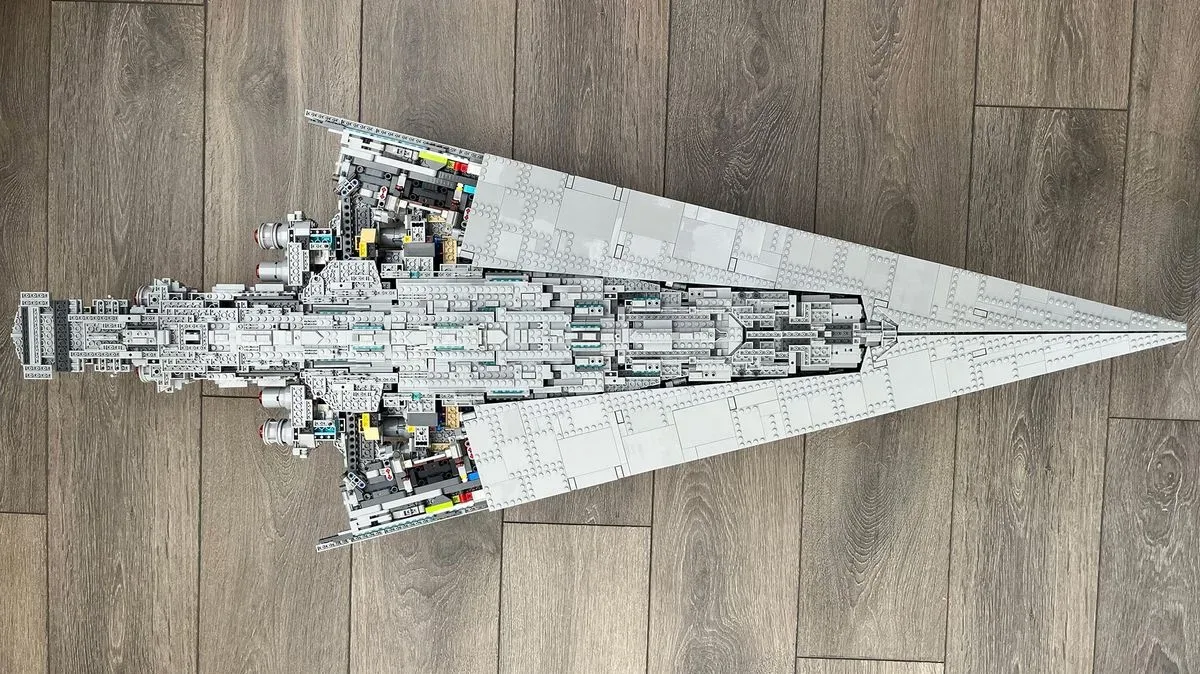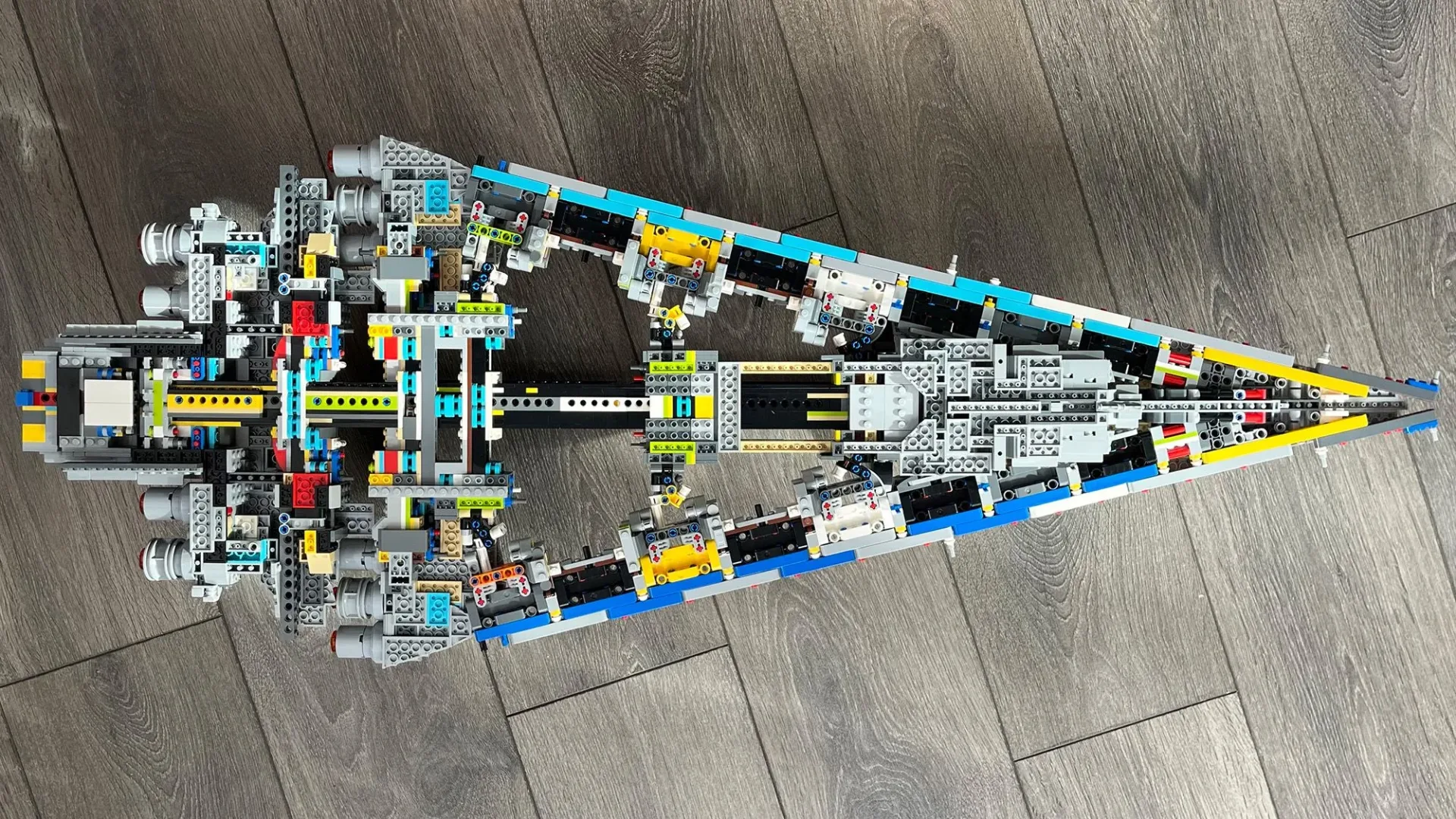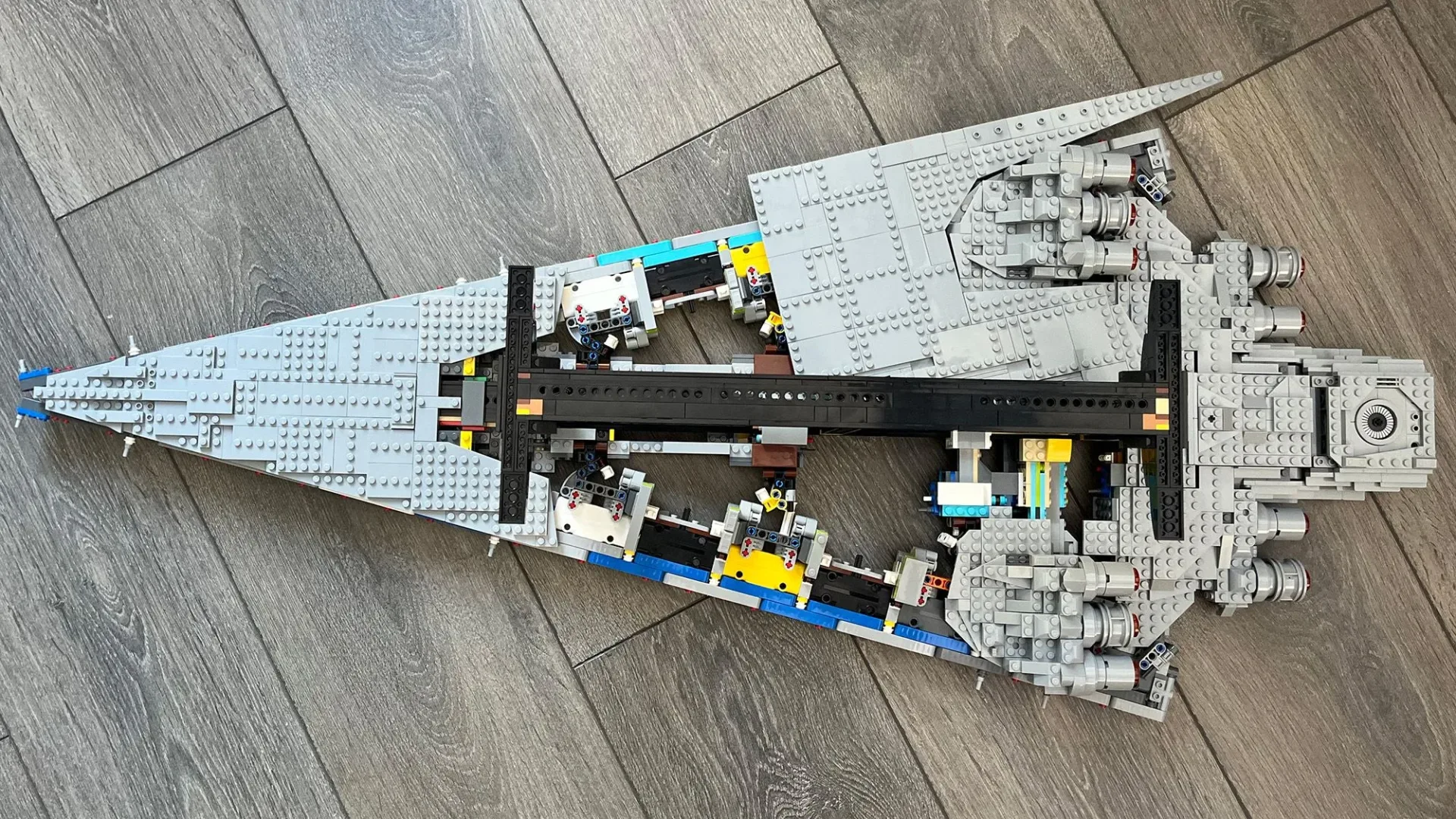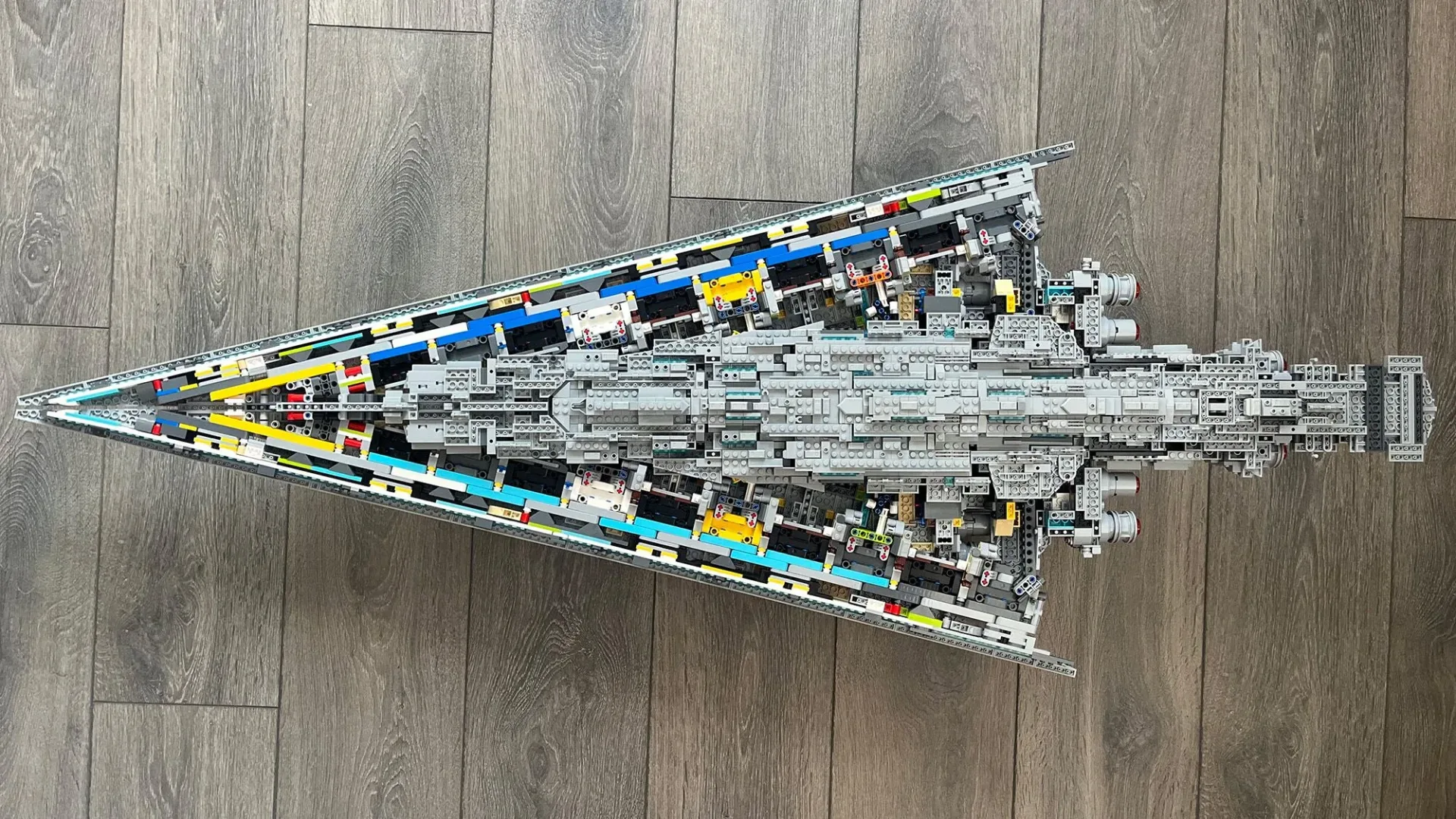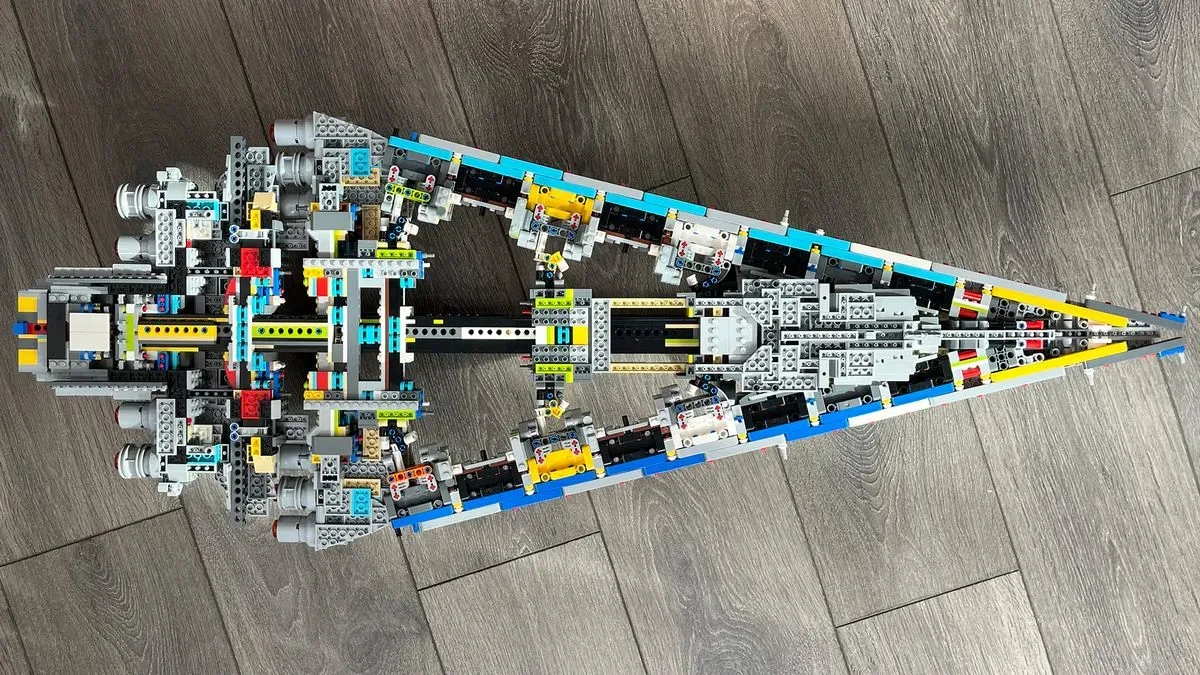
The Lego Star Wars Executor Super Star Destroyer (#75457) is designed to dominate a room before it dominates a shelf. At 53.5 inches (136cm) long, the 6,130-piece Ultimate Collector Series model is identified as the longest Lego Star Wars set made to date. It depicts Darth Vader’s immense flagship from The Empire Strikes Back, but this is not a playset built around opening panels, firing functions or an elaborate interior. It is a huge, low-slung display model whose appeal rests on scale, accuracy and an unusually generous selection of characters.
That means prospective buyers need to evaluate it as much like a piece of furniture as a brick build. The Executor measures 20 inches (50cm) wide and 7.5 inches (20cm) high, carries an 18+ age recommendation, and has a listed price of £649.99 / $799.99. A reported build time of 14 hours and 45 minutes also makes the set a multi-session project rather than a casual weekend diversion. Additional coverage of the model’s display-first approach reaches much the same practical conclusion: this is a flagship that needs a home before it needs an owner.
The new Executor is more than a simple reissue
Lego previously tackled the ship in 2011 with the 3,152-piece Super Star Destroyer (#10221). The current model nearly doubles that piece count, but the meaningful distinction is not merely a larger number on the box. The newer Executor uses its additional parts to pursue a flatter, wider silhouette based on the original ILM miniature rather than the slimmer profile some viewers may associate with shots in the films.
That choice explains much of the conversation around its shape. Screen perspective can make a ship appear proportionally different depending on the angle, while a physical display model has to settle on a fixed form. The new set’s broad, flatter wedge reportedly hews closer to the original production model. For an Ultimate Collector Series release—UCS is Lego’s collector-oriented line of large, detailed display sets—that kind of source-model fidelity is central to the pitch.
For more context, explore Lanterns Reworks Hal Jordan’s Past, and Its Creators Say Canon Changes Must Be Handled ‘Like Plutonium’.
The result is especially apparent in the rear, where 13 sublight engines give the vessel a dense, mechanical finish. The central cityscape, meanwhile, is presented in a more uniform light-grey treatment than the earlier UCS version. It is a subtle decision, but an important one: a model at this scale benefits from surface texture and varied structure more than from indiscriminate color contrast.
A long build built around structure, not tricks
The construction is said to be medium in complexity despite the enormous piece count. That does not mean it is quick or frictionless. It means its challenge comes chiefly from duration, repetition and managing a vast structure, not from a steady parade of startlingly complicated techniques.
The build is divided among four substantial instruction books and 54 numbered paper-bag sections. It begins with the smaller display components: a miniature Imperial Star Destroyer and a bridge-and-blast-doors diorama for Darth Vader and the bounty hunters. Then comes the base, which is not just a visual stand. It acts as the intended handhold for moving the finished model.
Related coverage includes LEGO’s Executor Super Star Destroyer Is a 53.5-Inch UCS Display Giant.
That is a consequential design decision. A 53.5-inch model cannot be treated like a standard ship set that can be lifted by its hull whenever a shelf needs dusting. The base uses Technic beams and SNOT construction to support the model. Technic refers to Lego’s system of beams, pins and specialized elements used to create strong internal frameworks. SNOT, short for “studs not on top,” is a building method that turns studs sideways or in other directions to achieve shapes and attachment points that conventional stacking cannot.
Those terms matter here because the Executor’s sheer length makes conventional brick stacking insufficient. The model is constructed directly onto its base and is not intended to be removed. Its framework is gradually enclosed with panels attached primarily through clips, and builders repeatedly turn the model over to work on the upper and lower surfaces. This is a process that sounds more methodical than dramatic: large sections begin as abstract assemblies before the unmistakable wedge shape finally emerges.
That may make it a good fit for a builder who enjoys a long, meditative assembly line of parts while listening to something else. It may be less satisfying for someone who wants a constantly changing sequence of mechanisms or colorful rooms. The phrase “big grey ship” is often used affectionately and critically in Lego Star Wars circles, and the Executor is perhaps the purest version of that proposition. It is giant, mostly grey, structurally repetitive and proudly uninterested in pretending otherwise.
Printed light openings solve a very specific display problem
The most distinctive decorative solution is a run of unique printed clear-blue 1x4 tiles. They represent the “light openings” on the original movie miniature and trace the sides of the ship while also appearing within its cityscape section. They are not simply blue pieces dropped onto a grey hull; their printing gives the enormous surface a controlled sense of scale and illumination.
Just as importantly for a premium display set, the Executor uses no stickers. That includes the UCS information plaque, which is printed, alongside the many light-opening tiles, the tractor beam projector details and the tiny Millennium Falcon tile on the miniature Star Destroyer. Printed elements are generally preferable for long-term display because they avoid application alignment issues and the possibility of adhesive deterioration over time.
The inclusion of exposed studs is also deliberate rather than unfinished-looking. A completely tiled surface can look sleek, but the original miniature was not uniformly smooth. Here, a less regular pattern of studs helps suggest the dense, industrial texture of the studio model while keeping the result recognizably Lego.
There are limitations to this approach. The hull panels are reported to line up snugly, but clip-connected sections do not always give a clear locking sensation during assembly. If caught while moving the model, some panels can separate or shed individual elements. One assembled example also showed a slight sag at the extreme nose, though that may not be universal. Neither concern appears to undermine the base-supported model as a stationary display piece, but they reinforce the same advice: use the stand as the handling point and give the Executor a stable, permanent spot.
No interior, but the extras serve the display
The quest for the flatter, more accurate outline comes with an obvious sacrifice: there is no internal bridge section. The 2011 UCS Executor included a small removable area that exposed a miniature bridge interior. The new model instead brings its figures together in a separate diorama based on Darth Vader’s bounty-hunter briefing in The Empire Strikes Back.
This is a sensible compromise, even if an interior would have broadened the model’s appeal. Adding one to a shallow, heavily supported hull could affect the exterior line or structural stability—the two areas the set prioritizes. The diorama includes bridge blast doors, while the accompanying miniature Imperial Star Destroyer gives the enormous Executor a useful in-universe scale reference.
That smaller ship has a particularly neat piece of storytelling: a printed 1x1 round tile showing the Millennium Falcon. It identifies the miniature destroyer as the Avenger, the vessel commanded by Captain Needa in The Empire Strikes Back, where the Falcon uses the larger ship as an unconventional hiding place. The miniature is not flawless—the forward triangular portion is attached with only two studs and can detach if handled—but the printed reference shows unusual care in a side build that could easily have been treated as an afterthought.
Seven minifigures make this more than a ship-shaped sculpture
The character lineup is the most persuasive argument that the Executor is meant to feel complete rather than austere. It contains Darth Vader and all six bounty hunters addressed by him in the famous briefing: Boba Fett, Bossk, Dengar, IG-88, Zuckuss and 4-LOM.
That is a significant upgrade from the 2011 model’s five-figure roster, which included Vader, Admiral Piett, IG-88, Bossk and Dengar. The latest set swaps Piett out while adding Boba Fett, Zuckuss and 4-LOM. Piett’s absence will disappoint collectors who want an Imperial command staff to accompany the ship, but choosing the entire bounty-hunter lineup gives the separate diorama a clear purpose and a memorable scene to represent.
Four of the minifigures—Dengar, IG-88, Bossk and 4-LOM—are exclusive to this set. Boba Fett has appeared previously, but this version adds a fabric cape. The detailing goes well beyond a basic selection of figures: Vader, Boba Fett and 4-LOM have printed arms, IG-88 uses a molded head with an exclusive print, and Bossk receives extensive printing plus dual-molded arms and legs to depict his clothing. Dual molding means two differently colored plastics are formed into one element, avoiding reliance on printed color for those boundaries.
For buyers interested in the physical collecting side of Lego Star Wars, that level of figure specificity improves the package considerably. A large UCS capital ship can otherwise risk feeling like a display sculpture with a token pair of minifigures. Here, the character selection is robust enough to stand as a substantial second feature, not just box art decoration.
Who should make room for it?
The Executor is a strong match for a committed Lego Star Wars collector with a clear display plan, a taste for Imperial vessels and an interest in the original filming miniature’s proportions. Its strengths are not mysterious: a record-setting length within Lego Star Wars, a reportedly sturdy base, carefully printed details, zero stickers, seven high-end minifigures, and a silhouette designed with accuracy in mind.
Its tradeoffs are equally plain. At £649.99 / $799.99, it sits among the most expensive current Lego Star Wars sets, behind the Death Star (#75419) and Millennium Falcon (#75192). It occupies a huge footprint. Its assembly is a test of patience more than a technical showcase. And it offers little conventional play value once completed.
For someone seeking an interactive Star Wars set, a compact build, or a model that can be moved casually from room to room, the Executor is the wrong kind of impressive. For someone who wants a large, unusually complete tribute to Vader’s flagship—one that makes its scale legible before a single minifigure is placed—the enormous grey wedge may be exactly the point.