From the Famicom to a New Generation
The Super Nintendo Entertainment System grew out of Nintendo’s need to replace a highly successful but increasingly limited machine. The Famicom, released in Japan in 1983 and marketed internationally as the Nintendo Entertainment System, had rebuilt confidence in home consoles after the North American market collapse of the early 1980s. By the end of the decade, however, its eight-bit processor, small memory capacity, restricted color handling, and relatively simple sound hardware placed clear limits on what developers could produce. Nintendo needed a successor that looked and felt familiar while making the generational leap obvious to consumers.
Nintendo’s answer was developed in Japan as the Super Famicom. The project was associated with Nintendo’s Research and Development 2 division, the group responsible for the Famicom and many of its most important games. Rather than treat the new console as merely a faster version of its predecessor, Nintendo built a coordinated audiovisual system around scrolling backgrounds, larger sprites, richer color, more sophisticated sound, and expanded controller input. The company also sought to preserve the cartridge model, which gave it control over manufacturing and distribution while allowing games to start immediately without disc loading.
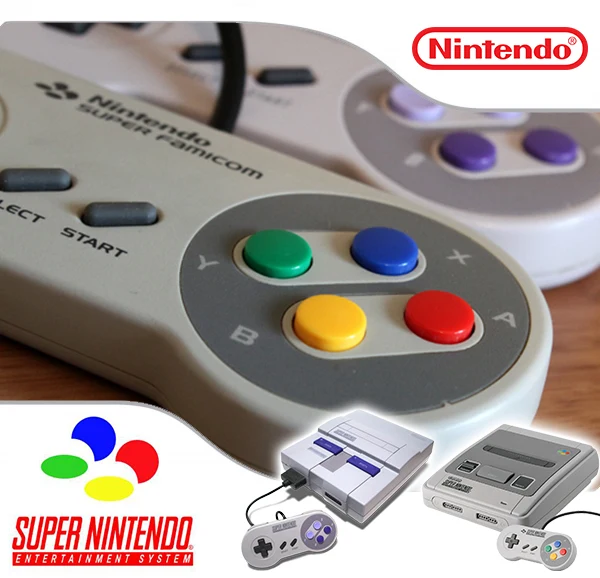
The controller became one of the system’s most influential elements. The Famicom and NES had established the familiar directional pad and two-button arrangement, but the Super Famicom controller added four face buttons arranged in a diamond and two shoulder buttons. This layout gave games more actions without requiring awkward combinations on a small number of buttons. It was especially useful for fighting games, role-playing interfaces, racing games, and platformers with several movement abilities. The arrangement was so successful that it became a template for later controllers from Nintendo and other manufacturers.
The timing of the project was commercially important. Sega had already introduced the Mega Drive in Japan in 1988 and the Genesis in North America in 1989. Its faster central processor and arcade-oriented presentation gave Sega an opportunity to challenge Nintendo before Nintendo’s successor was ready. Nintendo therefore entered the 16-bit generation after the competition had begun. The delay was a weakness at launch, but it also gave Nintendo time to build a substantial first-party lineup and to refine hardware that could remain competitive for much of the decade.
Japanese Launch and the Hardware’s Design
The Super Famicom launched in Japan on November 21, 1990. Its initial software lineup was deliberately small but carefully chosen. Super Mario World demonstrated the new platform’s expanded control and graphics, while F-Zero showed rapid scrolling, futuristic environments, and the use of the console’s distinctive background effects. Their pairing communicated Nintendo’s strategy: the machine would support familiar franchises, but it would also present new visual experiences that could not easily be mistaken for Famicom games.
At the center of the system was the Ricoh 5A22, a customized 16-bit processor related to the Western Design Center 65816 family. Its variable clock behavior meant that describing the SNES simply by its nominal processor speed could be misleading. Much of the console’s apparent power came from cooperation between the main processor, the picture-processing units, direct-memory-access systems, and specialized graphics modes. The system was designed less around one overwhelming component than around several relatively focused components working together.
The two picture-processing units, commonly called PPU1 and PPU2, handled the display. They supported multiple background layers, hardware scrolling, sprites, palette effects, and a wide range of display modes. The SNES could select colors from a palette of thousands, although each scene used only a smaller number at once. This mattered in practice because developers could create richer skies, shaded characters, textured environments, and more varied visual transitions than the Famicom allowed. The advantage was not just numerical. It gave artists more room to establish atmosphere and to distinguish foreground, background, and interactive objects.
The sound system was equally distinctive. Sony supplied a dedicated audio processor and digital signal processor, with separate memory used to store short samples and instructions. Instead of relying only on simple synthesized tones, composers could use sampled sounds as instruments, percussion, effects, or atmospheric layers. The system had limited memory compared with later disc-based machines, so samples had to be carefully selected and compressed. Even with those constraints, the hardware encouraged fuller arrangements and more expressive timbres. The musical identity of games such as Final Fantasy IV, Super Metroid, and The Legend of Zelda: A Link to the Past owed as much to this architecture as to the skill of their composers.
North American and European Rollouts
Nintendo adapted the machine substantially for North America. The Super Nintendo Entertainment System first appeared in North America on August 23, 1991, followed by a broader retail rollout during September. The North American console used a large, angular gray-and-purple case rather than the compact rounded shell of the Japanese Super Famicom. The different shape was partly a design decision and partly a branding choice. Nintendo of America wanted a system that looked sturdy and distinctive in stores, while the new name made clear that this was the successor to the NES rather than a minor accessory.
The North American launch centered on Super Mario World, which was commonly bundled with the console, along with titles such as F-Zero, Pilotwings, Gradius III, and SimCity. The launch software did not merely provide a collection of unrelated genres. Super Mario World offered a familiar character in a much larger world, F-Zero emphasized speed and scrolling, Pilotwings showcased perspective effects, and SimCity showed that the console could support slower, more analytical play. Together they helped Nintendo justify the system’s higher price and its late arrival against the Genesis.
Europe received the system during 1992, but there was no single uniform European experience. The United Kingdom and Ireland received the machine earlier in the year, while much of continental Europe followed in June, and individual countries could have their own distribution schedules. European television standards also created technical complications. PAL systems displayed at a different timing from the NTSC systems used in Japan and North America. Some games were converted carefully, while others ran with slower gameplay, borders, altered music timing, or other compromises. European releases could therefore feel delayed or technically different even when the underlying game was the same.
The regional divisions were reinforced by physical design and software protection. Japanese cartridges were shaped differently from North American cartridges, and lockout systems discouraged importing games between territories. European cartridges generally followed the Japanese form but were still subject to regional compatibility restrictions. Localization added another layer of difference. Games could receive translated text, changed character names, altered graphics, edited content, or entirely different release schedules. Some major Japanese role-playing games never reached Europe or North America at all, making the SNES library a collection of overlapping regional catalogs rather than one universal lineup.
The Sega Rivalry and the 16-Bit Contest
In North America, the SNES faced a Genesis that already had momentum. Sega of America marketed its system as faster, more energetic, and more appealing to teenagers than Nintendo’s family-oriented image. Sonic the Hedgehog gave Sega a mascot who could compete directly with Mario, while games such as Streets of Rage, Electronic Arts’ sports titles, and later Mortal Kombat broadened the Genesis audience. Sega’s advertising was unusually direct for the period, treating the competition as a public contest rather than allowing Nintendo to define the market on its own terms.
Nintendo’s response combined trusted franchises with a carefully managed publishing system. Its major games emphasized precision, exploration, polish, and audiovisual detail, while its licensing policies gave Nintendo significant control over cartridge production and release schedules. The same policies had helped prevent the oversupply and quality problems associated with the early-1980s crash, but they could also frustrate publishers. Nintendo controlled manufacturing capacity and often imposed strict standards, whereas Sega’s approach was more flexible and more willing to court publishers that wanted faster releases or access to older audiences.
The contest was not decided by processor comparisons alone. Sega benefited from reaching the market earlier, aggressive pricing, strong retail promotions, and a clear brand identity. Nintendo benefited from its large installed base, powerful first-party franchises, and the expectation that major third-party publishers would support the SNES. Street Fighter II was especially important because its home conversion turned a popular arcade fighting game into a reason to buy a console. Super Mario Kart, Donkey Kong Country, and other later releases helped Nintendo recover attention when Sega appeared to be ahead.
The rivalry also reflected changing ideas about who played games. Nintendo’s public image remained strongly associated with children and families, even though its software attracted older players. Sega openly targeted teenagers and young adults and used violence, attitude, and sports culture to broaden the perceived audience. The SNES ultimately became commercially successful without adopting exactly the same tone. Its victory was based on the cumulative strength of its software, the durability of its brand, and the ability of Nintendo’s developers to make technical limitations feel like deliberate design choices rather than shortcomings.
Cartridges, Enhancement Chips, and Expanding Capability
Cartridges were central to the SNES’s business and technical identity. They were more expensive to manufacture than optical discs, but they loaded immediately, were relatively durable, and connected directly to the console’s bus. More importantly, a cartridge could contain additional memory, a battery for saved games, or specialized chips. The console was therefore not limited to one fixed level of performance. Different games could extend its abilities in different ways, allowing the platform to remain technologically relevant after newer hardware had appeared.
The best-known example was the Super FX chip, developed with Argonaut Games and used in Star Fox, released as Star Wing in some regions. The chip was a supplementary processor that helped calculate and draw polygonal objects. Star Fox did not provide the fully textured 3D worlds associated with later consoles, but its spacecraft, corridors, and open flight spaces were a striking demonstration of polygonal movement on a system primarily designed for 2D graphics. The cartridge supplied the extra processing that the base console could not easily provide by itself.
Other cartridges used different enhancement chips for distinct purposes. DSP chips assisted with calculations in games such as Super Mario Kart, where track geometry and perspective effects had to be handled smoothly. The SA-1 improved processing and memory-management capabilities in selected late games. Super FX 2 hardware supported more demanding effects, including the large animated environments of Yoshi’s Island. These chips were not a single standardized upgrade. They were tools selected by developers and publishers according to the needs of a particular game.
The approach had costs. Enhanced cartridges required additional components and more complicated manufacturing, which increased development risk and often raised retail prices. Publishers had to decide whether a visual or technical improvement justified the expense. Nintendo also benefited because cartridge manufacturing remained tightly connected to its licensing structure. Yet the strategy produced an unusually long software curve. Early SNES games looked like improved 16-bit titles, while later releases could use advanced scrolling, polygonal scenes, large animated sprites, and complex calculations. The system’s capabilities were therefore defined by its entire software history, not merely by what it could do in 1990.
Nintendo’s Landmark Design Achievements
Super Mario World established the SNES as a platform for design refinement as much as technical spectacle. Its levels were connected by a world map containing secret exits, switch palaces, alternate routes, and hidden stages. Yoshi added new movement and combat possibilities, but the game’s most consequential feature was its structure. Players were encouraged to return to familiar areas after learning new techniques or discovering a different path. The result was a platformer that rewarded curiosity and completion without sacrificing immediate, responsive controls.
The Legend of Zelda: A Link to the Past translated the series’ top-down adventure formula into a denser and more coherent world. Its Light World and Dark World used related geography but changed the meaning of locations, routes, and puzzles. That structure created a strong sense of scale without requiring two unrelated maps. Dungeons introduced item-based progression, while the overworld connected exploration to story and practical problem-solving. Later adventure games repeatedly borrowed its relationship between map, dungeon, equipment, and environmental change.
Super Metroid offered a different model of progression. Rather than presenting a sequence of independent stages, it created one interconnected world whose inaccessible areas became understandable after the player gained new abilities. The design depended on memory: a sealed door, unreachable platform, or suspiciously empty corridor might become meaningful much later. Atmospheric music, environmental animation, and restrained storytelling reinforced the sense of isolation. Super Metroid showed that a console action game could be quiet, exploratory, and structurally ambitious without relying on long cinematic scenes.
Nintendo also used the system to develop new forms of competition. Super Mario Kart converted familiar characters into a split-screen racing game built around drifting, items, shortcuts, and deliberate disruption. The game’s importance was not simply that it created a successful series. It demonstrated how recognizable characters could be placed into a new genre while preserving the responsiveness and accessibility associated with Nintendo’s platformers. Multiplayer design became one of the SNES’s defining strengths, especially in homes where a second controller turned a solitary console into a shared social activity.
Third-Party Developers and the Role-Playing Library
Third-party developers were essential to the SNES, particularly in Japan. Square, Enix, Capcom, Konami, Hudson Soft, Namco, and many other publishers used the system for role-playing games, action titles, simulations, strategy games, fighting games, and licensed properties. The hardware was well suited to games filled with text, menus, character portraits, maps, and music. Cartridges eliminated disc loading, which helped the player move quickly between exploration, battles, conversations, and inventory screens.
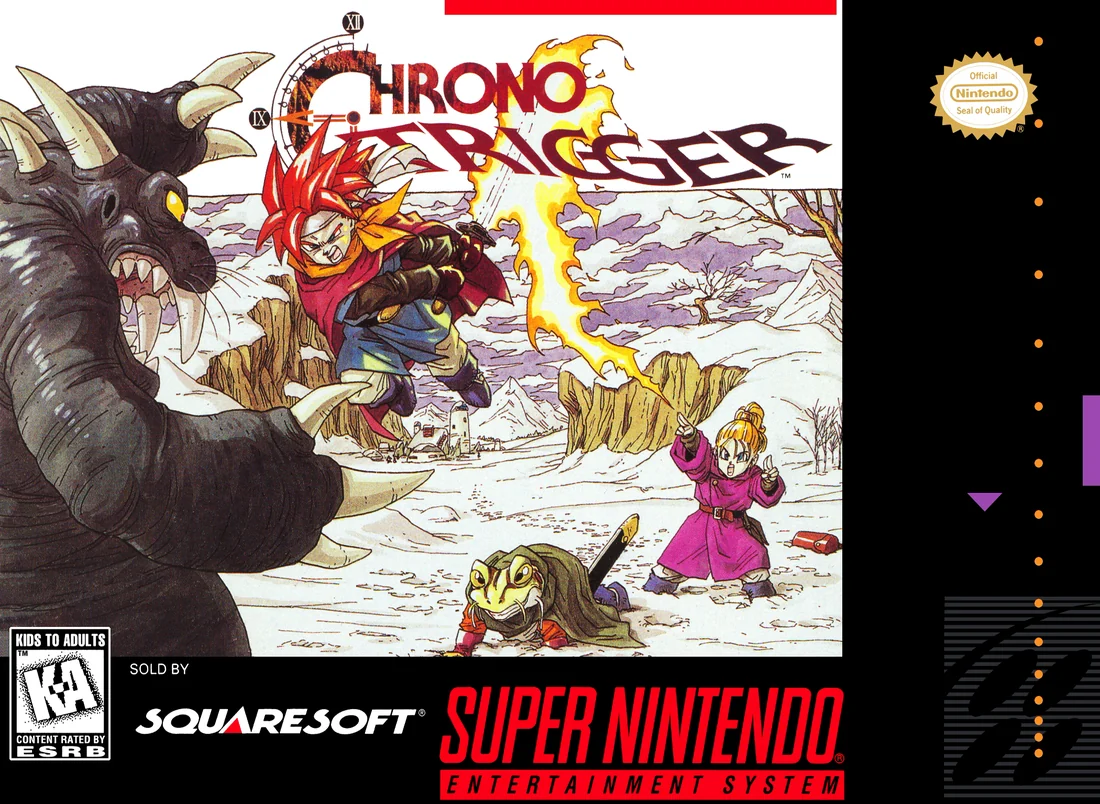
Square’s Final Fantasy IV, V, and VI expanded expectations for console role-playing games through larger casts, political conflicts, changing party structures, and more developed character arcs. Final Fantasy VI, released in North America under the title Final Fantasy III, treated its ensemble cast as a central design feature rather than simply surrounding one hero with interchangeable companions. Chrono Trigger used time travel to let players revisit locations across different historical eras, connecting narrative choices, world design, and replayable outcomes. Their influence extended beyond their commercial performance: they helped establish the idea that console games could sustain emotionally varied, highly structured stories.
Action role-playing games also flourished. Secret of Mana supported cooperative play, allowing multiple players to participate in real-time combat. The Japanese market received many additional titles that combined exploration, character growth, tactical battles, and experimental storytelling. These games benefited from the SNES controller’s expanded input and from the console’s ability to display colorful maps and detailed menus without loading screens. Their variety demonstrated that the system was not defined by a single Nintendo style, even though Nintendo’s own games dominated the platform’s public image.
Regional release policies limited how much of this library could be shared internationally. Translation was expensive, cartridge space was finite, and publishers were uncertain whether Western audiences would buy text-heavy role-playing games. EarthBound was a particularly unusual North American release, combining modern suburban settings, surreal humor, strange enemies, and a marketing campaign that did not resemble standard fantasy role-playing promotion. Secret of Mana and other localized titles reached Western players, but many important Japanese games remained unavailable officially outside Japan for years. The regional boundaries shaped not only business results but also the later reputation of the platform.
Peripherals, Add-Ons, and New Ways to Play
The SNES’s standard controller was itself a major peripheral innovation, but Nintendo also created accessories that expanded the machine’s roles. The Super Scope light gun supported compatible shooting games and positioned the console as an arcade-style target-shooting device. Its usefulness depended on the CRT televisions common at the time, since later flat-panel displays generally do not reproduce the same light-gun behavior. The Super NES Mouse, most visibly associated with Mario Paint, changed the console from a game-only appliance into a simple creative workstation.
Mario Paint allowed users to draw, animate, compose music, and experiment with stamps and effects. The software was intentionally playful, but it illustrated an important design idea: a television console could be a tool for creation rather than only a machine for winning. The mouse also demonstrated Nintendo’s willingness to build interfaces around specific activities instead of forcing every experience through the standard controller. Although such accessories were not universal successes, they broadened the cultural meaning of the platform.
The Super Game Boy adapter connected Nintendo’s home and handheld ecosystems. It allowed Game Boy cartridges to be played on a television through the SNES and could add color palettes or decorative borders to selected games. For owners who had purchased both systems, the adapter made the handheld library more visible and comfortable to play. It also helped Nintendo extend the life of Game Boy software without requiring developers to create entirely new home-console versions.
Japan received another ambitious experiment in the Satellaview, a broadcast and satellite-delivery service introduced for the Super Famicom. It transmitted data that could include games, revised content, timed events, and audio programming. Access depended on Japanese infrastructure and service schedules, so it was never a universal feature of the platform. Nevertheless, it anticipated later ideas associated with digital distribution, downloadable content, and time-limited online events. Nintendo also pursued a Nintendo Power rewrite service in Japan, allowing customers to replace software data on special cartridges at participating stores. These systems show that the SNES was not purely a fixed cartridge platform; Nintendo was already testing ways to distribute changing content.
The CD-ROM Episode and the Road to PlayStation
Nintendo’s relationship with optical media became one of the most consequential unfinished stories in the SNES era. Cartridges gave Nintendo strong control and offered fast access, but CDs provided dramatically more storage for music, dialogue, animation, and large amounts of text. Nintendo therefore explored a CD-ROM project with Sony, whose engineers had already contributed the SNES sound hardware. The proposed system was associated with the name Play Station and was intended to combine Super NES compatibility with CD-based software.
The project was not simply a canceled accessory in isolation. It raised questions about who would control the software format, licensing, manufacturing, and revenue generated by the new medium. Sony’s role in producing the CD technology gave it a position that could eventually turn into an independent platform business. Nintendo was wary of strengthening a partner that might become a competitor, while Sony saw an opportunity to enter interactive entertainment through a technically advanced format. The partnership broke down around 1991, and Nintendo publicly shifted toward a separate arrangement with Philips.
The Philips relationship also failed to produce the planned mainstream SNES CD expansion. Philips later received licenses to use Nintendo characters in games for its CD-i system, but those titles were not the equivalent of a successful Nintendo optical-media platform. Nintendo continued to rely on cartridges while Sega promoted the Mega-CD and Sega CD as extensions of its 16-bit machine. The company’s decision preserved manufacturing control and avoided committing to a format it did not fully control, but it also meant that Nintendo entered the next generation without a disc-based bridge from the SNES.
Sony continued developing its own console, using lessons from the abandoned collaboration and pursuing a system built around CD-ROM and 3D graphics. The resulting PlayStation launched in Japan in December 1994 and later in other territories. The connection between the failed SNES project and the PlayStation is often simplified into a single betrayal story, but the broader consequence is clearer: Nintendo’s reluctance to embrace optical media helped preserve the cartridge-based SNES business while simultaneously leaving room for a new competitor to define the next generation.
Revisions, Late Software, and the Transition to 3D
Nintendo revised the SNES internally throughout its production life. Later motherboards consolidated components, reduced manufacturing costs, and changed the arrangement of chips. These revisions were usually invisible to ordinary buyers, but they could produce small differences in video output, audio behavior, compatibility, and repair procedures. Collectors and preservationists therefore distinguish among several hardware revisions rather than treating every original-looking console as electrically identical.
North America eventually received a smaller redesign commonly called the SNS-101 or SNES 2. It used a compact case and a top-loading cartridge slot, removed the front eject mechanism, and simplified some expansion-related features. The redesign targeted the mature market: by then Nintendo had a large library and could sell access to established games through a cheaper, simpler machine. Japan also received later Super Famicom revisions. These systems were not new generations, but they extended the commercial life of the platform and reduced the cost of serving existing customers.
The SNES remained active while the industry shifted toward 32-bit machines and polygonal graphics. Nintendo’s next system, the Nintendo 64, did not launch in Japan until June 23, 1996, so the company and its publishing partners continued to support the 16-bit platform. Yoshi’s Island, Kirby Super Star, late role-playing games, and other releases showed that developers could still produce ambitious work within the older format. The console’s late software often used enhancement chips, refined visual techniques, or unusually large cartridges to postpone obsolescence.
The transition was therefore gradual rather than a single discontinuation event. Retail attention moved toward disc-based systems, and publishers faced increasing pressure to make games with 3D graphics, full-motion video, and larger soundtracks. Yet the SNES’s established library kept it valuable as a secondhand system. Its games were comparatively easy to understand, quick to start, and suitable for shared play. When new machines defined the future, the SNES became the generation many players continued to use because its design fundamentals remained strong.
Cultural Impact and the Mature Console Industry
The SNES helped establish a set of expectations that still define console games. Its controllers made six-button layouts feel natural. Its platformers connected immediate movement with secret routes and completion goals. Its adventure games made exploration, equipment, and world maps work together. Its role-playing games showed that music, dialogue, character development, and menus could carry substantial narrative weight. These conventions existed elsewhere, but the SNES presented them to a large audience through games that were unusually polished and widely distributed.
The physical culture surrounding the console was equally important. Cartridges could be borrowed, traded, rented, displayed, and carried between homes. Multiplayer games encouraged families and friends to gather around a television, while single-player adventures generated conversations about hidden stages, difficult bosses, and alternate endings. Magazines and rental stores served as informal information networks before widespread internet access. Manuals, box art, cartridge labels, and save batteries were part of the ownership experience. The platform’s memory was therefore attached not only to software but also to objects and social routines.
The SNES also participated in public debates about violence and age suitability. Nintendo had long enforced content policies that altered or restricted some depictions, while Sega used a more permissive approach to distinguish the Genesis. Mortal Kombat became the clearest example. The Nintendo version removed or changed the arcade game’s blood effects, while Sega’s version retained more of the original presentation and used a code to enable blood. The controversy contributed to wider political pressure on the industry and helped lead to the creation of the Entertainment Software Rating Board in 1994.
That episode showed that console manufacturers were negotiating more than market share. They were managing relationships with parents, retailers, journalists, legislators, and an increasingly visible entertainment business. Nintendo’s family-oriented identity supported trust but also limited how it could respond to older players. Sega’s challenge forced Nintendo to confront the fact that the console audience was aging and diversifying. The SNES’s cultural importance therefore includes both its celebrated games and the public debates that helped move games from children’s products toward a broader form of entertainment.
Sales, Preservation, and Lasting Influence
Nintendo’s official historical sales data lists 49.10 million Super Famicom and SNES hardware units worldwide and 379.06 million software units, measured as consolidated life-to-date figures through December 31, 2016. These totals should not be confused with a single year’s shipments, regional sell-through, or the number of original consoles still in use. They do, however, establish the system as one of Nintendo’s major hardware successes. The platform’s commercial strength came from a long production life and a software library that continued to sell after newer machines had appeared.
Preserving the SNES involves both digital data and physical objects. Cartridges can suffer from worn connectors, failing save batteries, corrosion, and aging electronic components. Consoles can develop problems with power regulation, video output, controller ports, or cartridge contacts. Regional differences complicate the work because Japanese, North American, and European versions can use different shells, lockout arrangements, display timing, and software revisions. A complete preservation effort therefore documents not just the game code but also manuals, packaging, peripherals, advertisements, broadcast services, and the hardware required to experience them accurately.
Nintendo’s later reissues made selected parts of the library easier to access. Digital collections and the Super NES Classic Edition introduced influential games to players who had never owned the original system. These products are useful gateways, but a curated collection is not the same thing as preserving the entire platform. It cannot represent every regional release, obscure publisher, canceled project, peripheral, service schedule, translation, or local retail practice. Emulation can reproduce gameplay behavior, yet preservation still requires careful attention to timing, display characteristics, sound differences, and controller response.
The SNES’s most durable legacy is visible in modern design. Independent platformers continue to use secret exits, interconnected maps, momentum-based movement, and precise controls. Role-playing games borrow its ensemble storytelling, tile-based worlds, expressive portraits, and musical approach. Pixel artists study its color restrictions, while composers revisit its sampled textures and compact looping structures. The system also anticipated later hardware strategies in which software could add specialized processing or new functionality. The SNES was not simply the successful endpoint of 16-bit technology. It was a platform that taught developers how to turn constraints into structure, how to make audiovisual detail serve interaction, and how a carefully designed library can remain influential long after its original hardware has disappeared from stores.