The optical-disc opportunity behind Sega CD
The Sega CD emerged during a period when compact discs were changing consumer electronics and reshaping expectations about software. Cartridge consoles such as Sega’s Mega Drive and its North American counterpart, the Genesis, offered immediate access and dependable performance, but their storage depended on expensive ROM chips. As games grew larger, publishers had to balance content against manufacturing cost. A CD-ROM could be pressed relatively cheaply and hold vastly more data than the typical cartridge of the early 1990s. That capacity invited music, speech, animation, illustrated scenes, long scripts, and video—features that were difficult or uneconomical to include on ordinary cartridges.
Sega also had a strategic reason to explore optical media. The Mega Drive was competing with Nintendo’s Super Famicom and Super Nintendo Entertainment System, while NEC’s PC Engine CD had already demonstrated that a console could use a CD drive for role-playing games, adventures, music, and cinematic presentation. A CD expansion allowed Sega to advertise a more advanced experience without immediately replacing the large installed base of Mega Drives and Genesis systems. Owners could keep playing their cartridge libraries while adding a second software format, and Sega could present the accessory as a bridge toward the next generation.
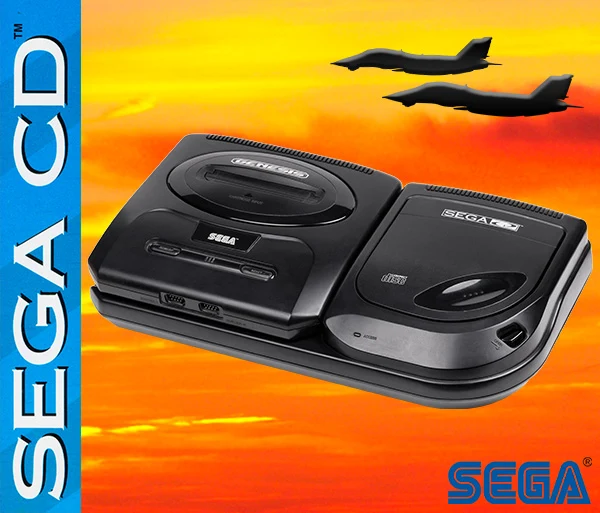
The resulting machine was an add-on rather than a replacement console. Sega worked with JVC, whose experience in optical and audio technology helped make the product practical, but the final design remained tied to the original 16-bit hardware. The Sega CD supplied a drive, additional memory, audio circuitry, a dedicated processor, and graphics support for selected effects. It did not discard the Genesis’s video architecture or turn it into a general-purpose 3D system. That distinction explains much of the platform’s later history: the disc expanded what developers could store and stream, but games still had to operate within the basic limits of a machine designed around cartridges.
Japanese origins and the Mega-CD launch
Sega launched the product in Japan as Mega-CD on December 12, 1991, according to Sega’s official hardware history. The Japanese list price was ¥49,800, an unusually high figure for an accessory that still required a Mega Drive. This price immediately shaped the platform’s reputation. Sega was asking established owners to make a major additional investment, while newcomers had to buy both the base console and the CD unit. The proposition was technologically impressive but economically difficult, particularly when the initial software range did not yet demonstrate a consistent new form of play.
The first Mega-CD used a motorized front-loading tray and was designed to sit beneath the original Mega Drive. Its industrial design resembled a modular audio component: broad, heavy, and visibly more elaborate than a conventional console. The drive connected through a side expansion interface, and the combined system required careful attention to regional hardware compatibility. The arrangement made Sega’s technological ambitions obvious, but it also meant that the buyer was assembling a stack of components rather than purchasing a single, self-contained machine.
The early Japanese library revealed several paths the format could take. Some games used CD music and extra storage to enhance familiar genres. Others emphasized animation, branching dialogue, or extensive text. A few treated the disc mainly as a source of recorded audio, while others experimented with compressed video. Sega’s own description emphasized that the Mega-CD added a dedicated CPU and hardware capable of image rotation, enlargement, and reduction. These features were real, but they were specialized rather than universal. The system could support effects that were awkward on a standard Mega Drive, yet it remained a 16-bit expansion whose strongest advantages were capacity and audio rather than raw all-purpose speed.
North American Sega CD and regional launch differences
North America received the accessory as Sega CD, matching the Genesis brand, on October 15, 1992. The launch price was $299, before adding the cost of a Genesis for buyers who did not already own one. Contemporary coverage presented the system as a multimedia machine and highlighted interactive cinema, filmed actors, animation, digitized sound, and CD-quality music. Sega’s American marketing was especially interested in demonstrating experiences that looked unlike ordinary cartridge games. The product was supposed to make the consumer feel that a new entertainment medium had arrived inside the living room.
The American launch also exposed the danger of allowing presentation to stand in for design. Full-motion-video games could fill a disc with filmed footage, but the hardware had to compress that footage heavily and display it within the limitations of the Genesis-era system. Video quality varied, loading interrupted the action, and interaction was often restricted to selecting a command, watching for a cue, or switching between surveillance views. A well-produced interactive film could create a memorable atmosphere, but a weak one felt like a low-resolution video interrupted by button presses. The Sega CD’s capacity made these productions possible without ensuring that they were satisfying.
Europe received the product later under the Mega-CD name. The first European rollout began in the United Kingdom on April 2, 1993, with other PAL territories following through 1993 rather than receiving one perfectly synchronized continental launch. PAL television standards affected display timing, and distribution was fragmented between national subsidiaries and retailers. The Mega-CD 2 became particularly important in Europe because it paired more neatly with the redesigned Mega Drive 2. Thus, “the Sega CD launch” was not one event worldwide: Japan’s December 1991 introduction, North America’s October 1992 release, and the staggered 1993 European rollout involved different names, bundles, prices, catalogues, and consumer expectations.
How the hardware expanded the Genesis
The Sega CD’s central benefit was storage. A compact disc could hold far more data than the cartridges common at launch, allowing developers to include lengthy dialogue, animated sequences, multiple language tracks, large maps, and extensive visual assets. That did not mean that every game became larger in the sense of having more levels. The extra space could instead support better sound, more story, a bigger script, or repeated animation. The most successful software treated capacity as a design resource rather than a reason to insert footage wherever possible.
The system’s audio features were especially valuable. Developers could stream recorded CD tracks instead of representing all music through the Genesis sound hardware. A game could use orchestral arrangements, vocal songs, sampled effects, and spoken dialogue while also functioning as an ordinary audio-CD player. For players in the early 1990s, that secondary function had practical appeal because CD players were still meaningful household electronics. It also helped Sega explain the product as part game machine and part multimedia device. Nevertheless, the audio advantage could create long loading pauses and required careful track management, especially when a game switched repeatedly between data and music.
The add-on included its own Motorola 68000 processor and additional memory, along with specialized audio and graphics support. The service documentation identifies memory for programs, pictures, and sound data, PCM waveform memory, CD-ROM cache, and battery-backed backup memory. The hardware could perform certain scaling and rotation effects and could use pre-rendered imagery to create visual depth. It did not provide the polygonal performance later associated with the Saturn or PlayStation, and it did not replace the Genesis video processor. Developers therefore had to combine the new capabilities with existing sprites, tile maps, palettes, and screen modes. The most convincing results came from selective enhancement: richer music, larger scenes, animation, and occasional hardware-assisted spectacle within a fundamentally 16-bit framework.
Model revisions and the Tower of Power
Sega introduced the second design, generally called Sega CD 2 in North America and Mega-CD 2 elsewhere, in Japan on April 23, 1993. It used a top-loading disc mechanism instead of the original motorized tray, reduced the enclosure’s size, and was designed to sit beside the redesigned Mega Drive 2. A joining plate and spacer made it possible to secure the unit to different Mega Drive shapes. The revision was not a new generation of software. It was a cost-reduced and more practical form of the same platform, intended to make the combined system less awkward and easier for retailers to present.
The redesign mattered because the original stack had become part of the problem. The first Mega Drive, front-loading Mega-CD, power supplies, connecting hardware, and cables created a substantial piece of equipment. The second model looked more coherent with the smaller Mega Drive 2 and reduced some of the visual intimidation. Sega also released integrated or related products, including the JVC-developed Wondermega in Japan and the Genesis CDX, known as Multi-Mega in some regions. These combinations demonstrated that the technology could be packaged more elegantly, but they generally remained expensive and did not erase the underlying question of whether consumers wanted an add-on at all.
The Sega CD later became one level in the informal “Tower of Power,” the nickname for a stack that could include the Genesis, Sega CD, and eventually the 32X. The phrase is affectionate because the arrangement looks spectacular, but it also captures Sega’s expanding product-line problem. Each accessory promised a specialized upgrade, yet every new component introduced questions about compatibility, power, cables, software support, and resale value. The Sega CD itself was not responsible for the entire confusion, but its existence made the strategy visible. A customer had to understand the relationship between several machines just as competitors were preparing simpler dedicated CD-based systems.
Full-motion video and the software identity crisis
The Sega CD’s most publicized software category was full-motion video. Developers could film actors or animation, compress the footage, and place it on a disc that offered more room than a cartridge. The format resembled interactive television: players watched scenes, selected responses, monitored rooms, or reacted to prompts. When production, editing, music, and interaction worked together, the result could feel unusual and cinematic. More often, however, the game exposed the limits of the technology. Compression produced blocky images, loading broke momentum, and shallow branching meant that replay frequently revealed only minor variations.
Night Trap became the platform’s defining controversy. Developed by Digital Pictures, the game placed the player in a security role, switching among cameras and activating traps to protect characters from intruders. Its origins went back to a planned live-action project for Hasbro’s Control-Vision system, which was abandoned before the finished concept found a home on Sega CD. The game’s presentation made it an obvious demonstration of the format, but scenes involving threatened young women were taken out of context by critics and politicians. Night Trap was treated as evidence in a wider argument about violent or sexualized entertainment, despite the game’s unusual and often campy surveillance mechanics.
The United States Senate hearings held in December 1993 and March 1994 brought Night Trap and Mortal Kombat into a national debate about video-game content. The immediate consequences were political pressure, industry self-regulation, and the creation of the Entertainment Software Rating Board in 1994. Sega’s willingness to defend adult-oriented material reinforced its image as Nintendo’s aggressive alternative, but it also made the company and the Sega CD visible targets. Other releases, including Sewer Shark, Cobra Command, Prize Fighter, Ground Zero Texas, and Slam City with Scottie Pippen, varied in quality but strengthened the public association between the platform and compressed interactive movies. That association was unfair to the entire library, yet it became difficult to dislodge.
Sonic CD and the strongest first-party case
Sonic CD was the clearest demonstration that the Sega CD could support a conventional game with a distinctive reason to exist. Developed by Sega, it retained the fast platforming structure of the Genesis Sonic games but added animated presentation, streamed music, new visual effects, and a time-travel system. Each stage included past, present, bad-future, and good-future versions. Players could move through time and search for objects that changed later versions of a level, giving the game a more exploratory structure than its immediate predecessors. The disc was used for atmosphere and scale without replacing direct control.
The game’s regional differences became part of its legacy. The Japanese and European versions used one soundtrack, while the North American release used a different score and opening theme. Both versions were official interpretations of the same game, and their contrasting musical identities produced decades of fan discussion. Sonic CD also appeared relatively late in North America compared with the Japanese release, contributing to the uneven way the platform was experienced across territories. A title that was central to the system’s reputation in one region could be less visible in another because of timing, marketing, or local retail support.
Sonic CD did not solve the Sega CD’s business problem, but it showed what a successful exclusive could accomplish. Its time-travel mechanics connected the medium’s audiovisual novelty to the structure of play. The animated opening and ending gave the game a sense of event, while CD music made the soundtrack more expansive than a standard Genesis release. Most importantly, the game still worked as a platformer. It did not ask players to admire the hardware instead of playing. That balance explains why Sonic CD has remained one of the platform’s best-known games rather than merely one of its most technically conspicuous demonstrations.
Role-playing games, adventures, and localization
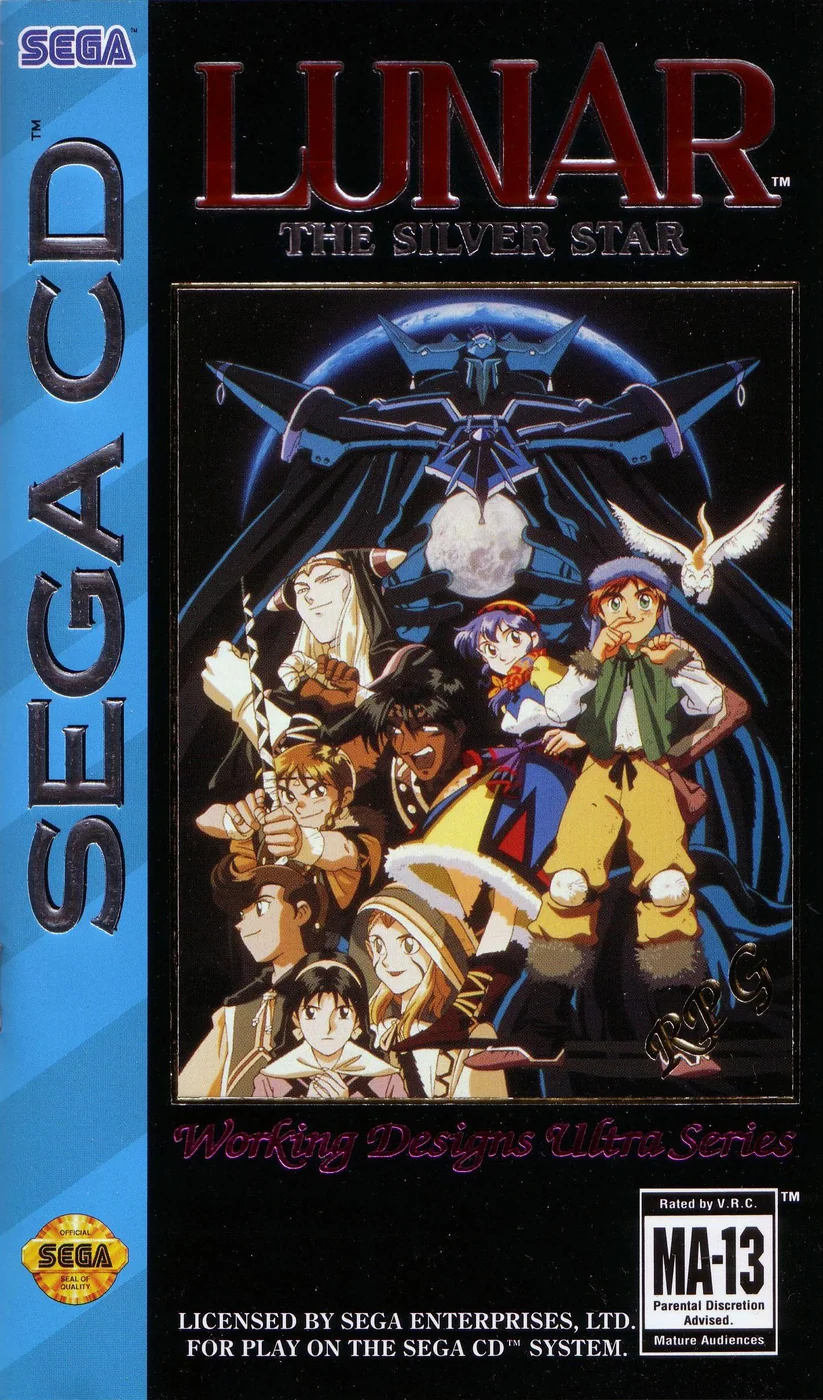
The Sega CD’s most durable software often came from genres that benefited from dialogue, music, animation, and long narrative passages. Game Arts’ Lunar: The Silver Star used animated scenes, voice acting, CD music, and extensive writing to give a traditional role-playing game a more television-like presentation. Towns, battles, exploration, character development, and equipment remained central, but the disc allowed the story to include moments that would have been expensive to fit on a normal cartridge. The result was not simply a movie with battles attached; it was a conventional role-playing structure enriched by audiovisual material.
Lunar: Eternal Blue expanded that approach and became especially important in North America through Working Designs’ localization. Working Designs translated large amounts of dialogue, added extensive voice work, and adapted jokes and cultural references for its audience. Its releases demonstrated that localization could be a creative production rather than a mechanical transfer of text. The company’s projects were expensive and niche, but the Sega CD’s capacity made ambitious English-language narrative releases possible. Lunar’s reputation therefore reflects both Game Arts’ design and Working Designs’ unusual willingness to invest in a small but committed audience.
Other games used the disc in different ways. Silpheed combined traditional shoot-’em-up controls with pre-rendered backgrounds and large spacecraft that created an illusion of three-dimensional movement. Robo Aleste pushed scrolling shooter presentation and animation. Popful Mail used speech, music, and adventure-game charm without abandoning platforming and action. Earthworm Jim: Special Edition added content and presentation improvements, while Heart of the Alien extended the cinematic platforming tradition associated with Another World. These titles did not all use the hardware identically, but together they showed that Sega CD software could be action-oriented, story-driven, technically showy, or humorous without reducing the system to FMV.
Snatcher and the platform’s cult reputation
Konami’s Snatcher became the Sega CD’s most famous example of a narrative game that used the format for atmosphere rather than merely filmed footage. Hideo Kojima’s cyberpunk adventure had originated on Japanese home computers and appeared in revised forms on other systems, but the Sega CD release was the only official English localization. Players investigate humanoid impostors in a future society, question witnesses, examine evidence, navigate a stylized interface, and occasionally enter shooting sequences. The game draws on detective fiction and science-fiction cinema, yet its strength lies in the combination of writing, illustration, sound, music, and pacing.
The English release was commercially vulnerable from the beginning. It arrived late in the Sega CD’s life, when consumers were beginning to look toward 32-bit hardware. Its adult tone and unusual structure made it less suitable for mass-market advertising than a mascot platformer or licensed film game. A game could be critically distinctive and still sell to a small audience. Snatcher’s later reputation was shaped by scarcity, word of mouth, and the recognition that its official localization might never be repeated. Its cultural importance therefore grew after the commercial moment when publishers would have been most willing to support it.
Snatcher also reveals the platform’s role in moving Japanese software across languages. The Sega CD was not only a North American showcase for interactive movies; it was also a bridge for adventures and role-playing games that needed space for text, voices, and music. Lunar and Snatcher became reference points for later localization communities, collectors, and preservationists. Their importance is partly historical: they show how a limited add-on could support software that was too specialized for mass retail but highly influential among players who valued unusual settings, extensive writing, and deliberate presentation.
Competition and Sega’s increasingly fragmented strategy
The Mega-CD entered a market already experimenting with CD-ROM. NEC’s PC Engine CD offered an established example of a console expansion built around optical media, particularly for Japanese role-playing and adventure games. Nintendo discussed a CD project associated with Sony before that partnership collapsed, helping create the circumstances in which Sony developed the PlayStation. Sega therefore occupied an important but unstable position. It was early enough to benefit from the novelty of CD games, yet its add-on architecture could not deliver all the advantages of a console designed around optical media from the outset.
Nintendo’s response was largely to continue refining cartridge technology and first-party software. Specialized chips inside cartridges could extend the capabilities of the Super Nintendo, and consumers could understand the purchasing proposition easily: buy a console, then buy games for it. Sega’s customer had a more complicated decision. Existing Genesis owners had to decide whether the CD features justified a large accessory price, while new buyers needed the base machine as well. Publishers faced the same problem in reverse: a small installed base made ambitious CD projects harder to finance, but a weak library made consumers less likely to purchase the hardware.
The transition to 32-bit systems made the Sega CD’s limitations more obvious. The 3DO, Sega Saturn, and Sony PlayStation were built as disc-based machines with more memory and more powerful processors. Their software could still contain FMV, but it also offered stronger support for polygonal graphics and more complex game worlds. Sega’s 32X added another layer to the Genesis strategy, while the Saturn represented a genuine next-generation platform. In that environment, the Sega CD looked increasingly like an interim solution. Its advantages—cheap storage, music, and video—were becoming standard, while its dependence on Genesis-era architecture, single-speed loading, and accessory complexity became harder to defend.
Commercial performance, revisions, and the end of support
A widely repeated historical figure places worldwide Sega CD and Mega-CD sales at approximately 2.24 million units. That number should be treated as a broad historical total rather than a perfectly transparent audited sell-through figure, because Sega’s reporting practices, regional subsidiaries, and the distinction between shipments and consumer sales are not always clear in surviving summaries. Even at that scale, the important comparison is with the much larger Genesis/Mega Drive audience. Only a minority of owners adopted the CD expansion, which limited the commercial foundation available to publishers.
The commercial difficulties were cumulative. The launch price was high, and the buyer still needed the base console. Early software libraries were small, regional, or technically uneven. Loading disrupted play, while CD production encouraged costly voice acting, animation, and filmed footage that could be difficult to recoup from a limited audience. The product’s image also became divided by territory. Japan emphasized role-playing, adventures, and animated presentation; North American advertising strongly featured multimedia and live action; Europe received a later, more fragmented rollout. Each market’s catalogue influenced how players judged the entire platform.
By 1995 Sega’s attention was shifting decisively toward the Saturn and away from promoting the aging Genesis family. The Sega CD continued to receive releases, and some of its most interesting games appeared late, but the commercial pipeline was narrowing. Sega officially discontinued the system in 1996 as it concentrated on fewer platforms and moved into the 32-bit generation. That ending was not caused by one disastrous title. It resulted from the intersection of expensive hardware, limited adoption, inconsistent software strategy, the arrival of better dedicated CD systems, and Sega’s own decision to move on. The add-on had been marketed as a route into the future, but the future arrived in a form that made its compromises conspicuous.
Preservation, repair, and lasting influence
The Sega CD’s physical design creates preservation problems that cartridge systems often avoid. Optical discs can be scratched, damaged, or affected by disc rot, while the consoles contain aging belts, gears, optical pickups, capacitors, connectors, and drive mechanisms. The original tray-loading model and the top-loading Model 2 have different mechanical concerns, and regional systems use different BIOS and compatibility arrangements. Preserving the platform therefore means documenting hardware revisions, manuals, service procedures, development materials, software variants, promotional campaigns, and the cables and spacers needed to assemble particular configurations.
Disc imaging and emulation have become important tools for research and access. A properly preserved image can protect a game from repeated use of fragile original media and make it possible to compare Japanese, North American, and European versions. Emulators must reproduce not only graphics but also CD timing, audio playback, memory behavior, regional checks, and loading routines. Hardware replacements and optical-drive emulators can extend the life of original systems, although they also raise questions about authenticity, copyright, and the difference between preserving a program and reproducing the original experience. The platform’s preservation community works across all of those concerns.
The Sega CD’s lasting influence is broader than its sales. It helped normalize streamed music, voiced dialogue, animated openings, larger narrative scripts, and disc-based localization. Its failures were equally instructive: storage capacity did not guarantee good design, video quality could not substitute for interaction, and an accessory divided the audience that publishers needed. Its best games remain valuable because they used the disc to expand play rather than merely decorate it. Sonic CD’s time-shifting structure, Lunar’s animated role-playing presentation, Snatcher’s localized cyberpunk investigation, and the system’s many experiments preserve a record of the industry learning how to move from cartridges to optical media. The Sega CD was neither simply a failure nor a hidden replacement for the next generation. It was an ambitious, uneven transitional platform whose limitations and successes both shaped console history.