A Console Maker Enters the Handheld Market
The PlayStation Portable emerged from Sony’s rapid transformation into a leading video-game company. The original PlayStation had made Sony a major force in the home-console business, and PlayStation 2 extended that success with DVD playback, online features, and a large library of technically ambitious games. Yet Nintendo remained overwhelmingly dominant in handheld hardware. The Game Boy family had developed a huge global audience through inexpensive, durable systems and accessible software, while Nintendo was preparing the Nintendo DS for release. Sony’s entry was therefore not a routine extension of its console business. It was an attempt to establish a second PlayStation ecosystem in a market where the company had no previous hardware presence.
Sony announced the PSP as a new handheld entertainment platform rather than as a smaller version of an existing PlayStation console. The company’s concept combined games with functions associated with consumer electronics: music playback, photographs, video, wireless networking, web browsing, and downloadable content. This ambition reflected Sony’s broader interest in connecting its electronics, film, music, and game businesses. The PSP was designed to be carried like a personal device, but it was also expected to showcase the PlayStation brand through games with detailed 3D graphics and production values closer to home-console software than to traditional portable titles.
The timing seemed favorable. Portable electronics were becoming more capable, compressed digital video was increasingly practical, and wireless networking was moving from specialist technology into everyday products. Sony believed there was room for a premium device that could sit between a dedicated game system and a personal media player. That positioning gave the PSP a distinctive identity, but it also imposed difficult requirements. A powerful processor, a large widescreen display, optical media, wireless hardware, and multimedia functions all increased cost, battery demands, and mechanical complexity. Sony was not trying to win by offering the cheapest handheld. It was asking consumers to pay for a more expansive idea of portable entertainment.
Development and the Pocket PlayStation Design
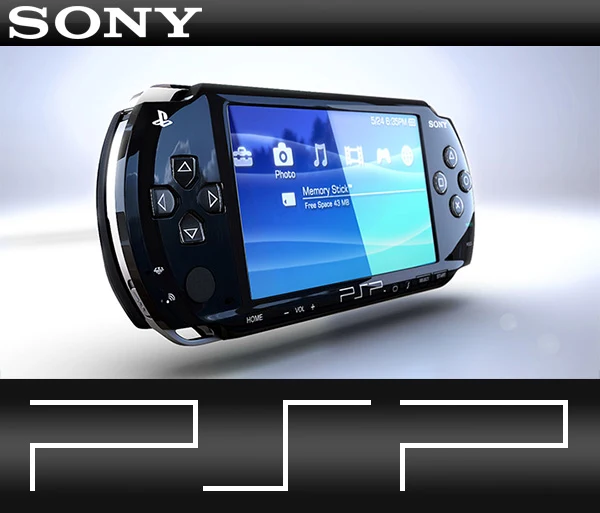
The original PSP established a design that remained recognizable throughout the system’s life. Its wide body placed a 4.3-inch widescreen LCD at the center, with a PlayStation-style directional pad and face buttons on either side. The controls were accompanied by the familiar shoulder buttons and a small analogue nub, which gave developers a way to design movement-heavy games without relying entirely on the digital pad. The screen’s horizontal shape made the machine look unlike earlier Game Boy-style handhelds and reinforced Sony’s intention to present portable gaming as a cinematic, technically advanced experience.
The display used a 480-by-272-pixel resolution and a 16:9 aspect ratio. For games, the wide panel allowed racing tracks, action scenes, and large environments to remain visible without the narrow framing associated with many older portable systems. For video, it matched the widescreen proportions increasingly associated with television and film. The screen was not merely a specification used in marketing. It shaped how games were composed, how menus were arranged, and how the PSP could double as a video viewer. It also made the machine physically wider than many competing handhelds, creating both a comfortable viewing area and a larger object to carry.
Internally, the PSP used a MIPS-based processor and a graphics system designed for relatively sophisticated three-dimensional rendering. In ordinary terms, it could display textured environments, lighting effects, animated characters, and fast-moving scenes that would have been difficult on earlier portable hardware. The technical achievement came with compromises. Three-dimensional games needed substantial processing power and storage, while the optical drive and bright screen consumed energy. Developers had to manage memory, loading, and battery life carefully. The PSP could approach the visual style of PlayStation 2 software, but it could not reproduce every home-console feature without reducing complexity, lowering resolution, or dividing content into smaller missions and stages.
UMD and Sony’s Physical Media Strategy
Sony created a new physical format for the PSP called Universal Media Disc, or UMD. The disc was enclosed in a protective plastic shell and could store up to 1.8 gigabytes of data. That capacity was far beyond the amount available on many earlier handheld cartridges, giving publishers room for detailed environments, full musical scores, voice acting, cinematic sequences, and expansive collections of game assets. Sony also positioned UMD as a general media format. Films, television programs, and music products were released on UMD in some territories, allowing the PSP to function as a small optical media player as well as a game machine.
UMD addressed the storage problem but introduced new technical costs. Optical discs require a drive, and a drive consumes more power than a simple solid-state cartridge reader. Games could also pause while data was retrieved from the disc, especially when large environments or cinematic files were loaded repeatedly. Developers sometimes copied frequently used data into system memory or used other caching strategies to reduce interruptions. Later PSP revisions improved disc access and reduced some loading problems, but loading remained part of the platform’s reputation. The format made the PSP feel like a miniature PlayStation, yet that same resemblance brought some of the limitations associated with optical media.
The format also expressed Sony’s belief that games and film might share a portable distribution system. A customer could buy a game on UMD, watch a movie on another disc, transfer music to a Memory Stick, and connect the PSP to a computer. The idea was attractive while physical video remained commercially important, but UMD Video faced obstacles. Consumers were often being asked to buy films again in a format intended for a small screen, and a UMD could not be played in a standard DVD player. As digital video became easier to obtain through computers and later smartphones, the economic case for a dedicated portable movie format weakened. UMD remained central to PSP games, but it never became the universal media standard its name implied.
Launch Dates, Regional Differences, and Early Reception
The PSP launched first in Japan on December 12, 2004, according to Sony’s contemporary sales announcement. Some later PlayStation history pages list December 11, 2004, which reflects a recurring date discrepancy in retrospective regional timelines. Sony’s own 2011 announcement of 70 million units used December 12 for the Japanese debut, so that is the most defensible date for the commercial launch. North America followed on March 24, 2005. Sony then released the system in Asian markets during May 2005 and in Europe and other PAL territories on September 1, 2005. These staggered launches reflected production, localization, retail planning, and the need to assemble software and accessories for several regions.
The launch schedules affected how audiences encountered the machine. Japanese consumers received the hardware first and saw early software such as Ridge Racers, while North American buyers received a substantial promotional campaign built around the system’s screen, media functions, and PlayStation identity. European players waited several more months and faced a different software calendar, with games and accessories arriving on regional schedules. Games were not always released simultaneously, and movie availability varied considerably by territory. The PSP was a worldwide product, but its early history was a sequence of regional launches rather than a single synchronized event.
Sony’s launch pricing placed the PSP above Nintendo’s new DS in many markets. The North American launch package included the handheld and accessories, while a less expensive core configuration was introduced later. The initial software lineup combined racing games, sports titles, platformers, puzzle games, and adaptations of established PlayStation properties. That strategy made the system easy to understand for existing PlayStation owners, but it also exposed a central challenge: the PSP had to prove that console-style production values were worth the additional cost. Strong visuals created immediate attention, yet long-term success depended on software that felt appropriate for portable play rather than on technology demonstrations alone.
The PSP and Nintendo DS Represent Different Ideas of Portability
The main competition was between two different theories of handheld gaming. Nintendo DS emphasized two screens, touch input, a stylus, microphone functions, accessibility, and games that could attract people outside the established console audience. Sony emphasized a wide screen, analogue control, recognized PlayStation brands, multimedia playback, and a premium object with the appearance of advanced consumer electronics. The systems were both portable, but they communicated different expectations about how players should interact with games and what a handheld should be capable of doing.
This difference influenced software development. Nintendo DS became associated with touch-driven experiments, puzzle games, training software, social play, and designs that used a second screen for maps, inventories, or simultaneous information. PSP developers more often worked in racing, action, role-playing, sports, shooters, stealth, and open-world formats. The distinction was never absolute: the PSP had puzzle and rhythm games, while the DS hosted major role-playing and action titles. Nevertheless, the PSP’s controls and graphics encouraged publishers to adapt recognizable console structures, while the DS’s interface made developers reconsider familiar assumptions about buttons and screens.
The competitive lesson was that power and scale did not automatically create a mass-market advantage. The PSP could present detailed graphics and large games, but its price, optical drive, battery requirements, proprietary storage, and loading times created friction. Nintendo DS was less powerful but easier to price and explain, and Nintendo supported it with software aimed at a much broader range of players. Sony nevertheless achieved an important result: it became Nintendo’s most successful direct competitor in dedicated handheld hardware. The PSP did not displace Nintendo, but it created a substantial alternative market based on premium design and console-like experiences.
Landmark Games and the Console-Scale Library
The PSP’s strongest case rested on its software. Early releases such as Ridge Racers, Wipeout Pure, Everybody’s Golf, Ape Escape: On the Loose, and sports games demonstrated how the screen, analogue nub, and processing power could support familiar PlayStation genres. Racing games were especially effective because the widescreen display kept tracks and opponents visible while the system’s hardware supplied convincing speed and scenery. The library also included ports and adaptations of PlayStation and PlayStation 2 properties, giving existing fans a reason to view the PSP as an extension of the broader platform rather than as an unrelated handheld.
Grand Theft Auto: Liberty City Stories became one of the most important commercial and critical demonstrations of the system’s capabilities. Developed by Rockstar Leeds in collaboration with Rockstar North, it adapted the open-world structure associated with Grand Theft Auto III and its successors to a portable device. Players could explore a large city, undertake missions, listen to radio stations, and interact with a mature crime narrative without a television. The game showed that a handheld could support a substantial open-world design, although the adaptation also required technical compromises and a structure suited to shorter play sessions.
Sony’s first-party studios and external partners continued to provide ambitious exclusives. God of War: Chains of Olympus brought the series’ combat, mythology, and cinematic presentation to a smaller screen. Daxter offered a character-focused platform adventure connected to the Jak and Daxter universe. Resistance: Retribution translated a science-fiction shooter into a control scheme built around the PSP’s limited analogue input. Metal Gear Solid: Portable Ops and Metal Gear Solid: Peace Walker used portable missions, stealth systems, recruitment, and cooperative features to make the series work outside the living room. These games mattered because they gave the PSP a recognizable software identity instead of leaving it dependent solely on ports.
Original Experiments and the Japanese Software Scene
The PSP’s historical importance also comes from games that did not attempt to imitate a home console. Lumines, developed by Q Entertainment, combined falling-block puzzles with music, rhythm, changing backgrounds, and audiovisual timing. Its rules were easy to understand, but the presentation encouraged repeated sessions and experimentation. The game demonstrated that a PSP title could exploit the system’s screen and sound without requiring a long campaign or a large narrative. It also became one of the clearest examples of how a distinctive interface and audiovisual style could make a portable game feel specific to its platform.
LocoRoco and Patapon offered more unusual approaches. LocoRoco used bright animation, musical feedback, elastic characters, and movement that relied on shifting the game world rather than directly steering a conventional avatar. Patapon combined rhythm commands with tactical positioning and progression, turning the player into a distant commander guiding a marching tribe. Both games stood apart from the darker, more realistic action titles frequently associated with Sony’s console catalog. Their success showed that the PSP could support stylized and experimental design, not merely compressed versions of blockbuster franchises.
Japan was particularly important to the depth of the library. The PSP received role-playing games, strategy games, rhythm titles, visual novels, anime adaptations, and other software that was often localized slowly or not at all for Western markets. Monster Hunter became a major social phenomenon in Japan, where players gathered for cooperative hunts using the PSP’s local wireless features. Its success illustrated that portable multiplayer did not need a permanent online account or a centralized service. Repeated in-person sessions, shared progress, and group strategy could turn a handheld into a social activity. The Monster Hunter model would influence later portable and mobile games even though the PSP’s infrastructure was relatively modest.
Wireless Networking and Portable Social Play
The PSP included Wi-Fi networking for two distinct kinds of communication. Ad hoc mode allowed nearby PSP systems to connect directly for multiplayer or data sharing. Infrastructure mode connected the system through a wireless access point to online services when a compatible game and network were available. Developers used these features for races, battles, cooperative missions, rankings, downloadable content, demos, and other interactions. Sony’s launch messaging presented wireless networking as a major part of the system’s future, not merely an optional extra.
The technology arrived before portable online play had become simple. Players had to configure wireless networks, access points differed in compatibility, and many public networks were difficult to use. Some games required separate versions of the same software in order to play locally, while online services depended on publisher support that could disappear over time. As a result, local multiplayer was often more dependable than infrastructure play. Monster Hunter’s cooperative format was particularly successful because it turned the limitations of networking into a social strength: players met physically, compared equipment, and helped one another through difficult hunts.
The PSP also connected to Sony’s wider ecosystem. USB transfer allowed users to move music, photos, and video between the handheld and a computer. Later software and hardware enabled downloads through PlayStation Network, and some features linked the PSP with PlayStation 3 systems. The Adhoc Party service used a PlayStation 3 as a bridge, allowing some local PSP multiplayer modes to reach players over the internet. These arrangements were inventive but cumbersome by modern standards. They reveal a transitional period in which Sony was moving from physical software toward networked entertainment without yet possessing the seamless account systems and always-connected infrastructure later platforms would take for granted.
Slim, Lite, and the Hardware Revision Family
Sony released the PSP-2000, widely known as the Slim and Lite, in 2007. The new model was approximately 33 percent lighter and 19 percent thinner than the original, reducing the weight from about 280 grams to approximately 189 grams. It retained the 4.3-inch screen and the central design philosophy but added a video-output port, improved UMD data caching, and the ability to charge through USB in supported circumstances. These changes addressed practical complaints about the launch model and made the PSP more useful as a portable player that could also connect to a television.
The PSP-2000’s video output was significant because it allowed games, photographs, videos, and UMD content to appear on a television. The handheld could therefore serve as a compact media device away from home and as a secondary console in the living room. The revision also reduced some loading delays by temporarily storing data from UMD. It did not eliminate the optical format’s fundamental limitations, but it improved the experience enough to extend the usefulness of the existing software library. Sony’s strategy was evolutionary: preserve compatibility while removing weight and adding functions that reinforced the system’s entertainment-center ambitions.
The PSP-3000 followed in 2008 with an improved LCD panel, stronger contrast, and a built-in microphone. The microphone supported communication features and applications such as Skype, while the revised screen made outdoor use and general visibility better in some conditions. However, the panel’s response characteristics produced visible motion artifacts that some owners found distracting. Sony also released numerous colors, themed bundles, and special editions. These variations turned the PSP into a fashion and collector object as well as a standardized game system. The hardware family ultimately included the PSP-1000, PSP-2000, PSP-3000, PSP Go, and PSP-E1000, with differences in weight, ports, speakers, storage support, networking, and battery access.
Peripherals, Storage, and the Digital Distribution Transition
The PSP depended heavily on removable storage. Memory Stick Duo and later Memory Stick Pro Duo cards stored saved games, music, photos, video, downloadable titles, and system data. This gave owners flexibility, but Sony’s proprietary memory format was usually more expensive and less universal than common media used in computers and cameras. Other accessories included protective cases, cradles, external batteries, cameras, GPS hardware, microphones, television cables, and control attachments. Some accessories worked only with particular models, making the PSP ecosystem more complicated than the name of the platform suggested.
Sony gradually expanded downloadable software through PlayStation Network and PlayStation Store. By the late 2000s, users could acquire selected games, minis, demos, comics, videos, and other content through a PSP, PlayStation 3, or computer-based software such as Media Go. This networked catalog did not replace UMD immediately. Instead, Sony operated two delivery systems at once: physical discs for traditional retail and digital files for users willing to manage storage and accounts. The arrangement foreshadowed modern digital libraries but still depended on a proprietary handheld, a removable card, and services designed for an earlier generation of network hardware.
The digital transition exposed problems that physical media had hidden. A UMD could be lent, resold, or placed in another compatible PSP, while a downloaded title was tied to account and service rules. Storage capacity was limited, downloads could be slow, and users had to consider whether a game would remain accessible if the store changed. Sony’s downloadable initiatives were historically important because they normalized portable digital purchasing before smartphones became dominant, but they were not yet frictionless. The PSP was a bridge between cartridge-and-disc ownership and the account-based ecosystems that would define later handheld platforms.
PSP Go and the Digital-Only Experiment
Sony introduced the PSP Go in October 2009 as a compact sliding model that removed the UMD drive. Its screen slid upward to expose the controls, and the device included 16 gigabytes of internal flash storage alongside a Memory Stick Micro slot. It also added Bluetooth support for compatible peripherals and supported ways to use a mobile phone as a modem. The product represented a direct attempt to make the PSP a digital-first device rather than simply a disc-based handheld with optional downloads.
The PSP Go’s most serious problem was its relationship with the existing PSP library. UMD games could not be inserted into the new system, and Sony did not provide a universal mechanism for converting every previously purchased disc into a digital license. Existing owners therefore had to retain an older PSP, buy some games again, or abandon part of their physical collection. The Go was technically coherent for a new customer willing to build a digital library, but it was awkward for the large audience Sony had already created. Removing the drive made the device smaller and quieter, but it also disconnected it from the platform’s most visible form of ownership.
The experiment arrived before the surrounding market was ready. Digital purchasing was becoming familiar, yet broadband access, storage costs, retail habits, and consumer expectations still favored physical products. The PSP Go anticipated later digital-only devices, but it placed the disadvantages of that model in front of the benefits. Its launch price also made it difficult to present as a clear value proposition against the conventional PSP-3000. Sony continued selling the disc-based model, effectively dividing the platform between a familiar physical product and a premium digital alternative. The Go was not incapable technology; it was a difficult business transition presented through hardware.
PSP Street, Late Support, and the Move to Vita
Sony later introduced the PSP-E1000, commonly called PSP Street, primarily for European and PAL markets. This lower-cost model used a matte finish and simplified several features. It removed Wi-Fi, used a mono speaker rather than the stereo arrangement found on earlier PSP models, and altered aspects of the body and controls. Those changes reduced production cost and made the system more attractive to price-sensitive buyers, but they also removed some of the networking capabilities that had defined the PSP’s original ambition.
The Street reflected the late-life economics of the platform. By the early 2010s, the PSP had a large installed base and a broad software catalog, but it was no longer Sony’s newest handheld. A cheaper model could keep the platform visible in stores and give new buyers access to its existing games. At the same time, the cutbacks revealed how the PSP’s functions had been reordered. The system began as an all-in-one entertainment device with wireless and multimedia aspirations; the Street treated it primarily as an inexpensive player for a mature game library.
Sony announced PlayStation Vita in 2011, and the successor launched in Japan on December 17, 2011, followed by North America and Europe on February 22, 2012. Vita offered more powerful hardware, dual analogue sticks, a touchscreen, a rear touch surface, improved networking, and a new software format. It was a genuine next-generation handheld, but it inherited some of the PSP’s structural challenges: high development costs, proprietary storage, and competition from smartphones and tablets. PSP software remained available and the older system continued circulating after Vita’s debut, but Sony’s strategic focus had moved to the new platform.
Commercial Performance, Software Economics, and Competition
Sony’s official business data records more than 76.4 million PSP units sold on a worldwide sell-in basis as of March 31, 2012. Sony has also used rounded retrospective language such as more than 80 million units on later PlayStation history pages. Those figures are not necessarily contradictory: one is a formal cumulative sell-in measure, while the other is a rounded historical summary. They should not be confused with retail sell-through, shipments in a particular year, or the number of active users. Sony announced 70 million cumulative units as of April 27, 2011, demonstrating that the platform had already reached a substantial global audience before its final years.
The PSP’s commercial performance was uneven across hardware, software, and regions. A large installed base created opportunities for publishers, but high-quality 3D games could be expensive to build. A publisher might adapt a console property to reduce risk, yet an ambitious original game still had to sell enough copies in a market where many consumers were buying used software or inexpensive alternatives. Sony reported more than 3,200 UMD titles worldwide and cumulative PSP software sales of 298 million units by 2011, figures that show a major software business even though not every publisher found the platform equally profitable.
Competition also came from outside dedicated game hardware. The iPod touch and iPhone changed expectations about portable software, digital purchasing, touch interfaces, and the role of an always-connected device. Smartphones did not instantly replace dedicated handhelds, and the PSP retained clear advantages in physical controls, battery-independent game design, and premium software. However, Sony’s multimedia pitch now faced general-purpose devices that handled music, video, communication, and downloadable applications without an optical drive. The PSP had originally anticipated convergence, but the market’s winning form of convergence increasingly belonged to phones rather than specialized entertainment handhelds.
Decline, Service Changes, Preservation, and Lasting Influence
The PSP’s decline was gradual rather than sudden. Sony continued to release hardware revisions, downloadable software, and selected games after the introduction of Vita. Regional support differed, and some territories received budget models or software later than others. The platform’s established library kept it relevant, especially in Japan and in markets where affordable used hardware mattered. Yet new development increasingly shifted toward newer handhelds, smartphones, and home consoles. As physical production ended and network services aged, the PSP changed from a current commercial platform into a large historical library distributed across discs, memory cards, and accounts.
Sony’s service changes made preservation a central issue. PSP commerce functionality in the PlayStation Store retired on July 2, 2021, after Sony reversed an earlier plan to close the PlayStation 3 and Vita stores but kept the PSP shutdown in place. Previously purchased content had some continued access routes, but the end of direct PSP commerce showed how digital ownership depends on corporate infrastructure. UMD games remain more independently usable than downloads, yet optical drives fail, batteries deteriorate, screens develop faults, and proprietary Memory Stick formats can become difficult to source. A complete PSP collection therefore requires attention to both software preservation and hardware maintenance.
The system also has a complicated homebrew and modification history. Enthusiasts explored custom firmware, emulation, interface changes, translation projects, and unofficial applications, helping the PSP remain active long after its commercial peak. Those activities supported experimentation and preservation, but they also intersected with copyright disputes and unauthorized software distribution. The historical importance of the scene lies not in treating every modification as automatically legitimate, but in showing that the PSP was unusually open to technical tinkering for a mass-market handheld. Its hardware became a platform for communities as well as a product sold by Sony.
The PSP changed expectations about what portable games could contain. Open-world adventures, stealth campaigns, role-playing games, sports simulations, cinematic action titles, and cooperative hunting games could all be carried away from the television. Its UMD format did not become a lasting media standard, and its digital strategy was limited by the technology and services of its era. Even so, the platform helped establish premium handheld gaming as a worldwide business, gave Sony a credible presence against Nintendo, and anticipated later combinations of physical software, downloads, local networking, and personal media. The PSP was not a perfect prediction of portable gaming’s future, but it was one of the most influential prototypes of that future.