A successor to an unusually successful handheld
The Game Boy Advance emerged from a position of unusual strength. Nintendo was not replacing a failed product when it began preparing the successor to Game Boy Color. The original Game Boy had become a worldwide phenomenon through inexpensive cartridges, durable hardware, long battery life, simple controls, and software that could appeal to children and adults. Pokémon transformed the handheld from a device for occasional play into a social hobby built around collecting, trading, and repeated use. By 2000, Nintendo said the Game Boy family had surpassed 100 million units, giving any successor a large audience and a valuable name to inherit.
At the same time, the basic Game Boy architecture dated from 1989. Game Boy Color, launched in 1998, added a color screen and improved processing, but it remained closely related to the original system. That continuity helped publishers and consumers, yet it also limited the scale of games that could be built. Nintendo needed a machine that could display more detailed art, animate larger characters, handle richer sound, and support games closer in ambition to Super Nintendo software without discarding the existing library. The company therefore pursued a generational upgrade rather than another cosmetic revision.
Nintendo’s solution reflected the different economics of portable play. A handheld had to be smaller and more power-efficient than a home console, start immediately, survive transport, and use inexpensive physical media. The Game Boy Advance was not designed to compete directly with PlayStation 2 or GameCube on three-dimensional graphics. Instead, it strengthened the two-dimensional techniques that had made Nintendo’s earlier software readable and expressive. It could support action games, platformers, racing, role-playing games, strategy, sports, puzzles, and adaptations of older console titles. This balance between familiar design and stronger hardware became the platform’s defining achievement.
Launch dates and the first hardware design
Nintendo released the Game Boy Advance in Japan on March 21, 2001, followed by North America on June 11 and Europe on June 22. These were separate regional launches rather than one simultaneous worldwide release. Japan received a broad selection shaped by the country’s strong role-playing, puzzle, sports, and character-game markets. North America’s launch emphasized recognizable Nintendo brands alongside licensed and third-party titles. Europe followed shortly afterward, with software and distribution handled across several national markets. Nintendo’s European history records that the system sold 500,000 units in its first week across Europe, a claim referring to that regional launch period rather than worldwide lifetime sales.
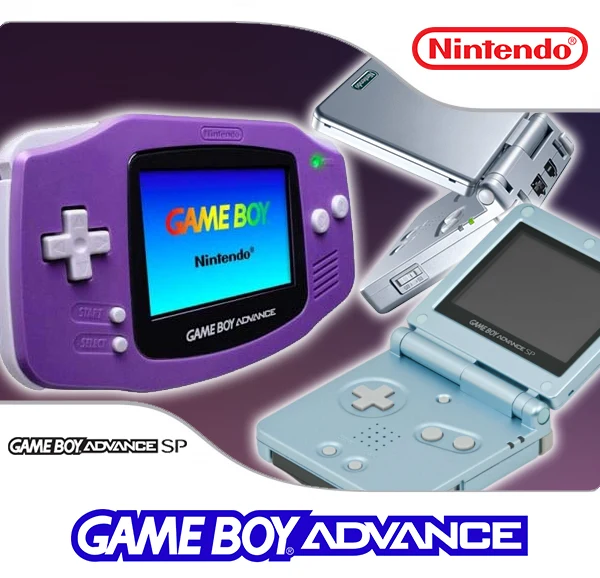
The original Game Boy Advance used a horizontal body, unlike the vertically oriented Game Boy and Game Boy Color. Its directional pad sat on the left, four face buttons on the right, and shoulder buttons along the top edge. The arrangement echoed the Super Nintendo controller and gave developers more input options than the older handheld’s two-button layout. The system used compact cartridges and remained compatible with both original Game Boy and Game Boy Color software. This backward compatibility was strategically important: buyers could purchase the new machine without abandoning an existing collection, while retailers could continue selling older games to the same audience.
The screen measured 2.9 inches diagonally and displayed 240 by 160 pixels. It was a reflective TFT color display capable of showing up to 32,000 colors simultaneously. A reflective screen used ambient light instead of a built-in lamp, conserving power but making visibility dependent on the environment. Outdoor light could make the image clear, while dim interiors often made it difficult to read. This was the central practical weakness of the launch model. Nintendo accepted that compromise in exchange for battery life, size, and cost, but users and accessory makers quickly showed that screen illumination was becoming an expected feature in a modern handheld.
What the hardware made possible
The Game Boy Advance used a 32-bit ARM-based processor running alongside hardware that supported the older Game Boy architecture. In ordinary terms, the new processor could handle more calculations and move more visual information than the original Game Boy’s 8-bit central processor. That allowed developers to create larger maps, more complex enemies, smoother animation, richer menus, and more elaborate sound. Because games still loaded from solid-state cartridges, they began almost instantly and did not depend on a fragile optical drive. The cartridge format also kept the device mechanically simple and well suited to travel.
The system was especially effective at two-dimensional graphics. Its hardware could arrange tiled backgrounds behind moving sprites, scroll scenery smoothly, and apply effects such as rotation, scaling, transparency, and distortion. A tile-based background stores repeated pieces of scenery rather than treating every screen pixel as a separate image, allowing developers to build large worlds within limited memory. These techniques made it possible for games to resemble the Super Nintendo era while adding more animation and interaction. F-Zero: Maximum Velocity, for example, used rapid scrolling to create a convincing sense of speed, while platform games could place more active objects on screen than their Game Boy predecessors.
The GBA also supported multiplayer through physical link cables. Depending on the software, two to four systems could exchange information or participate in a shared match. Some games required every player to own a cartridge; others offered single-cartridge modes in which additional systems received limited data from the host. This was less convenient than later wireless networking, but it gave local play a distinct social form. Players had to bring their handhelds, obtain the proper cable, and work within the limits of the game. The hardware therefore encouraged both solitary play and face-to-face group activity without needing an online infrastructure.
Launch software established the platform’s identity
Nintendo’s early games showed that the Game Boy Advance was more than a faster Game Boy. Super Mario Advance adapted Super Mario Bros. 2, known in Japan as Super Mario USA, with updated presentation and additional features. F-Zero: Maximum Velocity used the new processor and scrolling hardware to create fast racing without requiring polygonal 3D graphics. Castlevania: Circle of the Moon provided a substantial exploration-focused action game with interconnected areas, character progression, and a dark visual style. Together, these releases presented the GBA as a platform capable of both direct arcade action and longer-form adventure.
Nintendo also brought major Super Nintendo properties to the handheld. The Legend of Zelda: A Link to the Past and Four Swords combined a polished version of the Super Nintendo adventure with a new multiplayer component designed around connected systems. Mario Kart: Super Circuit translated the racing series into a portable format while adding original tracks and its own handling characteristics. Metroid Fusion reorganized the exploration formula around a more directed campaign, with stronger narrative pacing and carefully staged encounters. These games were not merely technical demonstrations; they showed how a familiar series could be reinterpreted for a smaller screen and shorter play sessions.
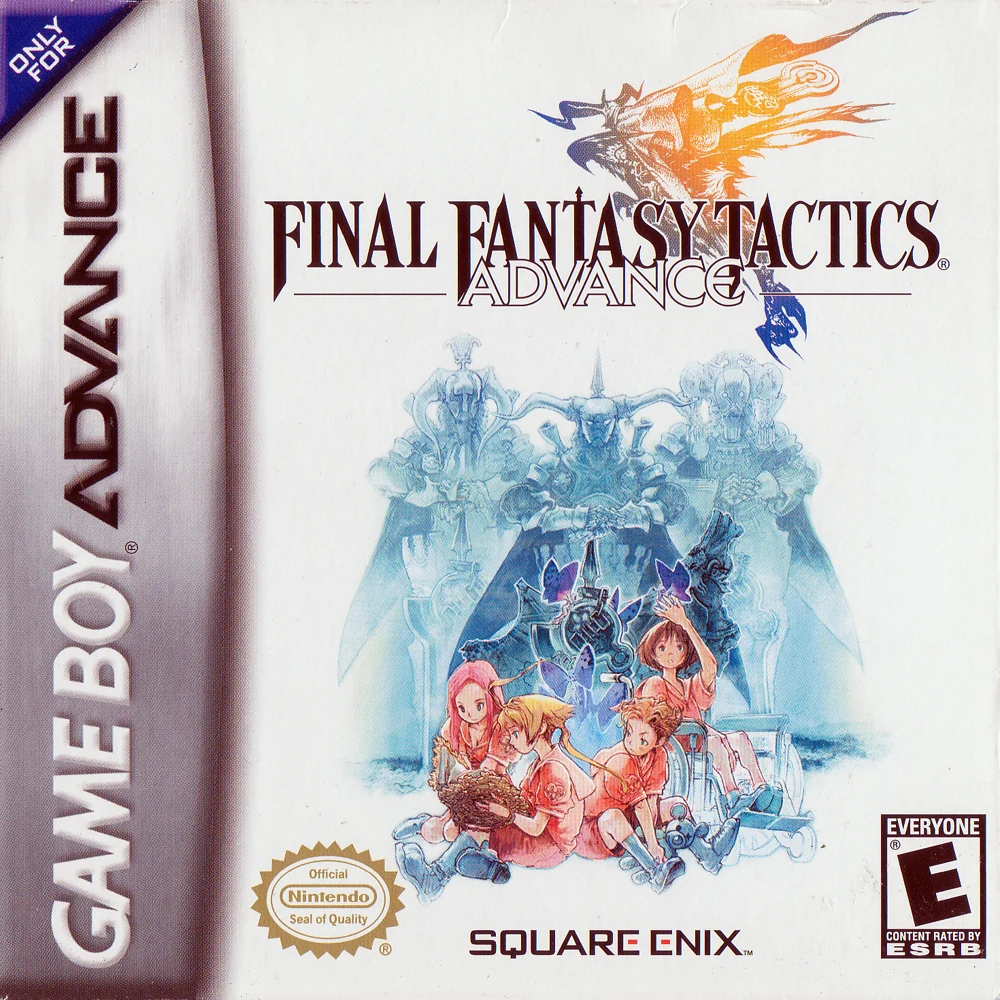
Third-party developers benefited from the GBA’s ability to support both original games and selective conversions. Capcom’s Mega Man Battle Network transformed the character’s action-game identity into a role-playing system with grid-based real-time combat. Konami continued to publish action and puzzle titles, while Square Enix and other Japanese publishers released role-playing games that emphasized menus, text, turn-based battles, and carefully drawn sprites. The cartridge format also encouraged remakes and collections from the NES and Super Nintendo periods. Some conversions changed graphics, music, controls, or content, but they gave the system a historical breadth that few contemporary portable libraries could match.
Pokémon and the growth of substantial portable games
Pokémon Ruby and Sapphire became the most important software turning point of the early GBA period. Nintendo released the games in Japan in November 2002 and in the Americas in March 2003, with Europe following later. They introduced the Hoenn region, new creatures, new characters, new environments, and revised competitive systems while preserving the series’ central loop of catching, training, trading, and battling. Nintendo’s fiscal reporting recorded more than 6.6 million combined sales in Japan and the United States within a relatively short period. The games demonstrated that the GBA could support an enormous long-term software ecosystem rather than only short portable diversions.
Pokémon’s significance extended beyond unit sales. Players returned to their cartridges for weeks or months, raised teams, searched for rare creatures, compared strategies, and traded with friends. The GBA’s link cable made ownership and exchange visible within schools, homes, and social groups. Later Pokémon software also connected with GameCube titles, giving the handheld a role in Nintendo’s larger hardware strategy. The platform did not need built-in networking to make Pokémon social; its cartridge saves, portable form, and physical link accessories were sufficient to support a community around the game.
Other role-playing and strategy games expanded expectations for portable depth. Golden Sun and Golden Sun: The Lost Age used animated battles, elemental abilities, puzzles, and a substantial narrative to make a handheld adventure feel expansive. Fire Emblem introduced many overseas players to a demanding strategy series in which positioning mattered and fallen characters could be lost permanently. Advance Wars made turn-based military tactics accessible through bright presentation and clear rules. Mario & Luigi: Superstar Saga, Final Fantasy remakes, and numerous Japanese releases gave the system variety beyond Nintendo’s most famous mascots. Mother 3 remained a Japanese-only release, but its later reputation among enthusiasts illustrates how GBA software continued to matter after its commercial period ended.
Competition and Nintendo’s connected hardware strategy
The Game Boy Advance competed with several systems that offered different approaches to portable gaming. SNK’s Neo Geo Pocket Color emphasized arcade-style play and a color display. Bandai’s WonderSwan and WonderSwan Color developed a following in Japan, while Nokia’s N-Gage later combined a mobile phone with dedicated gaming functions. Sony’s PlayStation Portable would arrive after the GBA’s launch and present a more direct challenge through optical media, multimedia features, and stronger three-dimensional graphics. These systems demonstrated that Nintendo could not depend on the Game Boy name alone. It needed a reliable software pipeline, broad retail reach, sensible hardware pricing, and a machine that suited everyday use.
Nintendo also promoted connections between the GBA and the GameCube. A cable could allow the handheld to function as a controller, display supplementary information, transfer data, unlock content, or support multiplayer. Some games explored the idea of giving each player a private handheld screen while the television showed shared action. Pokémon Colosseum could interact with Pokémon software on the GBA, and the Game Boy Player later made the portable library playable through GameCube hardware. These ideas were technically interesting and sometimes genuinely useful, but they required consumers to own multiple systems, the right accessories, and compatible games.
The connection strategy therefore worked best as an added benefit rather than the primary reason to buy a GBA. The handheld succeeded because it stood on its own. Its cartridges, battery operation, backward compatibility, and software library already offered a complete product. GameCube connectivity helped Nintendo link its ecosystems and encouraged additional purchases, but the average player did not need a home console to enjoy the GBA. This distinction matters because the platform is sometimes remembered mainly through experiments such as connectivity and the e-Reader. Those features were important parts of Nintendo’s thinking, but they supplemented a successful standalone handheld rather than defining its entire business.
The e-Reader and physical downloadable content
The e-Reader was one of Nintendo’s most unusual GBA accessories. It contained a scanner that read patterns printed on special cards. When a compatible card was passed through the device, the encoded data could add levels, items, music, minigames, or other material to a game. In an era before downloadable console content was a routine retail feature, the e-Reader offered a physical method of distributing small software additions. Players purchased cards, scanned them into compatible games, and in some cases connected the GBA to a GameCube to unlock additional content.
The concept received its broadest support in Japan, where the e-Reader launched on December 1, 2001 and became part of a larger ecosystem of cards and compatible software. North America also received the accessory and selected card products. The format was inventive because the data was not simply printed information; the card’s visual pattern carried instructions that the hardware decoded. It also fitted Nintendo’s existing retail strengths, allowing expansions to be sold as tangible objects that could be collected, traded, and displayed.
The e-Reader’s practical complications limited its reach. The accessory extended from the handheld, cards could be lost or damaged, and users needed both compatible software and a supply of cards. Some content was difficult to access outside its original region, while the hardware could make the GBA less portable. Nevertheless, the e-Reader anticipated later ideas associated with downloadable content, collectibles, toys-to-life products, and physical items that modify a game. It showed Nintendo experimenting with post-release expansion while still working within the company’s traditional cartridge-and-retail economy.
Game Boy Advance SP corrected the original model
Nintendo released the Game Boy Advance SP in Japan on February 14, 2003, North America on March 23, and Europe on March 28. The SP used a clamshell body that folded the screen against the controls, protecting the display during transport and making the machine more compact. Its most important improvement was a built-in front light that could be switched on or off. This did not illuminate the screen from behind in the same way as a later backlit display, but it made indoor play practical and addressed the original GBA’s most persistent criticism.
The SP also replaced disposable batteries with a rechargeable lithium-ion battery and included an AC adapter. Its metallic colors and folding shape gave it the appearance of a more refined personal electronic device, while retaining compatibility with Game Boy, Game Boy Color, and Game Boy Advance cartridges. The redesign had compromises. The standard body omitted a built-in headphone socket, requiring an adapter, and some players preferred the larger hand position of the original horizontal model. Even so, the combination of screen illumination, battery convenience, protection, and portability made the SP the version many consumers regarded as the definitive GBA.
Nintendo’s financial reporting shows the effect of the redesign. During the fiscal year ending March 31, 2003, combined sales of Game Boy Advance and Game Boy Advance SP hardware reached 15.65 million units, bringing life-to-date sales to 33.81 million. These figures combine models rather than presenting SP sales alone. The distinction is important because Nintendo’s reporting commonly grouped the family together. The SP extended the commercial life of the platform, encouraged existing owners to upgrade, and gave retailers a fresh hardware story without forcing developers to build a separate software library.
Game Boy Player, special editions, and Game Boy Micro
Nintendo expanded the platform through the Game Boy Player, an accessory that attached to the underside of the GameCube and allowed Game Boy, Game Boy Color, and Game Boy Advance cartridges to be played on a television. The device relied on GameCube hardware and software, so it was not a separate home console or a new GBA model. Its importance was practical: players could use a large screen for role-playing games, multiplayer sessions, and games whose small portable display was difficult to share. It also reinforced Nintendo’s idea that one software collection could move between portable and living-room settings.
The GBA family received numerous cosmetic variations, including themed editions connected to Nintendo’s history. The Classic NES series and Famicom-styled SP linked the modern handheld to older software and hardware traditions, while Zelda, Mario, Pokémon, and other special editions appealed to collectors and fans. These revisions did not fragment the main software base. A new color or shell could renew consumer interest while preserving compatibility with the same cartridges. The strategy was commercially efficient because Nintendo could create new retail attention without requiring developers to support a fundamentally different platform.
Nintendo released the Game Boy Micro in Japan on September 13, 2005. It was a much smaller GBA-only system with a two-inch backlit screen, adjustable brightness, a metal body, and interchangeable faceplates. Unlike the original GBA and SP, it could not play original Game Boy or Game Boy Color cartridges. Nintendo presented it as a compact fashion-oriented extension of the family and stated in its Japanese announcement that the GBA and SP had already sold more than 67 million units. The Micro was distinctive, but its timing was difficult: Nintendo DS had launched in 2004 and was becoming the company’s main handheld direction. The Micro therefore served a narrower audience than the SP.
Cultural impact and the preservation of older games
The Game Boy Advance arrived when portable gaming was expanding across age groups. Its library included children’s brands, sports, licensed games, Japanese role-playing games, strategy, puzzle games, experimental short-form software, and traditional console franchises. The hardware was simple enough for quick sessions but powerful enough for campaigns lasting dozens of hours. This flexibility helped the GBA serve different kinds of players without losing a clear identity. A person could use it for a few minutes of platforming on a journey or spend an entire month developing a Pokémon team or completing a strategy campaign.
The system became an important vehicle for Nintendo’s early commercial preservation efforts. Super Mario Advance, The Legend of Zelda: A Link to the Past, the Classic NES series, and numerous remakes brought older games to people who had never owned the original systems. These were often adaptations rather than perfect reproductions. Graphics, sound, dialogue, controls, multiplayer features, and even level behavior could change. Nevertheless, the GBA made a curated portion of Nintendo’s back catalog portable and gave older designs a continuing commercial life before digital libraries became the normal way to distribute classic games.
The platform’s limitations shaped its cultural character. Its cartridges made games feel like physical possessions, its small screen encouraged close personal play, and its link cables created visible local communities. It lacked built-in wireless networking, an online account ecosystem, and a general multimedia interface. Those omissions made it less flexible than later handhelds, but they also kept the device focused on games. The GBA represented a mature form of the classic dedicated handheld: durable, self-contained, easy to start, and supported by software that treated two-dimensional design as a strength rather than an outdated compromise.
The Nintendo DS transition and the platform’s final totals
Nintendo announced the Nintendo DS in 2004 as a different kind of handheld rather than a simple faster successor. It used two screens, a touch screen, a microphone, wireless communication, and new software possibilities. Yet the DS included a second cartridge slot for Game Boy Advance games, allowing owners to carry part of their existing library into the new generation. This backward compatibility reduced the risk of transition. Consumers could buy the DS for new experiences without immediately making their GBA cartridges useless, while Nintendo could move development toward the DS at a controlled pace.
The transition was gradual. Pokémon FireRed and LeafGreen refreshed the original Pokémon adventures, while Metroid: Zero Mission, The Legend of Zelda: The Minish Cap, Kirby & the Amazing Mirror, Mario Tennis: Power Tour, and other late-period games maintained the GBA’s identity. Nintendo’s European history lists several special editions released during 2004, including Tribal, Classic NES, pink, Zelda, and Mario versions. These products kept the platform visible even as the DS’s touch controls and wireless features attracted the company’s strategic attention.
Nintendo’s consolidated sales data records 81.51 million Game Boy Advance family hardware units and 377.42 million software units worldwide. These are lifetime platform totals, not sales for the original launch model alone, and the hardware total includes the associated GBA family revisions. The figures confirm the platform’s scale without requiring unsupported claims about individual versions. By the middle of the 2000s, the DS had become Nintendo’s primary handheld growth platform, but the GBA had already completed its central task: it modernized the Game Boy tradition, carried forward a large historical software library, and created a bridge between the cartridge handheld era and Nintendo’s more experimental future.
Lasting influence and why the GBA remains important
Preserving the Game Boy Advance is more complicated than preserving a file on a modern digital platform. Original play may require aging cartridges, functioning save batteries in some games, compatible link cables, region-specific accessories, and hardware with a readable screen. The e-Reader, Game Boy Player, wireless accessories, and multiplayer modes add further dependencies. A complete preservation record therefore includes not only the program data but also revisions, manuals, packaging, peripherals, regional releases, save methods, and the physical context in which the software was used.
The GBA’s software continues to attract attention because its constraints produced a coherent design language. Developers had to make sprites readable at low resolution, compose music within limited memory, design menus that worked on a small display, and create animation that communicated clearly without excessive resources. Games such as Metroid Fusion, Advance Wars, Fire Emblem, WarioWare, Golden Sun, Mario & Luigi: Superstar Saga, and The Minish Cap show how varied the results could be. Later remakes, independent games, and retro-inspired projects continue to draw from the platform’s visual clarity and compact structure.
The Game Boy Advance’s historical significance is therefore broader than its sales. It demonstrated that a successor could modernize an established platform while preserving backward compatibility, that a handheld could host substantial console-style adventures, and that two-dimensional graphics could remain commercially important during the industry’s rapid move toward 3D. The original model’s unlit display exposed the limits of Nintendo’s cost and battery compromises; the SP showed how a thoughtful revision could correct those weaknesses; and the Micro illustrated the difficulty of launching a niche refinement after a new generation had already changed the market. Between the enduring Game Boy past and the experimental Nintendo DS future, the GBA became Nintendo’s most complete expression of the classic cartridge handheld.