The vocabulary problem
“Decompilation” is often used as a convenient label for several different activities. That is understandable in casual conversation, but it becomes misleading as soon as a project makes claims about what it recovered, what it can reproduce, or what rights it has to distribute. A disassembly, a reconstructed C implementation, a native port, and an unauthorized source leak may all be discussed as if they were interchangeable. They are not. Each begins with different evidence, produces a different kind of artifact, and raises different questions about provenance and distribution.
Disassembly translates machine instructions into assembly-language notation. The result may be extremely useful: researchers can assign labels, identify data tables, annotate hardware operations, define macros, and gradually make an assembly listing understandable. The result is still assembly, however. It does not imply that the original developers wrote assembly by hand, nor that a readable listing has recovered their source files, variable names, comments, or build system. The Sonic Retro collection, for example, contains substantial assembly-focused work on Mega Drive and Genesis games. Such projects can illuminate a game’s low-level behavior without attempting to produce matching C source.
Decompilation, in the narrower source-reconstruction sense, means inferring higher-level logic from an executable representation. Researchers may reconstruct functions, structures, types, control flow, constants, and data relationships in C or another language. The code is source-like because it expresses the inferred logic in a form people can read and modify. It is not automatically the historical source. Names may be assigned by researchers, types may be hypotheses, and the organization of files may reflect the reconstruction project rather than the original studio’s repository.
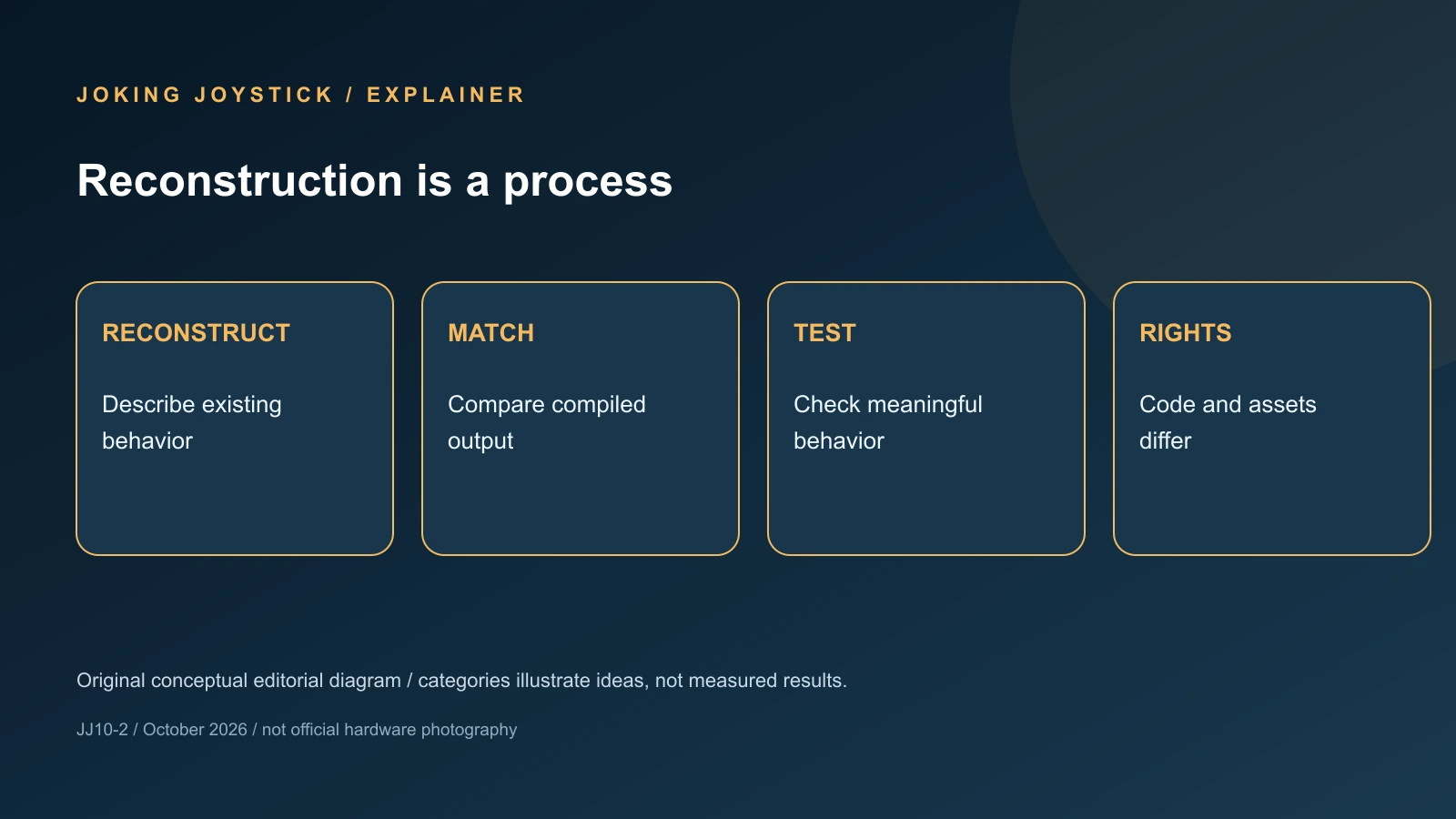
Matching reconstruction adds a stricter target. The reconstructed source is compiled with a specified toolchain, and its output is compared with a known executable or object file. A function may receive an “OK” result when the generated instructions match the target, or a “FAILED” result when they do not. The goal is not merely to create code that behaves similarly or looks plausible. It is to reproduce a particular artifact under particular build conditions.
That distinction matters because a readable function can be semantically convincing and still fail to match. A different structure layout, signedness choice, compiler optimization, register allocation, or instruction order may alter the output. Conversely, code that matches the bytes may not resemble the historical source in its names, comments, declarations, or file boundaries. Matching constrains the result; it does not authenticate the source tree from which the original binary was built.
Recompilation is the broad act of producing a new executable from source or another intermediate representation. Ordinary source recompilation is one narrower case: compiling source again, often after changes or on another system. A developer may rebuild a recovered or reimplemented program with a modern compiler and obtain a working executable without attempting to reproduce the original bytes. That build can support preservation and modification, but it does not by itself establish byte identity.
A source port adapts a program to another platform. It may replace the renderer, input system, or other platform-facing layers, but those changes should be tied to the specific project rather than assumed. It may use a decompilation as a foundation, while its purpose is to produce a playable program on a new target rather than reproduce the old executable. Ship of Harkinian is documented as a PC port associated with Ocarina of Time decompilation work; the port and the reconstruction remain related but distinct activities.
Finally, stolen or leaked source means an original source tree or development archive was disclosed without authorization. That is a provenance claim, not a technical description of decompilation. A leaked source tree may contain original comments, symbols, build scripts, and assets, but its authenticity and the conditions of its disclosure still require evidence. Calling reconstructed C “leaked source” is false; calling a leak a decompilation disguises how it was obtained.
Cleanroom development belongs in a separate category. It describes an information-separation process in which one group documents observable requirements or behavior and another implements software without access to protected implementation details. A project is not cleanroom merely because it is open source, independent, or based on public observations. Nor is cleanroom a universal answer to copyright or contract questions. The process must be documented, and its legal significance depends on the specific facts and jurisdiction.
These terms establish the questions an AI-assisted project must answer. What was the input: instructions, behavior, manuals, or an original source archive? What is the output: assembly, source-like C, a matching binary, or a new port? What evidence verifies it? And what material is being distributed? Without that vocabulary, a generated function that merely looks like source can be mistaken for history.
Rebuilding understanding
A reconstruction begins with an executable that records decisions but does not explain them. Machine code reveals operations, branches, memory accesses, constants, calls, and sometimes recognizable data structures. It does not directly reveal why a function exists, what a field was called, which declaration produced a layout, or whether a strange operation was deliberate, compiler-induced, or the consequence of undefined behavior. The practical task is therefore not “turn binary into C” in one automatic step. It is to build an evidence-backed account of what the program does.
Researchers infer function boundaries, calling conventions, global data references, stack layouts, pointer relationships, control flow, and interactions with hardware or operating-system services. They compare repeated patterns, inspect callers and callees, trace values through memory, and use known platform behavior to narrow possibilities. A number may be a signed coordinate, an unsigned bit field, a pointer offset, or a temporary compiler artifact. The surrounding instructions and data references determine which interpretation remains plausible.
The Ocarina of Time workflow makes this process visible. Unresolved routines can remain as assembly inclusions while contributors work on replacements in C. A proposed replacement is compiled, and the project’s matching test reports whether the generated result agrees with the target. That feedback is more informative than visual resemblance. It tells the researcher that a particular set of declarations, operations, and compiler conditions produced the expected instruction sequence—or that something in the hypothesis remains wrong.
A candidate can fail for reasons that are invisible in a casual code review. Choosing a 16-bit field where the target behavior implies a 32-bit field changes loads, stores, promotions, and structure offsets. Treating a value as signed can alter comparisons and shifts. Reordering declarations can change padding. A compiler may inline one function but not another, preserve a register in a surprising way, or schedule instructions around a dependency. An expression that is equivalent under ordinary arithmetic may compile differently because the language permits, forbids, or leaves certain behavior undefined.
This is why “plausible” is a weak technical category. Plausible code may explain a branch and produce sensible gameplay while still failing the reconstruction’s comparison. That does not necessarily mean the researcher misunderstood the game’s behavior. It may mean the source-level formulation does not reproduce the compiler’s route to the observed bytes. Reconstruction operates simultaneously at two levels: explaining the program and reproducing the artifact.
Three kinds of equivalence should be kept apart.
- Semantic equivalence means two implementations express substantially the same underlying computation or purpose. Their internal organization and compiled output may differ.
- Behavioral equivalence means they produce the same observed results for a defined set of inputs, environments, timings, and external interactions. It is always bounded by what has been tested.
- Byte equivalence means the generated object, executable, or selected region matches a target representation under specified build conditions.
Byte identity is powerful evidence, but its scope must remain precise. If a project documents the target hash, compiler, linker, build variables, and comparison method, a match shows that the project reproduced that artifact under those conditions. It does not prove that the reconstructed C is the source Nintendo, Microsoft, or another publisher historically stored. Different source trees can compile to the same output, particularly when names and comments are discarded. Even identical source text would not, by itself, prove which working copy was used during development.
This is where AI belongs in the evidentiary model. A language model can propose a function body, suggest a type, recognize a common control-flow pattern, generate comments, or help search a large collection of assembly and decompiler output. Those proposals may reduce the effort required to explore hypotheses. They remain hypotheses until the project’s own tests accept them. A human review gate may reject a syntactically polished answer because its aliasing assumptions are wrong; a matching build may reject a more convincing answer because one declaration changes the output.
The same caution applies in the other direction. A repository with scripts, automation, generated files, or rapid progress does not prove that AI was used. Disassemblers, compilers, binary diff tools, permutation search, and custom build systems can produce highly automated workflows without a model. AI attribution should come from explicit project disclosure, not from the appearance of the code or the enthusiasm surrounding it.
Super Mario 64 and version matrices
Super Mario 64 is a useful corrective to the phrase “the game was decompiled.” The project associated with the game does not treat every release as one interchangeable binary. Its documented targets include Japan, North America, Europe, Shindou, and the iQue Player. Those versions differ in code, data, platform assumptions, or build history. Each target must be identified before a matching claim has a clear meaning.
The basic unit of reconstruction is therefore not simply a title. It is a version matrix: region or market release, revision, hardware or platform variant, compiler configuration, linker behavior, and the inputs used to assemble the build. A North American target hash identifies one artifact. Matching that artifact does not establish a match for the Japanese release, the European release, Shindou, or the iQue Player adaptation. The same gameplay idea may exist across versions while the instruction sequence, assets, memory layout, and build variables differ.
Compiler settings are part of that identity. Optimization choices, assembler behavior, include paths, symbol ordering, and linker layout can all affect the final image. So can the precise asset set and the way data is converted into the format expected by the build. A statement such as “the source compiles” is consequently incomplete unless it identifies which target was built and whether the result was merely executable or actually matched.
The project’s build instructions make another boundary explicit: required game assets are not included in the repository, and a user-supplied prior ROM is used for extraction. That arrangement means the repository contains reconstruction code and tooling rather than a freely redistributed copy of the game’s copyrighted data. It does not turn the surrounding legal questions into a simple yes or no. Asset omission is a distribution choice. It is not a court ruling, a universal license, or proof that every act performed by every user is authorized.
Nor should the absence of assets be confused with an absence of technical dependency. A source tree can be complete enough to describe code while remaining unable to produce a faithful game image without the correct data inputs. Textures, geometry, sound data, animations, fonts, and other resources may be essential to the resulting artifact even when they are intentionally excluded from the repository. A code-only checkout is not necessarily a self-contained preservation package.
The version matrix also changes how progress should be reported. “Super Mario 64 is decompiled” may be useful as a shorthand in conversation, but it conceals the meaningful qualifier: which release, which target hash, which build mode, and which components remain unresolved? A careful account might instead say that a specified regional or platform build is supported, that certain source files match under documented conditions, or that the project builds when the user supplies the required data. The narrower wording is less dramatic and more informative.
Project completion labels deserve similar care. A repository may describe a target as complete, near-complete, or matching according to its own progress system. Those labels are legitimate descriptions of project status, but they should not be expanded into claims the documentation does not support. A completion badge may mean that all known functions have source replacements, that a selected build matches, or that the repository has reached a particular milestone. It does not automatically demonstrate that every release matches, every asset is present, or every gameplay path has been independently tested.
This matters especially when comparing AI-assisted efforts with established projects. A model may generate replacements for one release while another release still contains assembly or unsupported code. Counting generated functions without specifying the target would blur unlike tasks. One version may have clear symbols and existing research; another may differ in compiler behavior or data organization. Any meaningful comparison would need a defined corpus, a common verification standard, and a documented baseline. The available project descriptions do not justify invented productivity rates or field-wide conclusions.
Super Mario 64 also demonstrates why player-facing documentation cannot substitute for implementation evidence. A manual can describe controller assumptions, movement, objectives, and expected player behavior. It cannot tell a researcher whether a collision value is stored as a fixed-point number, how a particular actor list is laid out, or which compiler decision produced a branch sequence. Behavioral descriptions are valuable oracles for testing, but they are not historical source files.
The responsible presentation is therefore conditional: a specified Super Mario 64 reconstruction targets specified releases and relies on specified inputs. Its documented hash and build process support claims about those targets only. The result may be useful for study, modification, or downstream porting, but neither a matching North American image nor an asset-omitting repository should be described as representing every version of the game or resolving all rights questions.
Ocarina of Time: stubs to matching source
Ocarina of Time offers a particularly clear view of reconstruction because the project exposes an intermediate state rather than presenting a magical conversion from ROM to finished source. Its repository supports particular retail and debug versions, each associated with its own data and target information. The project asks users to provide the relevant game data. The work proceeds version by version, function by function.
At the beginning of that process, some routines remain in assembly. The build system’s GLOBAL_ASM mechanism marks those unresolved functions and includes the existing low-level implementation while the rest of the project is compiled around it. This is an important technical and editorial detail. A repository can contain C files, headers, scripts, and a functioning build while still relying on assembly for portions that have not yet been reconstructed. “Has source” is not the same as “every routine has a verified C replacement.”
Replacing a stub requires more than translating each instruction into an equivalent-looking line. Researchers inspect how the routine is called, which registers carry arguments, what memory offsets are accessed, whether a value is a pointer or an integer, and how the result is consumed by other functions. They infer structure layouts from repeated accesses and compare the routine with neighboring code. A name such as updateActor may summarize observed behavior, but it is a researcher’s label unless historical documentation directly authenticates it.
The first C version may compile and even appear to behave correctly. The matching test then supplies a stricter question: does the chosen source, built with the project’s toolchain and settings, produce the target routine or object? An “OK” result supports that limited claim. A “FAILED” result directs attention back to the hypothesis. The cause might be an incorrect type, a misplaced field, an expression with different promotion rules, a changed declaration order, or a compiler decision that produces different registers and instructions.
This process explains why a matching reconstruction is not simply a cleaned-up disassembly. Assembly can preserve exact operations while leaving the higher-level structure implicit. C reconstruction makes those relationships explicit, but it must do so without losing the details that determine the target output. The source is readable because researchers have added abstractions. It remains constrained because the generated binary is compared against evidence from the original executable.
Nor is the project an original-source leak. The evidence begins with executable material and associated analysis, not with an authenticated Nintendo source tree. The resulting names, comments, types, and file divisions are interpretive layers. They may be excellent explanations of the program, and they may be constrained tightly enough to reproduce the target, but they do not establish what the original engineers called a variable or how their internal repository was organized.
The workflow is also not automatically a cleanroom implementation. Cleanroom generally depends on separating a specification team from an implementation team so that the implementers do not receive protected implementation details. A matching reconstruction instead commonly involves direct examination of the executable and iterative comparison with it. Whether that process has legal significance depends on facts beyond the repository’s technical description. It should not be relabeled cleanroom merely because the project did not possess the original source.
Ocarina of Time further shows why reconstruction and porting must remain separate. A reconstruction seeks to explain and, in a matching configuration, reproduce a particular Nintendo binary. A PC port seeks to make the game operate within a modern platform environment. Depending on the documented project, that can involve adaptations to rendering, input, windowing, audio, file handling, display modes, or asset loading. These changes can be valuable while moving the result farther from the original executable. They should be attributed only where the port documents them.
Ship of Harkinian should be described more narrowly here: its documentation presents a playable PC port associated with Ocarina of Time decompilation work and extracted game data. Its player-facing features and platform adaptations are evidence about the port’s engineering goals, not proof that the underlying reconstruction was itself a PC port. A modern rendering backend shows that the port supplies a replacement or adaptation for its target environment; it does not show that the original N64 renderer has been recovered.
Assets create a second boundary. The reconstruction project requires user-supplied game data, while a downstream port may convert or package extracted resources for its own runtime. Code, data extraction, and redistribution therefore need to be described separately. A repository that omits the original game data has reduced what it distributes, but that omission does not settle whether a user’s extraction, modification, or sharing is lawful. It is neither an invitation to reproduce copyrighted material nor a legal clearance certificate.
AI can participate anywhere in this workflow, but its output remains subordinate to the same gates. A model might suggest a C replacement for a GLOBAL_ASM stub, infer a likely structure, or explain a control-flow pattern. The project must still compile the proposal, compare the result, inspect failures, and decide whether the interpretation is defensible. If a repository explicitly discloses LLM assistance, that is evidence about the reported workflow. It is not evidence that the model recovered Nintendo’s historical source, nor that every generated function is correct.
The durable achievement is therefore not a fictional return of the original repository. It is a layered reconstruction: executable evidence, researcher interpretation, compiler-constrained source, and documented tests. The closer the project gets to matching a specified target, the stronger its account of that target becomes. But the account remains an account built from evidence. It should be presented as reconstructed understanding, not as an authenticated source tree that appeared from nowhere.
Compiler archaeology
A matching reconstruction is not finished when its source is readable or when its executable runs. Those achievements answer useful questions, but neither establishes that the build reproduces the target artifact. Matching asks a narrower and more demanding question: can this source, under a specified set of tools and settings, emit the same object code or executable bytes as the historical target? The compiler is therefore part of the evidence. Its provenance is not an incidental footnote about obsolete development environments; it helps define the conditions under which a claimed reproduction can be evaluated.
Nintendo 64 work illustrates this especially clearly. The development environment associated with many N64 programs was Silicon Graphics’ IRIX Development Option, usually abbreviated IDO. Matching-oriented projects document versions such as IDO 5.3 and IDO 7.1, and some efforts reconstruct or adapt compiler components so that source can be tested against the output of those environments. The purpose is not to suggest that every N64 project requires precisely the same version. It is to establish which compiler behavior belongs to the particular target being studied.
Compiler version can affect ordinary-looking source in several ways. An optimizer may decide to inline a small function, leave it as a call, or transform a sequence of arithmetic operations into a different instruction pattern. It may use a register for a value in one circumstance and spill that value to the stack in another. The application’s behavior can remain unchanged while the generated instructions differ. A source file that looks like a convincing reconstruction can consequently compile into an executable that is correct in broad semantic terms but fails an object-level comparison.
The application binary interface, or ABI, adds another layer. An ABI specifies conventions for passing arguments, returning values, preserving registers, aligning data, and representing types at the machine boundary. A reconstruction may assign the right conceptual meaning to a function while using a declaration that causes arguments to be passed differently. A signed and unsigned interpretation can change extension instructions and comparisons. A pointer-sized field, a packed structure, or an aligned array can shift every later member. These are not mysterious compiler quirks; they are consequences of the interface between source declarations, compiler rules, and the target processor.
Structure padding is particularly easy to underestimate. Two source definitions can describe fields in the same apparent order while producing different offsets because of alignment rules or inserted gaps. A later load from an object then uses a different displacement, and the mismatch spreads into every caller that accesses the structure. Declaration order can matter even when the declarations appear unrelated. It can influence the layout of composite types, the order of emitted data, the visibility of inlines, or the arrangement of symbols passed to a later build stage.
Inlining and register allocation expose a similar distinction between source meaning and machine form. A function call visible in the reconstructed C may never have existed as a call in the target binary because the historical compiler expanded it at the call site. Conversely, a programmer may have written a compact expression that the compiler retained as a separate operation. Register allocation then determines where intermediate values live and when they are moved or spilled. A small change in a type, aliasing assumption, or surrounding statement can alter those choices without changing what a player observes.
Instruction scheduling matters on processors whose pipelines and hazards make operation order significant to the generated image. The compiler may move an instruction into a delay slot, preserve a particular dependency, or arrange loads and arithmetic differently from a modern compiler. Some scheduling decisions are tied to target architecture knowledge; others are tied to the optimizer’s historical implementation. Reconstructors therefore study the output as evidence of compiler behavior rather than assuming that a cleaner or more modern source formulation will generate the same sequence.
The linker supplies another set of constraints. Separate object files must be placed into sections, symbols must be resolved, relocations must be applied, and alignment must be preserved. Link-time optimization or code generation can change function boundaries and the order in which code appears. Even if each source file compiles to a plausible object, the final executable can differ because the linker lays out sections, merges data, or emits metadata differently. A whole-image comparison consequently requires information about the link step, not only the language compiler.
Halo 2 demonstrates that these issues are not limited to the N64. Its matching work documents a target Xbox executable, identified through an XBE hash, together with the relevant Xbox SDK and Microsoft compiler details. The project also records link-time code generation and byte-matching goals. In that environment, the question is not whether an N64-era compiler can be recreated. It is whether the documented Microsoft toolchain, SDK assumptions, and linker behavior can produce the observed Xbox artifact. The platform and tools change; the evidentiary principle does not.
That comparison also prevents an easy but inaccurate story about “old compilers.” Historical toolchains can be difficult to obtain, configure, or reproduce, but the research does not support claiming that they are universally impossible to recover. IDO-focused work documents compiler components and matching experiments. Halo 2 work identifies a Microsoft toolchain and pursues output comparison. Super Mario 64 and Ocarina of Time projects likewise document historical or compatible build environments. The relevant question is always which parts of the environment have been established for the target, not whether an entire generation of tools is presumed irretrievable.
Compiler provenance also helps interpret negative results. If a candidate function fails to match, the failure may indicate a wrong hypothesis about control flow or data types. It may instead indicate that the source is being built with a compiler whose optimization, ABI, assembler, or linker behavior differs from the target. A responsible project records those possibilities and narrows them through controlled comparison. It does not treat every mismatch as proof that the reconstructed logic is conceptually wrong.
For readers, the practical conclusion is precise. A matching claim should identify the target binary or object, the platform and variant, the compiler family and version where known, relevant SDK or libraries, link-time behavior, and the comparison method. Those details allow another researcher to understand what has been reproduced. They also prevent a working modern build from being mistaken for a historical rebuild. Compiler archaeology is therefore not nostalgia for obsolete software. It is the process of identifying the conditions under which binary evidence can support a reconstruction claim.
Disassembly and matching reconstruction
Assembly disassembly and C-level matching reconstruction are often placed on a ladder, as though one were an unfinished version of the other. That hierarchy is misleading. They are different outputs with different strengths. A disassembly can preserve a close view of the machine’s operations and expose details that a higher-level reconstruction may hide behind types and expressions. A C reconstruction can make relationships easier to search, modify, and discuss while remaining accountable to a target binary. Neither format automatically provides a more authoritative account of the original program.
The assembly-focused projects collected by Sonic Retro show what a substantial disassembly can contain. Researchers can assign labels to routines and data, add comments, define macros, organize sections, and identify tables or hardware interfaces. They may turn a stream of addresses into an intelligible map of the game. A disciplined disassembly can express control flow clearly and document assumptions about registers, memory locations, and object formats. Its output remains assembly, even when the annotations make it much easier for humans to understand.
That distinction is important because assembly notation does not prove that the historical developers wrote the program in assembly. A compiler may have produced the instructions from C or another language. Labels assigned by a modern researcher are not necessarily original symbols, and comments added during analysis are explanations rather than recovered documentation. The disassembly is a representation of the executable, enriched by interpretation. It is not an authenticated copy of the studio’s source tree.
Low-level representation nevertheless has an analytical advantage. It can expose exact loads and stores, register lifetimes, branch delay behavior, bit operations, hardware-facing sequences, and timing-sensitive arrangements. When a function interacts with a console register or a tightly specified data format, the assembly may preserve evidence that is difficult to express without making assumptions about types. A researcher investigating a suspected structure can compare offsets directly rather than relying on a guessed C definition.
Matching reconstruction works in the opposite direction from that low-level evidence. The researcher proposes source-level abstractions—functions, structures, enumerations, pointers, arrays, and control-flow constructs—and tests whether they produce the target output. The project may retain assembly stubs for unresolved routines while progressively replacing them with C. This is not a contradiction. Assembly provides a verified or provisional implementation for a portion of the program; C replacements are accepted only when their compiled output meets the project’s comparison requirements.
A C file can therefore be more readable without being less constrained. Its types and names help contributors search the codebase, discuss behavior, and make changes. Its declarations also influence the compiler, which means every abstraction carries reconstruction consequences. Choosing a 32-bit field rather than a pair of smaller values may produce the correct access pattern in one function and the wrong structure layout in another. A convenient helper function may introduce a call or an inline expansion that the target does not contain. Source-level clarity and machine-level fidelity must be balanced rather than treated as identical goals.
The distinction also clarifies what each project is trying to preserve. An assembly disassembly may aim to document the original instruction stream in a form that can be assembled or studied. A matching C project may aim to recreate a particular executable using source that contributors can progressively understand and modify. A source port may then use that reconstruction as one component while changing platform services. Reporting all three as “the source” erases the evidence chain.
Platform identification should accompany every account. A Genesis assembly disassembly and an N64 matching project do not expose the same processor model, ABI, memory arrangement, or development history. Even two projects for the same console may target different regions, revisions, or compiler environments. The expected output should be named as well: annotated assembly, assembled machine code, matching object files, a whole executable, or a playable port. Without those qualifiers, readers cannot tell whether a repository is documenting instructions or attempting to reproduce a historical build.
Modern tooling does not settle the question of AI involvement. A disassembler, syntax highlighter, binary diff tool, generated header, or active repository may be entirely conventional automation. A project can use extensive scripts and still make no claim that a language model contributed. Conversely, a matching project may explicitly disclose LLM-assisted tooling or model-generated proposals. Only that disclosure supports an account of AI use. The presence of generated-looking comments or rapid activity is not evidence.
Where AI is documented, the same distinction between proposal and verification applies. A model might translate a block of assembly into an initial C function, suggest names for registers, or identify a recurring idiom. The proposal remains subject to compilation, comparison, review, and correction. A human reviewer may accept a useful explanation while rejecting a type choice that changes the output. A matching test may reject code that appears elegant because the compiler takes a different route. The model’s participation does not alter what counts as a successful reconstruction.
Nor should the presence of assembly stubs be used as a simplistic measure of failure. A project can be making meaningful progress while unresolved routines remain in low-level form. Those stubs may preserve a known implementation and allow other parts of the source to be tested. The important report is which functions or objects have been replaced, which remain in assembly, and what comparison method supports the status. “Partly in assembly” describes an output state; it does not by itself rank the project’s quality.
Disassembly and matching reconstruction are best understood as complementary ways of organizing evidence. Assembly can keep the machine’s exact behavior visible. C can express hypotheses about the program’s higher-level organization. A project may move between them repeatedly as new comparisons reveal that an apparently reasonable abstraction is wrong. The result is not a recovered historical narrative in every detail. It is a documented, testable model of a specified executable—sometimes close enough to reproduce its bytes, sometimes primarily valuable as an understandable account of how those bytes work.
Static recompilation
Static recompilation offers another route from an old executable to a program that can run as a native executable on a newer platform. The name can sound similar to ordinary recompilation or decompilation, but the underlying operation is different. Rather than recovering the developers’ source structure and rebuilding it through the original compiler, a static recompiler processes instructions from the binary and emits another representation, often C or generated machine code, together with metadata and a runtime layer.
For the N64Recomp case, the input is the binary’s instruction stream together with metadata established around it. The tool processes instructions and emits literal C-oriented output, metadata, relocation information, and runtime requirements so the translated program can be built. That output may be readable enough to inspect, but its purpose is to encode the binary’s operations for a new build process. It should not be described as a general recovery of human-authored C or of the original developers’ abstractions.
This is not the same as recovering human-authored C. The original developers may have used abstractions that disappeared during compilation, chosen names that cannot be inferred from instructions, or organized source files in ways the executable does not preserve. A static recompiler has no automatic access to those design decisions. Its generated functions may reflect instruction boundaries rather than the original functions, and its types may be selected to preserve machine behavior rather than to express meaningful game concepts.
Metadata helps bridge the gap between raw instructions and a buildable output. Symbol boundaries, when known, can tell the tool where one routine ends and another begins. Relocations describe addresses that must be adjusted when code or data moves. Overlays or separately loaded regions may require the recompiler to preserve distinct address spaces or loading assumptions. Branch targets and jump tables must be represented accurately. These details allow the generated program to retain relationships found in the original executable without claiming that the original source organization has been recovered.
Runtime services are equally important. A translated instruction stream may expect console memory behavior, graphics interfaces, controller input, audio devices, timing, file access, threading, or other platform facilities. The native executable needs replacements or compatibility services for those expectations. Some services can be mapped closely to the host system; others require an implementation that approximates the old environment. The presence of a generated executable therefore says that the translation pipeline and its runtime produced a runnable artifact. It does not, by itself, establish that every original platform interaction has been preserved in every circumstance.
The distinction between a native executable and a recovered source tree is especially important in public descriptions. A recompiler can emit C and compile it with a modern compiler, yet the C may be an intermediate representation of machine operations rather than a reconstruction of readable, human-authored game logic. It may contain explicit temporaries, artificial labels, fixed-width operations, and structures designed to retain address relationships. Those choices can be exactly what makes translation practical. They should not be judged as failed attempts to rediscover the original programmers’ abstractions.
Static recompilation also has a different relationship with byte matching. A matching decompilation usually adjusts source-level hypotheses and historical toolchain conditions until the output agrees with a known target. A static recompiler generally seeks a new executable that carries out the old instructions or their intended effects on another platform. The emitted program may be functionally close while having entirely different code layout and host-machine instructions. A host executable’s hash consequently cannot be interpreted as a hash match for the original console binary unless the project explicitly defines and demonstrates a much narrower comparison.
That does not make static recompilation a lesser form of preservation. It answers another preservation need: retaining executable behavior in a form that can be built and run on a contemporary system without recreating the original compiler environment. It can provide a practical basis for analysis, debugging, and platform adaptation. Its evidence is strongest when the project documents the input artifact, translation assumptions, runtime components, supported modes, and tests used to compare behavior.
Testing must account for the translation boundary. A title may reach its menus and run a familiar level while still differing in timing, exceptional arithmetic, controller handling, file operations, audio synchronization, or rarely exercised code. Tests can compare selected outputs, traces, save-state behavior, asset results, or known gameplay paths. Each test covers a defined question. A successful launch is evidence of a successful launch; it is not a universal certificate of behavioral identity.
The same caution applies to modern recompilers that are described as preserving the original program “exactly.” Exactness needs a subject. It might mean that each source instruction is represented in the generated code, that a selected executable path produces the same results, or that a broad suite of tests agrees with the original. Without the project’s runtime and compatibility documentation, the word remains too broad. The research supports explaining static recompilation as instruction processing plus emitted code, metadata, and runtime requirements—not promising that every behavior survives automatically.
Static recompilation should also remain conceptually separate from an emulator or a general translation layer. An emulator presents one model of the original machine and executes or interprets its instructions within that model. A translation layer may convert calls or graphics behavior at runtime. Static recompilation instead analyzes the binary ahead of execution and produces another executable representation, while relying on runtime services for the parts that cannot simply be emitted as host code. The boundaries can overlap in a real project, but the technical question here is how the binary is transformed and what evidence that transformation supplies.
Finally, a native result does not settle provenance or rights. The fact that a recompiler can process an executable and emit a new program does not authenticate the source, authorize distribution of the original assets, or resolve questions about access controls and jurisdiction. Nor does a generated program become a historical source merely because its output is readable. Static recompilation is best reported as a documented transformation from one executable representation to another, with its own assumptions, runtime dependencies, tests, and limitations.
Source ports and assets
Executable reconstruction, platform adaptation, and asset handling are often presented as one achievement because a player encounters them together in a finished port. Technically, they are separate layers. A reconstruction tries to explain or reproduce code for a specified target. A source port adapts that code to another operating system, graphics API, controller model, audio environment, and file system. Asset handling determines how textures, models, animations, music, fonts, and other data are obtained, converted, packaged, and loaded. A playable result may depend on all three without proving that any one layer accomplished the others.
Ship of Harkinian makes the separation visible. Its project documentation describes a PC port with modern rendering and input features, support for specified source data identified by hashes, and extracted assets in an OTR-based format. Those are documented port features. Widescreen, high-resolution presentation, and other host-platform adaptations should be attributed to the project where documented; broader claims about replacing audio, timing, file, or asset systems should remain general possibilities unless the project specifies them.
A port can coexist with replacements for platform-specific systems, but the exact substitutions are project-dependent. In a documented PC port, original console rendering and controller interfaces may be adapted to host graphics and input systems, while extracted resources may be reorganized for the port’s runtime. Those changes can preserve selected player-facing behavior while making the executable a new platform implementation rather than a reproduction of the original binary. The article should not assert particular audio, timing, or file-system replacements without project documentation.
That distinction helps explain why a port should not be used as evidence that the original implementation has been recovered in full. A port’s success demonstrates that its own combination of reconstructed logic, replacement systems, converted assets, and runtime services can produce a playable program on its target platform. It does not show that the historical renderer, input code, audio scheduler, or file routines have been rebuilt byte for byte. Those claims require separate documentation and separate tests.
Player-facing manuals provide useful but limited evidence. A Super Mario 64 manual can document controller assumptions, movement rules, objectives, and expected interactions. It can help a tester determine whether a reconstructed or ported feature behaves as a player would expect. It cannot reveal the original structure definitions, actor lists, compiler settings, rendering commands, memory allocations, or source-file organization. Manuals describe the contract presented to the player, not the hidden machinery that implements it.
Assets add another chain of dependencies. A repository may deliberately omit copyrighted game data and require users to provide an appropriate copy for extraction. The source code can then contain the logic needed to load or process the resulting data without distributing the original textures, models, music, or ROM image. This arrangement is common in projects that want to publish code while limiting what their own repository hosts. It is important to describe it accurately: the repository omits the assets, and the user is responsible for obtaining and supplying the required data.
Asset hashes and version qualifications matter technically as well as legally. A port may support only specific ROM hashes because small changes in code or data affect extraction, address tables, or expected formats. An asset pack produced from one revision may not be interchangeable with another. If a project says that it supports a particular source image, that qualifier should remain attached to the claim. Saying simply that a port supports the game can conceal failures caused by regional revisions, altered data, or mismatched extraction inputs.
Asset conversion also changes what should be compared. A reconstruction may compare executable sections or object files. A port may compare decoded textures, model geometry, animation results, audio playback, or rendered frames. Those tests do not answer the same question. An asset can be visually similar while using a different encoding. A renderer can produce a recognizable scene while differing in precision or timing. A code match cannot certify that a converted asset is identical, and an asset comparison cannot certify that the underlying function matches the original binary.
Source ports can further separate preservation from modification. Developers may add widescreen support, high-resolution output, new controller mappings, debugging conveniences, or quality-of-life options. Those features can be valuable reasons to build a port, but they are changes to the target experience. The feature should identify them as adaptations rather than treating them as evidence that the old implementation has been recovered. A port can preserve game rules while changing the systems that present them.
The same layered description is necessary when AI is involved. An AI-assisted matching project and a downstream port may share code or contributors, but evidence of model use in one does not automatically establish model use in the other. A port’s generated asset pipeline, modern renderer, or active development does not prove that a language model contributed. Only explicit project disclosure supports that attribution. Even where AI use is documented, the relevant verification remains compilation, comparison, runtime testing, and asset validation—not the fact that a model produced code or conversion scripts.
Responsible reporting should therefore state what the project actually supplies: reconstructed source, a target-specific build, a platform port, an asset extraction or conversion path, or some combination. It should identify which data is omitted, what the user must supply, and which source hashes or variants are supported. It should not reproduce game artwork, music, textures, ROMs, keys, or extraction tools. The clearest conclusion is also the narrowest: a source port can build on executable reconstruction while replacing platform systems and relying on separately obtained assets. That describes the engineering chain without pretending that code, assets, and rights are one solved problem.
AI disclosures and evidentiary limits
Artificial intelligence is now easy to mention and difficult to measure. In retro-game reconstruction, that distinction matters because “AI-assisted” can describe anything from a language model suggesting a function body to an agent operating a build-and-test loop. It can also be used loosely by project authors who want to describe a workflow without publishing prompts, model settings, rejected outputs, or a reproducible record of human intervention. The responsible starting point is therefore not whether a repository looks automated. It is whether the project explicitly discloses model use, what role it assigns to the model, and what evidence it offers that the resulting code survived technical review.
Several projects in this field do make explicit disclosures. The Beetle Adventure Racing reconstruction reports LLM-assisted tooling, a human review gate, byte-exact verification, a USA-region target, and an IDO 7.1 build environment. Those details support a precise account: the project says that language-model assistance was used within a workflow that included human review and comparison against a specified binary. They do not independently establish how much code a model generated, how many suggestions were rejected, or whether every reported match has been reproduced by an outside party. The disclosure is evidence about the project’s process and stated target, not an audited productivity study.
The Gran Turismo 4 reconstruction makes a stronger attribution about the model involved, crediting Anthropic’s Claude with bulk matching work. Its documentation also separates the matching reconstruction from an experimental, non-playable native port. That separation is technically important. A model’s contribution to source hypotheses or matching work should not be casually transferred to a later port, whose rendering, input, runtime, and asset decisions may constitute a different engineering task. The repository’s statement is useful because it identifies an alleged division of labor, but it remains a project-reported claim. It does not by itself provide an independent account of the model’s actual contribution.
The Space Rangers HD project reports that the decompilation was carried out almost entirely by GPT-6 Astra in Codex, with some human steering, while also describing whole-executable SHA-256 verification and a requirement that users install their own game data. That wording should remain a project disclosure rather than being upgraded into an audit. A claim that the reconstruction was carried out almost entirely by GPT-6 Astra in Codex is not equivalent to a controlled experiment demonstrating that result. Nor does a whole-executable hash prove that the model operated without substantial human steering, undocumented scripts, pre-existing analysis, or corrections. It supports only the narrower claim documented by the project: that its stated verification procedure produced the reported executable under its specified conditions.
These projects illustrate why attribution and verification must be kept separate. Attribution asks who or what the project says contributed. Verification asks whether the proposed source, after compilation and any required linking or packaging, reproduces a target or passes a defined behavioral test. A model may produce a useful explanation that a human rewrites completely. It may generate a function that compiles but fails an object comparison. It may suggest a type that makes one caller clearer while changing structure layout elsewhere. The contribution can be real even when the first output is unusable; the match can be real even when the model’s role is difficult to quantify.
The human review gate reported by the Beetle project is consequently more significant than a headline about automated coding. Reverse engineering contains interpretive decisions that are hard to evaluate from source appearance alone. A reviewer can inspect whether a proposed function respects observed register use, address calculations, calling conventions, and data references. They can compare a failed result with a known target and decide whether the problem is the hypothesis, the declaration, the compiler environment, or the test harness. Human review does not make a project automatically correct, but it identifies a stage where generated hypotheses are supposed to encounter independent constraints.
Projects that document automation without mentioning models provide an essential comparison. Matching repositories may use disassemblers, object diff tools, permuters, build scripts, symbol processors, or automated tests extensively. Those tools can search compiler choices, compare functions, generate metadata, and report pass or fail states. None of that establishes language-model use. A modern repository, generated-looking code, rapid commit activity, or a large amount of scripting is not evidence that an AI system participated. If the project does not disclose a model, the feature should describe the documented automation and stop there.
This limitation is especially important when comparing older and newer projects. A repository that has automated function comparison may appear more technologically sophisticated than a project that reports only manual progress, even though both may rely on extensive local tooling. Conversely, a project may openly describe model use while providing less detail about its comparison harness than a conventional reconstruction project. The presence of an AI disclosure does not automatically make the evidence stronger. The useful comparison is between workflows: what enters the pipeline, what the system proposes, what humans inspect, and what independent test rejects or accepts.
There is no supported basis here for field-wide claims that AI has solved reverse engineering. Such a claim would require a defined corpus of games, target versions, languages, architectures, compiler environments, and success criteria. It would need a baseline against which human-only or conventional tooling workflows could be compared. It would also need to distinguish a readable decompilation from a matching reconstruction, a playable port from a byte-accurate build, and a partially tested result from comprehensive behavioral coverage. Project dashboards and commit counts cannot supply those controls.
What, then, should readers look for? First, a defined target: region, revision, platform variant, executable or ROM identity, and compiler conditions. Second, a description of the model’s role: suggestion, translation, search, code generation, review support, or autonomous build iteration. Third, a human review policy that explains what is checked and by whom. Fourth, a verification artifact such as function-level comparison, object matching, a whole-executable hash, runtime traces, or documented compatibility tests. Finally, a boundary between project-reported claims and outside reproduction.
That approach treats AI as a hypothesis generator rather than a substitute for evidence. A generated function is valuable when it helps expose a plausible control-flow or data-layout explanation. It becomes a reconstruction result only when the project’s build and test process supports the narrower claim being made. The central question is therefore not whether a model wrote code that looks like C. It is whether the resulting hypothesis survived compilation, comparison, review, and testing for a specified target. That standard is demanding, but it is also the one that makes AI disclosures technically meaningful rather than promotional.
Verification and its limits
“Verified” is not a single condition in reconstruction work. A project can compile successfully, match selected functions, reproduce a complete executable hash, run in an emulator, pass a set of gameplay tests, or load assets that appear correct. Each result answers a different question. Treating one as a universal completion badge obscures where the evidence is strong and where uncertainty remains. The most useful reports therefore present verification as layers, with the target artifact and method stated for every layer.
Source compilation is the first and least demanding layer. It establishes that the written source can be processed by the specified compiler, assembler, linker, and supporting build tools. Compilation may still produce the wrong object code, omit a required asset, place data at an unexpected address, or fail to create the intended executable. It is evidence that the build is internally coherent, not that it reproduces the historical program. A successful modern build is consequently worth reporting, but it should not be described as a match unless a comparison has actually been performed.
Function-level or object-level comparison narrows the question. In Ocarina of Time matching work, unresolved routines can remain as assembly inclusions while contributors replace individual functions with C. The project’s matching test reports whether a compiled replacement agrees with the target for that unit. This provides a concrete acceptance gate: the function is not accepted merely because it behaves plausibly or compiles. It must meet the project’s comparison condition. Such a result can establish that a particular source formulation reproduces the tested object under the specified toolchain, while leaving other functions and assets outside the claim.
Super Mario 64 reconstruction work documents target hashes, build variables, and matching or non-matching modes across identified versions. This is important because a comparison is meaningful only relative to an artifact. Japan, North America, Europe, Shindou, and iQue Player releases are not one interchangeable binary target. A result for a North American build does not establish a result for the Japanese release. The same principle applies to revisions, platform variants, compiler settings, and extracted inputs. “The game matches” is too broad unless the project identifies which game artifact it means.
Whole-executable hashing supplies a narrow but powerful result. The Space Rangers HD project reports SHA-256 verification for the complete executable. If a reader independently checks the project’s stated hash against the specified target file and the documented build conditions are fixed, that can establish file identity for that target. It does not establish that the reconstructed source resembles the historical source tree or recover original comments, names, file boundaries, or design intent.
Hashing also has conditions that should not be hidden. The result depends on the exact target file, build inputs, compiler and linker behavior, generated metadata, packaging steps, and any timestamps or nondeterministic content. If user-installed data enters the process, the relevant version and identity of that data matter. A whole-file hash can be compelling evidence of reproduction, but only when readers know what was hashed and how the file was generated. It should not be treated as a universal certificate attached to every build from the repository.
Runtime testing asks another question: does the reconstructed or rewritten program behave as expected when executed? The historical OpenRCT2 README describes rewritten procedures compiled into a DLL, the original executable patched to import that DLL, and replacement code running while accessing the original executable’s memory and procedures. Tests of those procedures could show that a replacement worked in the tested context. They do not prove identical machine code, complete caller coverage, or identical untested timing and error paths.
Emulator and hardware tests add platform context. A program may compile and match an object while still being linked incorrectly, loading the wrong asset, or failing when run on actual hardware. Conversely, a program may run in an emulator even though its code differs substantially from the target. Tests can examine boot behavior, controller input, save operations, graphics output, audio, timing, and known gameplay paths. Golden states or input traces can make comparisons more repeatable, but they still cover the paths represented by those states and traces. Passing them does not prove that every possible path agrees.
Asset comparisons form another layer that is often confused with code verification. A repository may omit required game data and ask the user to supply a prior copy for extraction. A port may then compare converted textures, models, animations, or other resources against expected outputs. These checks can establish that an asset pipeline produced the intended data for a supported version. They do not prove that the executable matches, that the extraction process was authorized, or that the port’s modern renderer behaves identically. Code, assets, and distribution status require separate descriptions.
Compatibility testing likewise has a defined scope. A port may test a particular operating system, graphics backend, controller, display mode, or input device. A native executable may pass on one configuration while differing on another. Technical documentation should name the tested environment rather than implying universal compatibility. This is especially important when a project changes original platform services. New rendering and input layers can make a game playable on a desktop while introducing behavior that was not present on the original console. Compatibility is a property of the tested configuration, not an automatic consequence of being native.
Verification should also distinguish project claims, project-measured results, and independent reproduction. A README may claim that a target is supported or that a model generated most of the work. A build log may record a measured hash or matching status produced by the project’s own tools. An outside researcher may reproduce the build, inspect the inputs, and obtain the same result. These are different evidentiary categories. None should be silently substituted for another. Reporting the distinction is not an accusation of unreliability; it is a way to describe how far a claim has travelled beyond its original environment.
Progress dashboards are particularly easy to overread. A percentage of matched functions can describe project status, but it is not an industry benchmark, a measure of difficulty across games, or a productivity statistic. Functions vary in size, dependencies, compiler sensitivity, and interpretive difficulty. A dashboard may count stubs, objects, symbols, or manually assigned statuses differently from another project. Without a common corpus and method, cross-project percentages cannot support conclusions about whether AI, a particular language, or a particular team is generally faster.
The strongest responsible conclusion is therefore layered. A project may have a source build that succeeds, a set of functions that match, a complete executable whose hash agrees with a target, runtime tests covering selected procedures, and asset comparisons for a specified data set. Those statements can all be true at once without proving original source authenticity or total gameplay equivalence. Verification does not weaken the achievement by being specific. It explains exactly what has been rebuilt, under which conditions, and what remains outside the evidence.
Cleanroom, leaks, and provenance
Cleanroom is often used as a compliment for a project that is not based on an obvious source leak, but the term has a more specific meaning. It describes an information-separation process in which one group observes or documents an existing system and produces functional requirements, while another group implements from those requirements without access to protected implementation material. The label is about how information flows. It is not a synonym for open source, independent development, reverse engineering, or legal immunity.
A cleanroom account should therefore identify the separated roles and the documents that passed between them. Observation might involve testing an original program, studying publicly available manuals, or examining interfaces necessary to understand interoperability. A specification team could record functional requirements without copying implementation text. An implementation team would then write new software from that specification. If the project does not document such separation, it is safer to describe its process more narrowly—perhaps as reverse engineering, reimplementation, or reconstruction—rather than assigning the cleanroom label because it sounds reassuring.
The distinction became important in Sega litigation. The Ninth Circuit’s opinion in Sega v. Accolade discussed disassembly, functional requirements, fair use, cleanroom arguments, and trademark issues while reversing a preliminary injunction. The decision concerned particular facts and a particular litigation posture. It does not establish that every act of disassembly, every form of copying, or every project calling itself cleanroom is lawful. Its value for this feature is analytical: it shows why the purpose of examining a program, the information obtained, the way it is used, and the product ultimately distributed can matter to the legal and technical characterization of the work.
Sony v. Connectix similarly addressed intermediate copying in a specific reverse-engineering dispute involving a commercial emulator. The Ninth Circuit held that the intermediate copying at issue was fair use on the facts before it. That holding should not be converted into a universal permission slip for modern game reconstruction. An emulator, a matching decompilation, a source port, and a leaked-source redistribution can involve different acts, purposes, outputs, contracts, and jurisdictions. A case about one technical process does not automatically decide all the others.
Provenance begins with a simple question: what artifact was accessed? An executable obtained from a lawfully owned copy is not the same category of evidence as an internal source tree copied from a developer’s server. An archived programming manual is not the same as a confidential SDK. A recovered object file is not the same as a public header. A disassembly produced by analyzing machine code is not the same as a repository containing the original comments, build scripts, and variable names. Technical usefulness does not erase those distinctions.
The second question is how the artifact was obtained. Public documentation, an official development manual, a researcher’s own copy, a licensed SDK, a recovered archive, and an unauthorized leak each carry different provenance concerns. The feature should not allege theft without evidence, but it should also avoid calling every unexplained archive “preservation.” If a project does not explain where a source file, object, SDK component, or asset came from, the correct description is uncertainty. Readers should not be encouraged to treat a convenient archive as legitimate merely because it makes reconstruction easier.
The third question is what was redistributed. A project might publish newly written source while requiring users to supply original game data. Another might publish converted assets, patches, object files, or tools that operate on user-provided material. A leaked source repository might redistribute the historical source itself, including comments, proprietary headers, build systems, and internal assets. These outputs are not interchangeable. “No ROM included” does not answer whether other copyrighted or confidential material has been distributed, and “the code is open source” does not establish rights in assets or copied historical files.
Archived manuals illustrate why historical materials need careful classification. An online index of Nintendo 64 programming manuals can preserve evidence about platform interfaces, functions references, serial I/O, and microcode documentation. Such material can help researchers understand hardware constraints and write compatible software. It does not authenticate any reconstructed game source. Nor does the existence of a public manual prove that every related SDK component, library, sample, or compiler package was public or redistributable. Documentation can inform a specification without becoming proof of access rights for other artifacts.
Source provenance notes in compiler-matching work make a related point. A project may reconstruct compiler components, use historical documentation, or rely on compatible tools while attempting to reproduce object output. That is different from possessing an original game studio’s source tree. Compiler archaeology can explain generated instructions without revealing the original developers’ names, comments, or file organization. The fact that a reconstruction uses historically accurate tools does not authenticate its source, and the absence of a leak does not automatically make every reverse-engineering act lawful.
Cleanroom also should not be confused with matching reconstruction. A matching project may infer source-like code directly from executable evidence, assign new names, and test compiled output against the target. That process can be technically rigorous without being a documented cleanroom process. Conversely, a cleanroom implementation may aim for functional interoperability without attempting to reproduce target bytes. The two concepts answer different questions: cleanroom concerns information separation; matching concerns output reproduction under a specified toolchain.
Nor is cleanroom a synonym for “not stolen.” A project can be independently written yet have used an unauthorized confidential document. It can be based on public observation but incorporate copied code later. It can describe itself as cleanroom without publishing enough process information to evaluate the claim. Responsible reporting should preserve the distinction between a project’s self-description and an independently established provenance record. The feature can say that a project describes a cleanroom process; it should not silently convert that description into a legal finding.
The same restraint applies to leaked archives and SDKs. They may contain historically valuable information, but preservation value does not settle ownership, confidentiality, contractual restrictions, or redistribution rights. Publishing a leak can expose material that a researcher was not authorized to share, even if the archive illuminates an otherwise difficult technical history. A careful account can discuss that provenance is disputed or undocumented without linking to the material, reproducing it, or romanticizing unauthorized access as a service to preservation.
The practical reporting standard is modest but demanding: identify the artifact, describe its acquisition at an appropriate level, state what the project actually redistributes, and distinguish documented facts from allegations or unresolved questions. Use “reverse-engineered,” “reimplemented,” “matching reconstruction,” “source port,” or “project-described cleanroom process” where those terms are supported. Reserve “original source” for directly authenticated historical material. That vocabulary protects both technical accuracy and the people whose work or property may be implicated by an unexamined provenance claim.
Rights and responsible conclusions
Technical success does not produce a universal rights answer. A reconstruction can compile, match bytes, run on hardware, and omit the original assets while still raising separate questions about access, copying, distribution, contracts, trademarks, circumvention, and jurisdiction. Those questions attach to particular acts, not to the general atmosphere of a project. “Open source,” “user-owned copy,” “cleanroom,” and “byte accurate” each describe one aspect of the situation. None automatically authorizes every other act connected with the work.
Section 1201(f) is conditional. It concerns a person who has lawfully obtained the right to use a copy of a computer program and circumvents that program solely to identify and analyze elements necessary to achieve interoperability of an independently created program, subject to the statute’s noninfringing and information-sharing limits. That provision does not authorize every bypass, extraction, copy, asset publication, or distribution method. Its conditions must be applied to the particular act and facts.
The Digital Millennium Copyright Act’s anti-circumvention framework adds another layer. Section 1201 generally prohibits circumvention of technological measures controlling access to copyrighted works, while exemptions can arise through a rulemaking process. An exemption is not the same as a general copyright license. It may cover a defined class of works, users, purposes, or acts and may change over time. A project’s technical instructions should therefore not be presented as legally authorized merely because a related exemption exists. The relevant act, purpose, work, and jurisdiction still require careful analysis.
Lawful access is also more specific than ownership rhetoric suggests. Possessing a cartridge, disc, download, or account may be relevant to one question while leaving others open. It does not automatically resolve whether a particular extraction method circumvents access controls, whether an agreement limits use, whether assets may be redistributed, or whether a port’s online service interactions are authorized. The feature should avoid telling readers what they personally may do. It can state that projects commonly require users to supply their own data and that this requirement, by itself, does not establish legality.
Distribution changes the analysis. A repository that omits game data and asks users to provide a copy is not distributing the original ROM, disc image, or extracted asset through its own repository. That is an observable policy. It does not prove that the project’s source, patches, generated files, asset converters, or build process raise no legal issues. Nor does it establish that every user has a lawful copy or that every jurisdiction treats the same technical acts alike. The precise statement is preferable: the repository does not include the game data and delegates that requirement to the user.
Assets deserve their own treatment because a project can separate code from content without eliminating all rights concerns. Textures, models, music, fonts, cinematics, and converted packages may be copyrighted or subject to contractual restrictions. A port may provide a modern engine while requiring an extracted asset archive. Another project may distribute a tool that transforms user-supplied data without hosting the resulting files. These arrangements differ technically and legally. The absence of artwork from a public repository should be reported as an asset policy, not as proof that the entire project is cleared.
Contracts and trademarks can create additional issues beyond copyright. A development SDK may have been supplied under terms limiting redistribution. An online service agreement may govern use of an executable or account. A project name, logo, or presentation may create trademark questions even if its source code is independently written. None of these subjects can be resolved by a byte match or an open-source license. The license may govern newly written repository code while saying nothing about the game’s original assets, marks, SDK components, or user-supplied files.
Jurisdiction matters as well. Sega v. Accolade and Sony v. Connectix are Ninth Circuit decisions involving particular parties, products, copying processes, and litigation records. Their reasoning can inform discussion of reverse engineering and intermediate copying, but it should not be written as a global rule. Statutes, exemptions, contractual doctrines, and court decisions differ across countries and sometimes across factual settings within one country. A feature article should explain the limited relevance of a decision rather than offering readers a conclusion about their own project or conduct.
Legal language should identify the authority being described. A court holding is not the same as an allegation in a complaint. A statute is not the same as regulator guidance. A project policy is not a judicial finding. A settlement is not necessarily an admission of liability, and an injunction or preliminary ruling is not the same as a final judgment. This vocabulary helps prevent a common error in technical coverage: treating a project’s README, a lawyer’s argument, and a court’s decision as equivalent evidence.
Byte accuracy has similarly narrow significance. It can establish reproduction of a specified target under specified build conditions. It does not grant permission to distribute the target, authorize the source of the input data, or settle whether the reconstruction copied protected expression. A readable source tree can be newly written and still require careful rights analysis. A functionally equivalent implementation can avoid some forms of copying while raising other questions. Technical similarity and legal permission are related only through the facts and applicable law, not through a simple rule.
Responsible conclusions should therefore use bounded language. A project may be described as a matching reconstruction for a named regional or platform variant. Its repository may be said to omit game data and require user-installed files. Its developers may report LLM assistance, human review, object matching, or whole-executable hashing. A source port may be identified as a separate downstream adaptation with modern rendering and input systems. None of those accurate statements needs to become “legal,” “original,” “complete,” or “identical in every behavior.” Precision is not evasive; it is the correct response to layered evidence.
The final question for this feature is not whether retro software can be rebuilt. Clearly, executable behavior can be disassembled, modeled, matched, recompiled, tested, ported, and documented in increasingly sophisticated ways. The question is what exactly has been rebuilt and what supports that description. AI disclosures should be treated as project claims until independently reproduced. Verification should be reported by layer. Provenance should be identified rather than romanticized. Rights should be analyzed by act, artifact, purpose, authority, and jurisdiction. That framework leaves room for impressive technical achievements without turning them into claims the evidence cannot carry.
Related reading and hardware searches
Check the exact item, edition, seller, compatibility, regional fit, price and availability before buying.
Affiliate disclosure: As an Amazon Associate, Joking Joystick earns from qualifying purchases. Search results do not guarantee stock or price.