The vocabulary problem: “translation layer” is an umbrella, not a method
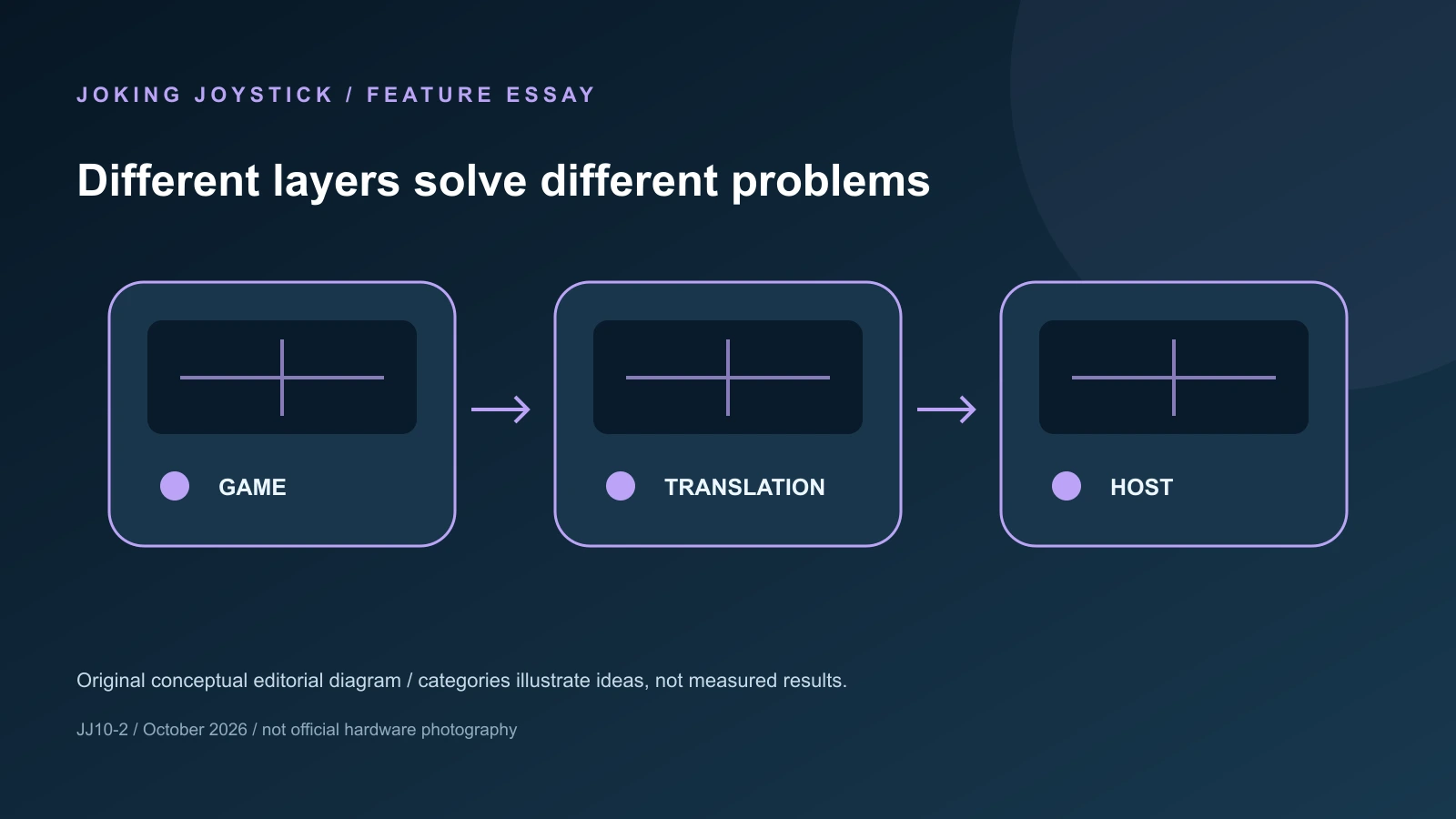
“Translation layer” sounds like a single technology, but it describes a family of techniques that operate at different boundaries. One may translate graphics commands, another may reproduce operating-system interfaces, and another may convert machine instructions from one processor architecture to another. An emulator may model an entire computer. A virtual machine may let an unmodified operating system run against virtual hardware. A native port may avoid translation at the application’s central execution path altogether. Those distinctions matter because “runs on Linux,” “runs on Arm,” and “runs natively” answer three different technical questions.
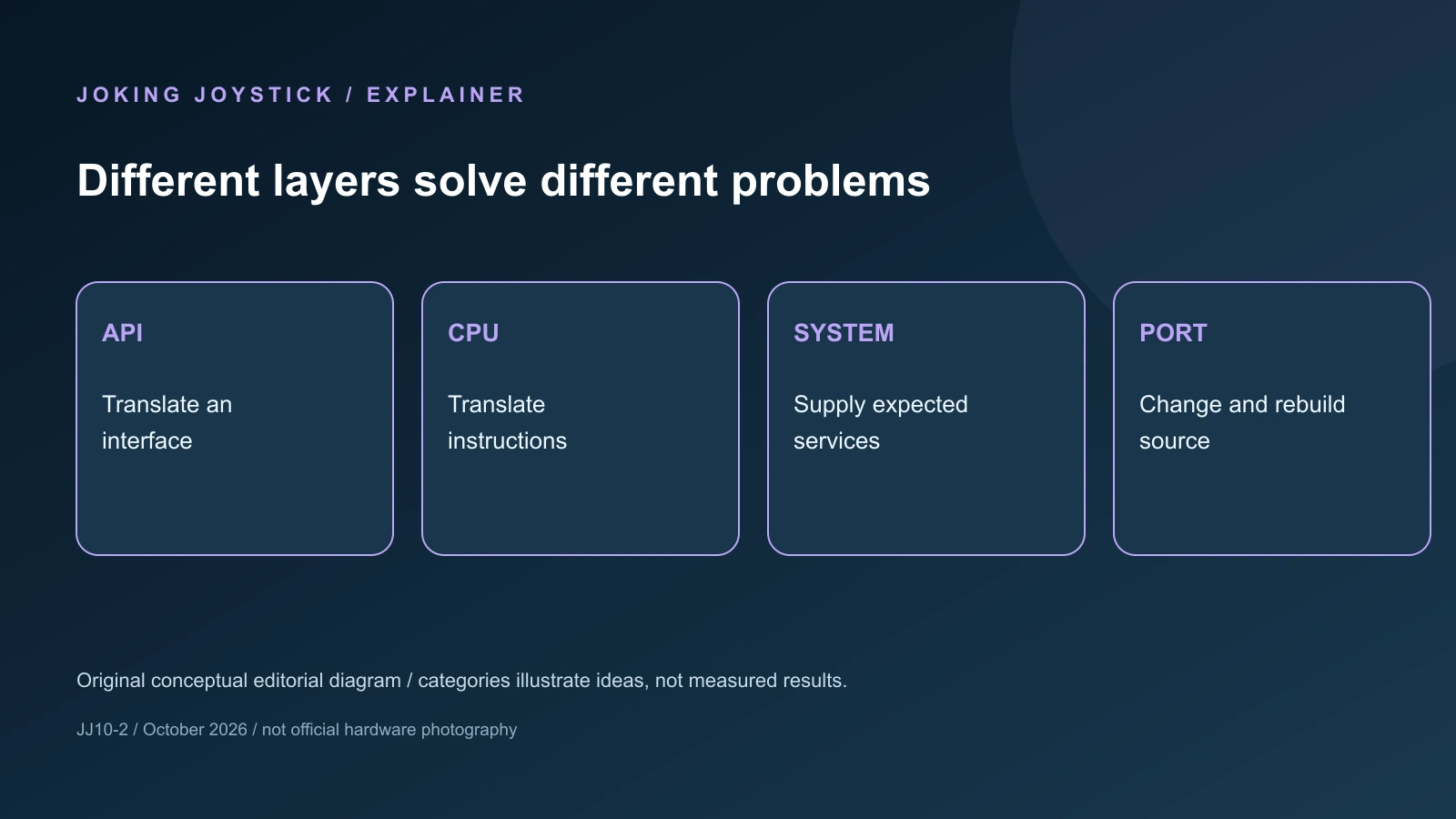
At the narrowest level, API translation reimplements one software interface on top of another. A game built around Direct3D, for example, can issue the calls it expects while a replacement implementation maps them to Vulkan. The executable may remain unchanged, but the meaning of its graphics requests is interpreted by new code. API translation does not necessarily address the rest of the operating system. Window creation, input, audio, files, threading, launch services, and networking may still require separate implementations.
An operating-system compatibility layer works at a broader boundary. Wine describes itself as a compatibility layer: it supplies implementations of Windows interfaces on systems whose underlying conventions are different. A Windows program can remain a Windows executable while replacement DLLs and runtime services provide expected behavior. Some calls may map directly to host facilities; others may be reimplemented, adapted, or handled with project-specific logic. This is not conventional hardware emulation, because the objective is not to reproduce every transistor, device register, or processor instruction of a Windows PC.
CPU binary translation addresses a different problem again. It converts instructions compiled for one processor architecture into instructions suitable for another. Microsoft’s Prism technology, for Windows 11 on Arm, translates x86 and x64 code blocks to Arm64 during execution and can cache translated code. Apple’s Rosetta performs a comparable category of work for x86_64 applications on Apple-silicon Macs, within Apple’s own platform boundaries. Neither mechanism is a general-purpose promise that any binary can run on any processor. Kernel extensions and some driver or privileged components fall outside the ordinary application-translation model. Unsupported instruction extensions can also prevent execution. Timing and memory-ordering assumptions are possible compatibility issues within translated application execution, rather than necessarily being code outside the translated process.
Dynamic recompilation is often used for CPU translation or emulation. Code is translated while the program runs, commonly in blocks that can be retained for later execution. The translator must discover or handle code paths as they are encountered. Static recompilation moves that work ahead of time. A project analyzes an existing binary and produces another representation—often C or C++—that can then be compiled for a target platform. The result may be a conventional target executable, but it is not automatically the original source code, an official source port, or a complete recreation of every surrounding service.
System emulation models a machine rather than merely replacing selected interfaces. The modeled system can include a CPU, memory map, graphics hardware, sound devices, input, timers, storage controllers, and firmware-facing behavior. QEMU separates system emulation from user-mode emulation, while MAME’s scope includes arcade machines, computers, consoles, and other systems. DOSBox illustrates a narrower historical-PC focus in which CPU, sound, graphics, and peripherals are represented together. The more of the original machine that must be modeled, the more state and timing behavior the project must account for.
Virtualization usually keeps the guest operating system intact. Instead of translating every guest program interface into a host equivalent, a hypervisor presents virtual processors, memory, interrupts, and devices to the guest. Hardware assistance may allow suitable guest instructions to execute without instruction-by-instruction emulation, while the hypervisor mediates access to physical resources. Hyper-V describes root and child partitions, virtual processors, synthetic devices, and VMBus; VirtualBox is a hosted, or type-2, hypervisor. QEMU can pair system emulation with acceleration facilities such as KVM, Xen, or Hypervisor.Framework.
These categories can be combined. A virtual machine may emulate a device while using hardware-assisted CPU virtualization. A guest operating system may itself run an API compatibility layer. Proton combines Wine with gaming-focused runtime components and graphics projects such as DXVK and vkd3d-proton. On an Arm computer, the host platform could additionally translate the x86 instructions inside the Windows executable. In that chain, operating-system compatibility, graphics API translation, and CPU binary translation are separate jobs, even if the user experiences them as one launch button.
A native code port is a more specific claim. It normally means that the application has been built for the target CPU and platform conventions, with appropriate implementations for graphics, input, audio, storage, threading, services, and distribution. A port can still reuse libraries or contain compatibility code, and a native architecture build can still load a translated plug-in. Conversely, a translated executable may use a target-native graphics driver while remaining a program designed around another operating system. “Native” therefore needs a stated boundary: native CPU code, native operating-system integration, native renderer, or a complete native port are not interchangeable descriptions.
API translation: changing the graphics conversation
Graphics API translation is best understood as semantic reimplementation rather than function renaming. The source API exposes a contract, and the translator attempts to express the game’s requests through another API. The examples below use resource handling, shader conversion, synchronization, presentation, and feature negotiation as explanatory mechanisms; the cited project documentation does not by itself establish every implementation detail for every title or driver.
DXVK provides a clear example. It supplies Vulkan-based implementations of Direct3D 8, 9, 10, and 11 for Linux through Wine. A Windows game can load replacement DLLs in place of the expected graphics libraries. The game continues to issue Direct3D commands; DXVK interprets those commands and builds corresponding Vulkan objects and operations. The operating-system compatibility work remains outside DXVK’s complete remit. Wine, the graphics driver, the window system, and other runtime components all participate in getting the game from executable code to a displayed image.
For Direct3D 12, vkd3d-proton follows a related but distinct path. It provides replacement DLLs that translate Direct3D 12 behavior to Vulkan, while sharing responsibilities associated with DXGI. The distinction between the two projects reflects differences in their source APIs, not simply a version number. Direct3D 12 exposes explicit resource and synchronization concepts that place more responsibility on the application and driver relationship. A translation layer must preserve those expectations while fitting them into Vulkan’s model, including its device capabilities and extension behavior.
Consider a texture as an explanatory example. The source API may describe its format, usage, access pattern, views, and lifetime in terms that do not correspond one-for-one with the target API. A translator must then represent those requirements in the target model and preserve the behavior the game can observe. The exact strategy varies by implementation and feature path; the general point is that API translation involves state and semantics, not merely similarly named functions.
Shaders add another interpretive boundary. A translation project converts a source representation into code the target driver accepts while attempting to preserve the shader’s resource access and observable behavior. Differences in source and target features can require project-specific handling, and a target device may lack a capability that the game assumes. These are implementation constraints and explanatory possibilities, not a claim that the cited READMEs document every listed shader property for every title.
Pipeline creation makes the timing of this work visible. Graphics systems combine shaders, render states, layouts, formats, and other objects into executable pipeline configurations. A translation layer may need to construct target pipelines as the game encounters new combinations. Projects document caches because retaining generated shader or pipeline information can avoid repeating some translation and compilation work later. That documentation supports a cautious inference: caches exist partly to manage recurring work. It does not, by itself, prove a universal reduction in stutter, frame time, latency, or loading time on every game and driver.
Presentation is another boundary that can differ from scene rendering. The translation stack must connect rendering to a window system and display path, including swap-chain behavior, synchronization, formats, scaling, and display modes. The exact consequences are implementation- and configuration-dependent. A game can therefore render a scene correctly while still encountering a problem in a less frequently exercised presentation path.
Driver dependencies make the result conditional. DXVK and vkd3d-proton document requirements concerning Vulkan support, device features, and driver behavior. A source API feature can be available in principle but unusable on a particular device, driver branch, or configuration. Conversely, a project may implement an experimental path that works for selected applications without representing a complete or stable contract. A project’s feature list is evidence of engineering scope; it is not an exhaustive certification of every game feature.
This is also why a successful launch is weak evidence by itself. The executable may initialize, create a device, and display a menu while later exposing errors in shadows, reflections, video playback, HDR, particle effects, texture formats, or synchronization. A title may reach gameplay but fail when a rarely used level, graphics option, cutscene, or multiplayer overlay exercises an unhandled path. Rendering compatibility is therefore a set of behaviors, not a binary state.
API translation should also be separated from a native renderer. A developer can write a renderer directly for Vulkan, Metal, or another target API. That renderer may share algorithms, assets, or higher-level engine code with a Windows version while replacing the source platform’s graphics implementation. It no longer needs to translate every source API call at runtime, but it may still rely on compatibility libraries elsewhere in the application.
DXVK Native demonstrates a narrower reuse model. It adapts Windows-oriented interfaces for native platform backends, allowing some renderer technology to be used outside its original Wine-facing context. That can reduce duplicated graphics work for a porting project. It does not automatically port a complete game. Window creation, input, audio, filesystems, launchers, networking, achievements, storefront integration, middleware, and platform services remain separate responsibilities. Reusing a renderer is not equivalent to rebuilding the game for the target platform.
Wine and Proton: compatibility at the operating-system boundary
When a Windows game runs through Wine or Proton, the central fact is that the original Windows executable can remain in place. The compatibility stack supplies the environment that executable expects. That environment includes Windows-style DLL interfaces, filesystem conventions, synchronization primitives, process behavior, runtime libraries, graphics entry points, and selected media paths. The game is not transformed into a Linux-native executable merely because its calls are being handled on Linux.
Wine’s design is therefore different from a conventional hardware emulator. It does not generally attempt to reproduce an entire Windows computer, down to a modeled CPU and device register set. Instead, it implements Windows-facing interfaces on a POSIX-like host. Some operations can map to host facilities relatively directly. Others require substantial reimplementation because Windows and the host system make different assumptions about object lifetimes, handles, permissions, threads, signals, files, or synchronization. The compatibility layer is judged by what the application can observe, not by whether the host internally resembles Windows.
The compatibility boundary can include behavior beyond a game’s headline graphics API. A title may depend on Windows-facing filesystem, registry, process, synchronization, multimedia, or device interfaces. These examples are explanatory categories, not a claim that Wine supplies every listed behavior uniformly or that the Wine overview documents each one as a general guarantee.
Graphics are only one portion of that work. In a Proton configuration, Wine can provide the Windows interface while DXVK handles Direct3D 8 through 11 or vkd3d-proton handles Direct3D 12. The stack may also involve runtime libraries, media components, input handling, synchronization changes, launch options, and project-specific patches; these are explanatory categories whose support varies by application and release. This layered structure explains why calling Proton “an emulator” is imprecise. The word may be used casually for software that helps one platform run another platform’s programs, but Proton is a maintained collection of compatibility mechanisms rather than a single machine model.
Proton’s project structure reflects that composition. Its behavior can depend on the Wine base, graphics components, runtime choices, driver capabilities, and the application itself. Different releases can contain different fixes or regressions, while a game or driver update can change the result without changing the Windows executable. A reported success should therefore be tied to the relevant build and configuration rather than treated as a permanent property of the title.
The maintenance surface is consequently larger than the phrase “run the game through Wine” suggests. Developers and contributors must respond to changes in applications, operating-system behavior, graphics drivers, compilers, middleware, security policies, and distribution environments. They may need to reproduce an application’s undocumented reliance on a Windows quirk, accommodate a game’s launcher, or preserve behavior expected by an anti-cheat component. Some fixes belong in a general compatibility layer; others are too specific and remain workarounds for a particular title or version.
Undocumented behavior is especially difficult. An application may depend on a result that is not part of an official interface contract but happens to occur on Windows. It might inspect timing, rely on an ordering detail, call a function with unusual parameters, or expect an error to be returned in a particular situation. A compatibility project can choose to reproduce that behavior when it is sufficiently understood, but each special case adds testing and future maintenance. The problem is not that the original program is necessarily badly written; it is that the replacement environment must preserve more than the visible headline features.
Middleware widens the boundary further. A game may bundle an engine, video decoder, audio library, input framework, launcher, crash reporter, overlay, or network service. Each component can make assumptions about Windows versions, installed runtimes, graphics adapters, process identity, or filesystem locations. The main game may work while a launcher does not, or gameplay may function while an overlay, video sequence, or account service fails. Treating the title as one executable hides the number of contracts being recreated.
Configuration can affect what “support” means. Project documentation can describe runtime options and requirements without promising identical behavior across applications. A reported success is best labeled by its conditions: game version, compatibility-tool build, graphics stack, driver, architecture, and relevant middleware.
The useful conclusion is conditional rather than celebratory or dismissive. Wine and Proton can make an original Windows program usable in a different host environment by supplying the interfaces it expects. Whether a particular game works completely depends on the interfaces it uses, the behavior those interfaces require, the graphics and driver path beneath them, and the version of every relevant component. “Runs through Proton” identifies an execution route. It does not certify rendering, online services, anti-cheat, suspend behavior, mods, accessibility, or future updates.
DXVK and vkd3d-proton: graphics translation is its own engineering problem
Graphics translation deserves separate treatment because a game can have correct CPU execution and substantial operating-system compatibility while still failing at the rendering boundary. DXVK and vkd3d-proton do not translate processor instructions, reproduce an entire Windows machine, or replace every Windows service. Their primary task is to make one graphics programming model behave through another. That requires preserving a large set of relationships that are not visible in a screenshot of a successful menu.
DXVK targets Direct3D 8, 9, 10, and 11 through Vulkan. vkd3d-proton targets Direct3D 12 through Vulkan and shares responsibilities associated with DXGI. The different projects correspond to different source interfaces and implementation demands. A translation layer must understand the objects and states exposed by the source API, then create target objects whose behavior is close enough for the game’s assumptions. The work includes resources, views, shaders, command submission, synchronization, presentation, and feature negotiation.
Resource models are a fundamental source of complexity. A game does not merely ask for “a texture” or “a buffer.” It specifies formats, dimensions, usage, access, bind flags, views, layouts, and lifetime. The source API may permit an access pattern that the target API represents differently. The translator must track what the game has promised, what it is allowed to do next, and which target transitions are required. If that bookkeeping is wrong, the result may be an incorrect image, corrupted data, a device error, or a failure that appears only under a particular sequence of rendering commands.
Synchronization is equally important. Modern graphics workloads involve the CPU, one or more queues, memory transfers, shader execution, and presentation. The source API’s rules for when work becomes visible and which operations may overlap must be reconciled with the target API’s rules. A translator may need to insert barriers, retain resources longer than the source application appears to, or serialize work that can be expressed differently on the target. The visible symptom might be a missing effect, a crash, an intermittent artifact, or simply a workload whose behavior changes with a driver revision.
Shader conversion is not a textual substitution. Shader languages and intermediate representations encode resource bindings, types, control flow, precision, derivatives, and stage-specific behavior. The translator must produce target shader code while retaining the source program’s meaning. It must also account for target features and driver restrictions. A shader can compile yet produce a different result if a precision or layout assumption is mishandled. It can fail only on a particular GPU feature level or when an optional effect is enabled.
Pipeline creation adds another stateful layer. A pipeline combines shader programs with render targets, blend modes, depth behavior, rasterization settings, vertex layouts, and other state. The target driver may need to compile or finalize an executable representation. vkd3d-proton documents shader and pipeline cache behavior, while DXVK also documents driver and cache-related conditions. Such caches can preserve generated information between runs or reduce repeated work in appropriate circumstances. The existence of a cache does not establish a fixed frame-rate benefit or guarantee the absence of stutter; it identifies one strategy for managing compilation and translation work.
Descriptors and bindings create related problems. Direct3D and Vulkan expose different ways to describe which resources shaders can access and how those resources are selected. A translator must maintain the relationship between the game’s descriptor or binding operations and the target’s descriptor sets or equivalent mechanisms. Games that use unusual binding patterns, large numbers of resources, or advanced features can exercise paths that simpler titles never touch. Correctness may depend on the driver’s limits and extension support as much as on the translator’s code.
Presentation is the final visible handoff, but it is not a trivial one. Swap chains, display modes, synchronization intervals, fullscreen transitions, color formats, scaling, and window-system integration all affect how rendered images reach the screen. High-dynamic-range behavior can involve formats and metadata that are not represented identically across APIs. A game might render its normal scene correctly yet show problems when changing monitors, toggling fullscreen, selecting HDR, or recovering from suspension. Successful initialization establishes only that one path through the stack worked.
Driver requirements make compatibility a matrix. A Vulkan device may expose some capabilities but not others. A translation project may require particular features, extensions, or driver behavior for a game’s rendering path. The same source title can exercise different code depending on its graphics settings, GPU vendor, driver branch, game update, or selected API mode. “Vulkan support” is therefore too broad a statement to predict a particular Direct3D feature. The relevant question is whether the target device and driver expose the capabilities that the translator and game require.
Game-specific workarounds are another sign that translation is not a universal mechanical conversion. Projects may need to account for a title’s shader assumptions, resource lifetime behavior, synchronization pattern, or use of an API edge case. A workaround can be justified by the game’s observed behavior, but it increases the maintenance burden. When the game updates, the workaround may remain correct, become unnecessary, or interact with a new code path. When a driver changes, the same workaround may need re-evaluation.
This explains how a title can launch while retaining rendering or feature problems. The executable, window, and menu may exercise only basic resource creation and presentation. A later level may use a shader variant that was not previously compiled. A cutscene may require a media path outside the graphics translator. A graphics option may rely on an optional Vulkan feature. A multiplayer overlay may depend on a separate component. Booting is evidence of partial compatibility, not a complete rendering audit.
It is also important not to turn the translation target into a performance verdict. Vulkan is a low-level graphics API, but a Vulkan-based translation path is not automatically faster than a native Direct3D path. Native Direct3D implementations can have their own driver optimizations and carefully tuned engine integration. A translator may add bookkeeping, or it may avoid some source-path costs in a particular workload; the direction and size of any effect require controlled testing. Frame rate, frame-time distribution, input latency, shader compilation behavior, and image quality are separate measurements.
Finally, graphics translation is not a complete porting strategy by itself. DXVK Native can adapt portions of Windows-oriented renderer infrastructure for native platform backends, which may help a developer reuse tested graphics code. It does not provide the target platform’s windowing, input, audio, storage, networking, launcher, account, achievement, or distribution services. A game that uses a native renderer can still retain non-native middleware or translated plug-ins. The engineering boundary must therefore be stated precisely: a translated renderer, a native graphics backend, and a complete native game port are different accomplishments.
CPU binary translation: Rosetta, Prism, and changing instruction sets
CPU binary translation operates below the application programming interface. Its input is machine code compiled for one instruction set, and its output is machine code that the host processor can execute. That makes it fundamentally different from DXVK, which translates graphics API behavior, or Wine, which supplies operating-system interfaces. A translated game may therefore pass through several independent boundaries: Windows calls may be handled by a compatibility layer, Direct3D calls may be mapped to Vulkan, and the processor may translate the executable’s x86 instructions to Arm64.
Microsoft’s Prism is a documented example of just-in-time CPU translation on Windows 11 on Arm. It works with x86 and x64 applications by translating blocks of instructions to Arm64 as they are needed. The translated result can be cached, so code that runs again does not necessarily have to be converted from scratch. The important point is temporal: Prism does not require the entire application to be converted before launch. It observes execution, translates suitable blocks, and retains the results according to the platform’s caching mechanisms.
A translated block is more than a list of substituted instruction names. The translator must preserve the source code’s observable control flow and machine-state behavior, sometimes by combining host instructions or calling helper routines. Indirect branches, generated code, and code modification can complicate block boundaries and cache validity. These are general mechanisms of dynamic binary translation, not a claim about an undocumented implementation detail of every product.
Apple’s Rosetta belongs to the same broad technical category but should not be treated as interchangeable with Prism. Apple documents Rosetta as a process-level mechanism for running x86_64 applications on Apple-silicon Macs. Its platform boundary is Apple silicon and macOS; Prism’s cited boundary is Windows 11 on Arm. Their existence does not establish a universal CPU-translation standard, nor does behavior documented for one system prove behavior on the other.
Process scope matters because an application is rarely isolated from privileged software. Rosetta can translate an application process, but Apple identifies kernel extensions as unsupported within that translation model. Kernel extensions execute at a privileged boundary and cannot simply be treated as ordinary user-space instructions. The broader point about drivers and other privileged components is architectural inference, not a claim that Rosetta and Prism document identical Windows behavior. A game can therefore launch while an associated driver or low-level utility remains subject to separate architecture and signing requirements.
Instruction-set extensions create another qualification. Apple specifically identifies AVX-512 as requiring qualification rather than assuming that every x86_64 instruction path is covered. SIMD code is especially significant in games because engines, middleware, physics libraries, audio systems, image processing, and compression routines may use vector instructions. A translator must either support the relevant operations, provide an equivalent implementation, or reject a path that cannot be represented safely. The presence of an x86 compatibility mode does not guarantee that every optional instruction set is available.
Timing is a possible compatibility boundary rather than a documented universal failure mode. A program may use counters, spin loops, ordering assumptions, or synchronization whose observed behavior changes when code is translated. Whether a particular game or security component is affected is workload- and platform-specific; the cited platform documentation supports caution, not a general prediction that timing differences will break translated software.
Memory behavior is another possible boundary. Source and target architectures can differ in atomic operations, alignment, instruction encodings, or ordering guarantees, so a translator must preserve the guarantees on which the application relies. This is general architectural analysis, not a measured claim about Rosetta, Prism, or any particular game.
Arm64EC illustrates an intermediate strategy rather than a pure translation-only model. Microsoft documents Arm64EC as allowing Arm64EC code to coexist with x64 code in a process where the x64 portions run under emulation. A developer can therefore move selected components to native Arm64-compatible code while retaining other components that have not yet been rebuilt. This can matter for large applications with plug-ins, third-party libraries, or a staged migration plan. It is not the same as converting the whole program into one uniformly native binary.
Mixed processes introduce practical boundaries. A game’s main executable might contain native Arm64EC code while loading an x64 plug-in, or a native application might communicate with a translated helper process. Data structures, calling conventions, callbacks, and ownership rules must remain compatible across those boundaries. A graphics driver or hardware interface may be native even while application code is translated. Consequently, the phrase “Arm version” can conceal several execution modes inside one product.
Drivers deserve particular caution because they operate outside the ordinary user-process model. A translated application can call a native graphics stack through supported interfaces, but that does not make an old x86 driver itself suitable for an Arm system. Kernel-level components, device filters, copy-protection modules, and anti-cheat drivers can require their own builds and platform authorization. A game that depends on such software may be constrained even if its user-mode executable is successfully translated.
Neither Rosetta nor Prism promises native-equivalent performance as a general rule. Translation can benefit from cached blocks and host instructions that efficiently express the source workload, but it can also incur conversion, bookkeeping, synchronization, or helper-call costs. The outcome depends on the application, instruction mix, SIMD usage, memory behavior, operating-system version, and host processor. A measured result would need a named application build, host model, operating-system version, settings, and reproducible workload. Without those conditions, the defensible claim is only that the platform provides a documented translation path.
CPU translation also has a lifecycle. Apple’s September 1, 2026 notice said macOS 27 would be the final general release supporting Rosetta on Apple-silicon Macs, while preserving Rosetta functionality for older, unmaintained games that rely on Intel-based frameworks. Apple’s release listings show macOS 27.0.1 dated September 28, 2026, so at the October 26, 2026 cutoff the transition was no longer merely a future plan. The example shows that a compatibility bridge can have both a shipped policy boundary and an explicitly maintained exception.
Dynamic recompilation versus static recompilation
The central distinction between dynamic and static recompilation is when the conversion occurs. Dynamic recompilation translates code during execution, often in blocks that are generated when the program reaches them and retained for reuse. Static recompilation translates ahead of time, producing a new representation before the resulting program runs. Both methods can convert machine code, but they confront different uncertainties and impose different maintenance obligations.
Prism provides a platform-documented example of dynamic translation. The system starts with x86 or x64 code and converts blocks to Arm64 as execution requires them. This permits an application to run without a complete pre-conversion of every possible code path. It also means that the runtime must identify executable regions, preserve control flow, manage translated-code caches, and handle paths that are discovered only during use. A rarely exercised function may not be translated until a particular menu, level, plug-in, or error condition reaches it.
Dynamic translation can make an unchanged executable useful across an architecture boundary, but it keeps a translation mechanism in the execution path. The runtime may need to validate cached blocks, handle indirect branches, respond to code modification, and bridge calls between translated and native components. The cost and behavior vary with the workload. A program dominated by repeated loops may benefit from cached translations; a program with frequent code generation, unusual instructions, or many short-lived paths may present different demands. These are mechanisms, not universal performance predictions.
Static recompilation moves the conversion before execution. The recompiled.games guide describes one project model in which an original binary is analyzed and translated into C or C++, which can then be compiled for a target platform. That description belongs to the cited project ecosystem rather than to every static recompiler. A resulting conventional executable should not be confused with recovery of the original source code.
In the cited static-recompilation project model, recompilation produces a compilable representation of binary behavior rather than the developer’s original names, comments, architecture, build system, or design intent. Generated code may preserve control flow and data relationships while remaining unlike human-written source. Project developers may still need to inspect, correct, annotate, and extend the result. If the original binary depended on undocumented hardware behavior or platform services, those dependencies remain engineering problems after recompilation. Other static-recompilation systems can use different output formats and responsibilities.
A statically recompiled game is also not automatically an official source port. An official port normally begins with source code or a developer-controlled codebase and adapts it deliberately to the target platform. Static recompilation begins from an existing binary and creates a new implementation of its behavior. The legal, licensing, and distribution arrangements can differ by project. A conventional target executable therefore answers a build question—what can now be compiled for the target? It does not answer who authorized the port, whether the original source was obtained, or whether all surrounding services have been rebuilt.
Zelda 64: Recompiled is a project-reported example of this model. Its project page describes static recompilation of an N64 game for native PC targets and identifies RT64 as the rendering technology. It distributes project code rather than the original game data and requires users to possess legally obtained game data. Those details define that project’s approach; they do not establish a universal template for every static-recompilation effort or a general legal rule for other games.
In the cited static-recompilation project model, removing one recurring form of runtime translation does not make the project self-sufficient. The resulting program still needs target-appropriate runtime services, a renderer or graphics backend, input and audio handling, save support, window management, and display integration. If the original game used a console-specific device, the project must represent enough of that behavior for the game logic to remain coherent. These responsibilities describe the referenced project approach; they are not requirements that every static recompiler implements in the same way.
Rendering is often the most visible extension. A recompiled program may preserve the original game logic while replacing the original graphics interface with a modern renderer. That can support higher-resolution presentation or new display paths, but such project capabilities are project-reported until independently tested. A new renderer can also expose differences in depth precision, texture formats, timing, effects, or ordering. Recompilation of the CPU-side logic does not automatically reproduce every property of the original graphics hardware.
Input and timing can be equally significant. A console game may assume a fixed controller layout, scanline or frame timing, a particular interrupt order, or a device response pattern. A target runtime must preserve enough of that behavior for the game logic to remain coherent. If the project changes timing to suit modern displays, it must determine whether gameplay, animation, physics, and audio remain synchronized. A conventional executable does not eliminate these emulation-like responsibilities; it relocates them into generated code and supporting runtime systems.
Static and dynamic approaches can also be combined. A statically recompiled project may use dynamic techniques for generated code, scripts, or optional components. A native target executable may call a compatibility library or emulate a particular device. Conversely, a dynamic translator may cache blocks so effectively that the user experience resembles a precompiled program. The categories describe where and when key work occurs, not mutually exclusive product labels.
Static recompilation can make maintenance more explicit. Instead of maintaining a general translator for many binaries, a project may maintain generated code and target-specific fixes for one title or one family of titles. The project must track compiler changes, graphics drivers, operating-system behavior, controllers, display systems, and game-specific bugs. If a new target platform is added, the runtime and renderer may need additional work even when the generated game logic is unchanged.
Claims about speed require particular discipline here. A project may describe its output as native or native PC software, but that label does not prove a frame-rate, latency, loading-time, battery, or CPU-overhead result. Such claims require reproducible tests with named hardware, software versions, settings, capture methods, and workloads. Static recompilation changes the execution model; it does not create a universal performance guarantee.
The useful distinction is therefore practical. Dynamic recompilation translates during execution and manages the resulting blocks at runtime. Static recompilation translates ahead of time and can feed a conventional target build. Neither process recovers original source code by definition, and neither removes the need for platform integration. A statically recompiled project can be more native-like in its executable structure while still depending on a custom runtime, renderer, assets, and continuing fixes. “Native executable” describes an output artifact; it does not, by itself, establish an official native port.
Emulation: reproducing a machine, not merely translating a call
System emulation begins with a larger question than “how should this API call be implemented?” It asks what software designed for another machine can observe, and how much of that machine must be represented to preserve the observation. QEMU, MAME, and DOSBox provide different project examples of this wider boundary. The following references to CPU, memory, devices, timing, graphics, sound, input, and firmware are an explanatory synthesis of those examples, not a claim that every emulator models every category in the same way.
That scope distinguishes system emulation from a narrow API layer. An API translator receives software requests at a defined interface and maps them to another interface. An emulator can instead expose a virtual machine whose operating system and applications believe they are addressing the original hardware. The guest may access memory-mapped registers, program a simulated display device, respond to interrupts, and communicate with peripherals that have no direct equivalent on the host. The emulator must represent those interactions well enough for the software to continue.
QEMU separates system emulation from user-mode emulation. In system emulation, QEMU provides a model of a complete machine on which a guest operating system can run. In user-mode emulation, it runs programs compiled for another architecture by translating or interpreting their user-space instructions while relying on the host operating system for many services. The distinction is useful because an application-level architecture boundary does not require the same device and firmware model as an entire guest computer.
QEMU’s Tiny Code Generator illustrates how one emulator can use dynamic translation internally. A target instruction sequence can be converted into host-executable code while the emulator supplies the target machine’s registers, memory behavior, exceptions, and device interactions. The translated CPU code is therefore one component of a broader machine model. This description is specific to QEMU’s documented architecture and should not be treated as a complete implementation description for every emulator.
MAME demonstrates another scope. It describes itself as a framework for emulating arcade machines, computers, consoles, and other systems. An arcade title may depend on a particular combination of CPU, video chip, sound hardware, input wiring, timing, and memory-mapped behavior. Emulating the game successfully can therefore require representing the relationships among those components rather than supplying a modern graphics API with similar surface features.
Hardware-specific behavior is one reason system emulation can matter for preservation. A title may depend on device behavior or timing that has no direct application-level equivalent. A high-level renderer could reproduce an ordinary image while omitting machine behavior that affects logic, animation, or effects. Whether a particular emulator preserves those dependencies depends on its target model and implementation; the preservation point is an editorial inference from the documented machine-emulation scope.
The modeled state can interact across subsystems. CPU execution, memory, devices, graphics, sound, input, and timing may each affect the others, so an error in one area can appear elsewhere. This is a general systems explanation of why emulation requires coordination and testing, not a claim that every listed interaction is documented by the cited projects.
DOSBox provides a useful historical-PC example because its official manual describes simultaneous CPU, sound, graphics, and peripheral emulation. It also warns that cycle settings can affect speed, stability, and compatibility. That warning captures an important mechanism: the guest software may react not only to results but also to the pace and ordering of events. If the emulated CPU is presented as too slow, too fast, or inconsistently scheduled relative to devices, a program can behave differently even when its instructions are logically supported.
Timing is not one universal number. A machine model may need to coordinate CPU cycles, video refresh, audio generation, timer interrupts, input sampling, disk operations, and wait states. Some software uses busy loops; some relies on periodic interrupts; some assumes that a sound buffer is consumed at a particular rate. An emulator can choose techniques that make the model practical, but its timing policy remains part of compatibility. DOSBox’s documented cycle controls make that relationship visible without implying that one setting is correct for every program.
Graphics emulation also has multiple layers. A project may reproduce the original graphics chip’s commands and rasterization rules, translate those commands to a host GPU, or combine hardware modeling with a more modern rendering path. A host-accelerated renderer can improve practicality while still needing to preserve source-device behavior. It may have to account for unusual blending, texture formats, depth rules, palette operations, or synchronization. “Uses the host GPU” therefore does not mean “stops being an emulator.”
Sound and input are similarly concrete. A sound device is not merely an audio file player; software may program channels, frequencies, envelopes, buffers, and interrupts. A controller is not merely a collection of buttons; the machine may expose a particular polling protocol or timing relationship. Emulating these devices can preserve behavior that a high-level compatibility wrapper would not know exists. It also expands the range of failure modes beyond graphics and CPU execution.
Emulation can preserve an operating system as well as a game. A guest operating system may run on a modeled processor and communicate with modeled devices, allowing old software to encounter the environment it expects. That can be useful when the original application depends on legacy drivers, firmware conventions, or hardware-specific utilities. It also means that more layers can fail: the guest OS, its drivers, the modeled devices, the emulator’s timing, and the host’s display or input integration all participate.
The term “emulator” is technical here, not a conclusion about legality. Whether a particular project may distribute code, firmware, or data depends on its licensing and the jurisdiction-specific facts. A technical description of system emulation does not provide instructions for sourcing software, bypassing protections, or obtaining proprietary material. Preservation and legal authorization are related discussions, but they should not be collapsed into the definition of the execution model.
The practical distinction is thus one of modeled boundary. An API layer primarily replaces a software-facing contract. A system emulator presents a machine whose CPU, memory, devices, and timing are part of the contract. That broader model can preserve hardware-specific behavior and support software that knows about the original machine. It also creates more state, more interactions, and more behavior to validate. Emulation is not merely a slower way to translate a call, nor is it automatically inaccurate; it is a different engineering commitment.
Virtualization: the guest keeps its operating system
Virtualization differs from emulation because the guest operating system remains an active participant. The hypervisor presents a virtual machine interface containing processors, memory, interrupts, storage, networking, and other devices. The guest boots and runs its own kernel, drivers, and applications against that environment. In suitable cases, hardware assistance allows guest processor instructions to execute directly on the host CPU under controlled conditions rather than being converted one instruction at a time.
That does not mean virtualization removes all mediation. The hypervisor must control privileged operations, isolate memory, schedule virtual processors, handle interrupts, and represent devices. Microsoft’s Hyper-V architecture describes a root partition and child partitions. The root partition has particular management responsibilities, while child partitions contain guest operating systems. Virtual processors are scheduled onto physical execution resources, and devices may be exposed through synthetic interfaces rather than direct physical hardware access.
VMBus is part of that model. Hyper-V documents synthetic devices and VMBus communication between partitions, allowing a guest to use virtualized storage, networking, and other services without requiring the host to reproduce an entire physical device in software. The guest still sees a device contract and its own drivers must understand that contract. A synthetic device can be more practical than emulating an old physical controller, but it is not the same device model the original game or operating system necessarily expected.
Hardware-assisted virtualization changes the CPU path. Features in the host processor can let the hypervisor run guest code at high speed while trapping privileged operations or events that require intervention. This differs from a full instruction-by-instruction emulator, which must interpret or translate the guest’s processor behavior as part of a software machine model. The distinction is architectural rather than a promise about a particular result. Host scheduling, memory translation, device access, and workload behavior still influence the outcome.
QEMU illustrates how these techniques can be combined. Its documentation distinguishes system emulation from virtualization-assisted operation and identifies acceleration through KVM, Xen, or Hypervisor.Framework. QEMU can therefore provide a machine model in software while using a host facility to accelerate eligible guest execution. The guest operating system remains intact, but selected portions of the path may be handled by hardware-assisted virtualization rather than complete CPU emulation.
VirtualBox is a different presentation of the same broad category. Oracle describes it as a hosted, or type-2, hypervisor. A hosted hypervisor runs above a conventional host operating system rather than controlling the machine as the sole foundational layer. The host supplies services and device access, while the hypervisor creates and manages guest machines. This arrangement can make virtual machines convenient across supported hosts, but the host operating system, hardware, drivers, and device model remain part of the compatibility picture.
For games, retaining the guest operating system may be useful when the application depends on a complete legacy software environment rather than one missing API. The guest can preserve its own system libraries, drivers, configuration, and services. Whether that is more practical than a compatibility layer is a scenario-dependent editorial inference, not a general compatibility result established by Hyper-V, QEMU, or VirtualBox documentation.
Graphics are a major qualification. A virtual machine may expose a virtual display adapter, a paravirtualized graphics path, or some form of accelerated device access. The guest’s graphics driver must support that virtual device, and the host must provide a compatible implementation. Features such as shader models, presentation modes, hardware overlays, high-dynamic-range output, controller integration, and capture can differ from a physical gaming system. A game may boot in a guest while advanced rendering, fullscreen transitions, video playback, or performance-sensitive effects remain limited.
Device access can be constrained for similar reasons. The guest may see a virtual controller rather than the host’s exact input device. Audio may pass through a virtual sound card and host mixer. Storage may be represented by a virtual disk whose timing and flush behavior differ from a physical drive. Network access may use a virtual adapter and translation or bridging supplied by the host. These choices can preserve broad operating-system compatibility while changing the low-level conditions that a game, launcher, or middleware component observes.
Timing is another boundary. A guest operating system schedules threads against virtual processors, while the hypervisor schedules those processors against host resources. Interrupt delivery, clock sources, power states, pauses, and host contention can affect what the guest observes. A normal application may tolerate those differences, but software that expects a particular hardware timer, checks execution conditions, or relies on precise device behavior can encounter problems. Virtualization provides a guest computer, not a guarantee that the guest’s computer is indistinguishable from the original physical machine.
Copy-protection and anti-cheat behavior can impose additional constraints. This is an architectural possibility, not a claim that every protected title detects virtualization or that every virtual machine fails. Such software may inspect drivers, privileged access, device identity, timing, virtualization indicators, or kernel behavior, while the developer or middleware provider may impose separate platform requirements. A virtual machine can preserve the guest operating system while presenting conditions that differ from a physical gaming PC. Virtualization does not authorize bypassing a protection system, and installing a component does not establish that it will function or be accepted online.
Virtualization also has a different maintenance profile from a compatibility layer. The guest operating system, its updates, drivers, virtual hardware, host operating system, hypervisor, and physical devices can all change. A stable guest may depend on an older virtual device model; a host update may alter graphics or input behavior; a security policy may restrict a previously available feature. The guest’s continued existence does not remove the work of maintaining the host and hypervisor around it.
It is tempting to describe virtualization as “near native,” particularly when hardware assistance lets ordinary guest instructions execute without full software translation. That phrase is not a universal property. It says nothing by itself about graphics, storage, audio, input latency, interrupt behavior, copy protection, or a game’s use of specialized hardware. A credible performance statement would require a defined host, guest, hypervisor, device path, game build, and reproducible test. The cited architecture documents establish mechanisms, not blanket results.
Virtualization can coexist with the other models in this feature. A guest operating system can run an API compatibility layer. QEMU can use system emulation for devices and hardware-assisted virtualization for processors. A game inside the guest can itself contain a statically recompiled component or load a translated graphics library. These layers answer different questions: what operating system is preserved, what hardware is exposed, what processor instructions execute directly, and which application interfaces are reimplemented.
The clean distinction is that virtualization preserves the guest operating system as the owner of its application environment, while emulation models enough hardware for that guest or application to believe it is running on a target machine. Hardware assistance can reduce the amount of CPU instruction translation required, but it does not guarantee complete device fidelity. For gaming, graphics access, timing, device identity, copy protection, and anti-cheat can remain decisive. A virtual machine is therefore a compatibility strategy with a defined guest boundary, not a universal substitute for a native port or a promise that every original environment can be reproduced.
Native ports and the meaning of “native-like”
A native port is best defined operationally, not rhetorically. The game’s code is built for the target processor architecture and for the target platform’s conventions, while the surrounding platform work is adapted as well. Graphics presentation, input, audio, filesystem access, threading, window management, user accounts, networking, storefront functions, controller support, accessibility features, updates, and distribution all need target-appropriate implementations or integrations. A native port is therefore more than an executable that happens to launch on a new system.
The definition does not require every line of a port to be newly written. A developer may retain game logic, middleware, tools, assets, or parts of a renderer. The important question is what the resulting program is built to run against. If the executable targets the platform’s architecture and uses its supported interfaces, while legacy dependencies have been rebuilt or replaced, it is reasonable to describe that build as native for the target. If it remains a Windows executable whose expected interfaces are supplied by Wine, it is not thereby a Linux-native port, even if the player never sees a Windows desktop.
Architecture and operating-system targeting are related but separate. Microsoft distinguishes an Arm-native application from an x86 or x64 application running through emulation on Windows 11 on Arm. Apple similarly distinguishes software built for Apple silicon from Intel software operating through Rosetta. But Apple’s process boundary is stricter than Windows Arm64EC’s mixed-process model: macOS prevents arm64 and x86_64 code from running in the same process, and Rosetta applies to the entire process, including all code modules it loads. “Native” therefore needs an object: native executable, native plug-in, native renderer, or native platform integration.
Universal binaries make the distinction especially visible. A universal application contains builds for more than one processor architecture, allowing the operating system to select a suitable slice. Apple encourages developers to distribute universal binaries during the transition between Intel and Apple-silicon Macs. Such a package can contain a genuinely native Apple-silicon build alongside an Intel build intended for translation. Calling the application “universal” describes its packaging; it does not mean that every component inside every selected slice is native. In particular, an in-process plug-in must support the same architecture as the process that loads it.
A universal game can still have mixed dependencies, but the platform determines how that mixture is handled. On Apple silicon, an arm64 process cannot directly load an x86_64 in-process plug-in; the plug-in must be rebuilt as arm64 or universal, or the developer must move it into a separate helper or XPC process that runs with the appropriate architecture. Alternatively, the user may run the entire universal application under Rosetta so that its process and Intel plug-ins use x86_64. Windows Arm64EC provides a different model in which Arm64EC and x64 code can coexist in one process, with the x64 portions running under emulation. These cases should not be generalized into one cross-platform rule.
Experience alone cannot settle questions about maintenance, dependencies, or future support. A Windows build running through Proton may feel integrated into a Linux gaming environment while still relying on Windows assumptions, replacement DLLs, a Windows-oriented launcher, and a translation path for graphics. If a game patch changes one of those assumptions, the player may encounter a regression even though the previous release felt native. The visible smoothness of one session does not reveal all the boundaries underneath it.
Renderer reuse creates another intermediate case. DXVK Native adapts Windows-oriented graphics interfaces for native platform backends. A developer can potentially reuse rendering code or an interface strategy without adopting the entire Windows execution environment. That can reduce duplicated graphics work, but it does not automatically provide native window management, input, audio, file paths, threading behavior, account services, networking, launchers, or distribution. A native renderer is one native subsystem, not a complete native game.
The same principle applies to engine reuse. A game studio may use one cross-platform engine and produce separate target builds. Shared game logic does not make the platform integrations identical. The engine’s graphics abstraction may select Direct3D, Vulkan, Metal, or another backend; its input system may map to different device APIs; its file and threading layers may use distinct implementations. From the player’s perspective, this can be one game. From an engineering perspective, it is a set of target-specific builds and dependencies.
Nor does native code guarantee complete compatibility. A port may omit a feature, alter video playback, lack a mod interface, use different save locations, or lose support for a storefront service. It may require new controller mappings or replace an old middleware component. Native compilation solves an architecture and platform-integration problem; it does not automatically reproduce every behavior of the original release.
The practical test is to ask several questions. What architecture does the game executable target? What operating-system APIs does it call? Are graphics, audio, input, and file handling implemented for the target? Are plug-ins and middleware native, translated, or unavailable? Does the distribution package include platform-specific services and update behavior? A “native port” is strongest when the answers describe a deliberately rebuilt target application rather than a preserved binary surrounded by compatibility machinery.
That leaves useful room for hybrid designs. A port can use a native executable, a compatibility layer for one legacy plug-in, a translated shader compiler, and a shared renderer. Another build can preserve the original executable but use a native host window and audio backend. Both may be sensible engineering choices. They should not be collapsed into one label. “Native-like” acknowledges what the player experiences; “native code port” identifies how the application and its platform dependencies were built.
Compatibility is a matrix, not a badge
Compatibility is often reported with a single word: works. That word is too small for a modern game. A meaningful assessment must separate installation, launch, rendering, input, audio, video playback, saves, networking, suspend and resume, mods, accessibility, storefront services, updates, and anti-cheat. A title can pass one dimension and fail another. It can boot to a menu while missing cutscenes, render the main game while breaking a controller, or run offline while being rejected by an online service.
The first dimension is installation and launch. A package may require a launcher, a particular installer behavior, a redistributable, or a service that the target environment does not provide. Successful installation proves only that the files were placed and the initial setup completed. Booting to a menu proves that early initialization succeeded. Neither establishes that every level, mode, video sequence, save operation, or online session will work.
Rendering deserves its own checks. A game can display an image while using an incomplete graphics path. Missing effects, incorrect lighting, broken shadows, damaged post-processing, display-mode failures, HDR differences, and feature-dependent crashes may appear only later. DXVK and vkd3d-proton document driver, feature, cache, and runtime conditions because graphics translation depends on more than matching an API name. The graphics adapter, driver version, Vulkan capabilities, game build, and selected renderer can all change the result.
Input compatibility is similarly multidimensional. Keyboard and mouse access may work while a controller does not. A controller may be detected but expose the wrong buttons, omit motion functions, or behave differently after suspend and resume. Games with local multiplayer, steering wheels, flight controls, touch input, or unusual polling assumptions create additional cases. “Input works” should specify which device and which interaction path were tested, rather than implying that every supported controller behaves correctly.
Audio and video can fail independently of gameplay. A game may produce music but lose positional effects, voice chat, or audio device switching. Video playback may depend on codecs, hardware acceleration, synchronization, or a media framework that is not fully represented by the compatibility stack. A title that reaches gameplay while silently skipping cutscenes is not equivalent to a complete result. These failures may also be content-specific, appearing only in one language pack, DLC sequence, or regional edition.
Save behavior requires separate attention. The game may save locally but use a different path, fail to synchronize through a storefront, or lose access to an existing save after a platform change. Cloud saves can depend on the storefront client rather than the game executable. Mods may redirect files, alter load order, or rely on tools that are not available in the target environment. A successful new game does not prove that old saves, modded saves, or cloud restoration will work.
Networking adds another boundary. A game may support a local session while failing matchmaking, voice services, relay connections, account authentication, or downloadable content checks. Servers can distinguish builds, clients, operating systems, or security environments. A compatibility project can implement the application interfaces correctly and still have no authority over a remote service. Online success is therefore partly a developer and service-provider decision, not merely a property of the translation layer.
Anti-cheat is a particularly visible example of conditional compatibility. Valve’s Steamworks documentation describes developer opt-in requirements for supported Easy Anti-Cheat and BattlEye configurations. That means the presence of a compatibility path does not itself activate protection support. The game developer and middleware provider must configure and authorize the relevant environment. A title can launch and play offline while refusing online play because the server expects a protection component that is missing, unsupported, or not enabled for that release.
Versioning changes the compatibility matrix. A game update, graphics-driver update, operating-system update, or compatibility-tool release can alter the result by changing executable code, features, security rules, window behavior, or process translation. Compatibility is therefore a relationship among versions and configurations, not a permanent badge attached to a title.
Architecture introduces another variable. A game may be x86, x64, Arm-native, or a mixture of native and translated components. A storefront can distribute a different build from a physical release, a regional edition can include different middleware, and DLC can add code paths that the base game never exercises. A compatibility report that omits the game build, storefront, architecture, operating system, graphics device, driver, and relevant content leaves important causes unresolved.
Evidence should therefore be labeled. A source-documented statement describes what a project or platform says its software supports. A project-reported statement records a project’s description of its own result, such as a static-recompilation project’s target or distribution model. An independently measured statement requires reproducible testing with named hardware, software versions, settings, workload, and capture method. An announced feature is a stated plan, not a shipped or universally available capability. An unverified claim should not be presented as established fact.
These labels prevent a common error: treating a compatibility list as exhaustive validation. A project may report that a game launches, while users still need to determine whether a particular driver, DLC package, controller, mod, or online service works. Community reports can identify patterns, but they may combine different builds and configurations. A careful feature can use such reports as leads without converting them into universal findings.
A responsible compatibility statement might therefore say that a specific Windows game has a documented Proton path, with graphics dependent on the required Vulkan features and driver support, while online anti-cheat remains conditional on developer and middleware configuration. That statement is less dramatic than “works,” but it tells the reader what is known and where uncertainty remains. Compatibility is not a badge awarded once at launch. It is a matrix that changes with software, hardware, services, and time.
Licensing, distribution, and anti-cheat constraints
Technical ability and permission are separate questions. A project may be capable of running a game while its distribution model, licenses, ownership requirements, or platform authorization remain distinct. Three issues should not be merged: the license governing the compatibility software, the user’s right to possess or use game data, and the platform or service provider’s decision to accept the resulting program.
Proton illustrates the first issue. It is a layered project incorporating Wine and other components, each with licensing obligations. The project documentation identifies those obligations and the conditions attached to distributing its components. That is a statement about the software being distributed by the project. It does not determine whether a particular game owner may copy, modify, or redistribute the game’s files, nor does it grant access to a publisher’s service.
Game ownership is a separate matter. A compatibility layer generally supplies replacement platform behavior; it does not automatically supply the game’s executable, assets, music, or other commercial data. Whether a user may obtain, copy, modify, or redistribute those materials depends on the applicable license and circumstances. A technical project can require original data without distributing it, as a design choice that keeps the project’s code and the game’s content separate.
Zelda 64: Recompiled presents a project-reported example of that separation. Its code project is described as GPL-3.0, while the original game data is not bundled and users are required to possess legally obtained data. This arrangement explains how a project can distribute code that reconstructs or hosts game behavior without presenting itself as a distributor of the original commercial data. It does not establish a universal legal rule for static recompilation, reverse engineering, or game preservation.
The distinction matters because project architecture and legal status are not interchangeable. A code-only distribution can still contain platform-specific dependencies, generated code, or third-party libraries with their own terms. A project’s license may govern its source while leaving original assets, trademarks, service access, and user obligations outside that license. Readers should not infer from one project’s arrangement that every similar project has identical rights or restrictions.
Distribution also affects maintenance. If a project distributes a complete application, it may need to track the licenses and notices of every included component. If it distributes code that consumes user-supplied data, it may avoid shipping that data but place more responsibility on the user and the build or runtime process. Neither model automatically provides a better technical result. They create different boundaries for updates, support, testing, and accountability.
Anti-cheat introduces a third boundary: platform authorization. A compatibility layer can reproduce many user-mode operating-system interfaces and still fail to satisfy a security system that expects a particular driver model, attestation path, process environment, or server-approved configuration. The game developer and middleware provider decide whether a given environment is supported. A player’s ability to launch a game is not evidence that its online protection system will accept the session.
Valve documents developer opt-in requirements for supported Easy Anti-Cheat and BattlEye configurations. The important word is opt-in. Support is not automatically inherited by every game that uses the same middleware, and it is not created merely because a translation layer has implemented the game’s ordinary Windows calls. The developer must configure the title and enable the relevant arrangement. Middleware support can also differ by game, mode, server, or release.
Security software is especially sensitive to execution boundaries. It may use privileged components, inspect process behavior, depend on a driver, or communicate with a remote service that evaluates the client environment. A translated user application may be accepted in one configuration and rejected in another. A virtual machine, static recompile, or native-looking launcher does not change that decision. Nor does technical ingenuity authorize bypassing a protection system.
Epic’s October 14, 2026 announcement describes EAC Linux v2 as a rebuilt Linux implementation. It discusses signed kernels and modules and lists TPM 2.0, Secure Boot, measured boot, IOMMU, kernel-lockdown integrity mode, disabled kexec and BPF LSM as distinct requirements. Epic describes a systemd service and eBPF-based approach rather than an equivalent anti-cheat kernel module. Epic said existing Proton/Wine support is opt-in per game, that Fortnite was not yet available on Linux in the announcement, and that EAC Linux v2 would be piloted before broader developer availability. At the October 26, 2026 cutoff, this remains an announced, conditional rollout rather than proof of universal Proton support.
These constraints explain why a compatibility project cannot promise online support for an entire catalog. Offline execution may require only the game, runtime, graphics path, and local services. Online play can add authentication, matchmaking, anti-cheat, voice, downloadable-content checks, and server policy. The more external decisions involved, the less a local translation layer can guarantee.
Licensing and authorization also affect preservation projects differently from commercial releases. A static recompiler may allow an old game to run on a modern operating system without distributing the original data. A compatibility layer may let a purchased Windows release run on another desktop platform. A virtual machine may preserve a legacy operating system. These approaches can be technically valuable while still requiring careful separation of project code, game data, firmware, account services, and protected online functions.
For readers, the practical evidence standard is straightforward. Identify what software the project distributes, what data it expects the user to supply, which licenses govern the components, and whether the relevant platform or service has expressly enabled the environment. If the documentation is silent, the status is unknown rather than implied. If a project reports a configuration, label it as project-reported. If a vendor announces a future or conditional feature, label it announced rather than shipped or universal.
Translation layers matter partly because they can separate a game from assumptions about the original platform. But that separation has limits. Code can be reimplemented; game data can remain separately licensed; online services can impose their own rules; security middleware can require explicit support. The result is not one legal or technical category called “runs.” It is an arrangement whose parts must each be identified.
Maintenance and the future: translation layers as infrastructure
Translation layers can function as shared infrastructure during a platform transition. A project may implement a common boundary—such as operating-system interfaces, graphics APIs, processor instructions, device behavior, or a guest-machine model—rather than requiring every application to receive a complete source-level port immediately. The inference that shared infrastructure can preserve access or reduce duplicated work is editorial analysis; the cited projects establish their mechanisms and scope, not a universal economic result.
Shared infrastructure is not self-maintaining. A translation layer must follow changes in host operating systems, graphics drivers, CPU features, security policies, middleware, storefront clients, and game patches. A change at any boundary can expose an assumption that had remained invisible. A driver may alter shader behavior. An operating-system update may tighten process permissions. A game patch may change synchronization or launcher behavior. A security provider may require a new attestation path. Each change creates work even when the game’s original code is untouched.
Graphics projects make this maintenance visible. DXVK and vkd3d-proton must track the behavior of Direct3D applications while targeting Vulkan implementations and the capabilities of current drivers. Their documentation discusses feature conditions, caches, debug controls, and driver requirements because a translation layer cannot define graphics behavior independently of the host. A new Vulkan feature may enable a path, while a driver regression or game-specific assumption may require a workaround. The existence of a translator does not freeze the graphics environment.
Operating-system compatibility has a broad maintenance surface. Wine and Proton must respond to Windows interfaces, runtime behavior, graphics components, media paths, launchers, and application-specific workarounds. The Proton project’s composition and continuing repository activity show an actively maintained stack, but they do not establish a universal release-channel taxonomy or guarantee that a newer fix will improve every title.
CPU translation has a lifecycle as well. Microsoft’s Prism is documented for Windows 11 on Arm, while Apple’s Rosetta is tied to Apple-silicon Macs and macOS. Apple’s September 1, 2026 notice announced macOS 27 as the final general Rosetta release, with continued support for older unmaintained gaming titles that rely on Intel-based frameworks; Apple lists macOS 27.0.1 on September 28, 2026. By the October 26, 2026 cutoff, this was a shipped transition with a documented exception, not only a future plan.
Emulation projects face a different but related maintenance burden. QEMU must maintain CPU targets, machine models, devices, acceleration paths, and host integrations. MAME’s scope covers many machines and therefore requires continuing work to represent hardware behavior across a large catalogue. Preservation depends on more than keeping an old executable archived. It requires a functioning model of the environment that executable expects, along with tests and corrections when host systems change.
Native ports also require maintenance, although their obligations are arranged differently. A native build may avoid a particular API or CPU translation boundary, but it still depends on operating-system APIs, drivers, middleware, storefront services, controllers, display systems, and security policies. A platform update can break a native plug-in or deprecate a service. A compiler change can expose undefined behavior. A new graphics driver can reveal an assumption in a renderer. Native code is not maintenance-free; it simply moves more responsibility into a target-specific codebase.
Maintenance economics therefore influence which approach is practical. A publisher with source access may support several native builds because the game has a current engine and active development team. A compatibility project may support a much wider catalogue by fixing shared interfaces, but it cannot inspect or correct every title-specific assumption. A static-recompilation project may achieve a conventional target executable for one game while maintaining generated code, a custom runtime, a renderer, input, assets, and platform integration. Each strategy concentrates effort in a different place.
Conservative scenarios are the easiest to defend. Existing compatibility projects continue to receive updates where maintainers and contributors find the work worthwhile. A game remains usable while its operating system, driver, middleware, and storefront conditions stay within supported boundaries. A native port receives targeted fixes for the platform versions its developer chooses to support. These scenarios describe continued maintenance, not automatic preservation of every title.
A plausible scenario is increasing hybridity. A product may ship a native architecture build with translated plug-ins, retain a shared renderer, use a compatibility layer for a legacy tool, or rely on a virtualized or emulated component for a specialized device. This is an editorial scenario derived from the fact that the execution models can be combined; it is not a forecast of unnamed future products or hardware.
An unsupported scenario is universal translation: the idea that one future layer will run every game, every middleware component, and every protected online service without developer involvement. The documented architectures do not support that conclusion. Translation depends on the interface being implemented, the behavior exposed by the application, the host’s features, the project’s maintenance resources, and the policies of external services. No cited project establishes guaranteed compatibility with unnamed future hardware or software.
Another unsupported shortcut is that native code will always perform better. Native targeting can remove a translation boundary, but performance remains workload-specific. A native port may use a less mature renderer, retain inefficient algorithms, or wait on services. A translated path may have optimized caches, efficient host instructions, or extensive application-specific tuning. Conversely, translation can add conversion, synchronization, or compatibility work. Only controlled testing can establish a result for a named game, build, configuration, and workload.
The future value of translation layers is therefore infrastructural rather than magical. They may extend the useful life of some software, reduce duplicated porting work in some projects, and provide bridges during particular architecture or operating-system transitions. Those outcomes depend on maintainers continuing to model interfaces, correct regressions, follow host changes, and document limitations. They are possible benefits of shared infrastructure, not guaranteed consequences of using a translation layer.
The most durable conclusion is also the most qualified. Native ports remain valuable when developers can maintain them and when target-specific integration matters. Compatibility layers remain valuable when existing software must cross a platform boundary. Emulators remain valuable when hardware behavior itself is part of the software contract. Virtual machines remain valuable when preserving a guest operating system is the most practical boundary. Static recompilation can create new target executables for particular projects. These methods can overlap, and none guarantees compatibility with every future game, service, operating system, or hardware platform.
Related reading and hardware searches
Check the exact item, edition, seller, compatibility, regional fit, price and availability before buying.
Affiliate disclosure: As an Amazon Associate, Joking Joystick earns from qualifying purchases. Search results do not guarantee stock or price.