Version 1.4 focuses on localization, display options and CPU use
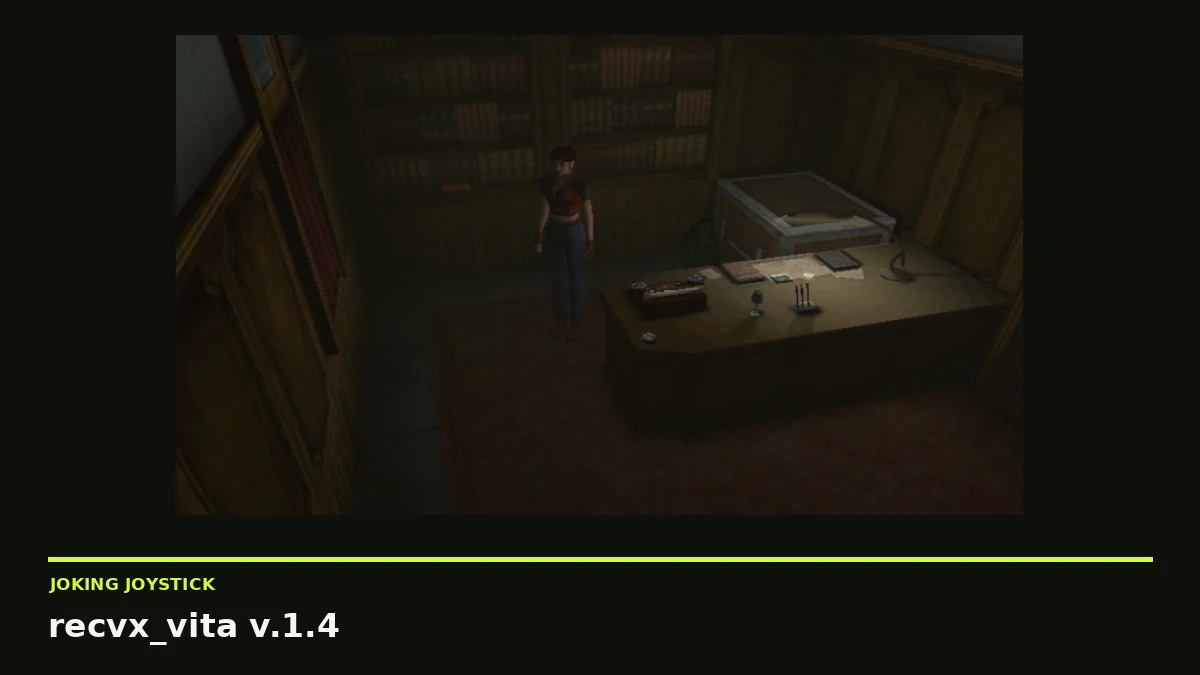
Resident Evil: Code Veronica X Vita has reached version 1.4, a new release for the PlayStation Vita port of Resident Evil: Code Veronica X. Published on November 10, 2026, the update expands localization support, adds two graphics settings and introduces another optimization for scenes containing translucent meshes.
The project is a Vita port based on the decompilation of the PlayStation 2 version. It runs the game on PlayStation Vita hardware rather than emulating a console. Version 1.4 is available with a Vita package named recvx.vpk and a setup archive for preparing the required game data.
Computer screens now use translated text
The localization system now covers computer screens encountered during gameplay. When players interact with a computer, its on-screen text can use the selected language instead of remaining untranslated. This extends the port’s existing localization work beyond interface elements and other image-based text.
The project supports English, French, Spanish, Italian, Russian, Turkish, Brazilian Portuguese and German. Computer-screen support is particularly relevant for players using one of these language options, since text displayed through in-game terminals is now included in the broader localization system.
Brightness and saturation can be adjusted in-game
Version 1.4 adds separate brightness and color saturation controls under Graphics Options. Brightness changes the overall light level, while saturation adjusts the intensity of colors, giving players more control over the game’s appearance on the Vita’s display.
These settings join an existing collection of visual options. The port supports a 960x544 internal resolution, widescreen presentation, up to 4x MSAA, adjustable fog density and optional shadow casting. It also includes post-processing choices such as CRT, CRT Bleeding, FXAA, Greyscale, LCD 3x, Negative, Sepia, Sharp Bilinear Grid, Sharp Bilinear Scanlines and Vignette. Motion blur can be disabled, while the new brightness and saturation controls provide further ways to adjust the presentation.
Translucent meshes receive another CPU optimization
The release simplifies the handling of translucent meshes. According to the project’s release notes, this can reduce CPU usage by up to 30 percent depending on the situation. The effect is expected to vary according to the scene and the amount of translucent geometry being processed.
This change follows performance work in earlier versions. Version 1.3 reported a CPU workload reduction of up to 40 percent and reduced the GPU impact of MSAA. Version 1.2 added further CPU optimization, improved shader handling and greatly reduced loading times. Those changes remain part of the current release, while version 1.4 adds another targeted improvement.
Earlier updates expanded the Vita port
The release builds on additions from versions 1.1 through 1.3. Modern controls can be paired with dual-analog movement, and the port offers first-person and third-person, over-the-shoulder perspectives. Players can also trigger a 180-degree turn by flicking the right analog stick while using fixed-camera tank controls.
Version 1.3 introduced Russian, Turkish and Brazilian Portuguese localization support, optional post-processing effects, a setting to hide the black bars during in-game cutscenes and a custom PlayStation 2 boot animation. It also fixed visual and control issues involving widescreen cameras, the Golden Lugers sequences, the Antarctica robots, Alexia’s fire attack and video-and-audio timing during in-engine cutscenes.
Version 1.2 added Italian localization, difficulty selection for Very Easy, Easy and Normal modes, a fog-density option, an option for shadow casting, improved widescreen clipping and more precise camera sensitivity. It also fixed text, model, inventory and input problems, bundled precompiled shaders to address shader-miss stutter and added an option to skip startup intros. That release introduced reloading while aiming by pressing Square and reduced loading times across the game.
BioRand randomizer support and an over-the-shoulder mode arrived in version 1.1. That update also addressed object-pushing problems with modern controls, improved movement during camera changes, fixed a stair-animation issue and added the TAPELESS SAVE cheat option.
What the project includes
The port includes a built-in cheats menu, widescreen support, customizable fog density, adjustable camera sensitivity and options for skipping door and stair animations. It also supports BioRand, listed as tested with version 3.3.2, allowing a compatible randomized game setup to be prepared for use with the port.
A touch-based additional options menu can be opened from the top-left portion of the Vita’s screen. Other platform-specific controls include the right-analog flick for a quick 180-degree turn in fixed-camera mode and the Square-button reload action while aiming.
The version 1.4 release provides recvx.vpk at 28,737,340 bytes and setup.zip at 24,267,298 bytes. The documented setup process uses an NTSC-U PlayStation 2 ISO named recvx.iso, prepares assets on a computer and places the resulting game data in the Vita’s ux0:data/recvx directory. The project documentation also lists libshacccg.suprx as a required Vita system component for users who do not already have it installed.
A focused update for a more configurable port
Version 1.4 is a focused update rather than a large feature overhaul. Its localization change makes computer interactions more consistent for supported languages, while the brightness and saturation controls give players direct control over the display. The translucent-mesh optimization continues the project’s work to reduce processing demand on Vita hardware.
Together with the previous releases’ control schemes, widescreen presentation, loading improvements, post-processing effects, localization work and gameplay options, the update adds more flexibility to Resident Evil: Code Veronica X Vita, the PlayStation 2-based game port for PlayStation Vita.