Keep Joking Joystick in your feed.Choose us as a preferred source on Google.
Add as a Preferred Source on Google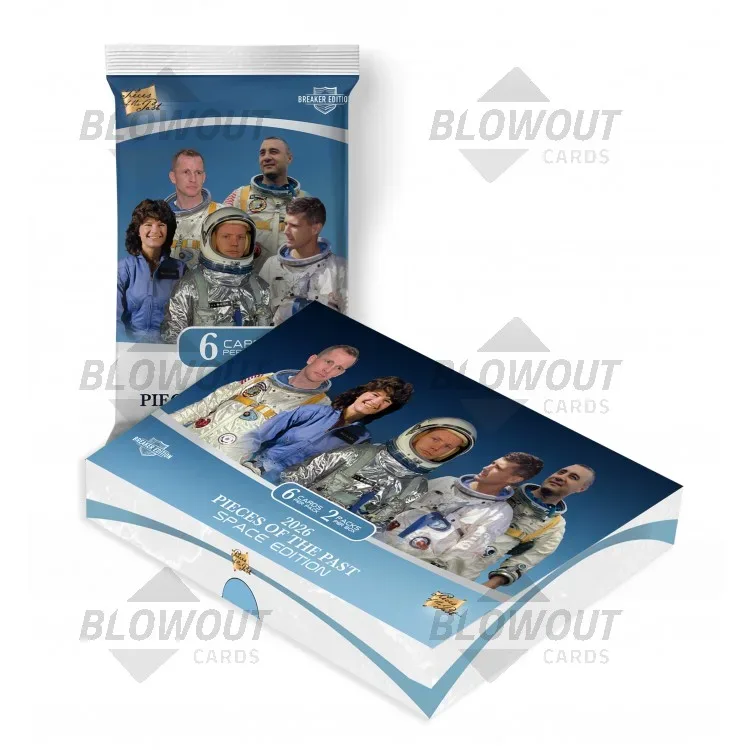
2026 Pieces of the Past Space Breaker Edition 10 Box Case
- Brand
- Piece of the Past
- Sport or category
- Other cards
Last checked
Shop this card release
2026 Pieces of the Past Space Breaker Edition 10 Box Case trading cards
We may earn a commission if you buy through these links, at no extra cost to you. As an Amazon Associate I earn from qualifying purchases.
Opens retailer search results. Check the model, edition, seller, availability and current price before buying.
About this set
2026 Pieces of the Past Space Breaker Edition leans into space history rather than a single sport or character line, with a 200-card base set built around astronauts, presidents, astronomers, physicists, and cosmic imagery. The release also names several premium insert themes and a top chase centered on a Neil Armstrong cut autograph, making it a set for collectors who enjoy historical storytelling across multiple eras of space exploration.
Base set structure and collecting angle
The base set is organized around four connected pillars: the Space Race astronauts, the presidents tied to the era, a long historical run of astronomers and physicists, and visual material drawn from the cosmos itself. That mix gives the release a broad scope, moving from early sky-mapping thinkers through the political decisions that shaped the Space Race and into the people who made spaceflight tangible. For collectors, the appeal is in that layered approach, where one set can cover both scientific history and the human side of exploration.
The confirmed astronaut group includes Neil Armstrong, Sally Ride, Roger B. Chaffee, Gus Grissom, and Ed White. The presidential side names Eisenhower, Kennedy, Johnson, and Nixon. Because the set also includes astronomers and physicists from Aristotle through Einstein and Hubble, the checklist shape suggests a wide historical sweep rather than a narrow spotlight on one mission or one decade. If you prefer building by theme, this is the kind of set that lets you focus on a branch of history instead of trying to chase everything at once.
Dates that anchor the history
Five cards close out the base set, and each one is tied to a specific historical date or milestone: 1514 for Copernicus and the Heliocentric Theory, 1609 for Galileo and the telescope, 1687 for Newton and the Law of Universal Gravitation, 1927 for Lemaitre and the Big Bang Theory, and 1969 for Armstrong’s moon landing. Those date-linked cards add a clear historical spine to the release and give collectors a natural way to organize a partial run or a themed display.
That structure makes the set feel chronological without being limited to a single timeline. Early scientific ideas sit beside later spaceflight milestones, so the release can be collected as a history lesson, a Space Race tribute, or a mixed timeline that tracks how astronomy and astronautics connect. If you like arranging cards by eras, these five closing cards are likely to be among the easiest cards to center a display around, even before considering the rest of the checklist.
Insert themes and chase pieces
The premium insert lineup is broad enough to support several different collecting approaches. Confirmed insert names include Ovalocity, which uses a die-cut format, along with Astro Vision, Black Hole, Moonwalker, Space Dust, The Cosmos, and Mangafied. Two of those inserts, The Cosmos and Mangafied, are marked as SSP, so they appear to sit at the more elusive end of the insert spectrum in this release.
For collectors who enjoy variety, that mix matters because the set is not built around one visual style. Some inserts sound focused on motion or design, while others lean into celestial imagery and stylized presentation. The die-cut Ovalocity cards add another layer for collectors who like distinctive card construction. A sensible approach is to decide early whether your goal is a broad insert sampler, a run of the named premium themes, or a narrower search focused on the SSP pieces.
Top autograph target and practical priorities
The standout autograph chase is the Ultimate 1/1 Neil Armstrong Cut Autograph. That makes Armstrong the clear headline for autograph-focused collectors, and it also fits the set’s larger historical frame because his name appears both in the astronaut pillar and in the dated 1969 moon-landing card. The release does not need a large autograph list to feel complete; one major historical signature can carry a set with this kind of theme.
If you are building around a personal collecting plan, the most natural choices are to choose one lane and stay consistent. A history-first collector might try to assemble the date-linked cards and a few key scientist or astronaut names. An insert collector might focus on the named premium themes, especially the SSP inserts if they surface in your tracking. A signature collector can keep the 1/1 Armstrong cut as the obvious centerpiece while treating the rest of the set as context. That flexibility is part of the release’s appeal: it can be collected as a timeline, a Space Race set, or a showcase of space-themed inserts without needing to fit a single mold.