Keep Joking Joystick in your feed.Choose us as a preferred source on Google.
Add as a Preferred Source on Google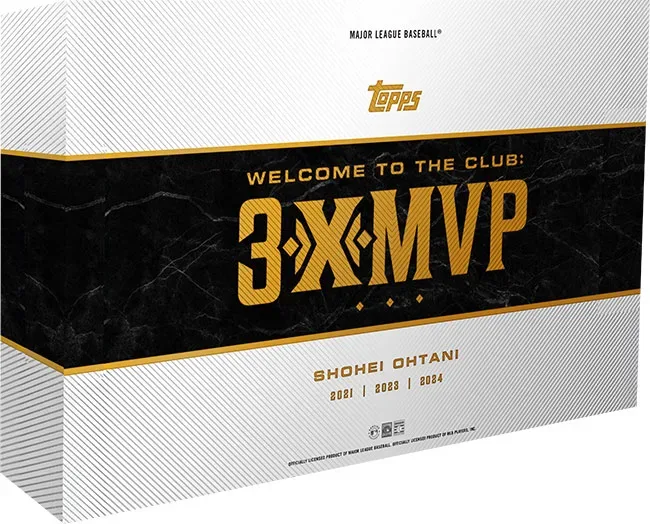
2025 Topps Welcome to the Club: 3X MVP Baseball
Last checked
Shop this card release
2025 Topps Welcome to the Club: 3X MVP Baseball trading cards
We may earn a commission if you buy through these links, at no extra cost to you. As an Amazon Associate I earn from qualifying purchases.
Opens retailer search results. Check the model, edition, seller, availability and current price before buying.
About this set
2025 Topps Welcome to the Club: 3X MVP Baseball centers on Shohei Ohtani while bringing together 12 players who each won MVP honors at least three times. The set mixes a 36-card base checklist, multiple foil parallels, Ohtani-focused inserts, on-card autographs, cut signatures, and dual autographs built around Ohtani pairings.
Set identity and collecting focus
This release is built around one very specific idea: repeated MVP excellence. The checklist brings together 12 players who fit that theme, with Shohei Ohtani as the central figure and 11 others joining him across the set. Three cards are assigned to each player in the 36-card base set, and each base card highlights a different MVP season from that player’s career. That structure gives the checklist a clear organizing principle, so collectors can chase the same player across different award years rather than treating every card as interchangeable.
The active-player element is limited. Ohtani and Mike Trout are the only players in the base set still active, while the rest of the roster reaches back through earlier eras, including names such as Mickey Mantle, Barry Bonds, and Joe DiMaggio. That mix makes the set feel like a career-spanning honor roll rather than a single-era snapshot, and it also gives team and player collectors different angles for building a focused run.
Base cards and parallel paths
The base cards are joined by a large parallel ladder, with 13 foil levels numbered to 150 or less. The confirmed tiers run from Blue Foil /150 and Pink Foil /125 through Green Foil /99, Green Stardust Foil /99, Aqua Foil /75, Gold Foil /50, Gold Stardust Foil /50, Orange Foil /25, Orange Stardust Foil /25, Black Foil /10, Red Foil /5, Cracked Ice Foil /3, and Foilfractors limited to 1/1. The same parallel levels and numbering apply to the base set cards, giving each player multiple chase paths without changing the core design concept.
For collectors, the practical choice is whether to build by player or by color. A player run is straightforward because each of the 12 players appears three times in the base set, while a parallel run can become more selective depending on how deep you want to go. Because the numbering ranges are confirmed, the parallel ladder has a clear top end, but the set still leaves room for more modest collecting goals at the lower-numbered tiers.
Insert material centered on Ohtani
Beyond the base cards, the standard insert group narrows back to Ohtani. Three Ohtani cards use a distinctive script treatment, which gives that portion of the release a separate visual identity and keeps the star of the set firmly in view. Since those inserts are tied to one player, they are a natural target for collectors who want a compact side run instead of chasing the full 36-card base checklist.
That Ohtani focus also helps define how the set should be approached. A collector can choose to stay with the base cards alone, build the Ohtani subset, or combine both into a more layered project. The key point is that the non-base material does not scatter in different directions; it reinforces the same central player narrative that drives the rest of the release.
Autographs, cuts, and dual signatures
The autograph content is split into two distinct formats. Six players have on-card autographs numbered to 10 and under, while the other six players in the product are represented with one-of-one Cut Signatures. That division matters for collectors because it creates two very different ways to chase signed cards: a small numbered autograph pool on one side, and true one-of-one cuts on the other.
Dual autographs add another layer, and Ohtani is part of every one of them. He is paired with Bonds, Trout, Schmidt, Pujols, and Rodriguez on hard-signed cards that max out at five copies, while Ohtani’s signature appears alongside cuts from the remaining players in one-of-one combinations. For collectors who prefer autographs as the centerpiece of a collection, this mix offers a clear hierarchy: numbered duals, hard-signed singles, and unique cut pairings, all anchored by the same MVP theme.