Keep Joking Joystick in your feed.Choose us as a preferred source on Google.
Add as a Preferred Source on Google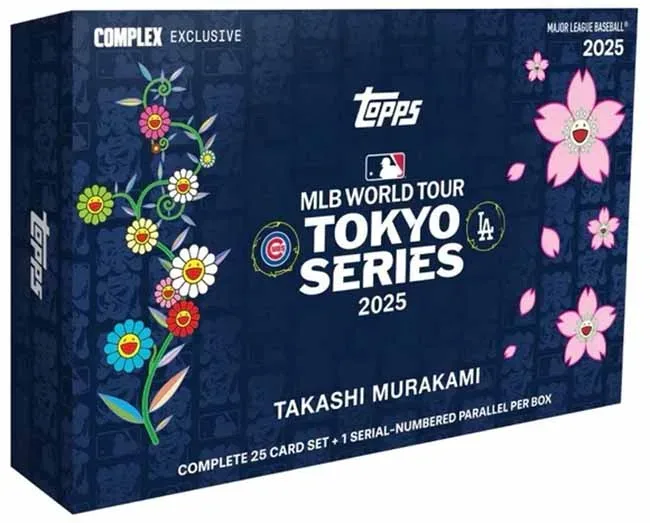
2025 Topps Takashi Murakami + MLB World Tour Tokyo Series Baseball
Last checked
Shop this card release
2025 Topps Takashi Murakami + MLB World Tour Tokyo Series Baseball trading cards
We may earn a commission if you buy through these links, at no extra cost to you. As an Amazon Associate I earn from qualifying purchases.
Opens retailer search results. Check the model, edition, seller, availability and current price before buying.
About this set
2025 Topps Takashi Murakami + MLB World Tour Tokyo Series Baseball pairs Topps baseball with Murakami’s vivid visual style in a compact Dodgers-and-Cubs checklist. The set centers on 24 players plus a second Shohei Ohtani card, with a one-of-one Dual Autograph featuring Ohtani and Murakami at the top of the release.
What this release is
This 2025 Topps issue brings together the MLB World Tour Tokyo Series theme and Takashi Murakami’s artwork in a baseball card format. The checklist is built around two clubs, the Los Angeles Dodgers and Chicago Cubs, with 12 players from each team. Shohei Ohtani appears twice, once as a batting card and once as a pitching card, bringing the total checklist to 25 cards. That structure makes the set easy to understand at a glance, but still distinctive because the same player gets two different cards.
The design direction is one of the main collecting points. Murakami’s color-forward style is described as blending with elements of the 1989 and 1990 Topps Baseball sets, so the release sits between contemporary art and familiar vintage Topps cues. For collectors who like themed team pairings, it has a very focused roster rather than a wide league-wide spread. For collectors who follow artist collaborations, the name attached to the artwork matters as much as the player list.
Checklist shape and player focus
Named players in the product notes include Ohtani, Yoshinobu Yamamoto, Shota Imanaga and Clayton Kershaw. Because the set is built from just two teams, the checklist has a tighter identity than a typical multi-team baseball release. That can make player selection feel more deliberate: Dodgers and Cubs collectors can target their own lanes, while broader collectors can focus on the marquee names that stand out within the small list.
The dual Ohtani treatment is the kind of detail that gives the release some collecting variety without relying on a large checklist. Instead of chasing volume, the appeal comes from comparing the two versions and deciding which image or role representation fits a personal collection better. If you collect by player, the set naturally encourages a focused display around the big names already named in the checklist notes.
The Murakami design angle
Murakami’s involvement gives the product its clearest visual identity. His contemporary art style is the defining feature, and the Topps design language is described as blending that look with recognizable late-1980s and early-1990s Topps Baseball styling. That combination suggests a set where the artwork and the card framework matter together, rather than one simply overpowering the other. The result should be especially appealing to collectors who value graphic design, not just player selection.
Because the release ties itself to a specific Tokyo Series theme, the artistic presentation feels connected to place as well as sport. That matters when deciding how to collect it. Some collectors may want only the strongest player names, while others may prefer to assemble a smaller art-led run that captures the set’s visual identity. In a product with a limited checklist, the design becomes part of the checklist story rather than just decoration.
Where the chase concentrates
The headline card is the one-of-one Dual Autograph pairing Ohtani with Murakami. That places the biggest collecting attention on a single high-point card rather than a long ladder of chase pieces. Even if a collector is not aiming at that centerpiece, it helps define the tone of the release: this is a compact set with one especially notable crossover card sitting at the top.
For a practical collecting approach, the set offers two clear paths. One is player-first, centered on Ohtani and the other named stars from the Dodgers and Cubs. The other is design-first, where the appeal is the Murakami artwork and the set’s retro Topps framing. Either way, this release works best when collected with a specific focus, since the checklist is intentionally narrow and the visual identity is a major part of its character.