Keep Joking Joystick in your feed.Choose us as a preferred source on Google.
Add as a Preferred Source on Google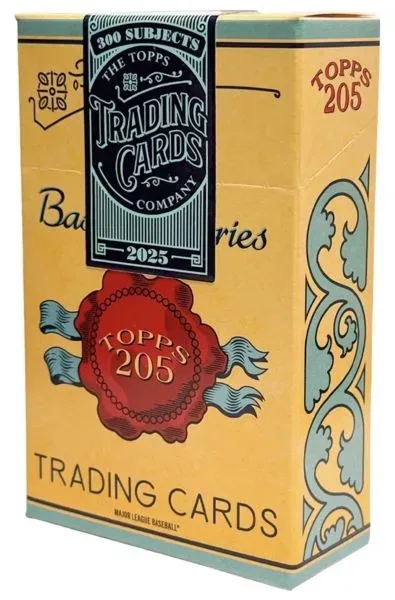
2025 Topps T205 Baseball
Last checked
Shop this card release
2025 Topps T205 Baseball trading cards
We may earn a commission if you buy through these links, at no extra cost to you. As an Amazon Associate I earn from qualifying purchases.
Opens retailer search results. Check the model, edition, seller, availability and current price before buying.
About this set
2025 Topps T205 Baseball revives the 1911 Gold Border look in original tobacco-card size, giving this release a distinct vintage feel without turning it into a straight reproduction. The 300-card base set mixes current stars, rookies, retired stars, and Hall of Famers, while the back variations, photo swaps, and No Cap cards make the collecting approach feel layered and deliberate.
A T205 revival with a different footprint
This release brings Topps back to the 1911 T205 Gold Border model after several seasons of T206-inspired designs. The most immediate collecting detail is the size: these cards are made to match the approximate dimensions of original tobacco cards, not modern standard card stock. That smaller format changes how the set feels in hand and how it may be displayed, especially if you prefer cards that echo early-1900s tobacco issues rather than contemporary baseball releases.
Because the design choice is so specific, the set’s identity is tied to presentation as much as player selection. Collectors drawn to vintage styling get a product that leans into the era it references, while still using a modern Topps baseball checklist built around current players and familiar legends.
Base set composition and player mix
The base set is confirmed at 300 cards and spans a broad mix of subjects: current stars, rookies, retired stars, and Hall of Famers. That combination makes the set flexible for different collecting goals. Some collectors will focus on active players and rookies, while others may build around retired names or use Hall of Famers as the anchor for a long-term run.
Because the checklist blends eras, the set can be approached in more than one way. A completion-minded collector may chase the full 300-card base set, while a narrower collector may choose a lane such as rookies, stars, or historical names. The player mix also keeps the set from feeling locked to one generation, which suits a design that is itself rooted in baseball history.
Back variations and the tobacco-card connection
One of the strongest parts of this release is the emphasis on different card backs. Topps uses the tobacco-card model by creating parallels tied to many of the original brands that appeared on 1911 T205 backs. That gives collectors a second layer beyond the front image, and it creates a natural sorting project for anyone who enjoys comparing design details rather than only chasing player names.
The back themes matter here because they are part of the set’s historical character. Early tobacco cards often used advertising backs tied to specific brands, and this release adopts that idea for its parallel structure. For collectors, that means a T205 run can be organized by subject, by back variation, or by a mixture of both. The result is a set that rewards patient sorting and close attention to design differences.
Photo variations and the No Cap nod
Photo variations are also part of the release, continuing another feature associated with early tobacco issues. In practical terms, that gives collectors another decision point when building the set: some may be satisfied with a base-card run, while others may want to pursue alternate images as a distinct side chase. Since photo swaps were part of the original tobacco-card landscape, their presence helps the release feel more faithful to the style it references.
The most specific variation mentioned is the No Cap treatment, a nod to the famous 1911 T205 Bobby Wallace No Cap card. That original variation is one of the best-known examples from the historic set, and Topps’ use of the idea adds a recognizable layer to the modern release. For collectors, this is the kind of feature that can define a variation-focused approach without requiring the entire set to be built around it.
How to shape a collecting plan
The cleanest way to collect this release is to decide how much of the design story you want to follow. A straightforward base-set build gives you the full player mix in the original-sized format. If you prefer a more selective project, you can narrow your focus to a player type, such as rookies or Hall of Famers, and then decide whether to add back variations or photo variations as a separate chase.
Collectors interested in historical continuity will probably want to pay attention to the backs and the No Cap references, since those features carry the strongest connection to the 1911 model. Others may prefer to treat those layers as optional rather than essential. Either approach fits this product, because the set is built to support both a simple base-card run and a deeper variation hunt without changing its core identity.