Keep Joking Joystick in your feed.Choose us as a preferred source on Google.
Add as a Preferred Source on Google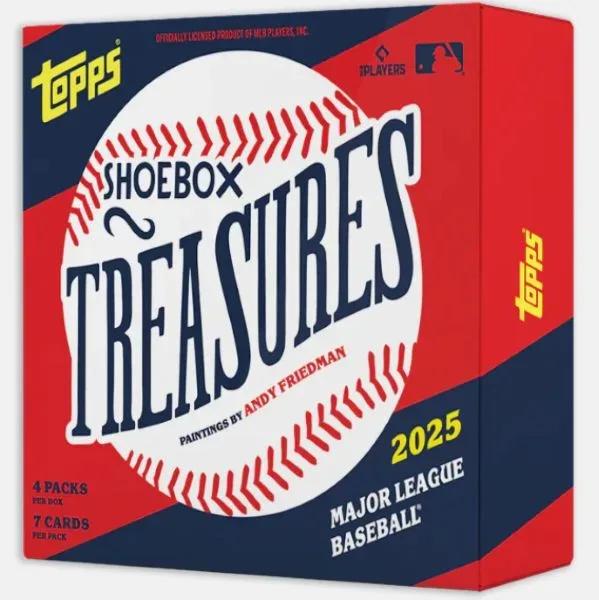
2025 Topps Shoebox Collection
Last checked
Shop this card release
2025 Topps Shoebox Collection trading cards
We may earn a commission if you buy through these links, at no extra cost to you. As an Amazon Associate I earn from qualifying purchases.
Opens retailer search results. Check the model, edition, seller, availability and current price before buying.
About this set
2025 Topps Shoebox Collection continues Topps’ artist-driven baseball card approach with Andy Friedman at the center. The set turns original Topps inspiration into standard-size cards, reaching from 1952 through 2024 and mixing Hall of Famers, current stars, and retired veterans. Collectors can focus on Friedman’s artwork, the era spread, or the blend of familiar Topps designs.
Andy Friedman’s return to baseball card art
This release is built around Andy Friedman’s painted interpretations of Topps history. It is the fourth full Topps set in five years to feature his work, and that continuity gives the collection a distinct identity. Instead of treating each card as a straight reproduction, Friedman reimagines original Topps cards through watercolor artwork that Topps then adapts into standard-size baseball cards.
The set also marks a first for baseball cards: Friedman used gouache along with watercolor. That matters to art-focused collectors because it adds another layer to the look and feel of the series. The result is less about cloning a vintage card and more about translating a familiar baseball image into a new visual medium.
A base set that spans eras and card styles
The base set includes 100 reworked cards, and the range is a major part of the appeal. The earliest confirmed source point is the 1952 Topps Duke Snider card, while the newest reach goes to 2024 subjects such as Shohei Ohtani, Juan Soto, Paul Skenes, and Gunnar Henderson. That broad spread gives the collection a long runway across baseball history without locking it to one era.
Most of the cards draw from Topps flagship base cards, but the inspiration pool is wider than that. Confirmed source sets also include Topps Mini, Topps Kids, Topps Allen & Ginter, Topps Chrome, Topps Pristine, and Topps Now. For collectors, that means the checklist identity is not just a parade of famous names; it is also a survey of how different Topps card lines can be reinterpreted in Friedman’s style.
Choosing a collecting angle
A straightforward way to collect this set is by era. Some collectors may want to follow the older references first, especially the 1950s material, while others may prefer the modern stars and recent Topps subjects. Because the checklist moves from Duke Snider to contemporary players, the set works well as a timeline of Topps imagery as much as a player list.
Another approach is to chase the cards whose originals were never the most obvious choices. The set name points toward that idea, and Friedman’s comments about being drawn to regular players fit the same spirit. If you like cards that highlight overlooked seasons, less famous Topps designs, or the everyday side of baseball history, this release gives that angle real space.
What the collection is and is not
This is best understood as an artist-led Topps baseball set rather than a traditional stats-first release. The confirmed focus is on Friedman’s interpretations, the cross-era base lineup, and the mix of well-known and less expected source cards. That makes it especially appealing to collectors who enjoy design history, original artwork, and the way Topps revisits its own archive.
At the same time, the title and format do not promise every possible type of card content or every kind of chase element. For that reason, the most useful collecting choices are the ones tied to the confirmed structure: follow the artist, follow the eras, or follow the specific Topps lines represented. Each path gives the set a different character, and all of them fit the collection’s shoebox theme of cards that feel found, remembered, and reworked rather than simply repeated.