Keep Joking Joystick in your feed.Choose us as a preferred source on Google.
Add as a Preferred Source on Google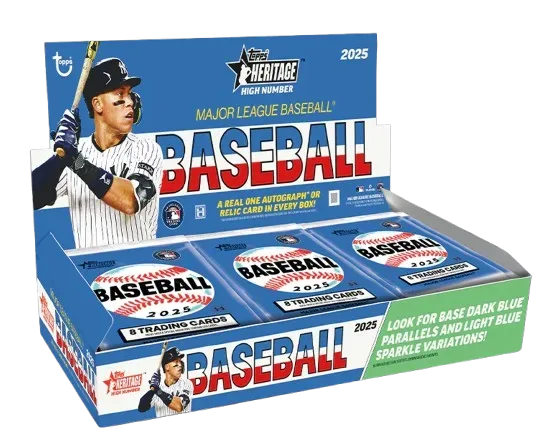
2025 Topps Heritage High Number Baseball
Last checked
Shop this card release
2025 Topps Heritage High Number Baseball trading cards
We may earn a commission if you buy through these links, at no extra cost to you. As an Amazon Associate I earn from qualifying purchases.
Opens retailer search results. Check the model, edition, seller, availability and current price before buying.
About this set
2025 Topps Heritage High Number Baseball extends the Heritage run with updated late-season subjects and a clear 1976 Topps Baseball throwback style. The set keeps the familiar update-series role for the brand, while adding short prints, new variation types, chrome base cards, and bicentennial-inspired inserts, relics, and buyback cards for focused collectors.
Season-ending Heritage with a 1976 feel
Heritage High Number works as the late-year companion to the main Heritage release, but it does more than simply extend a checklist. This edition continues the numbering from the spring set, starts at card #501, and brings in late-year rookies, traded players, and players in new uniforms. The design direction is anchored in 1976 Topps Baseball, which gives the set a strong retro identity without losing its update-series purpose.
The Heritage line itself began in 2001 with a design modeled on 1952 Topps Baseball, so the brand has a long history of using older Topps looks to frame current players. In this edition, the 1976 styling is the important collecting cue, and the historical callbacks are built around that specific year rather than the earlier Heritage template.
Base set, short prints, and variation paths
The base set is planned at 225 cards, and the last 25 cards are short prints. That late-run grouping is one of the main reasons High Number tends to appeal to set builders and player collectors alike: the checklist begins with familiar roster updates, then tightens near the end with tougher subjects. If you prefer chasing by player, that structure gives you a simple way to focus on the back half of the run.
Variations remain a major part of the appeal. Image variations and Nickname variations return, and this release adds Alternate Cartoons and Flipped Bat versions. Those different treatments create several ways to collect the same player, whether you want alternate photography, a playful name change, or a specific visual twist. For collectors who like building around a player rather than just a base card, the variation layer is one of the clearest choices in the set.
Chrome cards and parallel building
Select base cards also appear in chrome editions, with multiple color parallels available. That gives collectors two different directions: stay with the classic paper base cards, or move into chrome if you want a different finish and more color-driven collecting. Since the product is tied to a retro design, the chrome versions can feel like a modern contrast to the old-school layout, which makes them a natural target for people who enjoy that mix of new surface and vintage art direction.
Parallel chasing is best treated as a collecting style choice here rather than a requirement. You can build a straightforward base run, focus on specific players in chrome, or target a color path for a smaller side project. Because the set includes both standard parallels and chrome parallels, there is room to make the collection as simple or as layered as you want.
Bicentennial inserts, relics, and vintage links
The 1976 design theme also carries into the insert and relic content. Bicentennial Stars and Bicentennial Relics use patriotic styling tied to the mid-1970s look, while the broader insert lineup includes 1976 Retirees and Undefeated. The 1976 Retirees insert revisits players who finished their careers that year, including Henry Aaron, and Undefeated highlights the 1976 Cincinnati Reds and their seven straight postseason victories. These themes make the set feel connected to the era that inspired it, not just visually but historically as well.
Another notable chase is the foil-stamped buyback treatment for original 1976 Topps Baseball cards. That adds a direct vintage connection to the design year and gives collectors a different kind of target from the modern base, variation, and parallel groups. If your interest in Heritage leans toward history first, the buybacks and era-specific inserts are the clearest places to concentrate.