Keep Joking Joystick in your feed.Choose us as a preferred source on Google.
Add as a Preferred Source on Google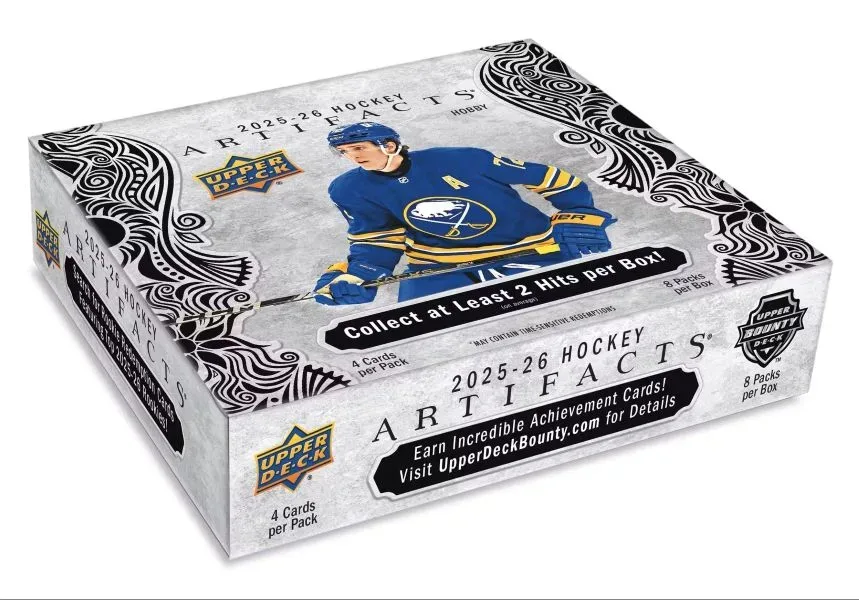
2025-26 Upper Deck Artifacts Hockey
- Brand
- Upper Deck
- Sport or category
- Hockey
Last checked
Shop this card release
2025-26 Upper Deck Artifacts Hockey trading cards
We may earn a commission if you buy through these links, at no extra cost to you. As an Amazon Associate I earn from qualifying purchases.
Opens retailer search results. Check the model, edition, seller, availability and current price before buying.
About this set
2025-26 Upper Deck Artifacts Hockey centers on a 250-card base set spread across six segments, with rookie redemptions, numbered base parallels, and a wide mix of autograph and memorabilia content. Collecting it is largely about choosing a lane: building the base set, chasing premium parallel versions, or focusing on signature and relic concepts with different levels of difficulty.
Base Set Structure
The foundation of the release is a 250-card base set divided into six segments. The first 100 cards follow a traditional base approach, while the full set extends well beyond that opening group into the larger Artifacts structure. For collectors, that makes the set feel layered rather than linear, with clear checkpoints for anyone trying to sort by segment or track progress card by card.
The product also includes rookie redemptions, which gives the set another collecting path beyond the regular base run. That matters for collectors who enjoy separating rookies from veterans and legends instead of treating the release as a single mixed checklist. It also adds another reason to organize cards by type before deciding which ones to keep in a master set build.
Parallel Choices
The first 200 cards in the set are covered by a lengthy range of numbered parallels, so base collecting is not limited to the plain version. That creates a strong sorting decision right away: some collectors will want only the standard cards, while others may prefer to chase parallel versions as the main focus of the set. Because the numbered parallels are part of the opening portion of the checklist, they give the release a broad chase element without changing the identity of the base set itself.
Select base cards also receive autograph and memorabilia parallels. The confirmed color versions here are Gold, Emerald, Purple, and Black. Those versions are especially useful for collectors who like a consistent visual ladder across a set, since the same card can exist in multiple forms. As always, the exact appeal depends on which player or subject is on the card, but the structure itself is clear: standard base, numbered parallel, and then special autograph or memorabilia treatments for selected cards.
Autographs and Memorabilia
Artifacts includes autograph and memorabilia content alongside the base set and its parallels. The confirmed product mix spans concepts that are easier to find and others that are more difficult, giving collectors room to decide whether they want to sample several themes or concentrate on tougher chase cards. That range can work for set builders who want a representative cross-section as well as for collectors who prefer to focus only on specific autograph or memorabilia categories.
Because the release combines signatures and relic-style cards across different levels, it works well for collectors who like to separate their goals by difficulty. One sensible approach is to focus on the easier concepts first and then decide whether to target the scarcer autograph and memorabilia pieces later. Another is to skip the broad chase entirely and concentrate only on the specific categories that fit a personal collection theme.
History Lesson Signatures
One of the clearest specialty concepts in the release is History Lesson Signatures. This is a two-card pairing: one card carries an autograph from a legend, and the other carries an autograph from a current star. When the two cards are placed together, they form one complete image. That format gives the insert a built-in collecting puzzle, since the appeal comes from assembling both halves rather than treating each card as a standalone hit.
For collectors, that makes History Lesson Signatures a natural choice if you enjoy connected inserts and pair-based collecting. The set’s structure suggests a deliberate blend of past and present, but the cards themselves remain separate pieces until matched. If you are building around this insert, the most practical mindset is to treat each half as part of a pair and decide in advance whether you want to collect one side, both sides, or only complete combinations.