Keep Joking Joystick in your feed.Choose us as a preferred source on Google.
Add as a Preferred Source on Google
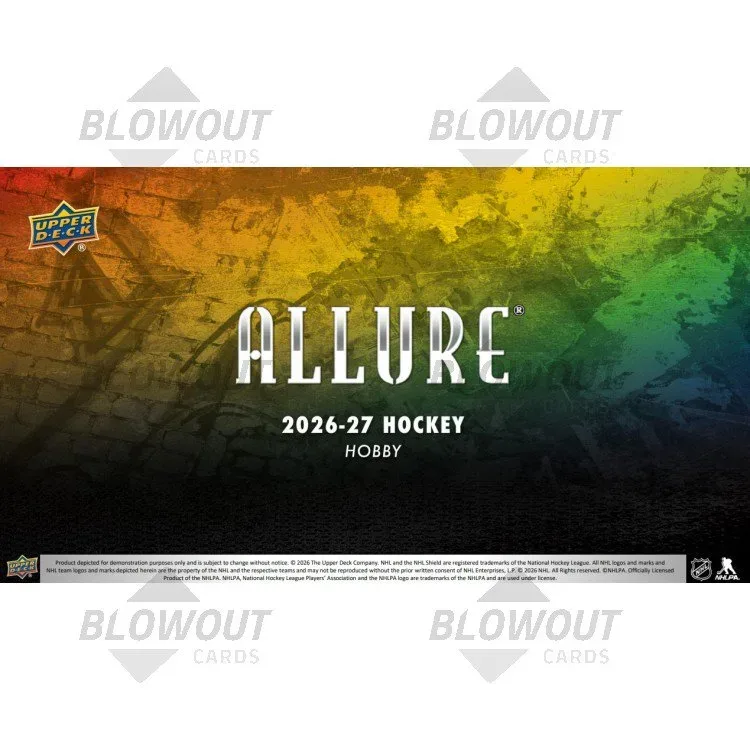
2025-26 Upper Deck Allure Hockey
- Brand
- Upper Deck
- Sport or category
- Hockey
Last checked
Shop this card release
2025-26 Upper Deck Allure Hockey trading cards
We may earn a commission if you buy through these links, at no extra cost to you. As an Amazon Associate I earn from qualifying purchases.
Opens retailer search results. Check the model, edition, seller, availability and current price before buying.
About this set
2025-26 Upper Deck Allure Hockey keeps the focus on bold color, modern design, and layered chasing across veterans, rookies, parallels, inserts, and autographs. The 150-card base set splits cleanly between 100 established players and 50 rookies, while multiple parallel and autograph paths give set builders and player collectors several ways to narrow their focus.
Base set shape and collector focus
The core checklist is built as a 150-card set, with the first 100 cards devoted to NHL veterans and the final 50 reserved for rookies. That structure makes the release easy to read at a glance: established names anchor the front half, and the rookie run closes the set with a separate collecting lane. For many collectors, that split creates two natural ways to build—one centered on known players and another centered on first-year cards.
Allure’s identity is tied to a flashy, modern look, so the base cards are only part of the appeal. The design language matters here as much as the checklist itself, and the set is aimed at collectors who like bright visuals and a cleaner, contemporary style rather than a traditional throwback presentation.
Parallel collecting choices
Parallels are a major feature across the full base set, and that matters for both veteran and rookie cards. Because the parallel treatment extends beyond just one segment of the checklist, collectors can choose whether to chase a specific player in one version or try to assemble a broader rainbow across the set. The same structure also gives team and player collectors a way to focus on a narrower lane without needing the whole checklist.
For builders, the parallel-heavy setup changes the collecting rhythm. A straight base run gives the set its foundation, but the alternate versions are where the chase becomes more specific. That can make it sensible to decide early whether the goal is a complete base set, a favorite-player run, or a hunt for selected parallel versions that fit a personal theme.
Autographs across the checklist
Autographs are not limited to a single corner of the release. Select base cards receive four autograph parallel tiers, which creates a layered signature chase rather than a one-note insert. That kind of structure gives signed cards more variation inside the same overall checklist, and it can appeal to collectors who like comparing different signature versions of the same player card.
There are also additional autographs tied to parallel versions of several insert sets. That broadens the signature path beyond the base set and gives autograph collectors more than one route into the product. If you enjoy chasing signed cards, the key choice is whether to center your collecting on base-card autograph parallels, insert autographs, or a mix of both.
New inserts and color depth
The release debuts several new insert themes, and each of those inserts is expanded with six colored parallels per design. That adds a lot of room for variation without changing the overall identity of the product. Collectors who enjoy insert collecting get a clear choice: stay with the standard version of a theme, or push further into the colored parallels and build around a specific look.
Because the parallel structure is built into the inserts from the start, the set rewards patience and selectivity. Some collectors may prefer to target just one favorite insert theme, while others may want to sample multiple designs and let the colors define the collection. Either approach fits the release well, since the product’s visual identity is as important as the checklist itself.
How to approach this release
This is a good release for collectors who like structure with room for choice. The veteran-rookie split gives the base set a clear frame, while the parallel and autograph layers create several distinct directions for building a collection. If you prefer a tidy project, the base set offers that. If you prefer chase cards, the parallels and signed versions provide enough variety to keep the hunt moving.
A practical way to approach the set is to decide what matters most before starting: complete base, rookie focus, veteran focus, autographs, or insert parallels. That decision can keep the collection from becoming too scattered, especially in a product with so many alternate versions. The result is a release that works best when collectors pick a lane and let the design and color structure guide the rest.