Keep Joking Joystick in your feed.Choose us as a preferred source on Google.
Add as a Preferred Source on Google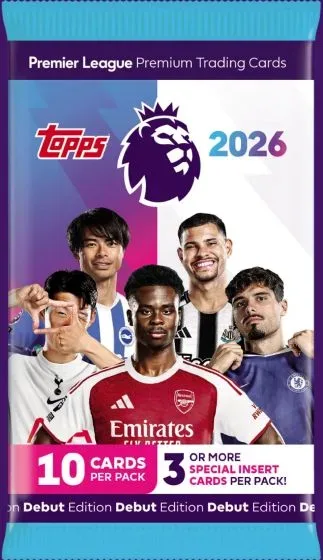
2025-26 Topps Premier League Soccer
Last checked
Shop this card release
2025-26 Topps Premier League Soccer trading cards
We may earn a commission if you buy through these links, at no extra cost to you. As an Amazon Associate I earn from qualifying purchases.
Opens retailer search results. Check the model, edition, seller, availability and current price before buying.
About this set
2025-26 Topps Premier League Soccer opens Topps’ new exclusive run with the league under the Fanatics agreement. The set centers on a broad base checklist built from 14 players across all 20 clubs, plus subsets that expand the release to 450 cards. Collectors will also see QR codes on every card and parallels in at least 15 colors.
Topps’ return to the Premier League
This release marks the first product issued under the new licensing agreement between Fanatics and the Premier League, giving Topps a lead role in England’s top league again. That context matters for collectors because the brand’s relationship with the competition stretches back to 1994-2019, and this set sits at the front of a new era rather than as a one-off revival.
For collectors, the most useful takeaway is that the product is built around broad league coverage. It is structured in a way that can suit team set builders, player collectors, and anyone who prefers a season-opening base set with room for variation through parallels.
Base set depth and checklist shape
The base set is described as running deep, with 14 players from each of the 20 clubs making up a 280-card base checklist. That size gives the set a clear club-by-club identity while still leaving enough room for focused collecting choices. A collector can approach it as a full league build, narrow it to one club, or target specific players and then use the broader checklist as a guide for sorting and trade planning.
Beyond the base cards, the product includes subsets that recognize special segments of players, and those additions bring the complete checklist to 450 cards. That means the set is designed with layers rather than a single straight list, so finishing a club or a player run may involve tracking both the core base cards and the related subset material. Since the exact composition of every subset is not detailed here, the smart collecting choice is to treat the base and subset tiers as separate goals instead of assuming they function the same way.
Parallels and the QR-code feature
The Premier League website indicates that parallels will appear in at least 15 colors. That gives the release a wide rainbow-style parallel structure, which is especially relevant for collectors who like color matching or want to focus on a particular player through multiple versions. Because the confirmed information only says “at least 15 colors,” it is best to think of this as a broad parallel program rather than a fixed, fully defined count. The practical collecting choice is whether to chase a single favorite player in several colors or to build a smaller team rainbow instead of spreading attention across the whole checklist.
Every card also carries a QR code on the back that leads to an interactive collector’s hub. That feature makes the set feel more connected to a digital collecting environment, but the important point for physical collectors is simply that the card design includes a back-side code on every card. If you enjoy sorting by design traits, the QR element becomes another way to recognize the release and separate it from older Topps Premier League issues.
Release pattern and what it means for collectors
Topps is releasing the product in waves, with the first wave landing in the United Kingdom. That staggered approach suggests the set will unfold in stages rather than all at once, so collectors may want to decide early whether they are building immediately around the first wave or waiting to see how later waves shape the overall chase. Since the confirmed information only identifies the United Kingdom retail launch for the first wave, it is safest to treat the release pattern as wave-based and not assume the same timing or format for every market.
For a collector, the most grounded approach is to define the goal before sorting cards: complete base set, club collection, selected players, or color-parallel chase. The release already has enough structure to support all four, and the combination of a large base checklist, subset layers, and a multi-color parallel program gives the set clear collecting lanes without needing to overcomplicate it.