Keep Joking Joystick in your feed.Choose us as a preferred source on Google.
Add as a Preferred Source on Google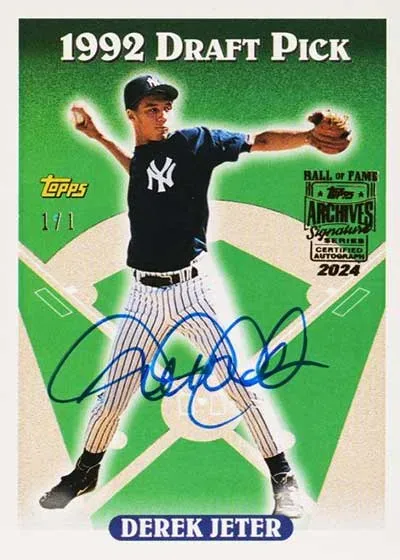
2024 Topps Archives Signature Series Baseball – Retired Edition
Last checked
Shop this card release
2024 Topps Archives Signature Series Baseball – Retired Edition trading cards
We may earn a commission if you buy through these links, at no extra cost to you. As an Amazon Associate I earn from qualifying purchases.
Opens retailer search results. Check the model, edition, seller, availability and current price before buying.
About this set
2024 Topps Archives Signature Series Baseball – Retired Edition keeps the focus on signed buybacks and retired stars, with every card numbered to 99 or fewer copies and many running lower in practice. The checklist is signer-based rather than card-based, and each card is housed in a one-touch holder with a foil stamp that separates these from other signed vintage cards.
What this release is built around
This edition is a straightforward buyback autograph concept built on retired names and older Topps cards. The emphasis is not on a broad card design program, but on the pairing of a past player with a past card, then finishing it with a signature and serial numbering. That gives the set a collected, curated feel even when the exact card list is not published in advance.
Because the product is centered on signers, the checklist naturally reads more like a roster than a traditional base set. That matters for collectors who like to follow names first and card variations second. The format also means that one player may appear across several different cards, adding variety without turning the release into a large, open-ended chase.
How the buybacks are identified
A key detail here is the foil stamp. It is the marker that distinguishes these buybacks from older cards that may have been signed in another setting, such as an event signing or through the mail. For collectors focused on authenticity within the buyback concept, that stamp is part of the appeal because it ties the autograph back to the Topps-issued release structure.
The cards also arrive in one-touch holders, which suits a product built around signed singles rather than stacks of commons. That presentation makes the release easy to store, display, or sort by signer, card design, or numbering. Since the cards are already encapsulated in that format, many collectors will treat the holder as part of the card’s identity rather than just its packaging.
Collecting choices that make sense
A sensible approach is to collect by retired player first, especially if you follow a specific era or a small group of names. Since the product can feature the same player on more than one card, it rewards collectors who care about the combination of signer and underlying card design rather than just a single autograph image. The appeal often comes from seeing how different Topps designs frame the same name.
Another way to build around the release is by card style. Even without a full card-by-card breakdown, the buyback nature of the set makes the original card design an important part of the draw. Some collectors will prefer a cleaner presentation or a design that feels strongly tied to a particular Topps era, while others will focus on the signature itself and let the card image be a bonus. Both approaches fit the product well.
If you enjoy narrower checklists, this is a release that works with that mindset. The confirmed 134 signers give it a defined collecting field without suggesting a massive base run, and the numbered nature of each card keeps the chase focused on individual autographs rather than volume. That makes it a good fit for collectors who like selecting specific names instead of trying to assemble every possible variation.
Using the history of Archives wisely
Topps Archives has long been tied to nostalgia, and that context helps explain why this retired edition feels at home in the larger Archives family. The original 1991 Topps Archives Baseball release reprinted the 1953 Topps set, and the line later grew to place current players on designs from earlier Topps eras in its 2012 return. Those earlier releases show how deeply the Archives name is connected to baseball memory and Topps history.
Even so, regular Archives releases and Archives Signature Series are different formats, so the history should be treated as background rather than a promise about contents. For this 2024 Retired Edition, the most useful takeaway is simply that the set follows the Archives tradition of pairing baseball’s past with a Topps-branded present. That gives the product its character without requiring it to mirror any older Archives structure exactly.