Keep Joking Joystick in your feed.Choose us as a preferred source on Google.
Add as a Preferred Source on Google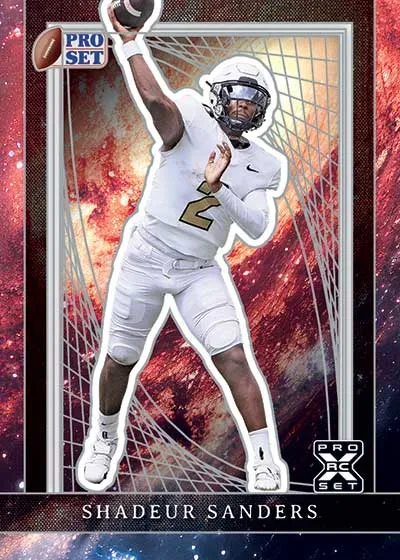
2024 Pro Set Metal Football
- Sport or category
- Football
Last checked
Shop this card release
2024 Pro Set Metal Football trading cards
We may earn a commission if you buy through these links, at no extra cost to you. As an Amazon Associate I earn from qualifying purchases.
Opens retailer search results. Check the model, edition, seller, availability and current price before buying.
About this set
2024 Pro Set Metal Football centers on prospect autographs while still leaving room for base cards, a Retro set, and insert themes. The set’s collecting range comes from low-numbered base cards, lenticular Shattered inserts, and multiple autograph families, with the strongest overall emphasis staying on prospects.
Set character and collecting shape
This release does not stay in one lane. The product leans on a chrome-and-metal look, but it also includes non-chrome elements, so the appeal is broader than a single finish. Autographs make up the largest part of the checklist, yet the set still keeps a defined base structure and a separate insert layer for collectors who want a more varied build.
The overall identity is prospect-driven. That matters when choosing how to collect it, because the base cards, many autograph issues, and much of the parallel chase all sit inside that prospect framework. If your collecting style favors future-focused checklists, this set is built around that idea rather than around a veteran-heavy roster.
Base set and Retro set choices
The base set has just over 150 cards, and each card is numbered to 10. That alone makes the base portion a low-run target rather than a common foundation. More than 50 parallel versions expand the chase with different color treatments and background styles, including Mojo, Crystal, Wave, and Pulsar. For collectors, that creates several natural paths: one can focus on the core numbered card, build around a favorite parallel family, or try to match a player across multiple finishes.
There is also a Retro set with the same basic configuration but a different design. Because the Retro version mirrors the structure rather than changing the collecting logic, it gives a second lane for player collectors who enjoy comparing artwork and parallel treatment across two looks. The key difference is visual presentation, while the attraction remains the low-numbered prospect checklist.
Insert themes and lenticular cards
Shattered is the new lenticular insert line in this product. It brings together prospects, veteran stars, and a few retired greats, which makes it the broadest player mix in the release. That mix gives the insert a different feel from the prospect-only base portions and makes it a sensible choice for collectors who want a single insert theme that crosses eras and player types.
Because Shattered uses lenticular stock, it sits closer to a specialty display card than a standard insert. Collectors who like visual movement and surface changes will likely treat it as a separate lane from the parallel chase. It also works well as a contrast piece inside a mostly autograph-centered collection, especially if you prefer inserts that feel distinct from the base design language.
Autographs and the main chase options
Signed cards are the central draw here, and Base Autographs are the most plentiful autograph type. The checklist includes more than 200 signers, and almost all of them are prospects. That makes the autograph side especially useful for collectors who follow emerging players and want a wide pool of names rather than a narrow star-only list.
Base Silver Prismatic versions are listed at 25 copies each, with 40 levels of parallels at 20 copies or fewer. That combination creates a layered chase around one autograph family instead of a single premium tier. Beyond that, the autograph menu stretches into Anime Nation, Pro Set Platinum, Pro Set Portraits, LIT, and die-cut Penned Pylons. A practical collecting approach is to pick one autograph theme, because the set offers enough variety that trying to chase every style could easily become its own separate project.
How to build around the release
A balanced approach is to decide first whether you want prospects, visual inserts, or autograph variety to lead the collection. If prospects are the focus, the base set and Base Autographs give you the clearest structure, with parallels adding depth. If design matters more than checklist size, Shattered and the Retro set provide two different visual lanes without moving away from the same release identity.
Collectors who prefer narrower goals may want to target one parallel family, one autograph insert, or a player run across a few card types. Because the set mixes low-numbered base cards, many parallel layers, and multiple signed subsets, it rewards choosing a path early. That helps the collection feel intentional rather than scattered, which is useful in a product where the checklist is built around breadth as much as around signatures.