Keep Joking Joystick in your feed.Choose us as a preferred source on Google.
Add as a Preferred Source on Google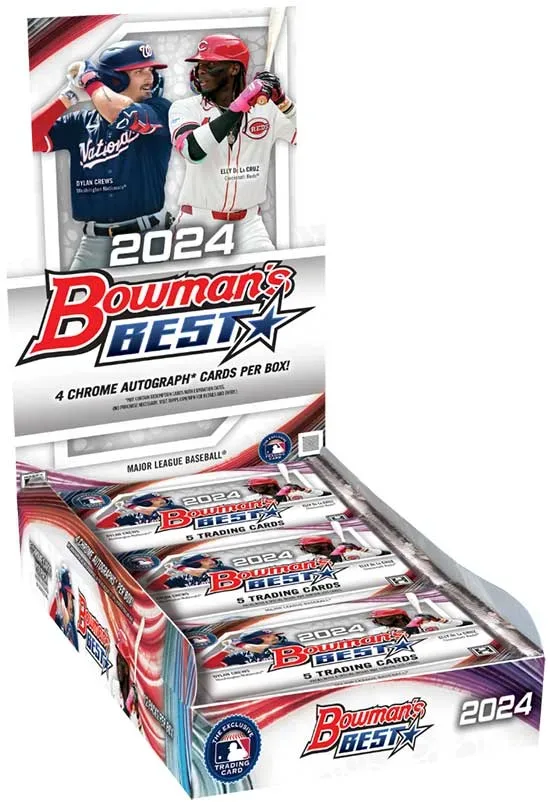
2024 Bowman’s Best Baseball
Last checked
Shop this card release
2024 Bowman’s Best Baseball trading cards
We may earn a commission if you buy through these links, at no extra cost to you. As an Amazon Associate I earn from qualifying purchases.
Opens retailer search results. Check the model, edition, seller, availability and current price before buying.
About this set
2024 Bowman’s Best Baseball centers on the Bowman mix of prospects, rookies, and veterans while using a brighter, busier design style than some other Bowman lines. Chromium-style cards, Refractors, autograph content, and varied inserts give collectors several different ways to approach the set, whether the goal is player collecting, parallels, signatures, or specific insert themes.
What defines this release
2024 Bowman’s Best Baseball follows the same broad lane that collectors associate with Bowman releases built around prospects, rookies, and veterans, but its look is much louder and more layered. Rather than the quieter design language used in some Bowman lines, this release uses a colorful presentation that gives the cards a more animated feel right away. That style matters because the set leans heavily on chromium-style cards, Refractors, and autograph chasing, so the visual package is part of the appeal, not just a frame for the names on the checklist.
The release is divided between active veterans and rookies on one side and prospects on the other, which keeps it connected to the broader Bowman identity while still giving collectors different player categories to pursue. Refractors are part of the chase in both areas, so the parallel side of the set is a major consideration even before moving into signatures or inserts.
Autographs and relic choices
Most of the set’s signatures are found in Best of 2024 Autographs, which uses a similar visual approach. That makes this one of the clearest collecting choices in the release: if the goal is to chase the main autograph material, this is the core lane to watch. The checklist also includes rookie signatures, so the autograph side is not limited to prospects alone. Refractors continue to matter here as well, adding another layer for collectors who like the same player but want a different version or finish.
Autographed relics are included for players from the 2024 All-Star Futures Game. That gives the release a separate memorabilia angle without turning it into a relic-heavy product. For collectors who prefer a more focused target, this means the memorabilia pieces can be treated as a distinct branch rather than something that needs to define the whole set.
Insert sets with distinct personalities
The insert lineup is one of the most recognizable parts of the product because the designs are deliberately varied. Impact Players is a throwback to 2001 Bowman’s Best and brings back a die-cut layout, which gives it a very different collecting feel from the standard base cards. Some cards in that insert also have autograph versions, so it can appeal both to set builders and autograph collectors who want a second route into the same theme.
Fabled Phenoms uses another die-cut format, while Best Ballers brings a colorful retro look. Together, those inserts give the release a mix of modern chrome style and older design callbacks. That balance is useful for collectors who enjoy sorting by visual theme: one stack can be built around die-cuts, another around retro design cues, and another around the signature-focused subsets.
How collectors might approach it
A sensible way to collect this release is to decide early whether the main goal is base-style completion, parallel chasing, autograph hunting, or insert collecting. Because the set mixes veterans, rookies, and prospects, it offers multiple entry points rather than forcing everyone into the same lane. Prospect collectors will likely spend more time on the base-style and autograph areas, while rookie-focused collectors can stay closer to the veteran-and-rookie side of the checklist.
Another practical choice is whether to build around design families. Bowman’s Best is especially friendly to that kind of collecting because its identity is visual as much as checklist-driven. Collectors who like a clean project can concentrate on one insert group such as Impact Players or Fabled Phenoms, while others may prefer to follow specific players across base-style cards, Refractors, and autograph versions. The set supports either approach without requiring a single path through it.