Keep Joking Joystick in your feed.Choose us as a preferred source on Google.
Add as a Preferred Source on Google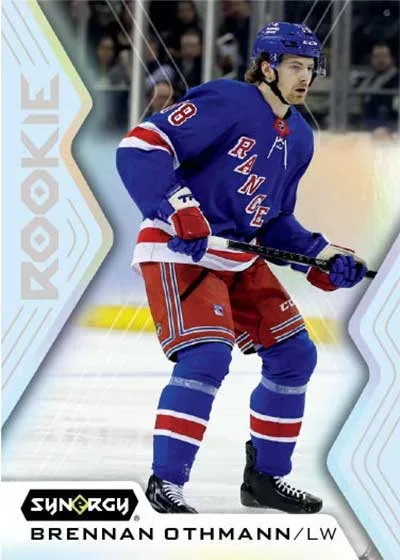
2024-25 Upper Deck Synergy Hockey
- Brand
- Upper Deck
- Sport or category
- Hockey
Last checked
Shop this card release
2024-25 Upper Deck Synergy Hockey trading cards
We may earn a commission if you buy through these links, at no extra cost to you. As an Amazon Associate I earn from qualifying purchases.
Opens retailer search results. Check the model, edition, seller, availability and current price before buying.
About this set
2024-25 Upper Deck Synergy Hockey is built around short prints, inserts, and serial-numbered parallels rather than a roomy base chase. The 125-card base set is split across veterans, legends, rookies, and rookies SP, with extremely limited standard cards and multiple parallel paths that change how collectors approach the release.
A set built around difficulty
Synergy keeps the base checklist compact, but that does not make it simple to finish. The 125 cards are divided into Veterans, Legends, Rookies, and Rookies SP, and the standard base cards are described as extremely hard to pull. Veterans and Legends are limited to 15 copies each, while the Rookie sections are limited to 24 copies each. That makes the set feel more like a serial-numbered chase than a traditional base build.
Because the core cards are so scarce, collectors may want to decide early whether they are chasing a complete base run, a focused subset, or specific players. The four-part structure gives the set a clear ladder for organizing a chase, but both Rookies and Rookies SP are listed with the same 24-copy print run.
Parallel paths matter as much as the base set
The parallel structure is one of the main collecting choices here. Red parallels are a major part of the product and average one per pack, while Purple parallels are numbered to 99. Some Purple cards also have autograph versions, capped at no more than 99 for rookies, 65 or less for veterans, and 35 and under for greats. That creates a wide range of collecting targets without changing the set’s overall identity.
There are also completion rewards tied to the Bounty program. In hobby packs, some Red parallels have codes on the back, and collectors who assemble and register the full 125-card coded set quickly enough are eligible for exclusive cards not available in packs. The first 10 to finish receive a set of Gold parallels plus Gold Cast for Greatness cards, while the next 15 receive the base Gold parallel set. Those details point to a release that rewards persistence, but collectors can still build around a single color family if a full chase is not the goal.
Autograph cards stay selective
Autographs are part of the checklist, but they do not dominate it. The confirmed autograph content includes standalone autograph inserts and autograph versions of selected Purple cards. That gives the release two different autograph angles: cards that stand on their own, and parallel-based autographs that extend the core design of the set.
For collectors who focus on signed cards, the key decision is whether to pursue the insert autographs, the Purple autograph parallels, or both. Since the product is built around scarcity, each path has a different feel. Standalone autograph inserts offer a dedicated chase, while the Purple autograph versions connect the signatures back to the base-parallel structure.
What to target if you collect Synergy
This release works best when you pick a lane. A base-set collector can chase the four tiers and treat the numbered scarcity as the main story of the set. A parallel collector can build around Red or Purple, with Purple offering the extra layer of autograph versions. A hit-focused collector may prefer the standalone autograph inserts and, where applicable, their Red Backcheck parallels or one-of-one Gold Checkmate versions.
The standalone autograph inserts have a relatively simple parallel structure, but it is not identical across all of them. Sygnatures and New Game Sygnatures also have one-of-one Gold Checkmate versions, while Rookie Sygnatures are noted only with Red Backcheck parallels. That kind of structure is useful for collectors who like a set that is easy to organize but still difficult to finish. Synergy’s appeal is less about volume and more about choosing exactly which narrow chase matters most to you.