Keep Joking Joystick in your feed.Choose us as a preferred source on Google.
Add as a Preferred Source on Google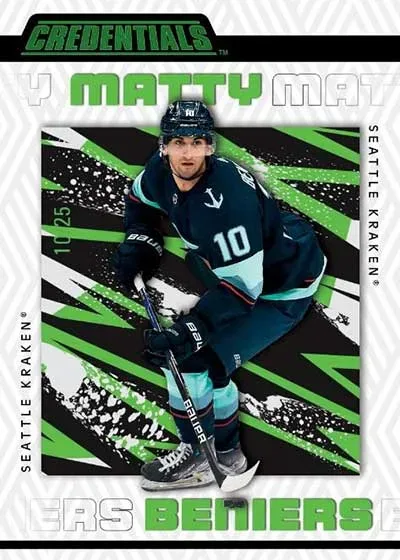
2023-24 Upper Deck Credentials Hockey
- Brand
- Upper Deck
- Sport or category
- Hockey
Last checked
Shop this card release
2023-24 Upper Deck Credentials Hockey trading cards
We may earn a commission if you buy through these links, at no extra cost to you. As an Amazon Associate I earn from qualifying purchases.
Opens retailer search results. Check the model, edition, seller, availability and current price before buying.
About this set
2023-24 Upper Deck Credentials Hockey leans into ticket-style design, bright layouts, and an autograph-heavy checklist built around the Debut Ticket Access concept. The 200-card base set splits into veterans and rookies, while several autograph and variation lines add color, horizontal formats, and low-numbered parallels for collectors who want a focused, theme-driven chase.
Ticket-style base set and rookie structure
The 200-card base set is arranged in a clean veteran-and-rookie split, with the first 100 cards covering veterans and the second 100 focused on rookies. The rookie half falls under the Debut Ticket Access banner, keeping the ticket motif at the center of that portion of the release. The base versions are numbered in tiers that depend on the player, which gives the set a built-in mix of more common and scarcer cards without changing the overall identity of the checklist.
Rookie collectors have an additional layer to consider through Horizontal Debut Ticket Access Variations. Those cover all 100 rookies and are described as slightly rarer than the standard rookie cards, with their own numbered structure and matching parallel approach. That makes the rookie portion more than just a straightforward half of the base set; it also gives collectors a separate lane for layout changes and scarcity differences.
Autographs built around the same theme
The autograph portion follows the same ticket-inspired style, which keeps the checklist visually coherent. Debut Ticket Autographs extend the base concept and are tiered by subject level, with standard versions numbered to 299, 199, or 99 depending on the player. Their parallel colors include Yellow, Red, Orange, Blue, Green, Purple, and Black, with each step moving lower in quantity. Collectors who prefer a color chase can follow the same structure across the autograph line instead of learning a different system for each subset.
Horizontal Variations also appear in the autograph lineup, and those are limited to no more than 99 copies each. They use the same parallel color family as the standard autographs, but with fewer copies. This makes the horizontal autograph cards a natural target for collectors who like the look of the alternate orientation and want a scarcer version of the same ticket design.
Veteran ink and retro signers
Numbered Ticket Access Autographs bring veteran signatures into the release. These cards shift the focus away from rookies and toward established names while still keeping the ticket framework consistent. The parallel colors for this group are Yellow, Red, Orange, Blue, Green, Purple, and Black, with the print runs tightening as the colors become scarcer. For collectors building by subject type, this line offers a straightforward way to separate veteran ink from the rookie-led Debut Ticket Autographs.
Retro Ticket Access Autographs add a smaller, more selective autograph concept. The checklist is limited to five signers, and the cards carry a full set of low-numbered parallels. Because this subset is narrower in scope, it may appeal to collectors who prefer a tighter autograph chase rather than a broad checklist. It also gives the release an older-reference layer without changing the ticket-based style that defines the set.
How collectors can approach the set
A sensible way to collect 2023-24 Upper Deck Credentials Hockey is to decide early whether the goal is the base set, the rookie variations, or the autograph families. The product supports all three paths, but they do not behave the same way. Base and variation collectors can focus on the Debut Ticket Access look and the tiered numbering, while autograph collectors can decide between rookie autographs, veteran Ticket Access Autographs, and the tighter Retro Ticket Access Autographs subset.
Color-match collecting is also a clear option here because the parallel structure is repeated across multiple lines. That consistency makes the release feel organized, but it also means a complete run can become quite ambitious once horizontal cards, numbered base versions, and multiple autograph groups are all considered together. For many collectors, the most practical approach is to choose one lane first and then add a second only if the design theme and numbering system are especially appealing.