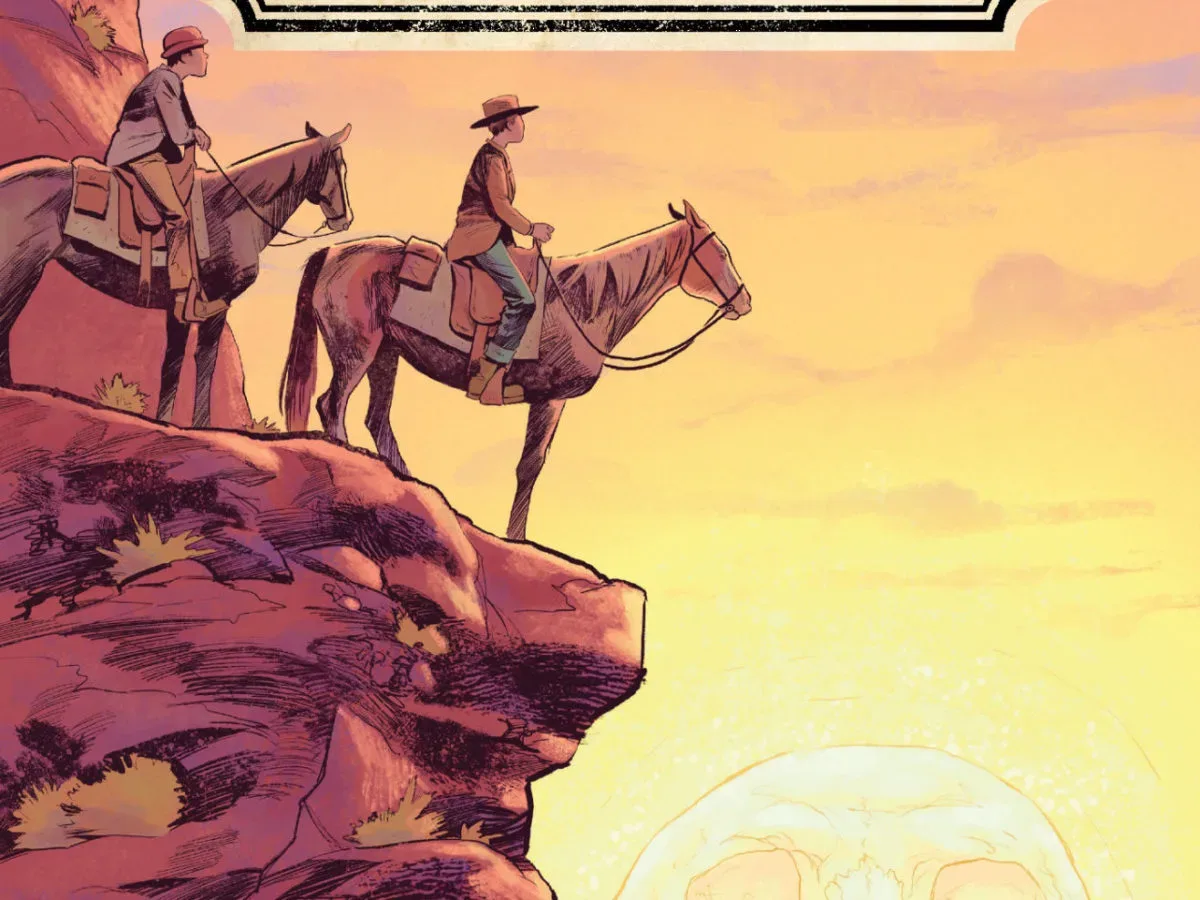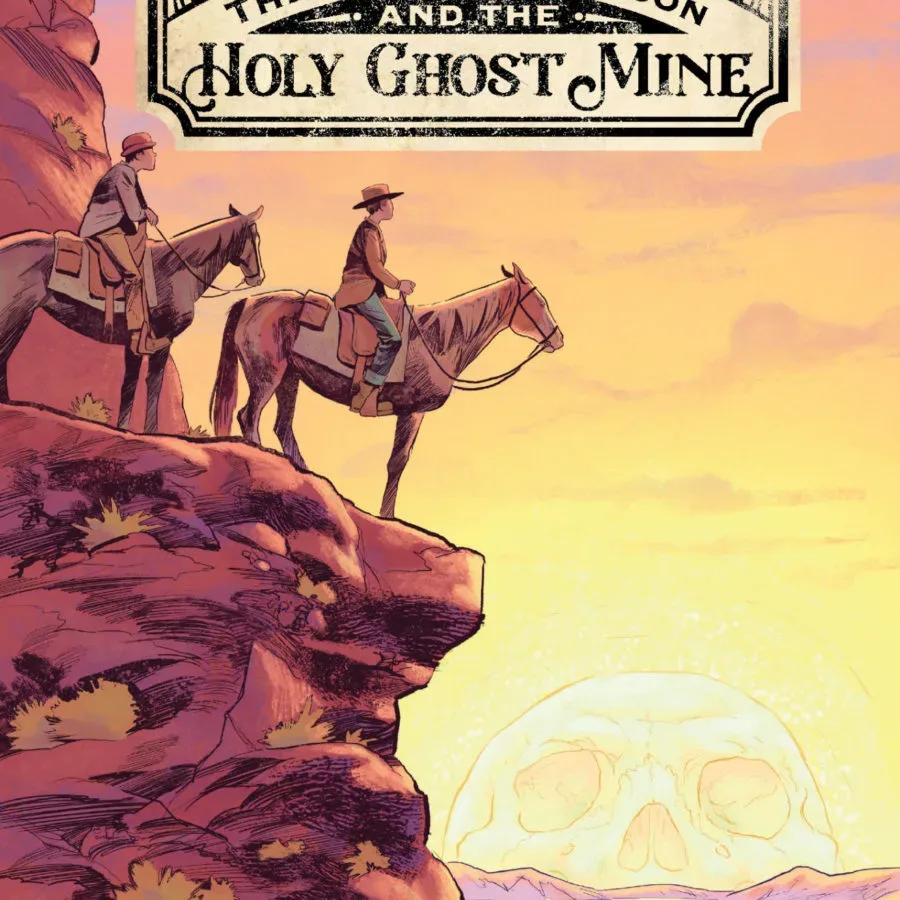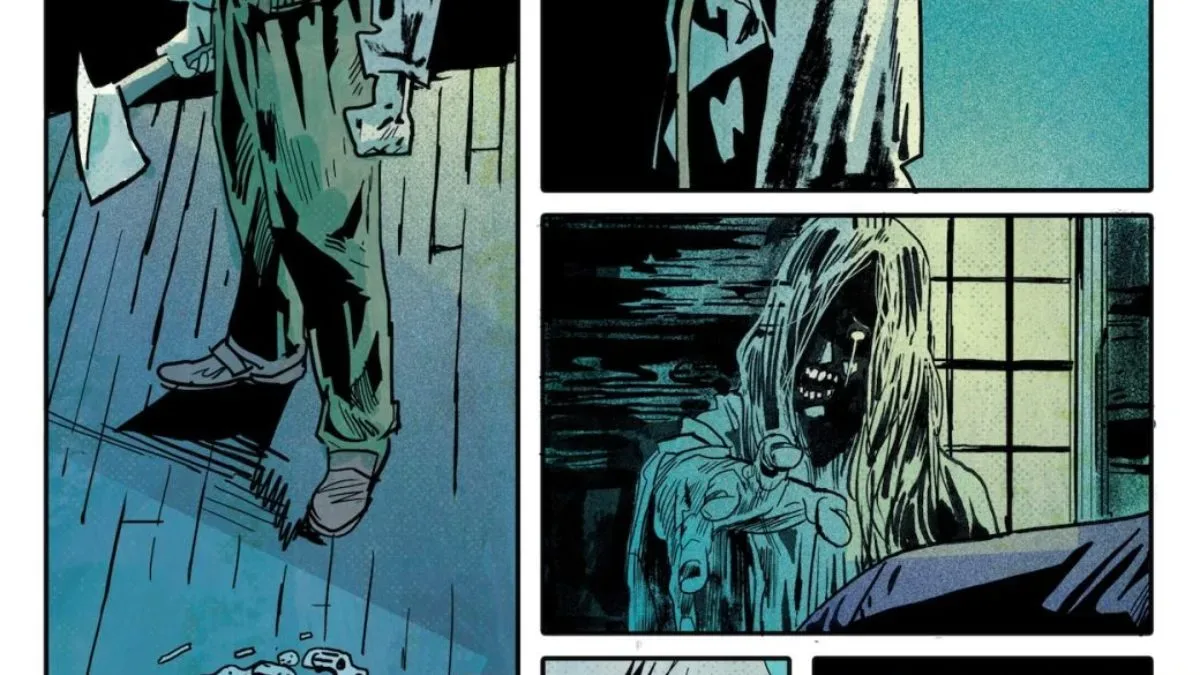
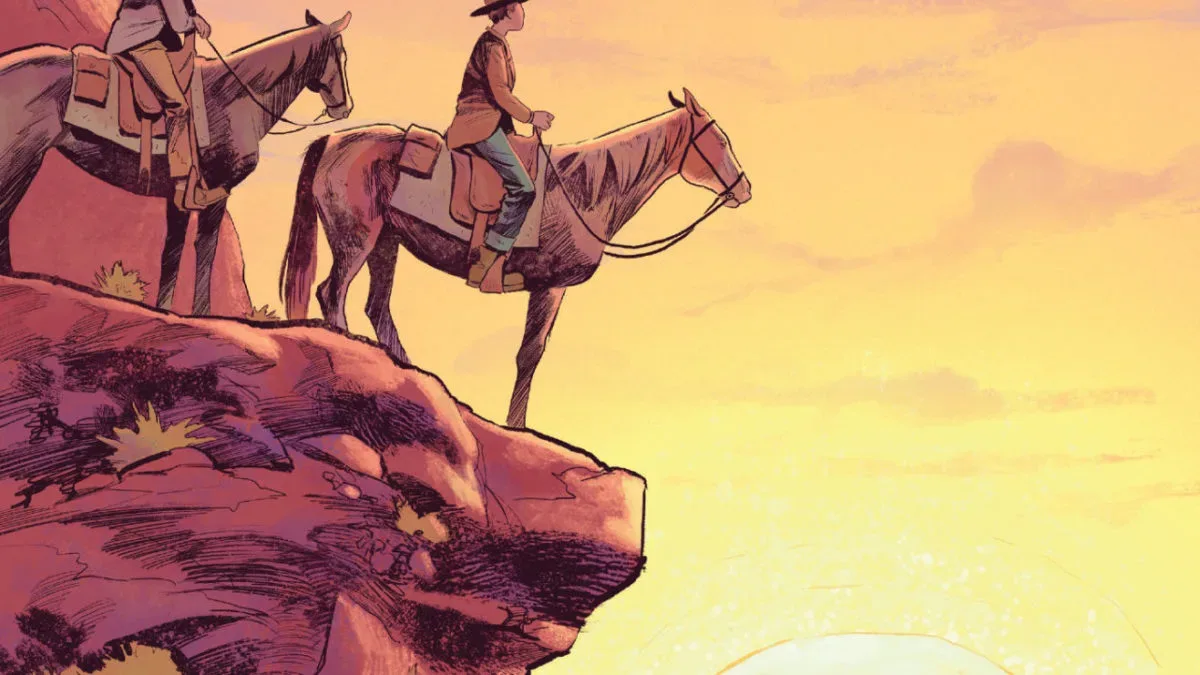
Oni Press will publish The Father, the Son, and the Holy Ghost Mine, a three-issue prestige-format horror western from writer Tyler Crook and artist Emily Schnall, beginning February 3, 2027. Its premise places a supernatural question at the center of an unforgiving frontier: what happens when someone discovers a way to sell other people’s souls rather than their own?
That idea takes shape through Buck and Toby, runaway teenagers who became brothers while living in an orphanage. Seeking both freedom and a fortune beyond its oppressive confines, the pair join a small crew headed for the Holy Ghost Mine, a silver claim in the Nevada Territory. Henry Gaines, the young and inexperienced leader of the expedition, believes his father Harlan has devised a method for producing exceptionally high-quality silver. The apparent opportunity soon gives way to a far worse discovery.
When the crew reaches the mining camp, the barracks are empty, the mine shaft is inactive, and Harlan is desperate for the newcomers to leave. That combination establishes the book’s central threat without giving away its answer: something ancient and horrific is tied to the mine, its silver, and the secrets Harlan wants buried.
A horror story driven by need, not just the mine
The supernatural hook is deliberately connected to more human forms of desperation. Crook has described the series as an exploration of friendship, family and ambition, with each major desire reflecting a different kind of absence. Wealth is one motivation, but it is not the only one. Other characters are looking for love or a way home.
That matters especially for Buck and Toby. The story begins with two young people fleeing an institution and pursuing the possibility of self-determination, so a mine promising wealth is more than a spooky location. It is an apparent exit from a life in which choices have been limited. In that context, the soul-selling concept is not merely a demonic gimmick. It turns people into resources and makes the pursuit of security inseparable from exploitation.
The series’ setting supports that tension. Schnall points to the exposed desert, the limited social safety nets of the 19th century, and capitalist greed as parts of the harsh world surrounding the characters. The narrative is set in the mid-1800s western frontier, where the promise of a silver stake can plausibly draw a vulnerable crew toward a remote salt flat despite the danger. The horror is therefore positioned inside a landscape of material risk rather than separate from it.
In practical storytelling terms, that setup gives the series two pressures operating at once. There is the immediate physical mystery of an abandoned camp and an unused shaft, along with Harlan’s urgent warnings. Then there is the emotional pressure of why Buck, Toby and the others might remain or press forward anyway. A frightening place is more effective when leaving it comes at a cost, and the promise of silver gives the Holy Ghost Mine that leverage.
Buck and Toby are the emotional center
Although the series is being presented as a horror western, Schnall emphasizes the tenderness between its two leads. Their bond is said to be carried largely through what they do not say: small gestures, expressions and body language. That emphasis makes illustration central to the story’s emotional readability.
Comic-book acting is the visual communication of feeling through posture, facial expression, pacing between panels and the physical distance between characters. It is particularly useful for a relationship such as Buck and Toby’s, where a history of shared hardship may be clearer in a protective gesture or a quiet glance than in explanatory dialogue. Schnall’s stated aim suggests the brothers’ connection will not simply function as backstory; it is meant to shape how readers experience the journey into the mine.
The contrast is purposeful. Vast desert landscapes can make people look small and isolated, while the brothers’ quiet care for each other offers a human counterweight to that scale. Schnall describes the environment as holding both hopeful adventure and dread. The approach does not treat those moods as opposites. For Buck and Toby, the very same open country that represents escape can also be a place where there is nowhere to hide.
That emotional focus also distinguishes the series’ horror from a simple monster-in-a-mine structure. The mine threatens the crew, but the premise asks readers to consider what people will do when completion, wealth, love or home feels out of reach. The danger is not only that characters could encounter an ancient evil. It is also that the desire to fix a damaged life may leave them open to one.
Crook and Schnall return to a shared creative space
The Father, the Son, and the Holy Ghost Mine reunites Crook and Schnall after their work on Tales from Harrow County, the continuation of the Cullen Bunn and Crook series. Their previous collaboration is useful context for readers interested in how a writer-artist team handles genre material over more than one project, but the new book has its own distinct setting and cast: the Nevada Territory, a remote silver operation and two runaway brothers at the heart of a supernatural western.
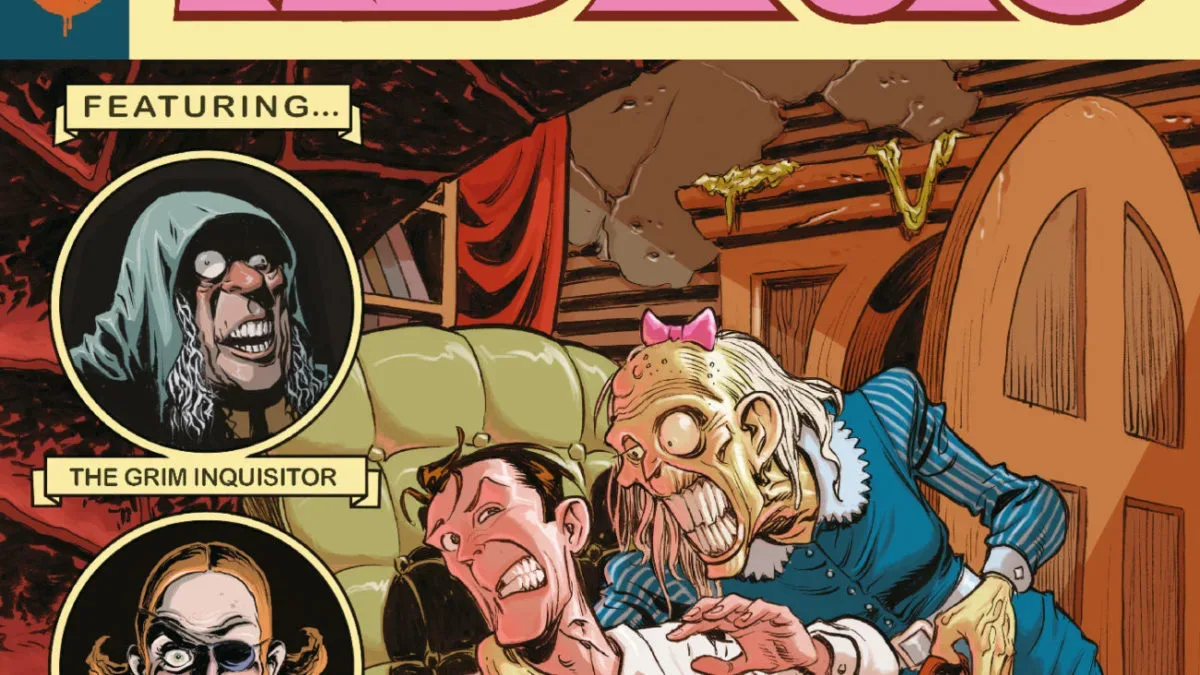
Crook’s other recent work at Oni includes Archie in Hell and Out of Alcatraz. Schnall’s credits include Earthdivers as well as the Harrow County stories. Those credits establish a reunion between creators with prior experience working together, while the new series places the collaboration in a much more open, dry and isolated landscape.
The book’s western framing is also important. The Old West carries familiar associations with violence, loss, failed dreams and hidden history, all of which can serve horror well. Here, those associations are not presented as decoration around a demonic premise. The supposed silver breakthrough, the abandoned worksite and the remoteness of the location all connect the frontier setting directly to the story’s mystery.
The project has been compared in tone to the grim frontier drama of There Will Be Blood and the demonic bargain tradition of The Tragical History of Doctor Faustus. Those references indicate the intended mix of resource-driven obsession and supernatural consequence; they should not be read as a confirmation that the comic follows either work’s plot. The stated premise is its own: a mine hiding ancient horrors, and a scheme involving the ownership and sale of other people’s souls.
What “prestige format” means for the three-issue run
The comic is a limited series, meaning its complete story is planned across a fixed number of issues rather than an ongoing monthly run. In this case, the count is three. Each installment is described as prestige format and will contain 30 pages of story, with additional backmatter, for 40 pages total in the first issue.
Backmatter refers to material placed after the comic’s main narrative. For this series, it is set to include process art, character designs and historical reference details. Process art can show elements of how pages and images are developed, while character designs document visual decisions behind the cast. Historical reference material may offer context for the book’s setting and visual world. For readers interested chiefly in the plot, the 30 story pages are the key count; for art-process fans, the extra material is a meaningful part of the package.
Cardstock covers are also planned for each issue. Cardstock is a heavier cover stock than a standard comic cover, a physical-format detail that aligns with the prestige label but does not change the story itself. The series will be full color.
Issue #1 carries a $6.99 price and will have several cover options: Cover A by Crook, Cover B by Schnall, Cover C by Anand RK, and a blank sketch variant. A Tyler Crook silver foil variant is listed at $9.99. A 1:20 Noah Bailey variant is also planned; “1:20” denotes an incentive-cover ratio, meaning retailers typically qualify to order one such copy for every 20 qualifying copies ordered under the applicable program. It is a distribution designation, not a statement about a reader’s odds of finding the cover in a specific shop.
Release details and why the first issue is worth watching
The Father, the Son, and the Holy Ghost Mine #1 arrives February 3, 2027. It is written by Tyler Crook, illustrated by Emily Schnall, and published by Oni Press. The debut is a 40-page, full-color issue priced at $6.99, including 30 story pages and bonus material.
For horror readers, the clearest draw is the central inversion of the classic Faustian bargain: the possibility that souls can be treated as someone else’s commodity. For western readers, the Nevada Territory setting and silver-mining venture make ambition a concrete force in the plot. And for readers drawn to character-led genre work, Buck and Toby’s unspoken, hard-won brotherhood appears to be the element designed to make the looming horror matter.
The early description promises ancient horrors, but it also makes room for a quieter kind of suspense: whether people who have already lost so much can recognize when a promised future is asking them to surrender too much. Readers looking for more forthcoming horror-comic news can also keep an eye on Lenore: The Secrets We Walk Upon, another title scheduled for February 2027.
Shop the products
Check current price, model and availability at the retailer.