Wanted arrives on Broadway with the raw materials for a stirring American musical: a family threatened with dispossession, two sisters making an impossible choice for survival, and a story shaped by race, land and the dangerous social calculations of 1893 Texas. Inspired by playwright and lyricist Angelica Chéri’s great-great aunts, Mary and Martha Clarke, the production has an arresting premise and a cast equipped to make its music soar.
But its considerable strengths do not fully resolve its central storytelling problem. Wanted begins by positioning Mary and Martha as audacious women forced into outlaw behavior to protect their family’s future. It later devotes much of its energy to romantic entanglements, leaving its most distinctive ideas—especially the sisters’ decision to pass as white, and the personal cost of that decision—less developed than the setup suggests.
The result is a Broadway musical with exceptional vocals, handsome theatrical atmosphere and an emotionally potent foundation, but an overburdened book that struggles to choose its defining conflict.
A fight for family land becomes a high-stakes escape
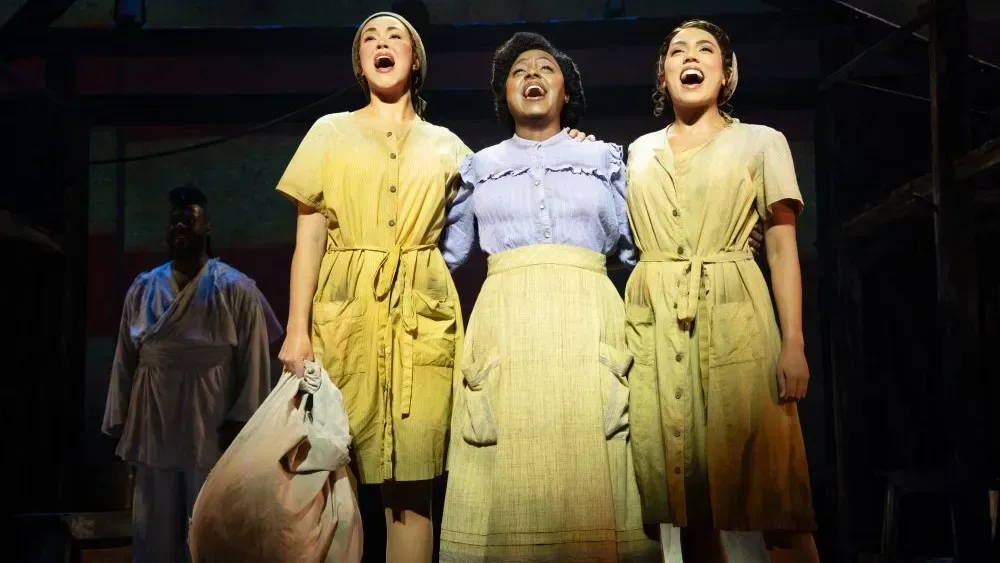
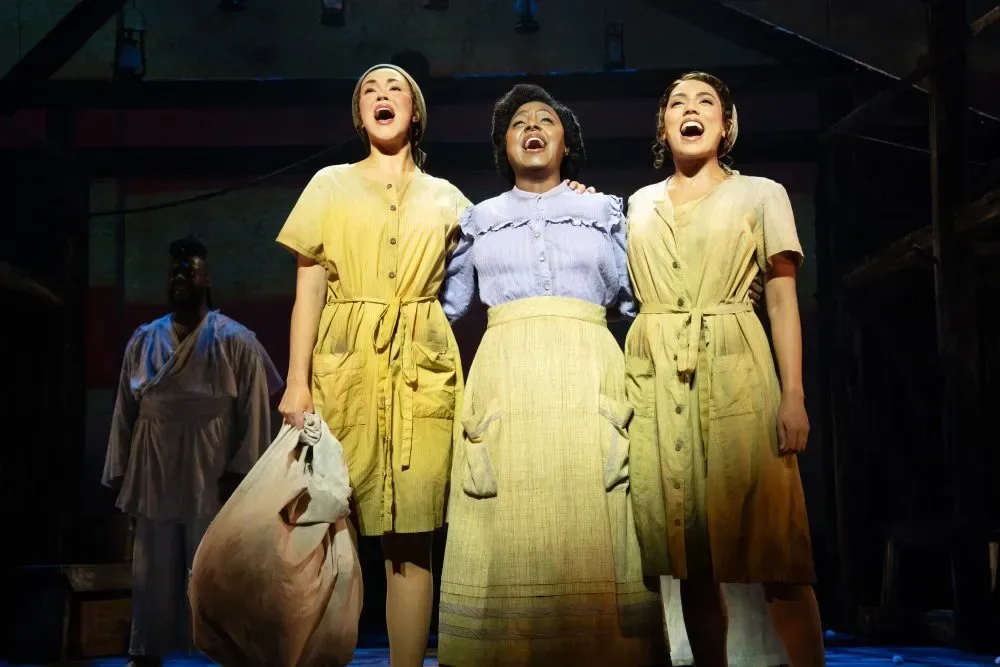
Directed by Stevie Walker-Webb, with book and lyrics by Chéri and music and arrangements by Ross Baum, Wanted is set in Marlon, Texas, in 1893. The Kinfolk ensemble leads the audience into the Clarke family’s story. Mary, played by Solea Pfeiffer, and Martha, played by Liisi LaFontaine, have worked and saved alongside their mother Tallulah, portrayed by Ledisi. Their aim is direct: buy the land their family has labored on for generations.
Mr. Billingsley, the landowner, rejects their $200 offer. Rather than recognize their savings, he claims the family is behind on rent, demands twice as much money and threatens eviction. That opening establishes a concrete external pressure. The sisters are not chasing wealth for its own sake; they are trying to prevent their household from being pushed into destitution.
The musical’s key dramatic device is passing: presenting oneself as belonging to a racial group different from one’s own in a society that assigns rights, danger and opportunity along racial lines. Mary and Martha can pass as white because of their absent French father. In the world of the show, this is neither a carefree disguise nor merely a plot twist. It is the survival mechanism available to two Black women confronting a racist property system and the hazards faced by women traveling alone in the 19th-century South.
They leave Marlon with Tallulah’s pistol, Ole Bessie, seeking a fast way to make enough money to save the family land. Theft and intimidation prove more lucrative than conventional work. That premise promises an outlaw musical centered on the sisters’ resourcefulness, the escalating danger of their deception and the tension between financial necessity and criminal action.
The show’s biggest idea does not remain at the center
Wanted does give its heroines stick-ups, schemes and opportunities to use their perceived whiteness strategically. Yet the outlaw thread is comparatively brief. After a saloon encounter with Jesse Banks, a wealthy white man played by Bradley Jaden, the plot increasingly follows Jesse’s interest in Mary. Jesse does not know Mary is Black. At the same time, Martha becomes involved with Elijah, a Black man in Jesse’s employ, played by Luke James.
Related coverage includes ‘Wanted’ Review: Powerful Voices Outpace an Unfocused Broadway Story.
These relationships create the principal disagreement between the sisters. That is a legitimate source of drama: Mary and Martha are taking different risks, and romance can expose the limits of the identities they are performing. Still, the shift changes the story’s center of gravity. The production’s early urgency comes from land ownership, economic coercion, sisterhood and a perilous bid for agency. Its later emphasis on love stories makes those threads feel less like the engine of the narrative than the route to it.
This matters because the musical introduces unusually rich material before narrowing its attention. Mary’s passing could be explored as an act of self-preservation, rebellion, performance or isolation. Martha’s differing relationship to the deception could sharpen their bond and reveal competing definitions of freedom. The choice to become criminals could demand an accumulating moral price. Instead, Mary is presented as increasingly naive and self-interested, a characterization that sits uneasily beside the confident outlaw figure initially promised.
The issue is not that a story about women on the run cannot include romance. Romance can deepen an escape narrative by raising the consequences of exposure. Rather, Wanted appears to give several potentially central stories roughly equal weight without allowing any one of them enough room to fully land. Its themes of racial identity, family legacy, property, danger and desire are all substantial; the structure does not always make clear which should be decisive.
Vocals are the production’s clear advantage
Where the narrative wavers, the performers supply force and specificity. Ledisi, Pfeiffer and LaFontaine are the production’s standout vocal presence. Their singing gives the Clarke family dynamic an emotional foundation even when the book moves quickly between its competing concerns.
The orchestra is led by Paul Byssainthe Jr., one of the production’s music directors alongside Austin Cook. “Inheritance” and “Mary’s Nightmare” are particularly effective numbers. The former title speaks directly to the musical’s strongest preoccupation: what a family leaves behind, what it has been denied, and what its descendants must fight to keep. “Mary’s Nightmare” points toward the internal turmoil that a passing narrative needs in order to feel more than procedural.
The distinction between a compelling song and a fully cohesive score is important here. A musical can have superb individual performances and memorable vocal climaxes while still lacking songs that consistently move character and plot forward. Wanted’s musical highlights demonstrate the capabilities of its cast, but not every number appears to carry comparable dramatic impact. That makes the show’s live singing its most reliable pleasure—and leaves the production feeling, at moments, more persuasive as an album than as a complete stage narrative.
For audiences interested in performance-forward music programming beyond Broadway, live vocal presence is also central to projects such as the upcoming Twice concert film theatrical release. Wanted, however, has the additional burden of making every vocal peak serve a historical drama, not simply delivering a set of individual showcases.
Design gives the Texas setting texture and dimension
The visual team helps make the setting legible. Scenic design by Beowulf Boritt, plus video and projection design by Stefania Bulbarella, lend depth to the stage picture and support the production’s period and geographic atmosphere. In a story that moves from cotton fields and threatened tenancy toward roads, schemes and a saloon, that sense of place is valuable.
The wider creative team includes choreographer Chelsey Arce, music supervisor Nadia DiGiallonardo, orchestrator John Clancy, costume designer Emilio Sosa, lighting designer Adam Honoré and sound designer Gareth Owen. Claire Warden handles fight and intimacy work, while Kaja Dunn is credited as cultural consultant. Those roles point to the many disciplines involved in staging a story whose characters navigate physical threat, racialized social rules and intimate relationships.
Design cannot solve a structural problem, but it can create the conditions in which an audience understands what is at stake. Here, the scenery and projections give the world a welcome dimensionality. They help underscore that the Clarke sisters’ choices are shaped by a specific place and period, rather than taking place in an abstract backdrop for romance.
What to know before seeing ‘Wanted’
- Broadway venue: James Earl Jones Theater.
- Opening: November 8, 2026.
- Running time: 2 hours and 30 minutes.
- Mary Clarke: Solea Pfeiffer.
- Martha Clarke: Liisi LaFontaine.
- Tallulah Clarke: Ledisi.
- Elijah: Luke James.
- Jesse Banks: Bradley Jaden.
The practical expectation for prospective theatergoers is fairly clear. Those drawn to commanding singers, a talented lead trio and a visually textured historical setting will find much to admire. Those looking specifically for a sharply sustained outlaw tale or a searching dramatic treatment of racial passing may find the musical’s priorities frustratingly unsettled.
Wanted is built around a story worth telling. Mary and Martha Clarke’s attempt to protect their family land supplies stakes that are personal, economic and historical at once. The production’s best elements recognize that power, particularly when Ledisi, Pfeiffer and LaFontaine are carrying it through song. Yet the musical ultimately seems less certain about what makes the Clarke sisters’ tale singular. Its strongest version is visible in its opening premise and vocal performances; it just does not consistently become the version that reaches the stage.