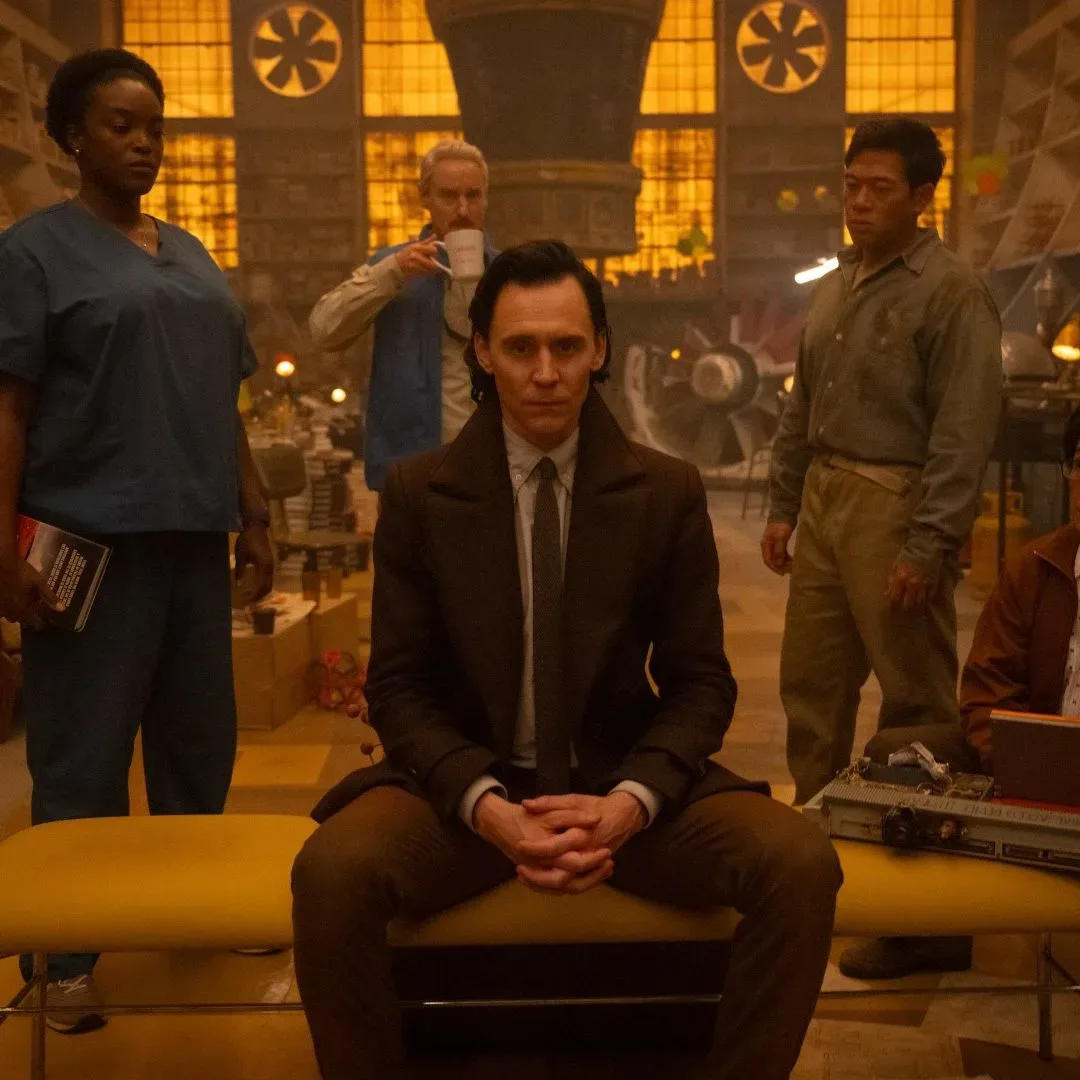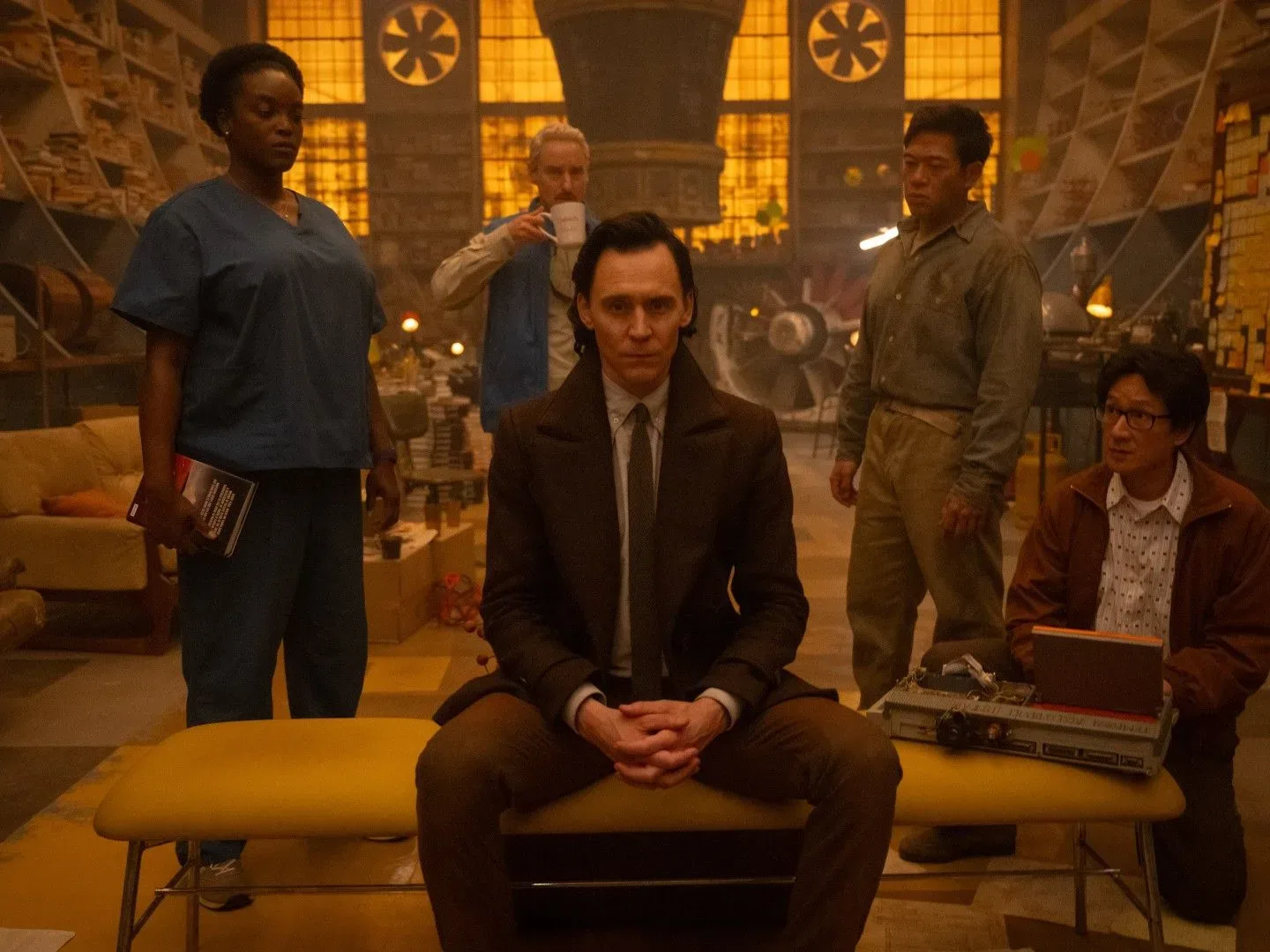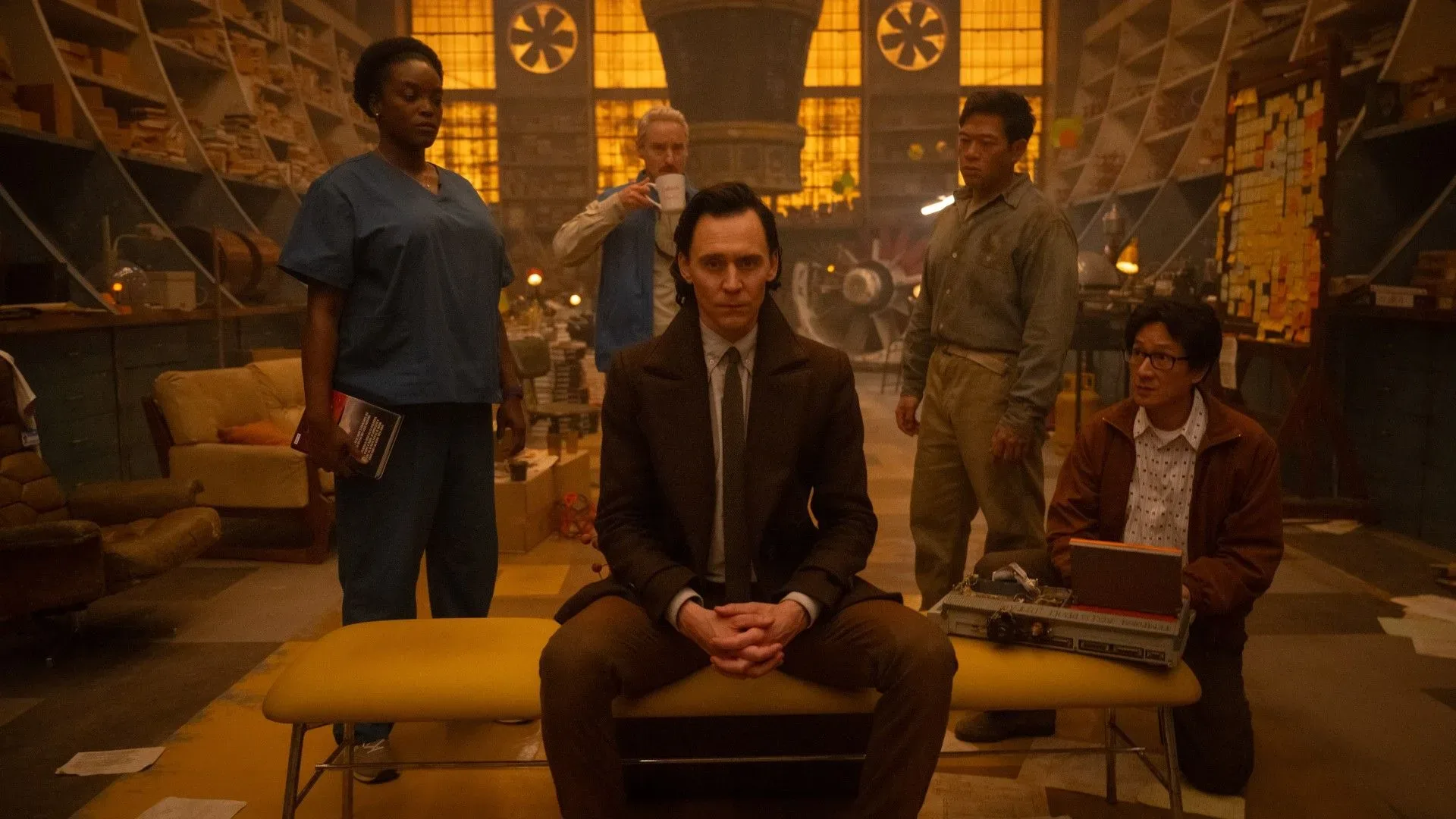
The Time Variance Authority has always looked like the sort of bureaucracy that could lose a form documenting the end of existence, then ask the end of existence to queue politely. Newly shared close-up images from the TVA office set used in the Avengers: Endgame Encore post-credits material make that contradiction wonderfully tangible: looming multiversal danger is surrounded by paper-filled drawers, chunky retro-futuristic machinery and office displays.
For viewers focused on the larger tease, the key detail is a monitor identified as “tree overview.” It depicts the branching universe structure being held together by Loki, while other screens track potential incursions. Nearby, a wall tribute names him the “Employee of all time,” directly framing his sacrifice to save the multiverse in the odd, deadpan corporate vocabulary that has become inseparable from the TVA.
That tonal collision is more than a sight gag. The TVA material in Endgame Encore puts an enormous crisis—employees witness 3,000 incursions as the multiverse collapses around them—inside an institution designed to process the unprocessable. The close-ups do not settle exactly what will happen next, but they add texture to the stakes surrounding Avengers: Doomsday, due December 16 in the UK and December 18 in the US.
A memorial that makes Loki’s role unmistakable
The dedication is the clearest piece of story-facing set dressing in the images. Calling Loki “Employee of all time” is intentionally silly on its face, but it also formalizes his place in the TVA’s internal mythology. He is not simply remembered as a heroic figure in abstract terms; the organization’s employees have translated his sacrifice into their own workplace language.
That distinction matters because the TVA’s visual identity is fundamentally administrative. Its spaces are filled with records, systems, screens and staff functions. A conventional heroic monument would feel out of place. An employee accolade, however, lets the office commemorate a world-saving act without ever dropping the bureaucratic mask. It is a joke, but one that preserves the emotional point: Loki’s action is treated as the thing keeping the larger multiversal structure intact.
The “tree overview” display reinforces the same idea in a more literal way. The image shows separate universe threads gathered in a tree-like structure and held together by Loki. In plain terms, it is a visual map of a multiverse: distinct realities are represented as branches or threads rather than as one uninterrupted timeline. The set’s interface turns a cosmic concept into something a TVA worker might monitor during a shift.
It is also an efficient visual shorthand. Instead of asking the audience to infer Loki’s ongoing role from dialogue alone, the screen presents him as part of the infrastructure of reality. The tree is not just a memorial image; it appears within a functional tracking system. That makes the tribute and the operational display work together: the former acknowledges what Loki did, while the latter presents the continuing consequence of it.
What an incursion means in this setting
The screens are also monitoring potential incursions, a term that carries obvious weight in a story about multiple universes. Within the information presented by the scene, an incursion is a threat significant enough to be tracked by the TVA alongside collapsing multiversal conditions. The office workers’ tally of 3,000 incursions makes the scale deliberately difficult to ignore.
Importantly, that number should not be read as a detailed explanation of every affected universe or a confirmed roadmap for the next film. It establishes magnitude, not a full mechanism. The scene shows TVA employees encountering an extraordinary count while the multiverse collapses around them; it does not, from this material alone, identify a culprit or specify how each incursion began.
Still, the production design makes a useful dramatic choice. The impending catastrophe is not represented only by a bright portal or a shouted warning. It is translated into monitors, reports and offices apparently attempting to keep pace with an impossible workload. The result makes the danger feel both vast and bureaucratically immediate. Somewhere, there is apparently a drawer for the apocalypse.
The production design does quiet storytelling work
The close-ups reveal drawers packed with reports and papers, as well as retro-futuristic equipment and arrays of displays. These details may occupy only the edges of a scene, yet they establish that the TVA is a functioning environment rather than a bare backdrop assembled for one ominous exchange.
“Retro-futuristic” is a useful term here. It describes imagery that combines an older idea of technology—physical cabinets, analog-looking controls, institutional furniture and tangible paperwork—with capabilities far beyond ordinary modern devices. The TVA’s machines may be charting universe-level threats, but their surroundings still resemble an office that could demand a stamped copy in triplicate.
That mixture is central to why the TVA is visually legible. A screen dedicated to a universe tree could be abstract or remote if placed in a sleek, empty science-fiction command center. Surround it with filing systems and stacked reports, and it becomes a workplace problem. The design gives staff a material relationship with otherwise intangible concepts: timelines can be filed, incidents can be monitored, and multiversal collapse can apparently generate paperwork.
The packed drawers suggest history as well as workload. They imply records accumulated over time, the kind of visual evidence that tells an audience this organization existed before the camera entered the room and will continue working after it leaves. Nothing in the images requires each sheet of paper to contain a hidden clue. Their primary contribution is environmental: the TVA has procedures, archives and an overwhelming volume of things it believes must be documented.
Easter eggs for the people behind the screens
The employee wall includes another layer of detail aimed beyond the immediate plot. Assistant set director Nathan Elliott appears among the TVA’s “Employees of the millennium,” alongside names including screenwriter Cassian Pryce. These are small crew-facing Easter eggs tucked into a setting that already has a narrative job to do.
An Easter egg is a deliberately hidden or lightly presented reference intended for attentive viewers to discover. In this case, the names do not appear to demand story interpretation. Rather, they turn a fictional recognition wall into a quiet acknowledgement of people involved in making the production. It is a fitting location for that nod: a fictional office celebrating exemplary staff becomes a place to salute real-world contributors without interrupting the scene.
That kind of detail can be particularly effective in a repeat-viewing franchise environment. A first viewing can absorb the central information—the TVA is facing a massive crisis, Loki’s sacrifice is still central, and the multiverse is in danger—without requiring anyone to pause on individual names. Later, close examination reveals an additional human layer inside the prop work.
What these images do—and do not—tell us about Doomsday
The TVA scene clearly positions the organization as a vantage point on a multiversal emergency. Its personnel see the incursions mounting, and the “tree overview” preserves Loki’s connection to the system they are watching. Those are meaningful pieces of context for Avengers: Doomsday.
But close set imagery is best treated as corroborating detail rather than a complete plot decoder. A screen label can explain what a prop is meant to represent. A memorial can clarify an emotional and institutional response. Neither, on its own, confirms the cause of the collapses, the identities of every party involved, or how the eventual film will resolve the situation.
That restraint is worthwhile. Production design often communicates theme, scale and atmosphere with extraordinary precision, while leaving the narrative’s decisive turns to the finished story. Here, the most defensible reading is also the most interesting: the TVA is still operating under the shadow of Loki’s sacrifice, using systems built to observe a multiverse that is now under extraordinary strain.
There is a practical viewing benefit, too. When Avengers: Doomsday arrives, the useful visual markers to remember are straightforward: Loki’s TVA recognition, the tree-like universe display, the “tree overview” label, and the scale-setting 3,000-incursion count. Those elements are more reliable anchors than treating every folder, screen and office placard as a guaranteed prediction.
Marvel’s release calendar can move in the wider industry—as illustrated by the recent change to the Helldivers movie’s date—but the stated dates for Avengers: Doomsday remain December 16 in the UK and December 18 in the US. Until then, these TVA images offer a closer look at the tiny, carefully constructed details behind a very large warning sign.