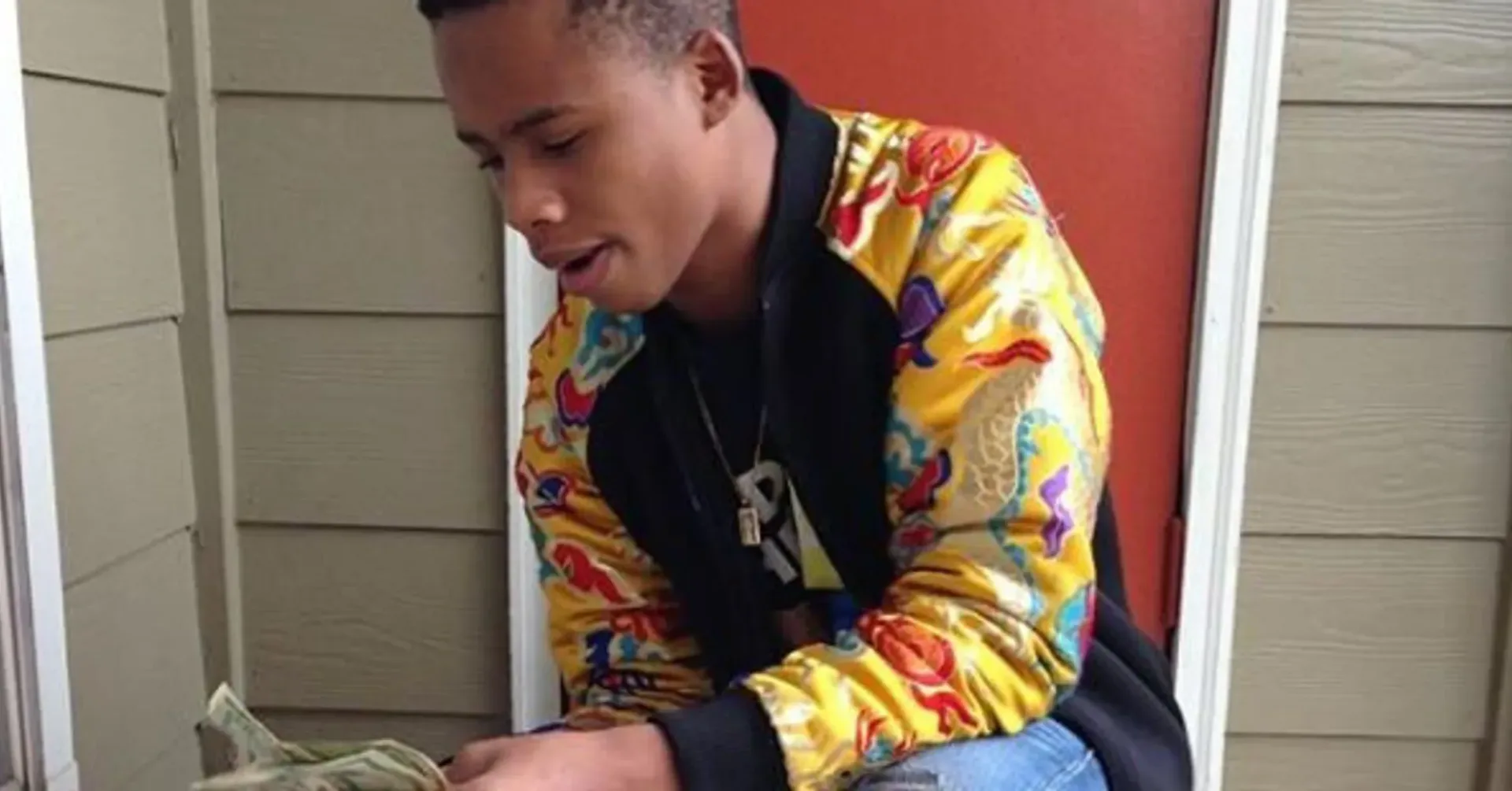
Tay-K is not distancing himself from “The Race,” even as the 2017 breakout track remains inseparable from the legal case that followed him. In a rare new interview, the 26-year-old rapper said he still loves the song and rejects the idea that its use in court should change how he regards the work.
“I love that song, bro. I ain’t going to lie,” Tay-K said. “That’s just a song for real. I won’t let the fact that people try to wield it like a weapon at me in these courtrooms make me not like my art. That’s art and that should be viewed as art and nothing more, nothing less.”
It is a direct statement about a record with an unusually complicated afterlife. “The Race” helped turn Tay-K into a widely known name, landing on the Billboard Hot 100 at No. 70 and attracting remixes from XXXTentacion, Lil Bibby and Lil Yachty. Yet prosecutors also presented the video to jurors during his murder trial, alongside screenshots said to show Tay-K holding firearms and making gang signs. He was found guilty of murder and received a 55-year prison sentence.
His stance does not erase that history. Rather, it draws the boundary he wants listeners to recognize: a boundary between art as a creative expression and art as material interpreted within a criminal proceeding.
Why “The Race” remains the song attached to Tay-K’s name
Released in 2017 while Tay-K was running from authorities, “The Race” arrived with circumstances that gave the title and its imagery an immediate, real-world weight. He was apprehended in the same month. The track nevertheless spread quickly enough to enter the Hot 100, an outcome that made it more than a regional moment or an internet curiosity.
That commercial marker matters because a Billboard Hot 100 placement records broad consumption across the U.S. music market, rather than a response limited to one platform or scene. The remixes from several other rappers further showed how rapidly the song had become a recognizable reference point in rap at the time.
But the elements that helped make the record feel urgent also helped make it contentious. When a song’s lyrics, music video, release context and the artist’s alleged conduct appear to overlap, audiences can be tempted to read every creative choice as literal reporting. Tay-K’s comment argues against that reading. In his telling, the piece should remain art even if others try to assign it a different legal or cultural function.
That is the core tension around “The Race.” It can be culturally significant as a hit song and legally significant because it was shown in court. Those are separate frames, but they coexist in the public story surrounding the record. For Tay-K, the courtroom history has not displaced his personal view of its musical value.
Related coverage includes Tay-K Says He Still Stands by ‘The Race’ Despite Its Courtroom Legacy.
Art, evidence and interpretation
The larger question raised by Tay-K’s comments is not unique to a single song: what does it mean when a creative work is presented as evidence? In a legal setting, prosecutors may seek to place a song, a video or an image beside other material to advance an argument. In an artistic setting, the same work is commonly judged through performance, persona, storytelling, provocation, style and audience response.
Those lenses do not necessarily ask the same questions. A listener may hear a track as dramatic first-person rap, a character study, a boast or a product of an artist’s public persona. A courtroom presentation may instead focus on whether particular details help establish a factual theory. The available account of Tay-K’s trial says prosecutors showed the “The Race” video and screenshots to jurors; it does not establish that the song alone determined the verdict, and it would be inaccurate to suggest otherwise.
Tay-K’s own phrasing is unequivocal: he considers the song art, “nothing more, nothing less.” That is an artistic claim, not a new account of the case or an attempt to relitigate the conviction. It is also why his remarks will likely resonate beyond the song itself. Rap has long grappled with a public tendency to collapse an artist, a narrator and a lyric into the same person, especially when the music is confrontational or tied to real events.
For listeners, the practical implication is simple but important: context matters, and it can be complex. The popularity of “The Race,” the artist’s legal history and the record’s eventual courtroom presence are all part of its public legacy. Treating any one of those facts as the entire meaning of the music leaves out the rest of the story.
A first extended public reflection in years
The interview is Tay-K’s first in nearly a decade. It follows his move to state prison roughly a year earlier after eight years in county jail. That timing makes his willingness to speak about “The Race” especially notable. The song is not simply an old hit being revisited for nostalgia; it remains the work most closely connected with his name and the consequences that shaped the years after its release.
He also discussed daily life in prison and described music-making as a place where he feels “free.” The comment gives his continued creative output a different context. Music is not framed merely as a way to keep a catalog active. It is presented as a means of personal expression within a life that is otherwise tightly controlled.
Tay-K has continued to release material while imprisoned. Most recently, he appeared on “SPOTLIGHT / INNER CHILD” with Dominic Fike. The available information does not detail how the track was made or released, so it is best understood simply as evidence that his musical presence has continued rather than as a claim about a particular creative process.
He also credited Comethazine, saying the rapper is the only artist who has put money on his prison account. It is a small, personal detail, but one that underscores how relationships can look different when an artist is removed from the usual infrastructure of touring, studios, collaborators and day-to-day industry contact.
Prison listening has widened his musical frame
One of the more revealing details from the conversation is the range of music Tay-K says he has encountered in prison. He named Olivia Rodrigo, Nirvana and Linkin Park among the artists he has come to appreciate. The list spans contemporary pop and alternative rock, a notable expansion from the genre association most listeners bring to his own work.
That does not tell us what his next music will sound like, and there is no basis to predict stylistic changes from those preferences alone. But it does show how listening can remain an active part of an artist’s life even when the conditions for creating and sharing work are profoundly altered. Discovering different music is not automatically a reinvention; sometimes it is simply an artist building a broader private reference library.
For a figure whose public image has been compressed around one explosive song and a highly visible legal case, that added musical detail is useful. It does not make the central story less difficult. It does, however, make the person speaking about it more dimensional: an artist still attached to a formative record, still making music, and still finding new influences from inside prison.
The legacy is not getting simpler
Nearly a decade on, “The Race” remains difficult to separate into neat categories. It was a charting breakthrough. It produced a remix wave. It was shown to jurors in a murder trial. And now its creator is publicly insisting that his affection for the song survived all of that.
That insistence is not the same thing as asking listeners to forget the surrounding facts. Tay-K’s history with the record is public, and the legal outcome is clear: he was convicted of murder and sentenced to 55 years in prison. His comments instead confront the reality that a song can carry multiple meanings simultaneously. It can be a major record to fans, a focal point in media narratives, and a contested object in discussions about artistic expression and the criminal justice system.
There is also a broader pop-culture lesson in the way a breakout work can become fixed in an audience’s memory. An artist may release more music, develop new tastes and try to describe their own work differently years later, while the first hit continues to define the public conversation. Tay-K’s new remarks make clear that he is not interested in renouncing the record that made him famous, regardless of the painful context now attached to it.
That makes “The Race” less a closed chapter than an enduring point of debate: one song, a huge cultural footprint, and competing ideas of what creative work should mean when it travels far beyond a speaker or a set of headphones. For more music-industry context, see our coverage of Rod Wave’s perspective on Jay-Z’s longevity.