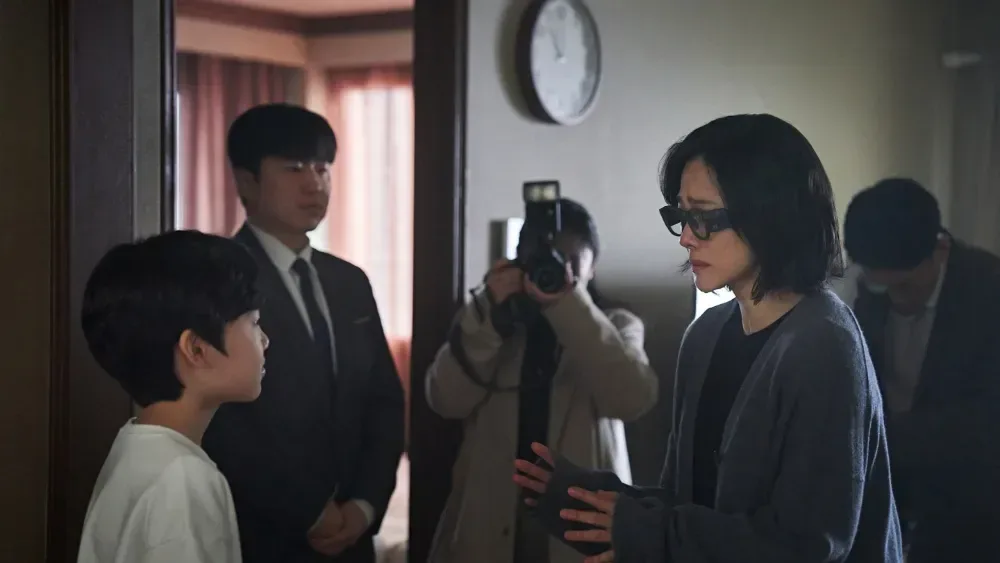
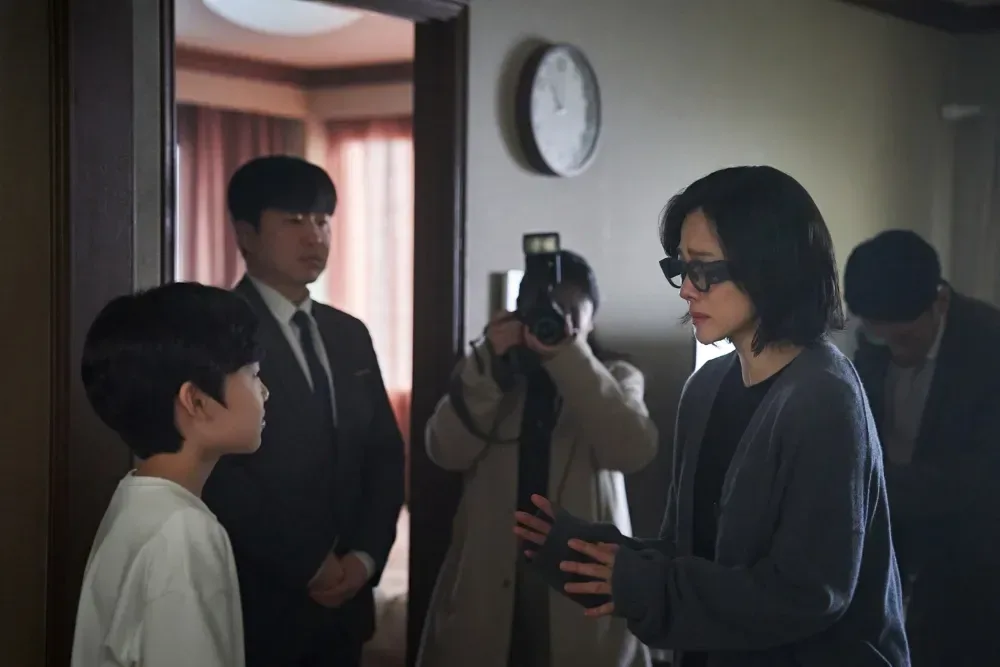
Yeon Sang-ho’s Paradise Lost starts with a piece of speculative technology that sounds designed to soothe an unbearable loss: augmented-reality glasses that let a mother spend time with the 10-year-old son she lost nine years earlier. Then it turns that comfort inside out. When the real child returns as a grown young man who is unfamiliar to her, the manufactured closeness promised by the glasses becomes the basis for a psychological thriller about grief, identity and who gets to define another person.
The premise is set in Musan City, a fictional, deteriorating small town created for the screen. Ryu So-young, played by Kim Hyun-joo, has lived with the disappearance of her son Sun-woo, one of several children who vanished on a camp bus. AR, short for augmented reality, generally describes technology that layers computer-generated material over a user’s view of the real world. In this story, it becomes an intimate and disturbing emotional interface: not simply a gadget, but a way to preserve a relationship in the shape the grieving parent most wants to remember.
That makes the eventual return of Sun-woo—played by Bae Hyeon-seong in his first major film lead—more complicated than a simple reunion. He has grown up elsewhere and is a stranger to the mother who has, through the glasses, remained close to an idealized younger version of him. The tension is not merely whether technology can convincingly imitate a person. It is whether a simulation built from memory, expectation and data can begin to compete with the difficult reality of a living person whose interior life cannot be accessed on demand.
AI as a contrast to the personal
Yeon’s stated interest is not AI as a shiny futuristic feature. He frames it as an expression of shared human knowledge and collective intelligence: the accumulated patterns of thought, material and behavior from which such systems may draw. That framing gives Paradise Lost a sharper thematic purpose. A technology associated with pooled information is placed against a mother-and-son bond, one of the most private relationships imaginable.
In the filmmaker’s view, the problem is not just that AI can be unpredictable or difficult to control. It is also that knowledge built from common patterns may exert pressure on individuality. Paradise Lost appears to locate its horror in that gap. A model of someone can feel uncannily personal because it reflects the details people have put into the world, yet it cannot settle the fundamental question of what another person truly thinks, feels or has experienced.
That distinction matters for the film’s emotional stakes. Ryu’s AR son may be informed by a version of Sun-woo that she recognizes, but the returned Sun-woo is a person who has spent nine missing years beyond her knowledge. A comforting reconstruction can therefore become a trap: it offers certainty and familiarity at the very moment reality demands that she accept uncertainty and change.
Yeon has compared AI itself to an uncharted realm, mysterious and beyond complete human comprehension. The image suits a story in which a seemingly helpful device does not erase the unknown at the center of another human being. It instead makes that unknown more painful. The technology can deliver a recognizable surface; it cannot grant ownership over the person behind it.
From Jung_E to a more grounded conflict
This is not the first time Yeon has used AI as a dramatic device. In 2023’s Jung_E, an AI recreation enabled a daughter to release her mother from an idealized image of self-sacrifice. Paradise Lost takes a more grounded route, using the technology as a contrast that draws attention back to what is uniquely human.
Related coverage includes Yeon Sang-ho’s ‘Paradise Lost’ Uses AR Grief to Explore AI and Identity.
The two uses point in different directions. In Jung_E, an artificial version of a person could create space for emotional liberation. In Paradise Lost, the AR experience threatens to preserve a relationship in a fixed form, potentially preventing the mother from confronting the returned son as he is. Neither approach treats an AI recreation as a neutral copy. The recreated person is connected to memory, love, responsibility and projection—and those forces can be freeing or confining.
The new film also continues Yeon’s interest in family as the first social structure people encounter. Families shape how people learn identity, connection and belonging. That observation gives the mother-son setup a scope beyond its central mystery: the fractured relationship becomes a small-scale test of how identity is formed and recognized. If a family member insists that they know you while refusing to meet the person you have become, what kind of recognition is that?
Yeon’s immediately preceding micro-budget feature, The Ugly, followed a son investigating his father’s hidden history. Paradise Lost shifts the generational arrangement to a mother and son, but retains the idea that close family bonds can conceal inaccessible territory. The family is not presented as a shortcut to complete knowledge. It is where the desire for such knowledge may be strongest—and where its impossibility can hurt most.
The title’s paradise is not a safe place
The title references Milton’s epic poem, and Yeon has connected it to the idea that human identity begins with losing paradise. In that light, paradise is not only a place of happiness. It can also suggest a sealed, uncomplicated state: a world in which a mother can remain with the child she remembers, untroubled by absence, growth or contradiction.
For Ryu, the AR glasses appear to provide precisely that kind of protected emotional space. But the grown Sun-woo’s return breaks its seal. The loss of the imagined paradise becomes unavoidable, and the film’s thriller premise seems rooted in the consequences of trying to recover it through technology.
This is a useful way to distinguish Paradise Lost from an AI story focused chiefly on technical rebellion. The supplied details do not position the film as a tale of machines seizing control in a conventional sense. Its fear is more intimate: a person’s own memories and desires can make a simulated connection persuasive, while that connection may make the messy autonomy of a real loved one harder to bear.
A lean production built around focus
Paradise Lost was made for KRW500 million, reported as about $374,000, across 14 shooting sessions. The schedule allowed few takes and limited locations. Kim’s established working relationship with Yeon was consequential in those conditions; she had already collaborated with him on both seasons of Hellbound and on Jung_E, and he relied on her understanding of his directing approach.
The production scale is especially notable beside Colony, another Yeon project premiered in the same year but made at a radically different scale. Yeon sees constraints as potentially constructive rather than automatically limiting. Limited time, locations and repeat takes require precise decisions, concentration and creative problem-solving from the cast and crew. That does not guarantee a result, but it helps explain why a contained psychological premise could be suited to a leaner production model.
There is a practical parallel between the film’s subject and its production. A story concerned with the distance between an outward representation and an unreachable inner self does not need to depend on spectacle alone. Its pressure can come from performance, changing behavior and the audience’s uncertainty over what is being perceived. Kim and Bae’s mother-son dynamic is therefore central, not decorative: the premise only works if the gap between remembered child and returned adult feels emotionally consequential.
Release, collaborators and an international path
Yeon wrote Paradise Lost with Ryu Yong-jae from an original idea they developed, later turned by author Oh Seong-eun into the novel Black Inferno. Wowpoint produced the film, while CJ ENM presents it with Wowpoint and handles distribution. The picture screened in Toronto’s Special Presentations program and as a Gala Presentation in Busan, with sold-out screenings at both festivals.
It has been sold to 118 countries. Well Go USA is handling North America and released the film there on November 6. International sales covered the net production budget before release, an outcome that illustrates how a film with a modest production cost can travel through sales even as theatrical conditions change.
Yeon has argued that a smaller domestic industry does not necessarily mean fewer worthwhile films. His perspective is not that distribution is solved simply by placing titles everywhere, either. He questions how effective recommendation algorithms on global streaming platforms are at helping films reach the audiences most likely to value them. That concern fits Paradise Lost unexpectedly well: algorithms sort people and culture through patterns, while the movie asks what those patterns cannot understand about an individual.
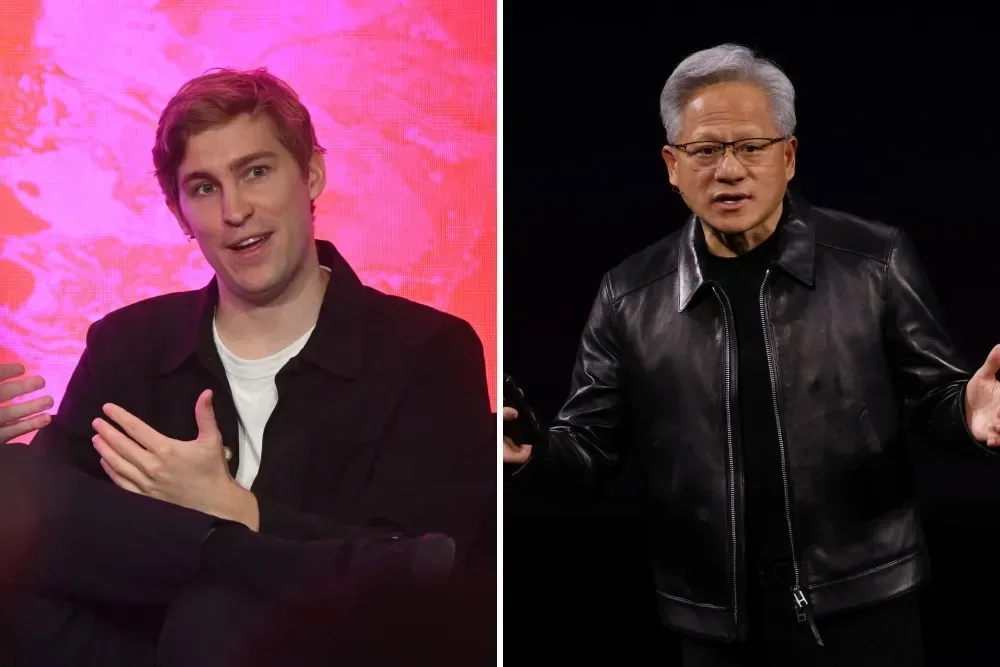
For a related look at AI’s ongoing expansion in another part of the entertainment-technology business, see this report on ElevenLabs and Nvidia’s voice AI partnership. Paradise Lost, however, uses its technology less as an industry forecast than as an emotional pressure point.
What Yeon is making next
Yeon has two projects in post-production. One is the Japanese-language Netflix series Parasyte: Tamiya, adapted from the manga and centered on the original story’s villain Tamiya Ryoko. Yeon serves as screenwriter and showrunner, and has highlighted the character’s gradual effort to understand humanity despite being a parasite rather than a human.
The other is Devotion, a horror feature due next year. It examines the way people display constructed versions of themselves while hiding behind the personas they create. Its Korean title, Yeto, is described as a Buddhist term for an imperfect world of suffering, opposed to a realm of ultimate bliss.
Those projects and Paradise Lost share a recognizable line of inquiry: what happens when the boundary around the human self becomes unstable? In the new thriller, AR and AI do not deliver an answer to grief. They make a mother’s longing visible, repeatable and potentially terrifying—and force a confrontation with the one thing no reconstruction can fully supply: another person’s unknowable self.