Spoilers follow for Sheriff Country Season 2, Episode 5, “No Way In,” and Fire Country Season 5, Episode 5, “No Way Out.”
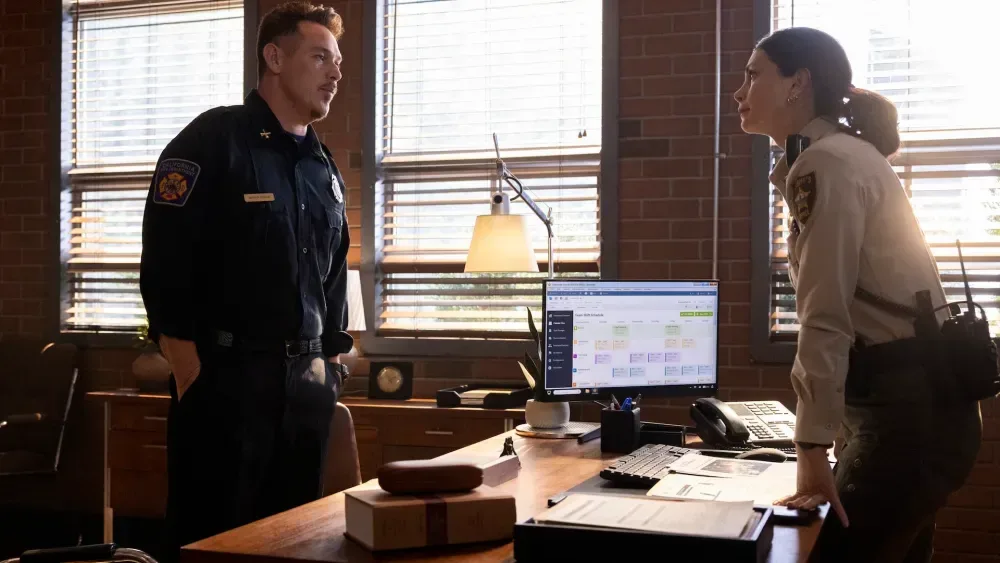
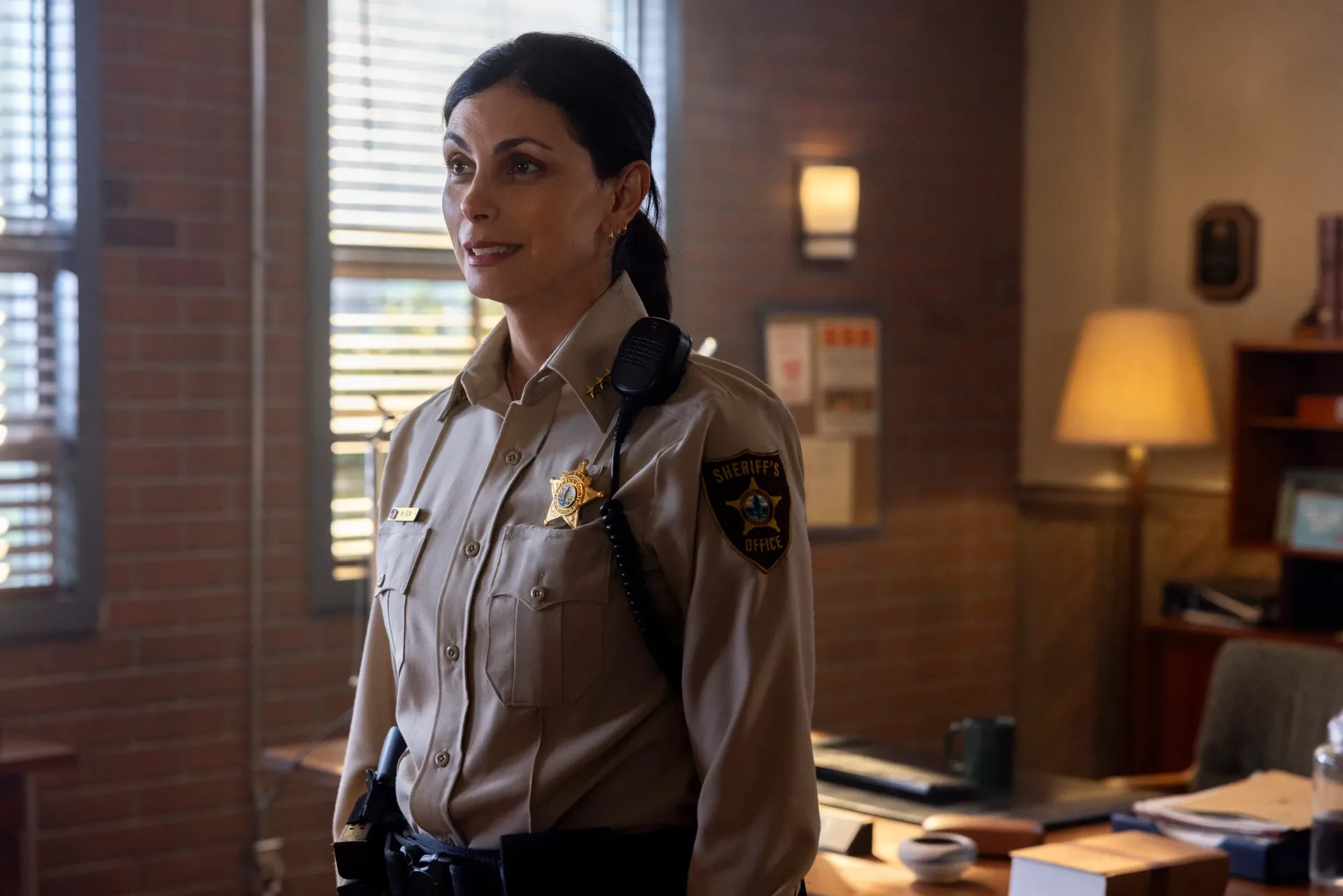
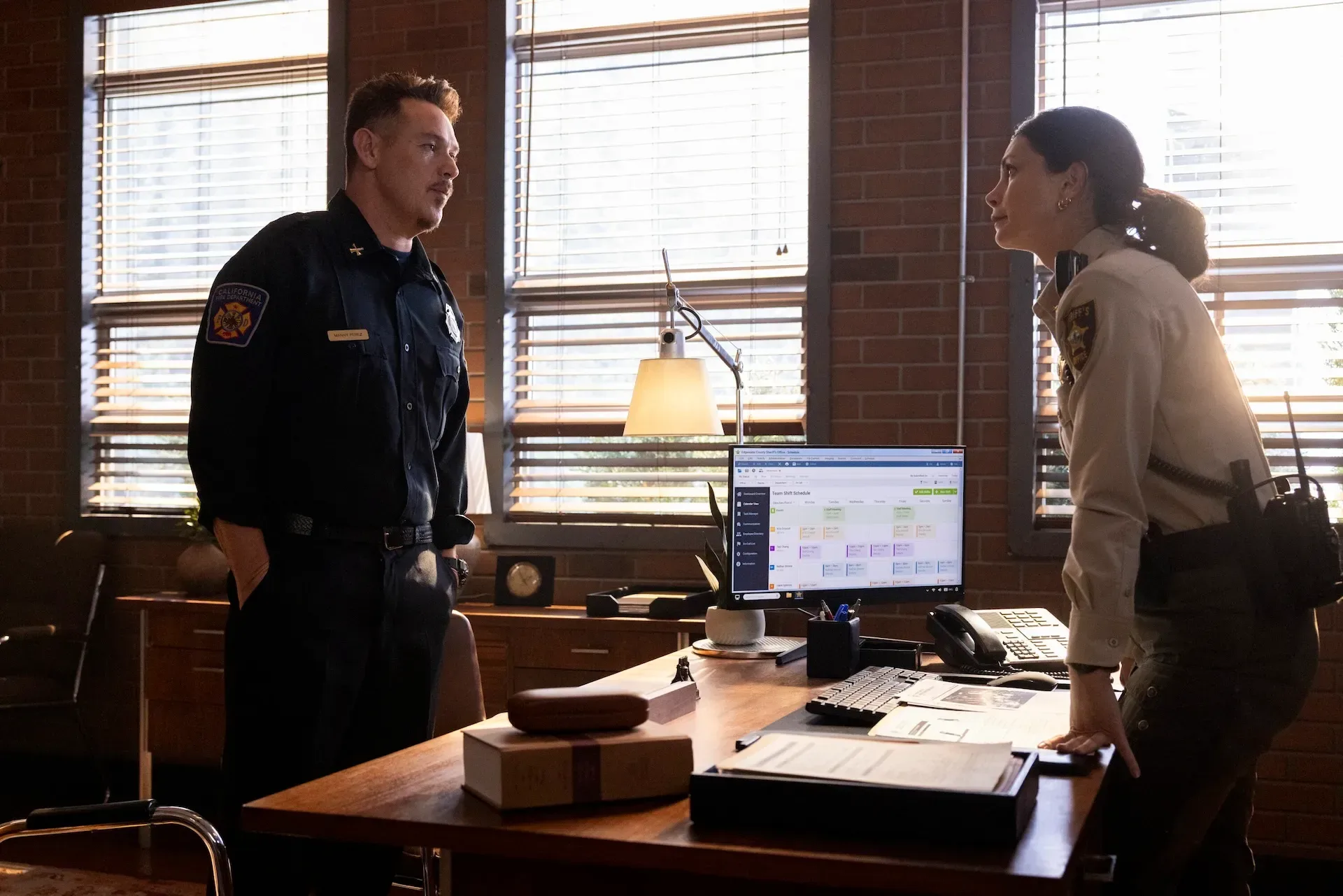
A wildfire, an inmate transport escape and a fire truck commandeered by desperate fugitives give the newest Fire Country/Sheriff Country crossover its large-scale action engine. Yet the most consequential material may be the character aftermath tucked inside the chaos. The paired episodes put Sheriff Mickey Fox, played by Morena Baccarin, and Station 42’s Manny Perez, played by Kevin Alejandro, at their center—and expose that the two once endured an exceptionally bad date.
That awkward history is not merely a gag pasted onto an emergency. It is the reason the crossover can make a familiar procedural premise feel personal. Mickey and Manny start as colleagues with a strange shared past, then must rely on each other while fire threatens the area and three escaped inmates take hostages. By the end, neither the wildfire nor the prison break has erased that discomfort; it has transformed it into a newly charged friendship.
A two-hour crisis built to keep widening
The setup begins with Manny and Station 42 seeking help from the Edgewater Police Department as the wildfire edges closer to town. The request is straightforward: police assistance may be required to evacuate residents. But the already strained allocation of personnel changes once three women escape from a prison transport van amid the emergency.
Instead of devoting her whole squad to the fire response, Mickey must pursue the escapees. The intersecting emergencies are key to how the crossover works. A wildfire is an external threat that affects a whole community; the fugitive story is a focused threat requiring police action. Combining the two prevents either show’s central discipline from becoming background decoration. Firefighters confront the physical danger of the blaze, while law enforcement deals with the human danger made worse by the same disorder.
The writers describe the premise as drawing on 1990s action thrillers, particularly films that pair extreme weather or disaster conditions with a criminal plot. Con Air and Thelma & Louise were among the stated creative reference points. That influence is evident in the structure: the story begins with immediate stakes, then repeatedly introduces a sharper complication rather than allowing the plot to settle into one rescue or one manhunt.
Mickey finds the escapees at The Meat Up and gives herself up to protect people inside. The fugitives demand that Skye, Mickey’s daughter, serve as collateral while they attempt to get across the county border. It is a particularly pointed choice because it moves the case from Mickey’s professional responsibility into her family life. Skye is not simply another hostage; she is the leverage that makes Mickey’s decisions emotionally punishing.
Skye is ultimately rescued by her mother. Manny then volunteers to drive the fire truck the three women want for their escape, positioning himself to help the captives battle the oncoming flames. When a downed semi-truck blocks the road, Mickey calls in help under the apparent rationale of clearing it, while actually trying to create time for her and Manny to break away. The plan does not go cleanly: the fugitives realize what is happening, a shootout follows, and one inmate attacks Mickey with an axe.
Related coverage includes ‘Fire Country’ and ‘Sheriff Country’ Crossover Sets Up New Romance and Fallout.
Boone, Bode and the wider crew eventually stop the captors. The fact that everyone makes it back to their families supplies the immediate resolution, but the episodes are designed less as a sealed event than as an engine for multiple ongoing threads.
Why Mickey and Manny became the crossover’s core pairing
Crossovers can easily become attendance-taking exercises, where familiar faces arrive for a scene without affecting the story. Here, the creative choice was to give Mickey and Manny an unexpected shared history and make them the pair carrying both hours. Their prior date came from an annual police-department date auction and, by every indication, went disastrously.
The notion has roots in an early concept for the Sheriff Country pilot that suggested the characters had dated, though that idea had fallen away. Rather than restore a full relationship history, the crossover reduces it to one infamous bad date. That adjustment matters. It creates tension and comic friction without requiring the audience to accept an unseen long-term romance as established canon.
There is also a production-side reason the pairing clicked. Alejandro had directed two Season 1 episodes of Sheriff Country, and the creative team had seen the playful off-camera rapport between him and Baccarin. In the episode, that dynamic gives Mickey and Manny a believable rhythm under pressure. They can argue, improvise and cooperate without the show having to force grand declarations of trust.
Still, viewers should distinguish on-screen chemistry from a promised romance. The final beer between Mickey and Manny was written as a friendly decompression scene between colleagues. Once filmed, the performers’ chemistry appeared more pronounced. The series has acknowledged the spark, but Manny remains in a committed relationship. In other words, the scene opens a possibility for viewers to consider; it does not confirm that the shows are immediately redirecting Manny into a new relationship.
That restraint could be useful. The best version of this dynamic may be its uncertainty: two professionals who emerged from a terrible first impression with more appreciation for each other, while the surrounding circumstances make anything further complicated. It also lets the crossover create a lasting connection between the shows without requiring a rapid romantic payoff.
Skye and Tex are the romance that is explicitly moving forward
The much clearer romantic setup belongs to Skye, played by Amanda Arcuri, and Tex, played by Elias Cacavas. Their interest is intended to continue on both series. The complication is not subtle: Skye wants to remain sober while dating someone connected to Three Rock, and Tex is an ex-con.
That will place Skye directly at odds with people protective of her. Mickey and Wes are both expected to learn about the relationship. Wes, who has served two terms in a federal penitentiary, is especially opposed to the match. The objection is not framed as a casual parental inconvenience; it is a conflict grounded in his experience and his fear that Skye is making a dangerous choice.
The setup gives both shows a way to examine the difference between a person’s record and their present conduct, while also leaving room for the entirely reasonable concern that recovery and a new romance can be difficult terrain. The important confirmed point is that the relationship will recur. Its outcome, and whether the adults around Skye can accept it, remain unresolved.
Mickey’s empathy remains central—even after violence
One of the escaped inmates, Crystal, played by Britney Young, has a personal grudge against Mickey and attempts to kill her. Earlier, Mickey had promised to try to help reunite Crystal with her son. After the attack, that promise appears far less certain, and the story does not suggest that attempted murder can be waved away.
However, the episode also underscores a core trait of Mickey’s character: compassion, particularly in cases involving mothers. The likely boundary is clear. Crystal’s violence puts a full reconciliation beyond reach, but Mickey could still check on Crystal’s child. That distinction is meaningful. Empathy does not require excusing harm, and the show’s approach suggests Mickey can recognize the needs of a child without minimizing what Crystal did.
This kind of thread is one reason the crossover is more than a stunt. The action gives characters a crisis, while the moral choices determine what those characters carry into later episodes.
What carries into each series after the event
The crossover is structured so that newcomers can follow the immediate danger without needing every detail of both seasons. Station 42’s budget and resource problems, for example, are not substantially addressed in the event despite Manny’s decision to demand a fire truck that the fugitives could have taken. That ongoing operational problem remains separate from this particular crisis.
Other character material is moving forward more directly. Sharon, played by Dianne Farr, appears in the crossover, but the episode does not explain more about the bag of money tied to her earlier story. What is established is that Sharon made a harmful choice for reasons she considered good and noble, and the consequences begin to intensify in Fire Country Episode 6.
On the Sheriff Country side, Mickey’s earlier confession that she regrets not giving Boone a chance is far from forgotten. Cassidy witnessed the confession, and Boone heard it too. The show is positioning those lingering feelings to force Mickey and Boone into a changed professional and personal dynamic. The precise result has not been revealed, but the issue is expected to break into the open rather than remain subtext.
For viewers who enjoy television built around ensemble relationships as much as spectacle, that is the crossover’s real value. It creates enough event-scale danger to unite its casts, then leaves behind several smaller, more durable pressures: Mickey and Manny’s uneasy chemistry, Skye and Tex’s contentious relationship, Sharon’s impending fallout, and the unresolved emotions between Mickey and Boone. That character-forward approach is also what makes crossover television compelling when it works, much like the broader conversation around other potential TV returns such as the proposed Girls revival without Adam Driver.
The practical challenge behind getting both casts together
The scale on screen required equally complicated logistics off screen. Fire Country films in Vancouver while Sheriff Country films in Toronto, placing the productions across three time zones. Scheduling performers across the two cities means factoring in not just shooting days, but travel time on both ends. The cast enjoys visiting the counterpart production, but jet lag is an unavoidable part of the arrangement.
Continuity presents an additional hurdle. Material for the crossover’s second part was filmed in Toronto before production began on Fire Country Season 5, while scenes from the first part were filmed later in Vancouver. In television terms, continuity means preserving the illusion that events happen in one coherent order: matching character knowledge, wardrobe, injuries, relationships and the practical details of a crisis even when the scenes are made out of chronological production order.
The crossover also asks performers accustomed to one procedural vocabulary to work inside another. Actors from the firefighting drama must handle police-business details such as stings and arrests, while performers from the sheriff series confront fire-related action. Technical consultants help establish those procedures, including a retired SWAT commander who advises Sheriff Country. Such input does not turn fictional television into documentary reality, but it gives actors a shared practical language for portraying specialized work.
There is already an early idea for the next crossover: reverse the order so that Fire Country leads and Sheriff Country follows. No premise has been confirmed. The creative teams have discussed continuing the larger-than-life approach and maintaining crossover romance as a recurring ingredient, but the next event remains at the concept stage.