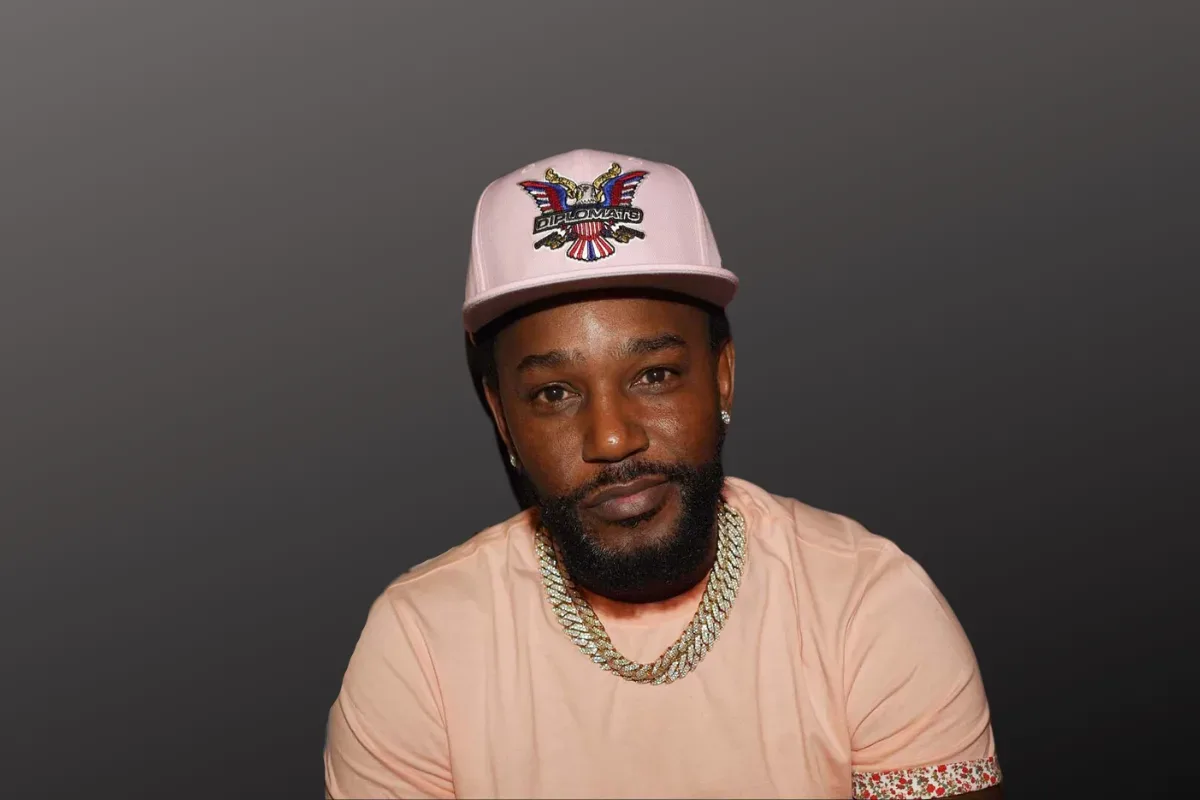
Cam’ron says a Super Bowl performance is one opportunity he would not automatically chase—even if the invitation came through Jay-Z.
Speaking on Talk With Flee, the Harlem rapper was asked about the possibility of performing at the event. His response was a no, but he took care to frame it as an assessment of fit rather than a personal rejection or the opening of another rap dispute.
“No. And I don’t mean that in a disrespectful way. I don’t mean that in a disrespectful way. I just don’t think it makes sense,” Cam’ron said.
The key qualifier is that no Super Bowl booking was announced. Cam’ron was answering a hypothetical question about what he would do if the call arrived, not revealing an offer that had been made or turned down. That distinction matters in a story likely to produce attention-grabbing shorthand: this is not news of an active halftime negotiation, a confirmed lineup, or a direct conflict with Jay-Z.
Instead, Cam’ron’s point was about scale. He drew a line between being an artist listeners recognize and being, in his own view, the right standalone choice for one of entertainment’s largest performance platforms.
“And I’m not saying people wouldn’t know me, but my career isn’t big enough for that moment,” Cam’ron said.
Recognition is not the same as the right fit
Cam’ron’s wording is notably more specific than saying he lacks an audience. He did not argue that the crowd would be unfamiliar with him, nor did he dismiss the prestige attached to the event. He said he does not believe his career is large enough for that particular moment.
That is a useful difference. “Recognition” means a public can identify an artist or knows at least some of their work. “Fit,” in this context, means whether an artist believes their catalog, present profile and overall reach match the unusually broad expectations placed on a Super Bowl-stage performer. Those are separate judgments, and Cam’ron made the latter about himself.
Related coverage includes Cam’ron Says He Would Pass on a Super Bowl Halftime Invitation.
The answer also avoids a common assumption around high-visibility entertainment slots: that every prominent musician should say yes. A major stage can be desirable, but accepting one comes with an implicit promise that the performer can convert a brief appearance into a set that works for an enormous, varied audience. Cam’ron’s comments suggest he sees that threshold as different from simple name recognition.
There is no sign in his remarks that he is rejecting the premise out of hostility toward Jay-Z. In fact, he repeated that he did not mean his answer disrespectfully. The available comments are therefore better read as a personal boundary than a feud headline.
A broader view of how Cam’ron weighs exposure
The comments arrive as Cam’ron has been discussing his approach to opportunities beyond releasing music. He recently spoke about appearing on ESPN’s First Take without taking a fee. He described that decision as an exposure play: a chance to show what he brings to the program and potentially direct viewers toward his own programming.
Put beside the hypothetical Super Bowl question, the two examples show that he is not treating visibility as a universal yes-or-no calculation. Exposure can have strategic value, but only where he believes it serves a clear purpose. The First Take appearance, as he described it, offered a way to demonstrate his value and build awareness for work he controls. The Super Bowl hypothetical is different because he does not see himself as the appropriate performer for that specific scale of show.
That distinction is practical for any creator watching from outside the music business, too. A platform is not merely “big” or “small”; it has an audience, a format and a set of expectations. The relevant question is whether the opportunity lets someone present their strongest work in a way that makes sense for that audience.
In Cam’ron’s case, his answer indicates that a massive audience alone would not settle the question. He has explained that he can see value in a high-profile appearance, including one he takes without a direct fee, while also believing another enormous platform is not a match for his career. Those positions are not contradictory. They reflect different goals and different standards for what success would look like.
What the comments do—and do not—establish
The remarks support a few clear takeaways:
- Cam’ron said he would decline a hypothetical invitation to perform at the Super Bowl.
- He said the decision would not be intended as disrespect toward Jay-Z.
- He did not say he had received an invitation or been offered a place on any lineup.
- He based his reasoning on his own view that his career is not big enough for that moment, while acknowledging that people know who he is.
- His earlier explanation of appearing on First Take shows that he has been thinking publicly about exposure, value and how appearances connect to his own programming.
Just as important are the claims the remarks do not support. They do not establish a confirmed Super Bowl performer list. They do not establish bad blood between Cam’ron and Jay-Z. And they do not show that Cam’ron rejects television or mainstream visibility as a whole. His account of the ESPN appearance points in the opposite direction: he is willing to use a large platform when he sees a specific benefit.
The larger music conversation often treats a Super Bowl appearance as a simple career-validation checkpoint. Cam’ron’s answer complicates that framing. He is not denying the cultural reach of the stage; he is saying that reach is not, by itself, the standard he uses to decide whether to participate.
It is also a reminder that public-facing career choices can be less dramatic than their framing. A direct “no” to a hypothetical can read as provocation if separated from its explanation. But Cam’ron supplied that explanation twice: he did not mean disrespect, and he did not think the appearance made sense for him. The story is therefore less about a rejection of another artist and more about an artist setting his own measure for a moment of extraordinary visibility.
For more on the intersection of rap careers and streaming-scale benchmarks, see the report on Drake’s reported Spotify-stream milestone.