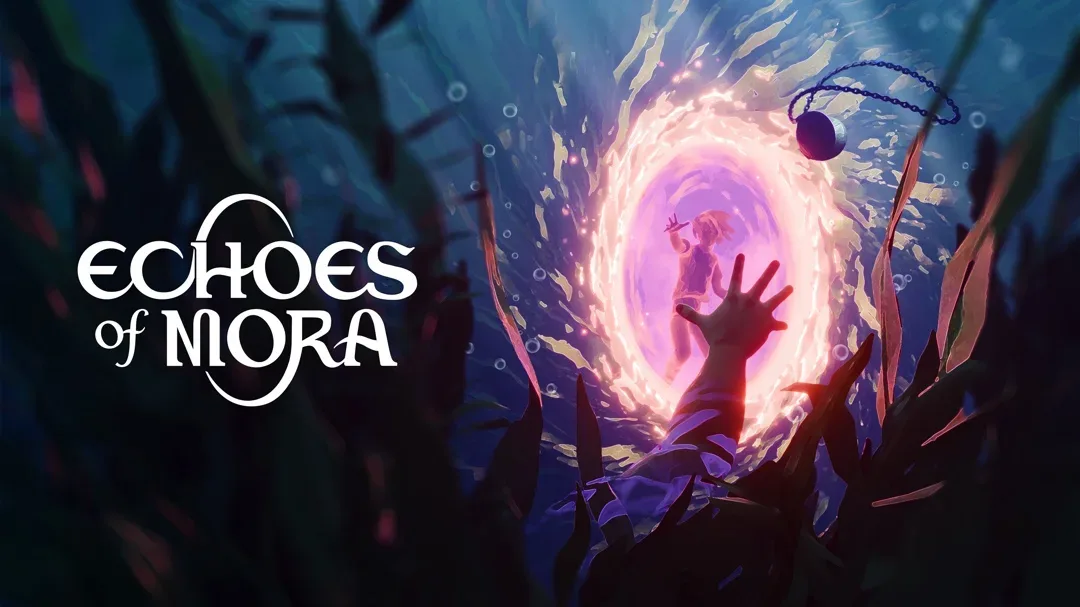
Echoes of Mora is now available on Steam for PC, bringing a quiet mystery about a lost village, a missing boy and the sister trying to find him. Developed by Selkies Interactive, the game sends players beneath the water to explore the remains of a settlement while working with Mora across different points in time.
The central setup is intimate rather than world-ending: a boy has disappeared, and Mora searches for him amid ruins that have been swallowed by water. The player’s role takes place in the present-day submerged village, where exploration, found objects and fragments of local life become the means of communication with Mora in the past. Those discoveries can inform her choices, meaning the investigation is not simply about reconstructing what happened. It is also about deciding what information reaches her and how that affects the story.
It is available for €14.99 / $14.99, with a 10% launch discount. A free Steam demo is also available. The PC edition supports both keyboard-and-mouse and controller input. A VR version is scheduled to arrive later on September 21.
A mystery built around two timelines
The game’s defining mechanic is the Echo: an interactive discovery that opens a portal into the village’s past. In practical terms, that makes an Echo more than a collectible or a piece of optional environmental decoration. It is a puzzle-linked connection between the flooded ruins being explored by the player and Mora’s earlier search through the village when it was still intact.
That setup positions information as the key resource. Players investigate underwater houses, streets and more hidden locations, looking for objects and traces left by residents. They can also listen to fragments of village life. These are intended to help assemble the stories of people who once lived there, while potentially revealing context that matters to Mora’s search for her brother.
Environmental storytelling, one of the game’s stated points of emphasis, means narrative details are communicated through places and objects rather than only through direct explanation. A submerged home, street or hidden space can carry clues about the people who used it and the events surrounding the village. In Echoes of Mora, those observations are part of the mystery-solving loop, because discoveries can be shared across time.
The result is a structure where the player is not portrayed simply as an observer of Mora’s story. Direct interaction with her in the past can influence her decisions. That distinction matters: finding something in the ruins is one part of play, but the game also asks players to consider what that knowledge means when passed to someone who has not yet lived through the village’s fate.
Exploration without time pressure
Selkies Interactive describes Echoes of Mora as a quiet, unhurried exploration experience. There are no timers and no waiting dangers. For players, that means the game’s underwater setting is not presented as a countdown challenge in which every detour risks failure. Instead, attention can stay on navigating spaces, examining the remnants of the settlement and following the threads of its mystery.
Related coverage includes Echoes of Mora Launches on Steam, Sending Players Into a Village Lost Beneath the Water.
That design choice is especially relevant to a game built around fragmented narrative evidence. When progress depends on noticing an object, hearing a memory-like fragment or understanding why a space matters, pressure-free exploration can make room for closer observation. The game may still require puzzle solving, but it does not frame its puzzles around racing a clock or outrunning an immediate threat.
The description does not establish a combat system, and the announced feature set places its focus elsewhere: diving through the ruins, locating hidden elements, activating Echoes, listening to village stories and communicating with Mora. Players looking for a contemplative mystery rather than a survival-focused dive into a dangerous environment are the clearest audience for that approach.
What “choices shape the ending” means here
Echoes of Mora has multiple possible endings shaped by player choices. The confirmed basis for those choices is the player’s interaction with Mora and the decisions she makes after receiving discoveries from the future. The exact number of endings, the branches involved and whether every piece of information changes an outcome have not been detailed.
Still, the premise gives the choices a clear narrative role. A conventional mystery often asks players to uncover a fixed chain of events. Here, the past is accessible through portals, and Mora can be guided by knowledge uncovered in the flooded future. That creates a more active relationship with the investigation: evidence can do more than answer questions; it can influence a person’s response before the village becomes ruins.
Players interested in replayability should therefore distinguish between what is confirmed and what remains unknown. Multiple endings are confirmed. The full decision map is not. There is no stated completion estimate, no disclosed route guide and no promise that every discovery leads to a major branch. The free demo is the most direct way to determine whether its pacing, underwater exploration and puzzle flow fit a player’s tastes before buying.
PC release details and the VR version
The Steam PC release is live as of September 21, 2026. It includes keyboard-and-mouse support and controller support, offering two input options for exploring the village and interacting with its puzzles. The game is priced at €14.99 / $14.99 before the 10% launch reduction.
The scheduled VR release is a separate point worth keeping in perspective. It is due later the same day, but specific VR platform details, control features and pricing have not been outlined here. Players who specifically want to experience the underwater setting in virtual reality should check the relevant storefront details when that version becomes available rather than assuming it is identical to the standard PC edition in every respect.
Echoes of Mora arrives alongside other PC releases exploring unconventional premises, including a physics-driven narrative take on golf, but its own hook is more meditative: one player searches a drowned settlement while another character receives the consequences of those findings in the past.
Who Echoes of Mora is for
The launch information points most strongly toward players who enjoy narrative puzzles and atmospheric exploration. Its premise combines a personal missing-person search with a broader attempt to understand an entire lost community. The emphasis on listening to residents’ fragments suggests the village itself is meant to be more than a backdrop; the people connected to it form part of the case players are piecing together.
- Story-focused players can expect a sibling-centered mystery whose outcome can change through choices.
- Puzzle and exploration players can expect Echoes to connect hidden discoveries with access to the past.
- Players who dislike timed pressure can explore without timers or waiting dangers.
- VR-curious players have a version scheduled for later on launch day, though further platform specifics have not been provided.
With a demo available and a clearly defined focus on patient discovery, Echoes of Mora offers a low-pressure route into its sunken-village mystery. Its most distinctive idea is not merely that players visit the past, but that they can send what they find back to Mora—then live with the way those discoveries shape her path.