
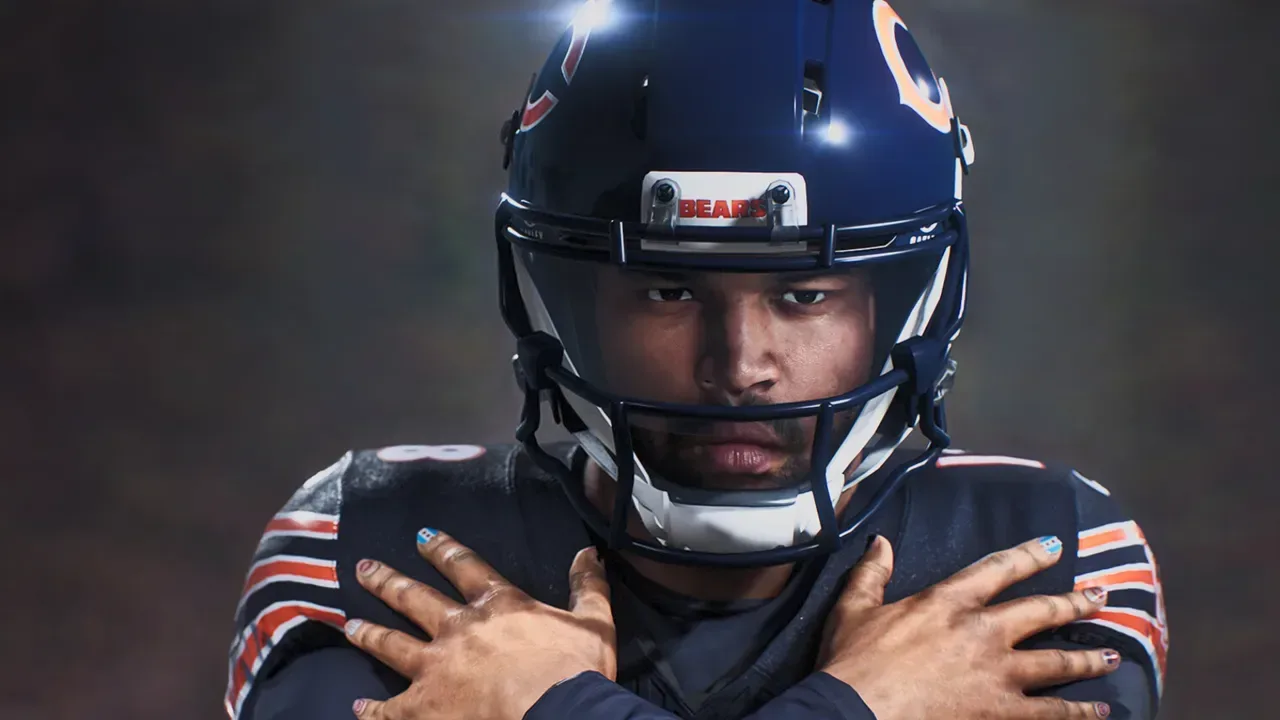
EA is using Madden NFL 27 to make a very pointed joke about the looming arrival of Grand Theft Auto 6: please, whatever players do, do not uninstall the football game to clear console storage.
A new in-game Madden NFL 27 pop-up opens with the blunt instruction “Don’t Delete!” It does not name GTA 6, but its pink-and-purple tropical presentation, palm-tree imagery, and a coded-operation theme closely resemble the Vice City-adjacent visual language associated with Rockstar’s next game. The timing removes much of the mystery. Madden’s message directs players toward an update on November 17, while GTA 6 is scheduled to launch November 19 for PlayStation 5 and Xbox Series X/S.
“[ENCRYPTED SIGNAL] The target is locked. The crew is assembling for a high-stakes run. Await the signal from our insider on 11/17… do not leak this transmission!”
It is an unusually direct bit of self-aware marketing for an annual sports release. The gag works because it addresses a practical player behavior rather than merely competing for attention: deleting installed games to make room for a new one.
The joke lands because storage space is a real decision
Digital games live on a finite storage budget. On a console, players may need to choose among deleting a title, moving compatible games to another storage device, or managing downloads around the games they expect to play immediately. Uninstalling a game generally removes its locally installed game data, making room for something else; it is not necessarily a declaration that someone is done with that game forever. But for a title seeking continued engagement, an uninstall is still a meaningful warning sign. A game that is not installed is less convenient to launch, less visible in the library, and easier to postpone.
EA’s own social media messaging made the storage joke even clearer. In a November 10 post promoting a November 18 Madden NFL 27 update, the publisher wrote: “Don’t let 210GB get between you and Your League.” That number refers to GTA 6’s much-discussed file size in the campaign’s framing, turning a hardware constraint into the punchline.
For players, file size is not an abstract specification. It can dictate which games stay installed during a busy launch week. The effect is especially pronounced when two games share the same platforms, as Madden NFL 27 and GTA 6 do on PS5 and Xbox Series X/S. A player does not need to abandon Madden permanently to remove it; they may simply be prioritizing room and download time. Yet EA’s pop-up treats that mundane bit of library housekeeping as a high-stakes mission.
Anyone trying to understand why platform hardware and storage decisions can create different experiences between console and PC can also read why console GPUs and PC graphics cards can deliver such different results. The underlying point here is simpler: specifications and system limits shape player habits, including what remains installed when a major release arrives.
Related coverage includes Madden NFL 27 Tells Players Not to Delete It as GTA 6 Nears.
A short message built around retention
The November 17 reference gives the pop-up a clear purpose beyond a one-line GTA joke. Madden NFL 27 is telling existing players that fresh material is imminent and that keeping the game installed will be useful. In live-service terms, this is a retention message: an attempt to keep players active and ready for the next update rather than letting attention drift elsewhere.
Live service is the industry term for a game designed to receive ongoing updates, events, and other post-launch activity. The supplied details do not specify the contents of Madden NFL 27’s November updates, so it would be wrong to assume new modes, rewards, or gameplay changes. What is established is the schedule: the pop-up points to November 17, while the social post advertises a November 18 update. That close sequence puts Madden in the conversation immediately before GTA 6’s November 19 arrival.
There is a useful distinction between a game’s launch and the work of retaining its audience. Madden NFL 27 launched on August 13, 2026, for PC, Nintendo Switch 2, PS5, and Xbox Series X/S. By mid-November, the central challenge is no longer informing people that Madden exists. It is giving current players a reason to keep the game installed, keep returning, and regard the next update as worth their time during an unusually crowded moment.
That does not prove that Madden needs saving, nor does it establish that players will leave. The alert is playful promotional copy, and big launches routinely inspire this kind of brand-to-brand wink. Still, the design is revealing in a modest way: it recognizes that a huge release can compete with other games not only for money, but for time, dashboard space, social attention, and SSD capacity.
Why fans read the alert as a GTA 6 plea
Players quickly interpreted the notice as EA asking them not to clear Madden off their systems for GTA 6. The reaction has ranged from amused to deliberately ruthless, with posts characterizing the campaign as EA being frightened by GTA 6’s launch or begging users to keep Madden around. One player joked that GTA’s arrival could mean never returning to Madden.
That reaction is largely a product of the combined signals, not the words “GTA 6” appearing on screen. The tropical neon aesthetic, the “Don’t Delete!” headline, the secret-message format, the November dates, and the separate 210GB line all point in the same direction. Marketing often depends on plausible deniability; the reference is never explicit, but it is legible enough that the audience can supply the name.
There is also an element of good-natured exaggeration in calling the notice “begging.” The message has the language of a heist briefing: encrypted signals, targets, crews, insiders, and leaked transmissions. That theatrical approach makes a basic request—leave our app on your drive—feel intentionally melodramatic. The campaign is not just warning about storage; it is turning storage management into the bit.
The typo became part of the moment
Early screenshots reportedly showed the phrase “awating signal,” missing the second “i” in “awaiting.” Later posts indicated that the error was corrected quickly. It is a small detail, but it illustrates the awkward speed of modern in-game messaging. A carefully timed pop-up can reach players quickly, and a tiny spelling mistake can travel just as fast through screenshots and social feeds.
The corrected wording matters less than the idea behind it. The message asks players to wait for a signal on November 17 and retain Madden NFL 27 in the meantime. Whether the typo was seen before it was fixed does not alter the campaign’s meaning, but it gave people another reason to circulate the notice and laugh at a marketing effort already designed to be conspicuous.
What the timing says about the GTA 6 launch window
GTA 6 is positioned as an enormous event for the game business, and the supplied information describes other games moving their calendars to avoid its launch window. Madden NFL 27 is taking the opposite approach. It is not trying to pretend GTA 6 is absent; it is acknowledging the gravitational pull head-on and asking players to remember there is a football update waiting for them.
That is a sensible tonal choice for a game with an established installed base. Madden cannot stop players from downloading GTA 6, and it does not need to. Its more realistic aim is to prevent the new release from becoming a clean break in players’ routines. The “Don’t Delete” line is memorable because it presents Madden and GTA 6 as literal rivals for the same drive space, then makes the rivalry a joke rather than a solemn warning.
For PS5 and Xbox Series X/S owners, the practical choice remains personal: keep both games installed if space permits, remove one temporarily if it does not, or decide later which receives more of their time. EA’s campaign does not change that math. It simply turns the uninstall prompt into a moment of promotional theater—and, judging by the response, one that players immediately understood.